MyCompetitiveExams Logo MyCompetitiveExams
Search 1,140+ Questions
Chapters, formulas, speed tricks
→
⚡ Brahmastra NEET 2027
720 MARKS

Dynamic 180-question full-length simulator mixed dynamically from all 6 years for 2027 & 2026 aspirants.

Launch Brahmastra 2027 Test →
Start Practice →
100% Free · No Login Required
Q.98 Chemistry · Section B ⭐ 360° Option Elimination Active
Vault ↗

NEET 2024 Chemistry Question 98 Solution

Topic: The d- and f-Block Elements · Official NTA Booklet Code T1
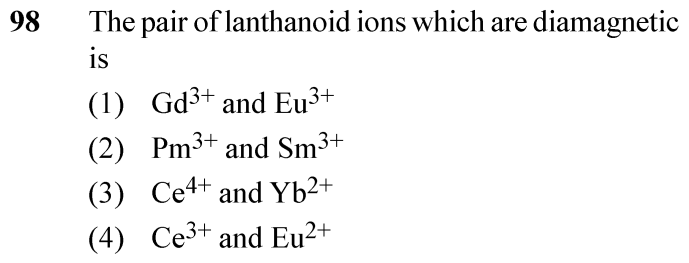
NEET 2024 Chemistry Question 98: Diamagnetic Lanthanoid Ions (4f0 and 4f14 Configurations)

Question

— The pair of lanthanoid ions which are diamagnetic is

✓
Verified Against NTA Final Answer Key
Option (3) : Ce4+ and Yb2+
📚 The d- and f-Block Elements Easy
📋 Given Parameters & Problem Setup
Target property Diamagnetic lanthanoid ions (unpaired electrons n = 0)
Elements involved Cerium (Ce, Z=58), Ytterbium (Yb, Z=70), Gadolinium (Gd, Z=64), Europium (Eu, Z=63)
⚡

The 30-Second Exam Hall Shortcut: ⚡ Empty 4f0 and Filled 4f14 Diamagnetism Hack

⏱️ Save ~35 seconds

Lanthanoid ions are diamagnetic ONLY when 4f is completely EMPTY (4f⁰, e.g. Ce⁴⁺, La³⁺) or completely FILLED (4f¹⁴, e.g. Yb²⁺, Lu³⁺)! Ce⁴⁺ and Yb²⁺ is the only diamagnetic pair!

1 Diamagnetic requires zero unpaired electrons: n = 0.
2 In lanthanoids, this occurs exclusively with 4f⁰ (noble gas [Xe] core) or 4f¹⁴ (completely filled f-subshell).
3 Check Ce⁴⁺: Ce is [Xe] 4f¹ 5d¹ 6s². Losing 4 electrons leaves [Xe] 4f⁰ -> n = 0 (DIAMAGNETIC).
4 Check Yb²⁺: Yb is [Xe] 4f¹⁴ 6s². Losing 2 valence 6s electrons leaves [Xe] 4f¹⁴ -> n = 0 (DIAMAGNETIC).
5 Both Ce⁴⁺ and Yb²⁺ have zero unpaired f-electrons and are diamagnetic.
6 Other ions have unpaired f-electrons (e.g. Gd³⁺ has 4f⁷, Eu²⁺ has 4f⁷, Eu³⁺ has 4f⁶).
7 Option (3) in 5 seconds!
🛡️
Why You Can 100% Trust This Shortcut: NCERT Chemistry · The d- and f-Block Elements (Lanthanoids: electronic configurations, oxidation states, and magnetic properties: Ce4+ [4f0] and Yb2+ [4f14] are diamagnetic).
📐

Step-by-Step Rigorous Workflow & Mathematical Proof

Step 1

Electronic Configurations of Lanthanoids

Lanthanoids have valence electrons filling the 4f subshell, with neutral ground states: - Cerium (Ce, Z = 58): [Xe] 4f¹ 5d¹ 6s² - Ytterbium (Yb, Z = 70): [Xe] 4f¹⁴ 6s² - Europium (Eu, Z = 63): [Xe] 4f⁷ 6s² - Gadolinium (Gd, Z = 64): [Xe] 4f⁷ 5d¹ 6s²

Ce: [Xe] 4f15d16s2;Yb: [Xe] 4f146s2\text{Ce: } [\text{Xe}]\,4f^1 5d^1 6s^2; \quad \text{Yb: } [\text{Xe}]\,4f^{14} 6s^2
Step 2

Determining Configurations and Unpaired Electrons of Cations

Removing electrons from the outermost orbitals: 1. Ce⁴⁺: Loses 6s², 5d¹, and 4f¹ ⟹ [Xe] 4f⁰. Possesses an empty 4f subshell (n = 0 unpaired electrons) ⟹ Diamagnetic. 2. Yb²⁺: Loses 6s² ⟹ [Xe] 4f¹⁴. Possesses a completely filled 4f subshell (n = 0 unpaired electrons) ⟹ Diamagnetic. 3. Gd³⁺: Loses 6s² and 5d¹ ⟹ [Xe] 4f⁷ (n = 7 unpaired electrons) ⟹ Strongly paramagnetic. 4. Eu³⁺: Loses 6s² and one 4f ⟹ [Xe] 4f⁶ (n = 6 unpaired electrons) ⟹ Paramagnetic. 5. Eu²⁺: Loses 6s² ⟹ [Xe] 4f⁷ (n = 7 unpaired electrons) ⟹ Paramagnetic.

Ce4+  ([Xe] 4f0)  ⟹  n=0;Yb2+  ([Xe] 4f14)  ⟹  n=0\text{Ce}^{4+} \;([\text{Xe}]\,4f^0) \implies n = 0; \quad \text{Yb}^{2+} \;([\text{Xe}]\,4f^{14}) \implies n = 0
Step 3

Conclusion

Ce⁴⁺ (4f⁰) and Yb²⁺ (4f¹⁴) both possess zero unpaired f-electrons. Consequently, both are diamagnetic, matching Option (3).

Diamagnetic pair: Ce4+  and  Yb2+  (Option 3)\text{Diamagnetic pair: } \text{Ce}^{4+} \;\text{and}\; \text{Yb}^{2+} \; (\text{Option 3})
⭐

360° Option Elimination Engine Key Feature

Diagnose every choice: Know exactly why the right option works and why distractors fail.

4-Option Deep Scan
1 (1)
✗ Incorrect
Verdict & Scientific Reason:

Gd3+ has 7 unpaired electrons (4f7); Eu3+ has 6 unpaired electrons (4f6). Both are paramagnetic.

⚠️
Student Fallacy (Why candidates pick this trap): Confusing half-filled stability with diamagnetism.
2 (2)
✗ Incorrect
Verdict & Scientific Reason:

Pm3+ is 4f4 (n=4) and Sm3+ is 4f5 (n=5). Both are paramagnetic.

⚠️
Student Fallacy (Why candidates pick this trap): Random selection.
3 (3)
✓ 100% Correct
Verdict & Scientific Reason:

Ce4+ is 4f0 and Yb2+ is 4f14; both have zero unpaired electrons and are diamagnetic.

💡
Why this is airtight: None.
4 (4)
✗ Incorrect
Verdict & Scientific Reason:

Ce3+ is 4f1 (n=1) and Eu2+ is 4f7 (n=7). Both are paramagnetic.

⚠️
Student Fallacy (Why candidates pick this trap): Confusing Ce3+ with Ce4+.
⚠️

NTA Trap Alert: Confusing Half-Filled 4f7 (Gd3+) with Diamagnetism

Students frequently associate "extra stability" of half-filled 4f7 with diamagnetism. 4f7 has SEVEN unpaired electrons, making it the MOST paramagnetic ion, not diamagnetic!

🛡️ How to avoid the -1 mark: Diamagnetic means NO unpaired electrons: only 4f⁰ or 4f¹⁴.
📖

Core NEET Syllabus Standard

Chemistry Core Inorganic Chemistry · The d- and f-Block Elements Standard Benchmark
Core Scientific Principle Tested:

"Lanthanoid ions are diamagnetic only when they possess empty (4f0, e.g. Ce4+, La3+) or completely filled (4f14, e.g. Yb2+, Lu3+) f-orbitals."

Syllabus Focus: Lanthanoids: Electronic Configurations, Oxidation States, and Magnetic Properties
✓ Core NEET UG Syllabus Anchor Syllabus & Academic Standards ↗
Empty zero (Ce4+) and full fourteen (Yb2+): the only diamagnetic lanthanoids seen!

Ready to attempt under real exam pressure?

Test your speed and accuracy in the authentic 200-minute timed NTA simulator.

Launch NEET 2024 CBT Test →

Spotted a mistake in this solution? Report an error ([email protected])

⚖️ Legal & Fair Dealing Notice: Sourced from publicly released NEET 2024 question papers and NEET answer keys for private study, research, and non-commercial educational practice under Fair Dealing (Section 52(1)(a) of the Indian Copyright Act, 1957). Not affiliated with or endorsed by NTA or NMC.

Solve 4 NEET Questions a Day — One per Subject

Cover all 1,140 official NEET questions in 285 days at your own pace. Progress is saved on your device. No login needed.