MyCompetitiveExams Logo MyCompetitiveExams
Search 1,140+ Questions
Chapters, formulas, speed tricks
→
⚡ Brahmastra NEET 2027
720 MARKS

Dynamic 180-question full-length simulator mixed dynamically from all 6 years for 2027 & 2026 aspirants.

Launch Brahmastra 2027 Test →
Start Practice →
100% Free · No Login Required
Q.97 Chemistry · Section B ⭐ 360° Option Elimination Active
Vault ↗

NEET 2024 Chemistry Question 97 Solution

Topic: Chemical Bonding and Molecular Structure · Official NTA Booklet Code T1
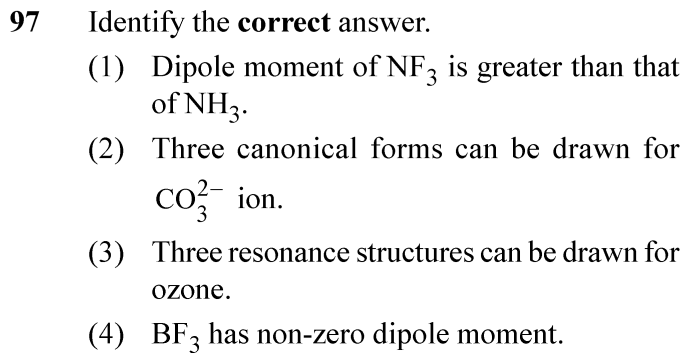
NEET 2024 Chemistry Question 97: Resonance Structures of Polyatomic Ions and Dipole Moments

Question

— Identify the correct answer.

✓
Verified Against NTA Final Answer Key
Option (2) : Three canonical forms can be drawn for CO3²⁻ ion.
📚 Chemical Bonding and Molecular Structure Easy
📋 Given Parameters & Problem Setup
Option 1 statement Dipole moment of NF3 is greater than that of NH3
Option 2 statement Three canonical forms can be drawn for CO3²⁻ ion
Option 3 statement Three resonance structures can be drawn for ozone
Option 4 statement BF3 has non-zero dipole moment
⚡

The 30-Second Exam Hall Shortcut: ⚡ Carbonate Resonance Canonical Form Rule

⏱️ Save ~35 seconds

Carbonate CO3²⁻ has 3 equivalent oxygen atoms sharing one double bond and two single bonds -> Exactly THREE canonical Lewis forms! Option (2) is TRUE!

1 Check Option (1): In NH3, N-H bond dipoles add to the lone pair dipole (μ = 1.47 D). In NF3, electronegative fluorines pull in the opposite direction to the lone pair, opposing it (μ = 0.24 D). Thus, μ(NH3) > μ(NF3) -> Option (1) is FALSE.
2 Check Option (2): In carbonate ion CO3²⁻, the central carbon is bonded to three oxygens. The C=O double bond can reside with oxygen 1, oxygen 2, or oxygen 3. Exactly 3 equivalent canonical forms -> Option (2) is TRUE!
3 Check Option (3): Ozone (O3) has only 2 main canonical resonance Lewis structures (O=O⁺-O⁻ ↔ ⁻O-O⁺=O) -> Option (3) is FALSE.
4 Check Option (4): BF3 has symmetrical trigonal planar geometry (120° bond angles); the three B-F bond dipoles cancel to yield μ = 0 (zero dipole moment) -> Option (4) is FALSE.
5 Option (2) in 5 seconds!
🛡️
Why You Can 100% Trust This Shortcut: NCERT Chemistry · Chemical Bonding and Molecular Structure (Resonance structures of CO3 2-, ozone, and dipole moments of NH3 vs NF3 and BF3).
📐

Step-by-Step Rigorous Workflow & Mathematical Proof

Step 1

Analysis of Carbonate Resonance Structures (Statement 2)

In the carbonate ion (CO3²⁻), the carbon atom forms one double bond (C=O) and two single bonds (C-O⁻) with formal charges -1 on each single-bonded oxygen. Because all three oxygens are chemically and spatially equivalent, the double bond is delocalized equally among the three oxygen atoms, generating three equivalent canonical Lewis resonance structures:

[:O¨=C(O¨:⊖)2]⟷[⊖:O¨−C(=O¨)−O¨:⊖]⟷[(⊖:O¨−)2C=O¨:](3 canonical forms)[:\ddot{\text{O}}=\text{C}(\ddot{\text{O}}:^\ominus)_2] \longleftrightarrow [^\ominus:\ddot{\text{O}}{-}\text{C}(=\ddot{\text{O}}){-}\ddot{\text{O}}:^\ominus] \longleftrightarrow [(^\ominus:\ddot{\text{O}}{-})_2\text{C}=\ddot{\text{O}}:] \quad (\text{3 canonical forms})
Step 2

Analysis of NH3 versus NF3 Dipole Moments (Statement 1)

Both NH3 and NF3 have trigonal pyramidal geometries with one lone pair. In NH3, nitrogen is more electronegative than hydrogen, so N-H bond dipoles reinforce the lone pair dipole: μ = 1.47 D. In NF3, fluorine is more electronegative than nitrogen, so N-F bond dipoles oppose the lone pair dipole, resulting in a tiny net dipole: μ = 0.24 D. Hence μ(NH3) > μ(NF3). Statement 1 is false.

μ(NH3)=1.47  D  >  μ(NF3)=0.24  D\mu(\text{NH}_3) = 1.47\;\text{D} \;>\; \mu(\text{NF}_3) = 0.24\;\text{D}
Step 3

Analysis of Ozone Resonance (Statement 3)

Ozone (O3) is an angular molecule with a central oxygen atom bonded to two terminal oxygens. It possesses only TWO principal canonical resonance structures:

O¨=O¨⊕−O¨:⊖⟷ :⊖O¨−O¨⊕=O¨(2 resonance structures, not 3)\ddot{\text{O}}=\overset{\oplus}{\ddot{\text{O}}}{-}\ddot{\text{O}}:^\ominus \longleftrightarrow \,:^\ominus\ddot{\text{O}}{-}\overset{\oplus}{\ddot{\text{O}}}=\ddot{\text{O}} \quad (\text{2 resonance structures, not 3})
Step 4

Analysis of BF3 Dipole Moment (Statement 4)

Boron trifluoride (BF3) has sp² hybridization and symmetrical trigonal planar geometry with 120° bond angles. The vector sum of the three identical B-F bond dipole moments is identically zero:

μ⃗net=μ⃗1+μ⃗2+μ⃗3=0  ⟹  Dipole moment of BF3 is ZERO\vec{\mu}_{net} = \vec{\mu}_1 + \vec{\mu}_2 + \vec{\mu}_3 = 0 \implies \text{Dipole moment of BF}_3 \text{ is ZERO}
⭐

360° Option Elimination Engine Key Feature

Diagnose every choice: Know exactly why the right option works and why distractors fail.

4-Option Deep Scan
1 (1)
✗ Incorrect
Verdict & Scientific Reason:

False: μ(NH3) = 1.47 D > μ(NF3) = 0.24 D.

⚠️
Student Fallacy (Why candidates pick this trap): Assuming higher electronegativity difference in N-F automatically gives higher dipole moment.
2 (2)
✓ 100% Correct
Verdict & Scientific Reason:

True: Carbonate has exactly 3 equivalent canonical Lewis resonance structures.

💡
Why this is airtight: None.
3 (3)
✗ Incorrect
Verdict & Scientific Reason:

False: Ozone has only 2 principal canonical forms.

⚠️
Student Fallacy (Why candidates pick this trap): Confusing 3 oxygen atoms with 3 resonance structures.
4 (4)
✗ Incorrect
Verdict & Scientific Reason:

False: Trigonal planar symmetry cancels all bond dipoles to zero.

⚠️
Student Fallacy (Why candidates pick this trap): Forgetting vector cancellation in symmetric planar molecules.
⚠️

NTA Trap Alert: The NF3 vs NH3 Dipole Direction Trap

Even though fluorine is much more electronegative than hydrogen, in NF3 the bond dipoles oppose the lone pair, canceling most of the dipole. In NH3, they add constructively!

🛡️ How to avoid the -1 mark: Draw the dipole vectors: In NH3 arrows point up (constructive); in NF3 bond arrows point down (destructive).
📖

Core NEET Syllabus Standard

Chemistry Core Inorganic/Physical · Chemical Bonding and Molecular Structure Standard Benchmark
Core Scientific Principle Tested:

"Carbonate ion CO3 2- exhibits resonance among three equivalent canonical structures where the double bond is shared across each C-O bond."

Syllabus Focus: Resonance and Dipole Moments: Carbonate, Ozone, and NH3/NF3
✓ Core NEET UG Syllabus Anchor Syllabus & Academic Standards ↗
Three oxygens in carbonate take turns with the pi: Three canonical forms catch the eye!

Ready to attempt under real exam pressure?

Test your speed and accuracy in the authentic 200-minute timed NTA simulator.

Launch NEET 2024 CBT Test →

Spotted a mistake in this solution? Report an error ([email protected])

⚖️ Legal & Fair Dealing Notice: Sourced from publicly released NEET 2024 question papers and NEET answer keys for private study, research, and non-commercial educational practice under Fair Dealing (Section 52(1)(a) of the Indian Copyright Act, 1957). Not affiliated with or endorsed by NTA or NMC.

Solve 4 NEET Questions a Day — One per Subject

Cover all 1,140 official NEET questions in 285 days at your own pace. Progress is saved on your device. No login needed.