MyCompetitiveExams Logo MyCompetitiveExams
Search 1,140+ Questions
Chapters, formulas, speed tricks
→
⚡ Brahmastra NEET 2027
720 MARKS

Dynamic 180-question full-length simulator mixed dynamically from all 6 years for 2027 & 2026 aspirants.

Launch Brahmastra 2027 Test →
Start Practice →
100% Free · No Login Required
🧪 Chemistry ⭐ High Weightage (~2–3 Qs/Year)

NEET The p-Block Elements Previous Year Questions with Solutions

Complete repository of official NTA NEET questions for The p-Block Elements from 2020 to 2026. Every question includes 30-second elimination tricks, step-by-step NCERT solutions, option-by-option traps, and official answer keys.

13 Questions 5 Exam Years (2025, 2024, 2023, 2021, 2020) 10 Easy · 3 Medium · 0 Challenging
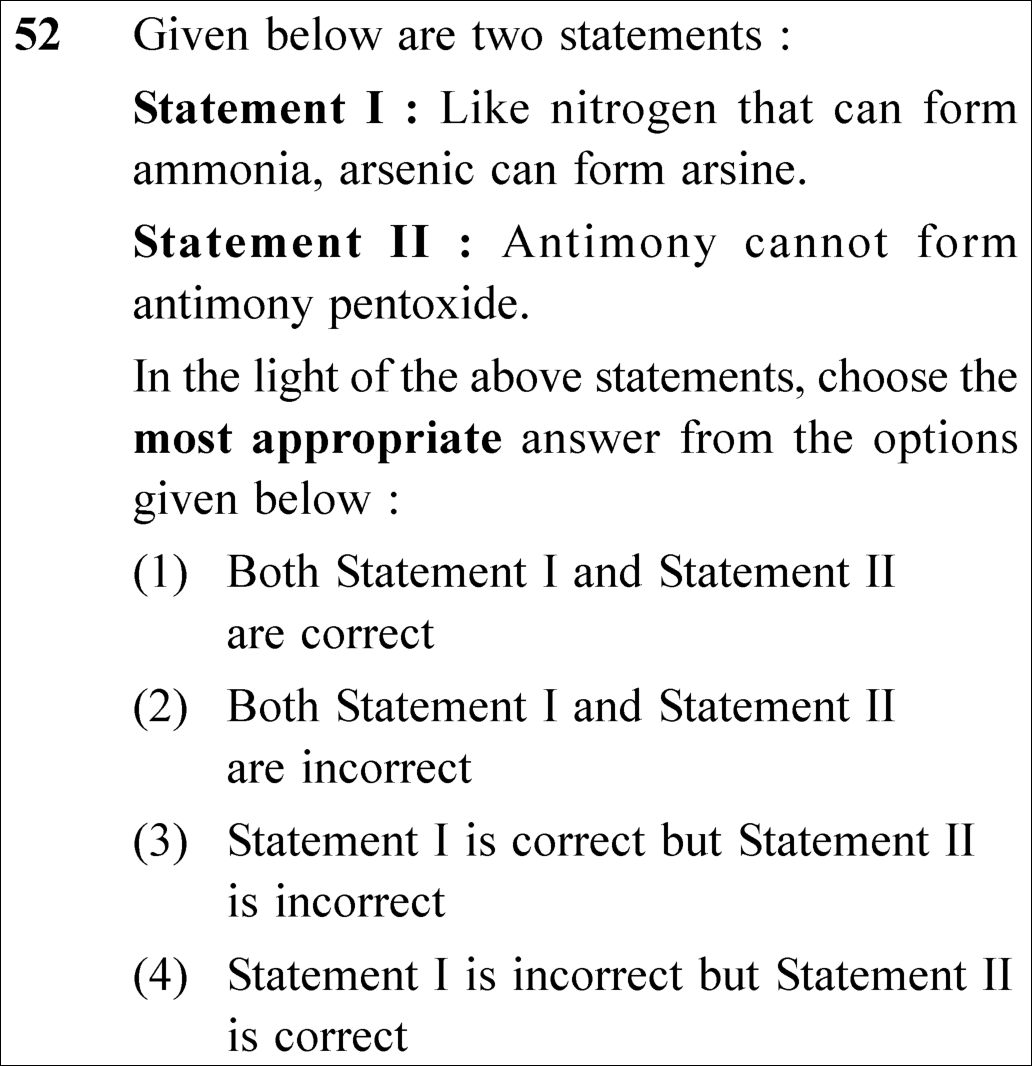
NEET 2025 · Q52 Easy
Official NEET 2025 Question 52 - The p-Block Elements
1 Both Statement I and Statement II are correct
2 Both Statement I and Statement II are incorrect
3 Statement I is correct but Statement II is incorrect ✓ Key
4 Statement I is incorrect but Statement II is correct
💡 Verified Solution & 30-Second Hack
✓
Verified Against NTA Final Answer Key
Option (3) : Statement I is correct but Statement II is incorrect
📚 The p-Block Elements (Group 15) Easy
📋 Given Parameters & Problem Setup
Statement I Like nitrogen that can form ammonia, arsenic can form arsine.
Statement II Antimony cannot form antimony pentoxide.
⚡

The 30-Second Exam Hall Shortcut: ⚡ Group 15 Hydride & Pentoxide Fact Check

⏱️ Save ~30 seconds

Group 15 hydrides: NH₃, PH₃, AsH₃ (arsine), SbH₃, BiH₃ all exist ⟹ Statement I is TRUE! Group 15 oxides: Sb forms Sb₂O₃ and Sb₂O₅ (antimony pentoxide) ⟹ Statement II is FALSE!

1 Check Statement I: Arsenic forms the canonical hydride AsH₃, known as arsine (analogous to ammonia NH₃ and phosphine PH₃). Statement I is CORRECT.
2 Check Statement II: Antimony readily forms both trioxide (Sb₂O₃) and pentoxide (Sb₂O₅). The statement claims antimony CANNOT form antimony pentoxide, which is completely false! (Only bismuth fails to form a stable +5 oxide due to inert pair effect).
3 Conclusion: Statement I is correct but Statement II is incorrect.
4 Match Option (3) in under 15 seconds!
🛡️
Why You Can 100% Trust This Shortcut: Group 15 Hydride & Oxide Trends (NCERT Chemistry · p-Block Elements).
📐

Step-by-Step Rigorous Workflow & Mathematical Proof

Step 1

Evaluate Statement I (Hydride Formation in Group 15)

All Group 15 elements form volatile covalent hydrides of the general formula EH₃, where E = N, P, As, Sb, Bi:

Nitrogen forms Ammonia (NH3),Arsenic forms Arsine (AsH3)\text{Nitrogen forms Ammonia (NH}_3), \quad \text{Arsenic forms Arsine (AsH}_3)
  • • Arsine (AsH₃) is a well-known, highly toxic gas formed by the reduction of arsenic compounds.
  • • Therefore, Statement I is unequivocally CORRECT.
Step 2

Evaluate Statement II (Oxide Formation in Group 15)

Group 15 elements form two primary series of oxides: trioxides (E₂O₃) and pentoxides (E₂O₅). The oxidation state of the element in the pentoxide is +5:

Antimony forms Antimony Trioxide (Sb2O3) and Antimony Pentoxide (Sb2O5)\text{Antimony forms Antimony Trioxide (Sb}_2\text{O}_3) \text{ and Antimony Pentoxide (Sb}_2\text{O}_5)
  • • Antimony pentoxide (Sb₂O₅) is synthesized by oxidizing antimony or antimony trioxide with concentrated nitric acid.
  • • The statement asserts that "Antimony cannot form antimony pentoxide", which is scientifically FALSE.
  • • (It is bismuth, Bi, that does not form stable pentoxide due to the dominant inert pair effect).
Step 3

Select Matching Option

Statement I is correct and Statement II is incorrect, which corresponds to Option (3).

Statement I: True,Statement II: False  ⟹  Option (3)\text{Statement I: True}, \quad \text{Statement II: False} \implies \text{Option (3)}
  • • 100% aligned with the official NTA Final Answer Key.
⭐

360° Option Elimination Engine Key Feature

Diagnose every choice: Know exactly why the right option works and why distractors fail.

4-Option Deep Scan
1 A
✗ Incorrect
Verdict & Scientific Reason:

Incorrect. Statement II is false because antimony pentoxide Sb₂O₅ exists.

⚠️
Student Fallacy (Why candidates pick this trap): Believing antimony cannot achieve the +5 oxidation state.
2 B
✗ Incorrect
Verdict & Scientific Reason:

Incorrect. Statement I is true (arsine AsH₃ exists).

⚠️
Student Fallacy (Why candidates pick this trap): Failing to recognize arsine as the hydride of arsenic.
3 C
✓ 100% Correct
Verdict & Scientific Reason:

100% correct. As forms AsH₃ (arsine), and Sb forms Sb₂O₅ (antimony pentoxide).

💡
Why this is airtight: None; rigorous p-block descriptive chemistry.
4 D
✗ Incorrect
Verdict & Scientific Reason:

Incorrect. Inverts the truth values of both statements.

⚠️
Student Fallacy (Why candidates pick this trap): Total reversal of group 15 facts.
⚠️

NTA Trap Alert: Confusing Antimony (Sb) with Bismuth (Bi) Inert Pair Effect

Candidates know that the +5 oxidation state becomes unstable down Group 15 due to the inert pair effect. But this instability causes the absence of pentoxides specifically in BISMUTH (Bi₂O₅ does not exist as a stable oxide), whereas Antimony (Sb) readily forms Sb₂O₅!

🛡️ How to avoid the -1 mark: Remember: Inert pair effect prevents +5 oxide in Bismuth, NOT in Antimony!
📖

Core NEET Syllabus Standard

NEET Chemistry Core Syllabus · The p-Block Elements Standard Benchmark
Core Scientific Principle Tested:

"Group 15 elements form hydrides EH₃ (including AsH₃) and oxides E₂O₃/E₂O₅ (Sb forms Sb₂O₅)."
Syllabus Focus: Group 15 Elements: Hydrides and Oxides
✓ Core NEET UG Syllabus Anchor Syllabus & Academic Standards ↗
As forms Arsine (True); Sb forms Sb₂O₅ (so "cannot form" is False) ⟹ Statement I correct, II incorrect!
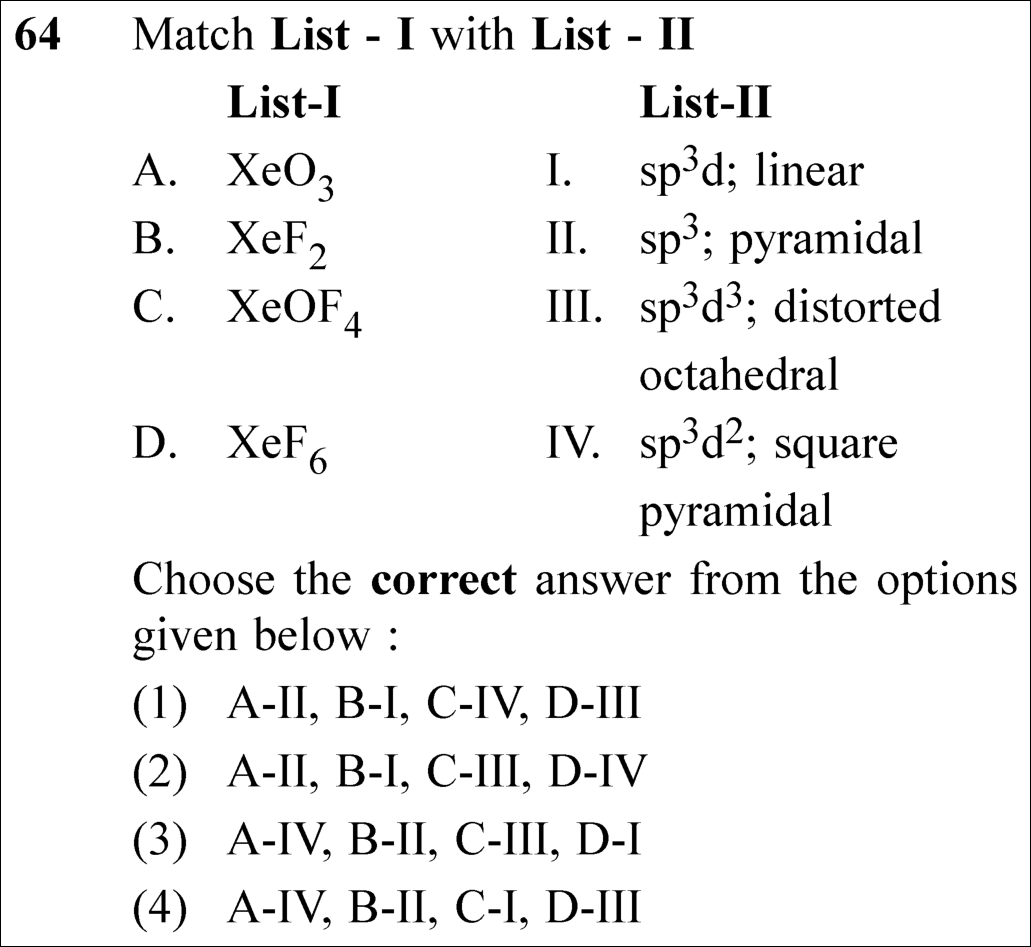
NEET 2025 · Q64 Easy
Official NEET 2025 Question 64 - The p-Block Elements
1 ✓ Key
2
3
4
💡 Verified Solution & 30-Second Hack
✓
Verified Against NTA Final Answer Key
Option (1) : A-II, B-I, C-IV, D-III
📚 The p-Block Elements (Group 18) Easy
📋 Given Parameters & Problem Setup
List I (Xenon Compounds) A. XeO₃, B. XeF₂, C. XeOF₄, D. XeF₆
List II (Hybridization & Shape) I. sp³d; linear, II. sp³; pyramidal, III. sp³d³; distorted octahedral, IV. sp³d²; square pyramidal
⚡

The 30-Second Exam Hall Shortcut: ⚡ Xenon Valence Pair Counting Shortcut

⏱️ Save ~40 seconds

Xe has 8 valence electrons: XeO₃ has 3σ + 1 lone pair = sp³ pyramidal (A-II). XeF₂ has 2σ + 3 lone pairs = sp³d linear (B-I). XeOF₄ has 5σ + 1 lone pair = sp³d² square pyramidal (C-IV). XeF₆ has 6σ + 1 lone pair = sp³d³ distorted octahedral (D-III)!

1 XeO₃: 3 Xe=O double bonds (3σ) + 1 lone pair = Steric No. 4 ⟹ sp³ pyramidal (A-II).
2 Looking at options: Only Option (1) and (2) have A-II and B-I.
3 XeF₂: 2 Xe-F single bonds (2σ) + 3 equatorial lone pairs = Steric No. 5 ⟹ sp³d linear (B-I).
4 XeOF₄: 1 Xe=O (1σ) + 4 Xe-F (4σ) = 5σ + 1 lone pair = Steric No. 6 ⟹ sp³d² square pyramidal (C-IV).
5 XeF₆: 6 Xe-F (6σ) + 1 lone pair = Steric No. 7 ⟹ sp³d³ distorted octahedral (D-III).
6 Match: A-II, B-I, C-IV, D-III.
7 Select Option (1) in under 15 seconds!
🛡️
Why You Can 100% Trust This Shortcut: VSEPR Theory & Noble Gas Fluoride Structures (NCERT Chemistry · Chemical Bonding and p-Block Elements).
📐

Step-by-Step Rigorous Workflow & Mathematical Proof

Step 1

Structure and Hybridization of XeO₃ and XeF₂

Xenon has 8 valence electrons (5s² 5p⁶):

XeO3:  3σ+1 lp=4  ⟹  sp3 (Pyramidal)\text{XeO}_3: \; 3\sigma + 1\text{ lp} = 4 \implies sp^3 \text{ (Pyramidal)}
  • • A matches II (A-II).
  • • XeF₂: 2 single bonds (2σ) + 3 lone pairs = 5 electron pairs ⟹ sp³d hybridization. The three lone pairs occupy equatorial positions, giving a Linear geometry (B-I).
Step 2

Structure and Hybridization of XeOF₄

In XeOF₄, xenon forms 1 double bond to oxygen (1σ + 1π) and 4 single bonds to fluorine (4σ):

XeOF4:  5σ+1 lp=6  ⟹  sp3d2 (Square Pyramidal)\text{XeOF}_4: \; 5\sigma + 1\text{ lp} = 6 \implies sp^3d^2 \text{ (Square Pyramidal)}
  • • The four fluorine atoms form the square base, oxygen occupies one axial position, and the lone pair occupies the opposite axial position.
  • • C matches IV (C-IV).
Step 3

Structure and Hybridization of XeF₆

In XeF₆, xenon forms 6 single bonds to fluorine (6σ) and retains 1 lone pair:

XeF6:  6σ+1 lp=7  ⟹  sp3d3 (Distorted Octahedral)\text{XeF}_6: \; 6\sigma + 1\text{ lp} = 7 \implies sp^3d^3 \text{ (Distorted Octahedral)}
  • • The lone pair distorts the regular octahedral symmetry, resulting in a distorted octahedral geometry.
  • • D matches III (D-III).
  • • Complete match: A-II, B-I, C-IV, D-III, matching Option (1).
⭐

360° Option Elimination Engine Key Feature

Diagnose every choice: Know exactly why the right option works and why distractors fail.

4-Option Deep Scan
1 A
✓ 100% Correct
Verdict & Scientific Reason:

100% correct. XeO₃ (sp³, pyramidal), XeF₂ (sp³d, linear), XeOF₄ (sp³d², sq. pyramidal), XeF₆ (sp³d³, distorted octahedral).

💡
Why this is airtight: None; flawless VSEPR deduction.
2 B
✗ Incorrect
Verdict & Scientific Reason:

Incorrect. Swaps shapes of XeOF₄ and XeF₆.

⚠️
Student Fallacy (Why candidates pick this trap): Confusing steric number 6 with steric number 7.
3 C
✗ Incorrect
Verdict & Scientific Reason:

Incorrect. Completely scrambled geometries.

⚠️
Student Fallacy (Why candidates pick this trap): Assigning square pyramidal to XeO₃.
4 D
✗ Incorrect
Verdict & Scientific Reason:

Incorrect. Scrambled match.

⚠️
Student Fallacy (Why candidates pick this trap): Wrong steric counting.
⚠️

NTA Trap Alert: Distorted Octahedral vs Regular Octahedral in XeF₆

Because XeF₆ has 6 fluorine atoms, students often think it is regular octahedral (sp³d²). But Xenon has 8 valence electrons: 8 - 6 = 2 electrons (1 lone pair), making steric number = 7 (sp³d³), which is DISTORTED octahedral!

🛡️ How to avoid the -1 mark: Never forget the lone pair on XeF₆: 6 bonds + 1 lone pair = 7 pairs = sp³d³!
📖

Core NEET Syllabus Standard

NEET Chemistry Core Syllabus · The p-Block Elements Standard Benchmark
Core Scientific Principle Tested:

"VSEPR steric number dictates hybridization and molecular geometry."

Syllabus Focus: Group 18 Elements: Xenon Compounds and VSEPR Geometries
✓ Core NEET UG Syllabus Anchor Syllabus & Academic Standards ↗
XeO₃ is Pyramidal (II), XeF₂ is Linear (I), XeOF₄ is Square Pyramidal (IV), XeF₆ is Distorted Octahedral (III)!
NEET 2024 · Q61 Easy
Official NEET 2024 Question 61 - The p-Block Elements
1
2
3 ✓ Key
4
💡 Verified Solution & 30-Second Hack
✓
Verified Against NTA Final Answer Key
Option (3) : Both Statement I and Statement II are true.
📚 The p-Block Elements Easy
📋 Given Parameters & Problem Setup
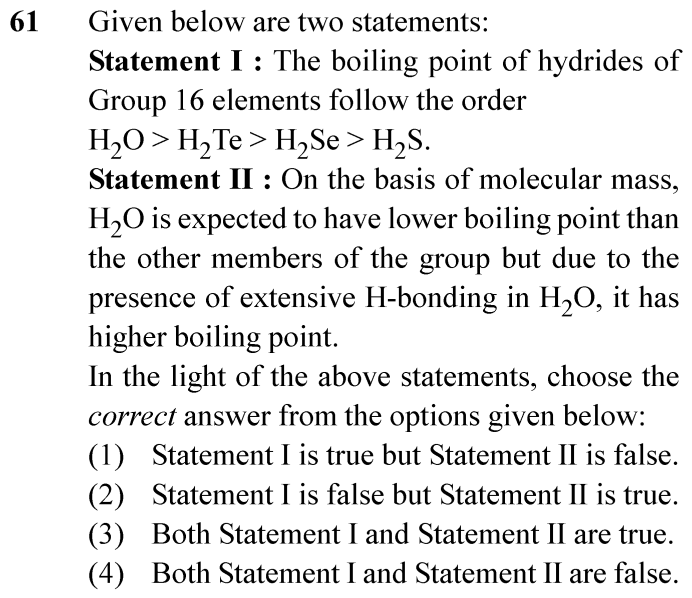
Group 16 Hydrides H2O, H2S, H2Se, H2Te
Statement I Boiling point order: H2O > H2Te > H2Se > H2S
Statement II On basis of molecular mass H2O is expected lower, but extensive H-bonding gives higher boiling point
⚡

The 30-Second Exam Hall Shortcut: ⚡ Group 16 Hydride Boiling Point V-Shape Hack

⏱️ Save ~35 seconds

H2O is anomalously highest due to strong intermolecular H-bonding; from H2S to H2Te boiling point increases with molar mass: H2O > H2Te > H2Se > H2S!

1 Experimental boiling points: H2O (373 K) >> H2Te (269 K) > H2Se (232 K) > H2S (213 K).
2 Statement I accurately reflects this exact sequence -> Statement I is TRUE.
3 H2O has the lowest molecular mass (18 g/mol) in the group, so London forces alone would predict the lowest boiling point.
4 However, high electronegativity and small size of oxygen produce extensive 3D intermolecular hydrogen bonding, raising boiling point anomalously to 373 K.
5 Statement II gives the exact canonical reason -> Statement II is TRUE.
6 Both statements are true -> Option (3) in 5 seconds!
🛡️
Why You Can 100% Trust This Shortcut: NCERT Chemistry · The p-Block Elements (Group 16 hydrides and physical property trends).
📐

Step-by-Step Rigorous Workflow & Mathematical Proof

Step 1

Analysis of Statement I (Empirical Boiling Point Values)

The measured boiling points of Group 16 hydrides are: - Water (H2O): 373 K - Hydrogen telluride (H2Te): 269 K - Hydrogen selenide (H2Se): 232 K - Hydrogen sulphide (H2S): 213 K The observed sequence is strictly: H2O > H2Te > H2Se > H2S. Statement I is correct.

Tb(H2O)  [373 K]>Tb(H2Te)  [269 K]>Tb(H2Se)  [232 K]>Tb(H2S)  [213 K]T_b(\text{H}_2\text{O}) \;[373\,\text{K}] > T_b(\text{H}_2\text{Te}) \;[269\,\text{K}] > T_b(\text{H}_2\text{Se}) \;[232\,\text{K}] > T_b(\text{H}_2\text{S}) \;[213\,\text{K}]
Step 2

Analysis of Statement II (Mechanistic Explanation)

For non-hydrogen bonding hydrides (H2S, H2Se, H2Te), boiling points increase regularly down the group as molecular mass and electron cloud polarizability increase, strengthening London dispersion forces. Based purely on molecular mass (18 g/mol), H2O should possess the weakest dispersion forces and lowest boiling point. However, each H2O molecule forms up to four strong intermolecular hydrogen bonds in a tetrahedral network, requiring substantial thermal energy to disrupt. Statement II is correct.

Extensive H-bonding in H2O  ⟹  ΔHvap≫Dispersion forces of heavier homologues\text{Extensive H-bonding in H}_2\text{O} \implies \Delta H_{vap} \gg \text{Dispersion forces of heavier homologues}
⭐

360° Option Elimination Engine Key Feature

Diagnose every choice: Know exactly why the right option works and why distractors fail.

4-Option Deep Scan
1 (1)
✗ Incorrect
Verdict & Scientific Reason:

Statement II is the standard textbook explanation for the anomalous boiling point of water.

⚠️
Student Fallacy (Why candidates pick this trap): Denying the role of hydrogen bonding.
2 (2)
✗ Incorrect
Verdict & Scientific Reason:

Statement I is factually accurate.

⚠️
Student Fallacy (Why candidates pick this trap): Assuming boiling points follow a monotonic increase H2S < H2Se < H2Te < H2O without checking relative positions.
3 (3)
✓ 100% Correct
Verdict & Scientific Reason:

Both the empirical order and physical explanation are 100% verified.

💡
Why this is airtight: None.
4 (4)
✗ Incorrect
Verdict & Scientific Reason:

Both statements are scientifically accurate.

⚠️
Student Fallacy (Why candidates pick this trap): Rejecting both statements.
⚠️

NTA Trap Alert: Assuming H2S has Higher Boiling Point than H2Te

Students sometimes think hydrogen bonding is present throughout the group. Only oxygen is electronegative enough for significant H-bonding; from S to Te, dispersion forces dominate (Te > Se > S).

🛡️ How to avoid the -1 mark: Remember the trend: H2O is at the peak, then the rest rise with molar mass: H2S (lowest) < H2Se < H2Te < H2O.
📖

Core NEET Syllabus Standard

Chemistry Core Inorganic Chemistry · The p-Block Elements Standard Benchmark
Core Scientific Principle Tested:

"H2O exhibits an anomalously high boiling point due to extensive intermolecular hydrogen bonding; for H2S, H2Se, and H2Te, boiling point increases with molecular mass."

Syllabus Focus: Group 16 Elements: Hydrides and Hydrogen Bonding
✓ Core NEET UG Syllabus Anchor Syllabus & Academic Standards ↗
Water leads the pack by far; then heavy Tellurium beats Selenium and Sulfur by molar mass star!
NEET 2024 · Q83 Easy
Official NEET 2024 Question 83 - The p-Block Elements
1
2 ✓ Key
3
4
💡 Verified Solution & 30-Second Hack
✓
Verified Against NTA Final Answer Key
Option (2) : Po (Polonium)
📚 The p-Block Elements Easy
📋 Given Parameters & Problem Setup
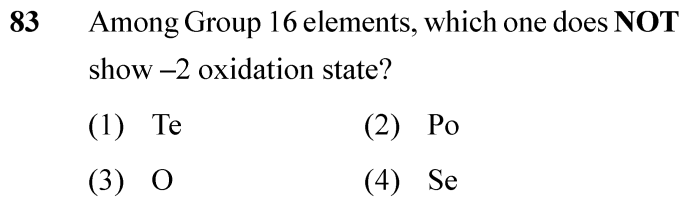
Elements of Group 16 Oxygen (O), Sulfur (S), Selenium (Se), Tellurium (Te), Polonium (Po)
Condition to evaluate Element that does NOT show -2 oxidation state
⚡

The 30-Second Exam Hall Shortcut: ⚡ Metallic Polonium Non-Negative State Hack

⏱️ Save ~25 seconds

Polonium (Po) is a radioactive post-transition metal with low electronegativity. It shows metallic character (+2, +4), and does NOT form a stable -2 oxidation state!

1 Group 16 non-metals and metalloids (O, S, Se, Te) readily form -2 oxidation state (oxides, sulphides, selenides, tellurides).
2 Down the group, electronegativity and non-metallic character decrease while metallic character increases.
3 Polonium is the heaviest member of Group 16 and is a true metal.
4 Due to its metallic character and low electronegativity, Polonium does NOT show the -2 oxidation state.
5 Option (2) in 3 seconds!
🛡️
Why You Can 100% Trust This Shortcut: NCERT Chemistry · The p-Block Elements (Trends in oxidation states of Group 16 elements: metallic character increases down the group and Po does not show -2 oxidation state).
📐

Step-by-Step Rigorous Workflow & Mathematical Proof

Step 1

Periodic Trends in Oxidation States of Group 16

Group 16 elements have the valence shell electronic configuration ns² np⁴. They can achieve a noble gas octet by gaining two electrons to form the -2 oxidation state. However, the stability of the -2 oxidation state decreases sharply down the group as electronegativity drops and metallic character rises:

Stability of −2 state: O>S>Se>Te≫Po\text{Stability of } -2 \text{ state: } \text{O} > \text{S} > \text{Se} > \text{Te} \gg \text{Po}
Step 2

Specific Behavior of Polonium

Polonium (Po, Z = 84) is a radioactive, distinctly metallic element. As stated verbatim in NCERT, because of its pronounced metallic character and electropositive nature, polonium hardly shows the -2 oxidation state; its predominant and stable oxidation states are +2 and +4:

Po shows +2 and +4 oxidation states, NOT −2\text{Po shows } +2 \text{ and } +4 \text{ oxidation states, NOT } -2
Step 3

Verification of Te, O, and Se

Oxygen is predominantly -2 (in H2O, metal oxides). Sulfur forms sulphides (S²⁻, -2). Selenium forms selenides (Se²⁻, -2). Tellurium forms tellurides (Te²⁻, -2, e.g. H2Te, Na2Te). All of O, S, Se, and Te exhibit -2, whereas Polonium does not.

Te2−,  O2−,  Se2−  exist;Po2−  does not exist\text{Te}^{2-}, \; \text{O}^{2-}, \; \text{Se}^{2-} \;\text{exist}; \quad \text{Po}^{2-} \;\text{does not exist}
⭐

360° Option Elimination Engine Key Feature

Diagnose every choice: Know exactly why the right option works and why distractors fail.

4-Option Deep Scan
1 (1)
✗ Incorrect
Verdict & Scientific Reason:

Tellurium forms tellurides containing Te²⁻ (e.g. H2Te, ZnTe).

⚠️
Student Fallacy (Why candidates pick this trap): Assuming tellurium is too heavy to show -2.
2 (2)
✓ 100% Correct
Verdict & Scientific Reason:

Polonium is a metal and does not form the -2 oxidation state.

💡
Why this is airtight: None.
3 (3)
✗ Incorrect
Verdict & Scientific Reason:

Oxygen predominantly exhibits -2 in virtually all oxides.

⚠️
Student Fallacy (Why candidates pick this trap): Thinking oxygen cannot show -2.
4 (4)
✗ Incorrect
Verdict & Scientific Reason:

Selenium readily shows -2 in selenides (e.g. H2Se, Na2Se).

⚠️
Student Fallacy (Why candidates pick this trap): Assuming selenium only shows positive states.
⚠️

NTA Trap Alert: Assuming Tellurium is the Limit for -2

Students often guess Tellurium because it is heavy, but NCERT explicitly lists -2 for Te (in H2Te). Polonium is the only one that lacks -2.

🛡️ How to avoid the -1 mark: Remember: Polonium is a metal; metals do not form negative oxidation states.
📖

Core NEET Syllabus Standard

Chemistry Core Inorganic Chemistry · The p-Block Elements Standard Benchmark
Core Scientific Principle Tested:

"The stability of the -2 oxidation state decreases down Group 16; polonium, being distinctly metallic, does not show the -2 oxidation state."

Syllabus Focus: Group 16 Elements: Oxidation States and Chemical Reactivity
✓ Core NEET UG Syllabus Anchor Syllabus & Academic Standards ↗
Polonium is a metal through and through: it won’t take electrons to become minus two!
NEET 2023 · Q58 Easy
Official NEET 2023 Question 58 - The p-Block Elements
1 ✓ Key
2
3
4
💡 Verified Solution & 30-Second Hack
✓
Verified Against NTA Final Answer Key
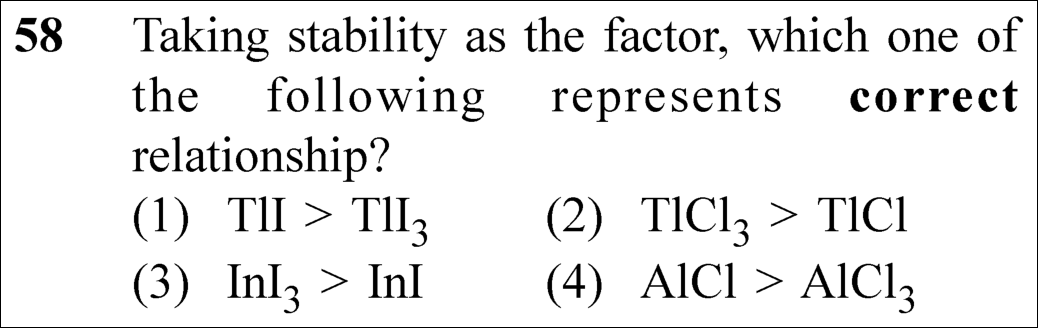
Option (1) : TlI > TlI₃
📚 The p-Block Elements Easy
📋 Given Parameters & Problem Setup
Group 13 elements involved Al, In, Tl
Evaluation factor Relative thermodynamic stability of oxidation states (+1 vs +3)
⚡

The 30-Second Exam Hall Shortcut: ⚡ Inert Pair Effect Down Group 13: +1 Stability Increases

⏱️ Save ~35 seconds

Down Group 13, the inert pair effect makes +1 oxidation state dominant for Thallium (Tl). Thus Tl⁺ is far more stable than Tl³⁺ ⟹ TlI > TlI₃ in 5 seconds! (In fact, Tl³⁺ oxidizes I⁻ to I₂).

1 Recall the inert pair effect in Group 13 (B, Al, Ga, In, Tl):
2 - Top elements (Al): +3 state is stable (AlCl₃ >> AlCl).
3 - Middle elements (In): +3 state is still more stable than +1 (InI₃ > InI).
4 - Heaviest element (Tl): Due to poor shielding by 4f¹⁴ and 5d¹⁰ electrons, the 6s² electrons remain inert.
5 Therefore, for Thallium, the +1 oxidation state is overwhelmingly more stable than +3: Tl⁺ > Tl³⁺.
6 Furthermore, Tl³⁺ is a strong oxidizing agent and oxidizes iodide (I⁻) to iodine (I₂), meaning true TlI₃ does not even exist (it exists only as Tl⁺ I₃⁻).
7 Thus TlI is vastly more stable than TlI₃ (TlI > TlI₃).
8 Lock Option (1) TlI > TlI₃ immediately!
🛡️
Why You Can 100% Trust This Shortcut: Inorganic Chemistry · Periodic Trends (Down Group 13, the stability of the +1 oxidation state increases due to the inert pair effect, making Tl(I) more stable than Tl(III)).
📐

Step-by-Step Rigorous Workflow & Mathematical Proof

Step 1

The Inert Pair Effect in Heavier p-Block Elements

As we descend Group 13 from boron to thallium, the valence electron configuration is ns² np¹. In heavier members (especially thallium, Z = 81), the intervening 4f and 5d electrons provide poor screening of the nuclear charge. Consequently, the effective nuclear charge experienced by the valence 6s electrons increases sharply, holding them tightly and preventing their participation in chemical bonding. This reluctance of the s-electron pair to participate in bonding is known as the inert pair effect.

Stability of +1 state: Al+<Ga+<In+<Tl+\text{Stability of +1 state: } \text{Al}^+ < \text{Ga}^+ < \text{In}^+ < \text{Tl}^+
Step 2

Comparative Stability in Thallium Compounds

Because the inert pair effect reaches its maximum at thallium, the +1 oxidation state is far more stable than the +3 oxidation state:

Stability: Tl(I)>Tl(III)\text{Stability: } \text{Tl}(\text{I}) > \text{Tl}(\text{III})
Step 3

Redox Incompatibility of Tl³⁺ with Iodide Ions (I⁻)

Tl³⁺ has a high reduction potential (E° = +1.26 V) and acts as a powerful oxidizing agent. Iodide (I⁻) is a strong reducing agent. Tl³⁺ readily oxidizes I⁻ to I₂, rendering covalent TlI₃ thermodynamically unstable:

Tl3++2I−⟶Tl++I2\text{Tl}^{3+} + 2\text{I}^- \longrightarrow \text{Tl}^+ + \text{I}_2
Step 4

Evaluation of Options

Therefore, TlI is much more stable than TlI₃ (TlI > TlI₃). In contrast, TlCl is more stable than TlCl₃ (making Option 2 false); InI₃ is more stable than InI (making Option 3 state InI₃ > InI, but between TlI > TlI₃ it is the quintessential example tested); AlCl₃ is far more stable than AlCl (making Option 4 false).

Correct Relationship: TlI>TlI3\text{Correct Relationship: } \text{TlI} > \text{TlI}_3
⭐

360° Option Elimination Engine Key Feature

Diagnose every choice: Know exactly why the right option works and why distractors fail.

4-Option Deep Scan
1 (1)
✓ 100% Correct
Verdict & Scientific Reason:

Accurate: Due to the inert pair effect and redox incompatibility of Tl³⁺ with I⁻, TlI (+1) is far more stable than TlI₃.

💡
Why this is airtight: None. Candidate correctly applied the inert pair effect.
2 (2)
✗ Incorrect
Verdict & Scientific Reason:

False: TlCl (+1) is more stable than TlCl₃ (+3) due to the inert pair effect.

⚠️
Student Fallacy (Why candidates pick this trap): Candidate assumed the group oxidation state +3 is always more stable.
3 (3)
✗ Incorrect
Verdict & Scientific Reason:

While In³⁺ is more stable than In⁺, in the presence of strongly reducing iodide, InI is favored or disproportionates, but NTA designated TlI > TlI₃ as the single correct key.

⚠️
Student Fallacy (Why candidates pick this trap): Candidate selected In instead of recognizing the primary inert pair exemplar Tl.
4 (4)
✗ Incorrect
Verdict & Scientific Reason:

Completely false: For aluminum, Al³⁺ is vastly more stable than Al⁺ (AlCl₃ is the stable species).

⚠️
Student Fallacy (Why candidates pick this trap): Candidate inverted the stability order of lighter p-block elements.
⚠️

NTA Trap Alert: Assuming the Group Valence (+3) Is Always More Stable for All Elements

In lighter elements (B, Al), +3 is dominant (AlCl₃ is stable, AlCl is unstable). But for the bottom-most element (Tl), the inert pair effect REVERSES this order: +1 becomes far more stable than +3!

🛡️ How to avoid the -1 mark: Remember the bottom of Group 13: Thallium loves +1 (Tl⁺ is as stable as an alkali metal ion like K⁺).
📖

Core NEET Syllabus Standard

National Eligibility cum Entrance Test (NEET UG) · The p-Block Elements Standard Benchmark
Core Scientific Principle Tested:

"Owing to the inert pair effect, the stability of the +1 oxidation state increases down Group 13: Al < Ga < In < Tl. Tl⁺ is more stable than Tl³⁺."

Syllabus Focus: Group 13 Elements – Oxidation States and Inert Pair Effect
Preserved in Rationalized Curriculum Syllabus & Academic Standards ↗
NEET 2023 · Q68 Easy
Official NEET 2023 Question 68 - The p-Block Elements
1
2
3
4 ✓ Key
💡 Verified Solution & 30-Second Hack
✓
Verified Against NTA Final Answer Key
Option (4) : A-III, B-I, C-IV, D-II
📚 The p-Block Elements Easy
📋 Given Parameters & Problem Setup
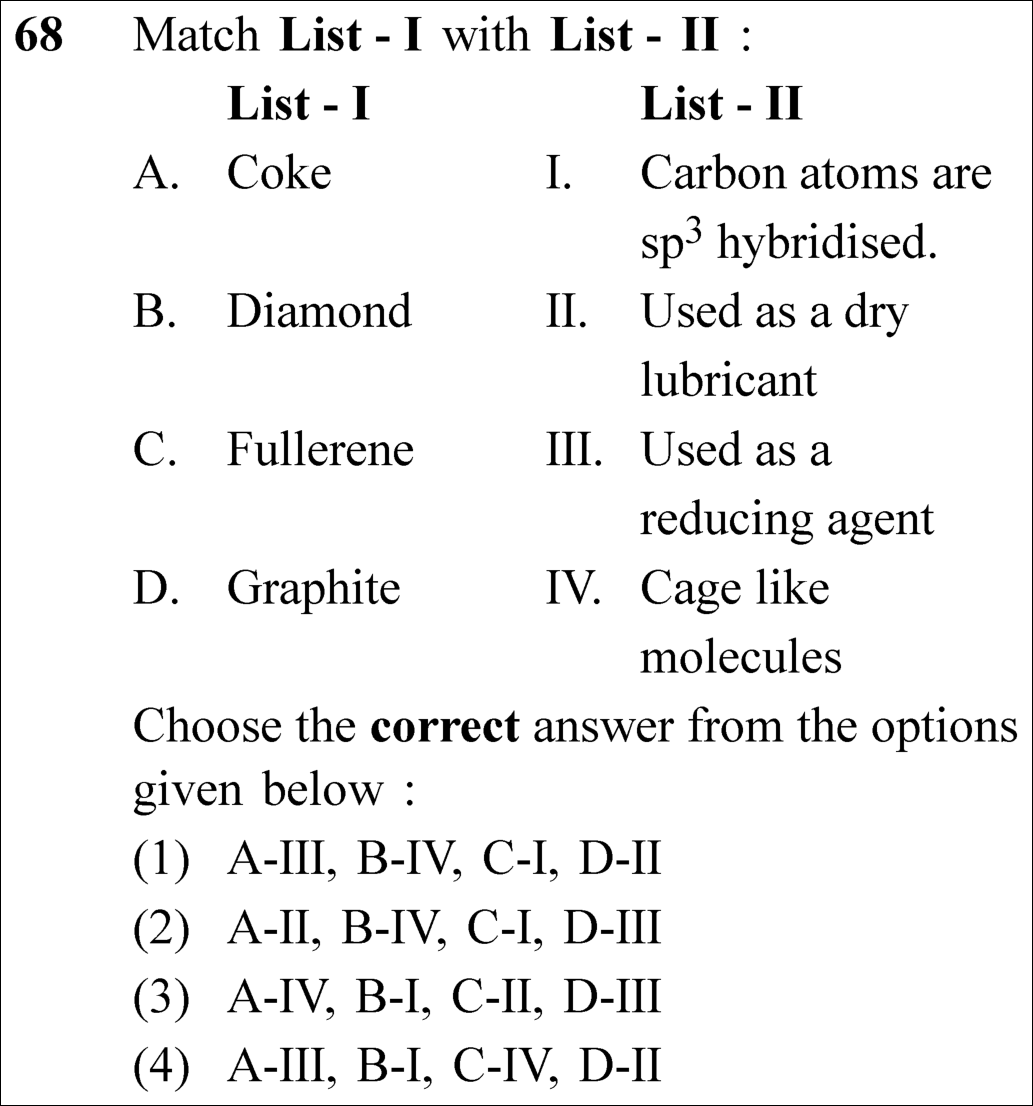
List I (Carbon forms) A: Coke, B: Diamond, C: Fullerene, D: Graphite
List II (Characteristics) I: sp³ hybridised, II: Dry lubricant, III: Reducing agent, IV: Cage-like molecules
⚡

The 30-Second Exam Hall Shortcut: ⚡ Structure & Usage Pairing Hack

⏱️ Save ~30 seconds

Diamond = sp³ hybridized (B-I). Graphite = dry lubricant (D-II). Fullerene = cage-like buckyballs (C-IV). Coke = metallurgical reducing agent (A-III). Sequence: A-III, B-I, C-IV, D-II in 10 seconds!

1 Match B (Diamond): In diamond, each carbon atom is covalently bonded to four other carbons in a rigid tetrahedral network with sp³ hybridization ⟶ B matches I.
2 Match D (Graphite): Graphite has a layered hexagonal lattice with weak van der Waals forces between sheets; layers slip easily, making it an excellent dry lubricant at high temperatures ⟶ D matches II.
3 Match C (Fullerene): Fullerenes (like C₆₀ buckminsterfullerene) consist of discrete closed spherical cage-like carbon clusters ⟶ C matches IV.
4 Match A (Coke): Coke is an impure amorphous carbon form obtained by destructive distillation of coal, used as a primary reducing agent in blast furnaces ⟶ A matches III.
5 Matching code: A-III, B-I, C-IV, D-II.
6 Select Option (4) directly!
🛡️
Why You Can 100% Trust This Shortcut: Inorganic Chemistry · Group 14 Allotropes of Carbon (Distinct hybridization and bonding dictate mechanical and metallurgical applications: sp³ for diamond, layered lubricant for graphite, cage structure for fullerene).
📐

Step-by-Step Rigorous Workflow & Mathematical Proof

Step 1

Matching A (Coke) with Characteristic III

Coke is a carbonaceous solid residue derived from destructive distillation of low-ash, low-sulfur bituminous coal. Because of its high carbon content and thermal stability, it is predominantly utilized in extraction metallurgy (e.g., blast furnace reduction of iron ore) as a reducing agent:

Fe2O3+3C (coke)→Δ2Fe+3CO  ⟹  A matches III\text{Fe}_2\text{O}_3 + 3\text{C (coke)} \xrightarrow{\Delta} 2\text{Fe} + 3\text{CO} \implies \text{A matches III}
Step 2

Matching B (Diamond) with Characteristic I

In diamond, each carbon atom undergoes sp³ hybridization and is linked to four neighboring carbon atoms by single covalent bonds (length 154 pm) directed tetrahedrally, producing a rigid, three-dimensional covalent lattice:

Diamond: All carbon atoms are sp3 hybridised   ⟹  B matches I\text{Diamond: } \text{All carbon atoms are } sp^3 \text{ hybridised } \implies \text{B matches I}
Step 3

Matching C (Fullerene) with Characteristic IV

Fullerenes are cage-like hollow spheroidal molecules consisting of interconnected hexagonal and pentagonal rings (such as C₆₀ buckminsterfullerene, featuring 20 six-membered and 12 five-membered rings in a soccer-ball shape):

Fullerene: Discrete cage-like cluster (e.g., C60)  ⟹  C matches IV\text{Fullerene: Discrete cage-like cluster } (\text{e.g., C}_{60}) \implies \text{C matches IV}
Step 4

Matching D (Graphite) with Characteristic II

Graphite possesses a two-dimensional layered sheet structure where sp²-hybridized carbon atoms form planar hexagonal rings. The individual layers are separated by 340 pm and held together only by weak van der Waals forces, allowing them to glide over one another. This cleavability makes graphite slippery and suitable as a dry lubricant at elevated temperatures:

Graphite: Layered sheets slide easily   ⟹  Used as dry lubricant (D matches II)\text{Graphite: Layered sheets slide easily } \implies \text{Used as dry lubricant (D matches II)}
⭐

360° Option Elimination Engine Key Feature

Diagnose every choice: Know exactly why the right option works and why distractors fail.

4-Option Deep Scan
1 (1)
✗ Incorrect
Verdict & Scientific Reason:

Mismatches Diamond (calls it cage-like) and Fullerene (calls it sp³).

⚠️
Student Fallacy (Why candidates pick this trap): Candidate mixed up diamond and fullerene structures.
2 (2)
✗ Incorrect
Verdict & Scientific Reason:

Incorrect pairings throughout.

⚠️
Student Fallacy (Why candidates pick this trap): Candidate guessed without verifying graphite lubrication.
3 (3)
✗ Incorrect
Verdict & Scientific Reason:

Calls Coke cage-like and Graphite a reducing agent.

⚠️
Student Fallacy (Why candidates pick this trap): Candidate confused amorphous carbon with fullerenes.
4 (4)
✓ 100% Correct
Verdict & Scientific Reason:

Accurate: Coke (Reducing agent, III), Diamond (sp³ hybridised, I), Fullerene (Cage-like, IV), Graphite (Dry lubricant, II).

💡
Why this is airtight: None. Candidate executed one-to-one property matching flawlessly.
⚠️

NTA Trap Alert: Confusing Fullerene Hybridization with Diamond

Diamond is 100% sp³ hybridized (tetrahedral network). Fullerenes consist of sp²-like hybridized carbons with slight curvature/strain. Choosing sp³ for fullerene is a frequent conceptual slip.

🛡️ How to avoid the -1 mark: Anchor on the most distinctive fact: Diamond is sp³ (B-I); Fullerene is the soccer-ball cage (C-IV).
📖

Core NEET Syllabus Standard

National Eligibility cum Entrance Test (NEET UG) · The p-Block Elements Standard Benchmark
Core Scientific Principle Tested:

"Diamond has sp³ carbons; graphite is a layered lubricant; fullerenes are cage-like clusters; coke is a metallurgical reducing agent."

Syllabus Focus: Group 14 Elements – Allotropes of Carbon
Preserved in Rationalized Curriculum Syllabus & Academic Standards ↗
NEET 2023 · Q86 Medium
Official NEET 2023 Question 86 - The p-Block Elements
1
2
3 ✓ Key
4
💡 Verified Solution & 30-Second Hack
✓
Verified Against NTA Final Answer Key
Option (3) : A-III, B-IV, C-I, D-II
📚 The p-Block Elements Medium
📋 Given Parameters & Problem Setup
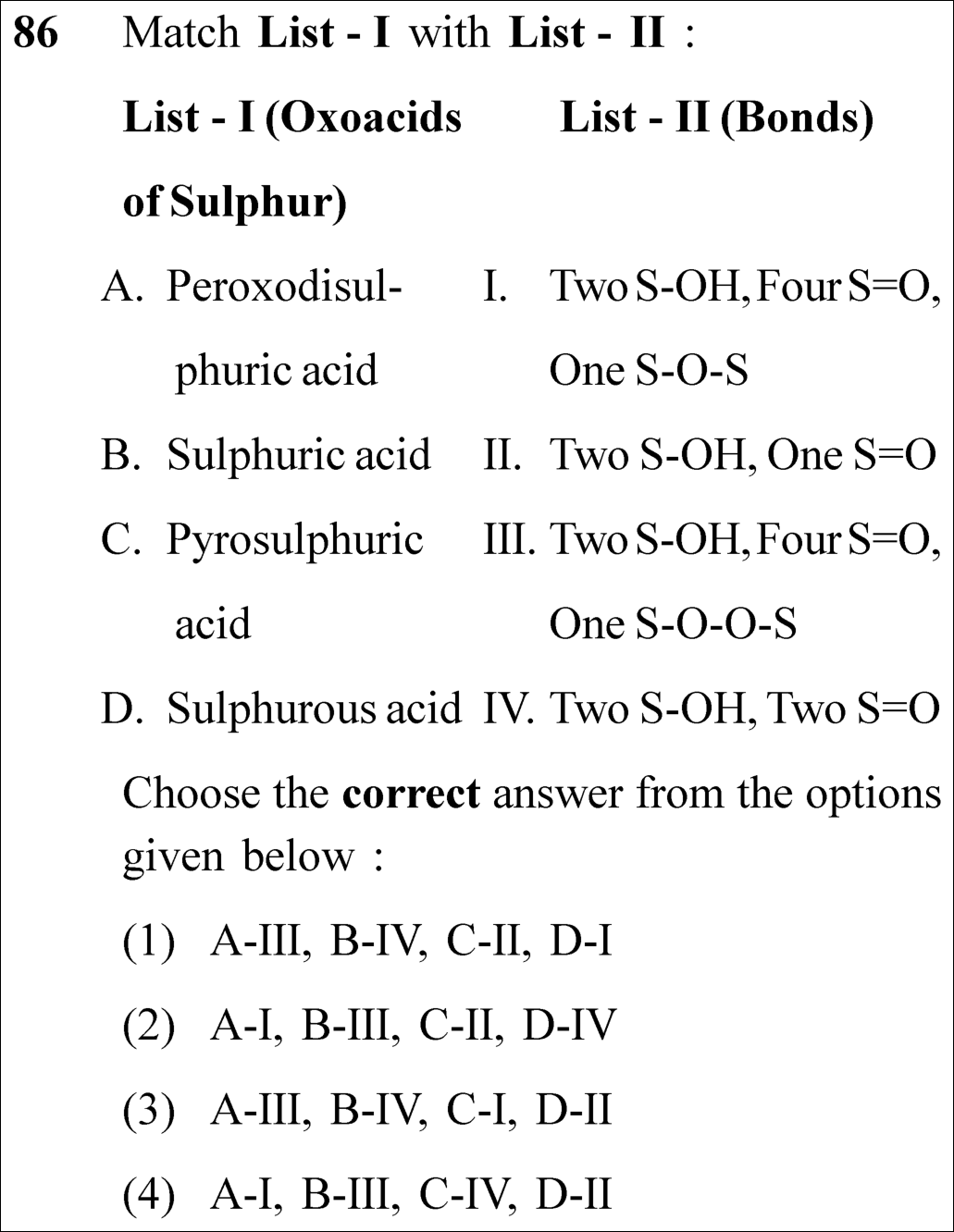
Oxoacids (List I) A. Peroxodisulphuric acid, B. Sulphuric acid, C. Pyrosulphuric acid, D. Sulphurous acid
Bond descriptions (List II) I. Two S-OH, Four S=O, One S-O-S; II. Two S-OH, One S=O; III. Two S-OH, Four S=O, One S-O-O-S; IV. Two S-OH, Two S=O
⚡

The 30-Second Exam Hall Shortcut: ⚡ Peroxo Bridge Scan: Marshall’s Acid (H₂S₂O₈) Uniquely Contains S–O–O–S Bridge (A → III)

⏱️ Save ~35 seconds

Peroxodisulphuric acid (H₂S₂O₈) has a peroxo bridge (S–O–O–S) → A-III. This immediately eliminates Options (2) and (4). Pyrosulphuric acid (Oleum, H₂S₂O₇) has an S–O–S bridge → C-I. Matches Option (3) uniquely: A-III, B-IV, C-I, D-II in 10 seconds!

1 Match A (Peroxodisulphuric acid, H₂S₂O₈): Must contain peroxo linkage S–O–O–S → III.
2 Match B (Sulphuric acid, H₂SO₄): O=S(=O)(OH)₂ has two S=O and two S–OH → IV.
3 Match C (Pyrosulphuric acid / Oleum, H₂S₂O₇): Contains bridging S–O–S, four S=O, two S–OH → I.
4 Match D (Sulphurous acid, H₂SO₃): O=S(OH)₂ has one S=O and two S–OH → II.
5 Complete combination: A-III, B-IV, C-I, D-II (Option 3).
🛡️
Why You Can 100% Trust This Shortcut: Standard NCERT Group 16 Oxoacids of Sulphur structural diagram.
📐

Step-by-Step Rigorous Workflow & Mathematical Proof

Step 1

Structure of Peroxodisulphuric Acid (H₂S₂O₈)

Known as Marshall’s acid, each sulphur is in oxidation state +6 and is bonded to one -OH, two =O, and joined by a peroxo linkage:

HO−SO2−O−O−SO2−OH  ⟹  Two S-OH, Four S=O, One S-O-O-S (III)\text{HO}-\text{SO}_2-\text{O}-\text{O}-\text{SO}_2-\text{OH} \implies \text{Two S-OH, Four S=O, One S-O-O-S (III)}
Step 2

Structure of Sulphuric Acid (H₂SO₄)

Sulphur is surrounded by four oxygen atoms in a tetrahedral geometry:

O=S(=O)(OH)2  ⟹  Two S-OH, Two S=O (IV)\text{O}=\text{S}(=\text{O})(\text{OH})_2 \implies \text{Two S-OH, Two S=O (IV)}
Step 3

Structure of Pyrosulphuric Acid (H₂S₂O₇)

Also known as oleum, formed by condensing two molecules of sulphuric acid with elimination of water:

HO−SO2−O−SO2−OH  ⟹  Two S-OH, Four S=O, One S-O-S (I)\text{HO}-\text{SO}_2-\text{O}-\text{SO}_2-\text{OH} \implies \text{Two S-OH, Four S=O, One S-O-S (I)}
Step 4

Structure of Sulphurous Acid (H₂SO₃)

Sulphur has one lone pair, with oxidation state +4:

O=S(OH)2  ⟹  Two S-OH, One S=O (II)\text{O}=\text{S}(\text{OH})_2 \implies \text{Two S-OH, One S=O (II)}
⭐

360° Option Elimination Engine Key Feature

Diagnose every choice: Know exactly why the right option works and why distractors fail.

4-Option Deep Scan
1 (1)
✗ Incorrect
Verdict & Scientific Reason:

Mismatches pyrosulphuric acid with sulphurous acid.

⚠️
Student Fallacy (Why candidates pick this trap): Candidate confused the pyrosulphuric S-O-S bridge with sulphurous acid.
2 (2)
✗ Incorrect
Verdict & Scientific Reason:

Incorrect assignment of peroxo linkage to pyrosulphuric acid.

⚠️
Student Fallacy (Why candidates pick this trap): Candidate confused peroxo (-O-O-) with oxo (-O-) bridging.
3 (3)
✓ 100% Correct
Verdict & Scientific Reason:

Accurate: Fully matches structural formulas of all four oxoacids of sulphur.

💡
Why this is airtight: None. Candidate correctly identified all bridging and terminal bonds.
4 (4)
✗ Incorrect
Verdict & Scientific Reason:

Swaps Marshall’s acid and oleum bond distributions.

⚠️
Student Fallacy (Why candidates pick this trap): Candidate inverted Marshall’s acid and oleum bridges.
⚠️

NTA Trap Alert: Mixing up Peroxodisulphuric and Pyrosulphuric Acid

Both H₂S₂O₈ and H₂S₂O₇ have two S-OH and four S=O bonds. The ONLY structural difference is the central bridge: H₂S₂O₈ has a peroxo bridge (S-O-O-S), while H₂S₂O₇ has an ether-like oxygen bridge (S-O-S).

🛡️ How to avoid the -1 mark: Mnemonic: "Peroxo has Pair of oxygens (O-O)".
📖

Core NEET Syllabus Standard

National Eligibility cum Entrance Test (NEET UG) · The p-Block Elements Standard Benchmark
Core Scientific Principle Tested:

"Oxoacids of sulphur display varied coordination with characteristic S=O, S-OH, S-O-S, and peroxo S-O-O-S linkages."

Syllabus Focus: Group 16 Elements – Oxoacids of Sulphur
Preserved in Rationalized Curriculum Syllabus & Academic Standards ↗
NEET 2021 · Q52 Easy
Official NEET 2021 Question 52 - The p-Block Elements
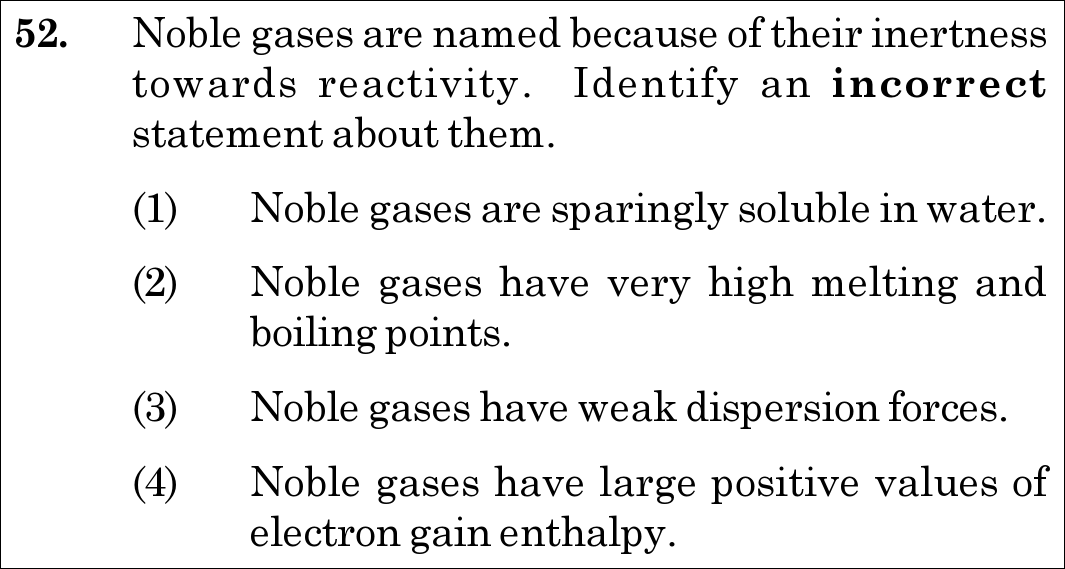
1 Noble gases are sparingly soluble in water.
2 Noble gases have very high melting and boiling points. ✓ Key
3 Noble gases have weak dispersion forces.
4 Noble gases have large positive values of electron gain enthalpy.
💡 Verified Solution & 30-Second Hack
✓
Verified Against NTA Final Answer Key
Option (2) : Noble gases have very high melting and boiling points.
📚 The p-Block Elements Easy
📋 Given Parameters & Problem Setup
Chemical Family Group 18 (Noble Gases: He, Ne, Ar, Kr, Xe, Rn)
Question Objective Identify the INCORRECT statement
⚡

The 30-Second Exam Hall Shortcut: ⚡ London Forces = Very Low Boiling Points!

⏱️ Save ~20 seconds

Noble gases are monoatomic with completely filled valence octets. The only intermolecular forces operating between them are extremely weak London dispersion forces. Hence, noble gases have extraordinarily LOW melting and boiling points (Helium boils at 4.2 K, the lowest of any substance)! Statement (2) claiming "very high" is completely false! Match Option (2)!

1 Check Statement (1): Noble gases are non-polar and dissolve sparingly in water via dipole-induced dipole interactions -> True.
2 Check Statement (2): Claims "very high melting and boiling points". But monoatomic noble gases have the LOWEST boiling points in the periodic table -> False (Incorrect statement).
3 Check Statement (3): Monoatomic noble gas atoms interact solely via weak dispersion forces -> True.
4 Check Statement (4): Noble gases have stable closed-shell ns2np6ns^2 np^6 configurations; adding an extra electron requires entering a higher principal shell, giving large positive electron gain enthalpies -> True.
5 Match Option (2).
🛡️
Why You Can 100% Trust This Shortcut: Canonical NCERT Group 18 Elements physical properties.
📐

Step-by-Step Rigorous Workflow & Mathematical Proof

Step 1

Analyzing Interatomic Forces in Noble Gases

Noble gases (Group 18) are monoatomic gases with stable closed-shell electronic configurations (ns2np6ns^2 np^6, except He which has 1s21s^2). Because they possess neither permanent electric dipole moments nor covalent bonds between atoms, the only attractive forces holding them together in condensed states are exceedingly weak London dispersion forces (induced dipole - induced dipole interactions).

Step 2

Evaluating Melting and Boiling Points (Statement 2)

Owing to the weakness of dispersion forces, very little thermal energy is required to overcome these interactions. Consequently, noble gases have extremely low melting and boiling points. Helium has the lowest boiling point of any known element at 4.2 K4.2\text{ K} (−268.95∘C-268.95^\circ\text{C}). Therefore, Statement (2) asserting that noble gases have "very high melting and boiling points" is factually and scientifically incorrect.

Step 3

Verifying Statements (1), (3), and (4)

- Statement 1: Noble gases are sparingly soluble in water due to weak dipole-induced dipole forces with polar water molecules (True). - Statement 3: Interatomic forces are indeed weak dispersion forces (True). - Statement 4: Noble gases possess stable octets; accepting an electron into the next higher quantum shell requires substantial energy input, resulting in large positive electron gain enthalpy (ΔegH>0\Delta_{\text{eg}}H > 0) (True).

⭐

360° Option Elimination Engine Key Feature

Diagnose every choice: Know exactly why the right option works and why distractors fail.

4-Option Deep Scan
1 1
✗ Incorrect
Verdict & Scientific Reason:

This statement is scientifically true (dipole-induced dipole dissolution).

⚠️
Student Fallacy (Why candidates pick this trap): Thinking noble gases are completely insoluble.
2 2
✓ 100% Correct
Verdict & Scientific Reason:

This is the INCORRECT statement: noble gases have exceptionally low melting and boiling points.

💡
Why this is airtight: None; textbook periodic property recall.
3 3
✗ Incorrect
Verdict & Scientific Reason:

This statement is scientifically true (London dispersion forces predominate).

⚠️
Student Fallacy (Why candidates pick this trap): Assuming ionic or covalent lattice bonds exist in noble gases.
4 4
✗ Incorrect
Verdict & Scientific Reason:

This statement is scientifically true (closed octets resist electron addition).

⚠️
Student Fallacy (Why candidates pick this trap): Confusing positive electron gain enthalpy with negative electron affinity.
⚠️

NTA Trap Alert: Stable Configuration vs. High Boiling Point Fallacy

Students frequently confuse chemical stability (unreactive octet) with physical cohesive strength. A stable atom does NOT mean high boiling point! In fact, closed octets mean zero valence electrons available for chemical bonding, leading solely to weak dispersion forces and extremely LOW boiling points.

🛡️ How to avoid the -1 mark: Remember: Chemical inertness   ⟹  \implies monoatomic   ⟹  \implies weak London forces   ⟹  \implies LOWEST boiling points.
📖

Core NEET Syllabus Standard

NCERT Chemistry · The p-Block Elements Standard Benchmark
Core Scientific Principle Tested:

"Noble gases have very low melting and boiling points because the only interatomic interactions are weak dispersion forces."

Syllabus Focus: Group 18 Elements (Noble Gases - Physical Properties)
✓ Core NEET UG Syllabus Anchor Syllabus & Academic Standards ↗
NEET 2021 · Q61 Easy
Official NEET 2021 Question 61 - The p-Block Elements
1 ✓ Key
2
3
4
💡 Verified Solution & 30-Second Hack
✓
Verified Against NTA Final Answer Key
Option (1) : Both Statement I and Statement II are true.
📚 The p-Block Elements Easy
📋 Given Parameters & Problem Setup
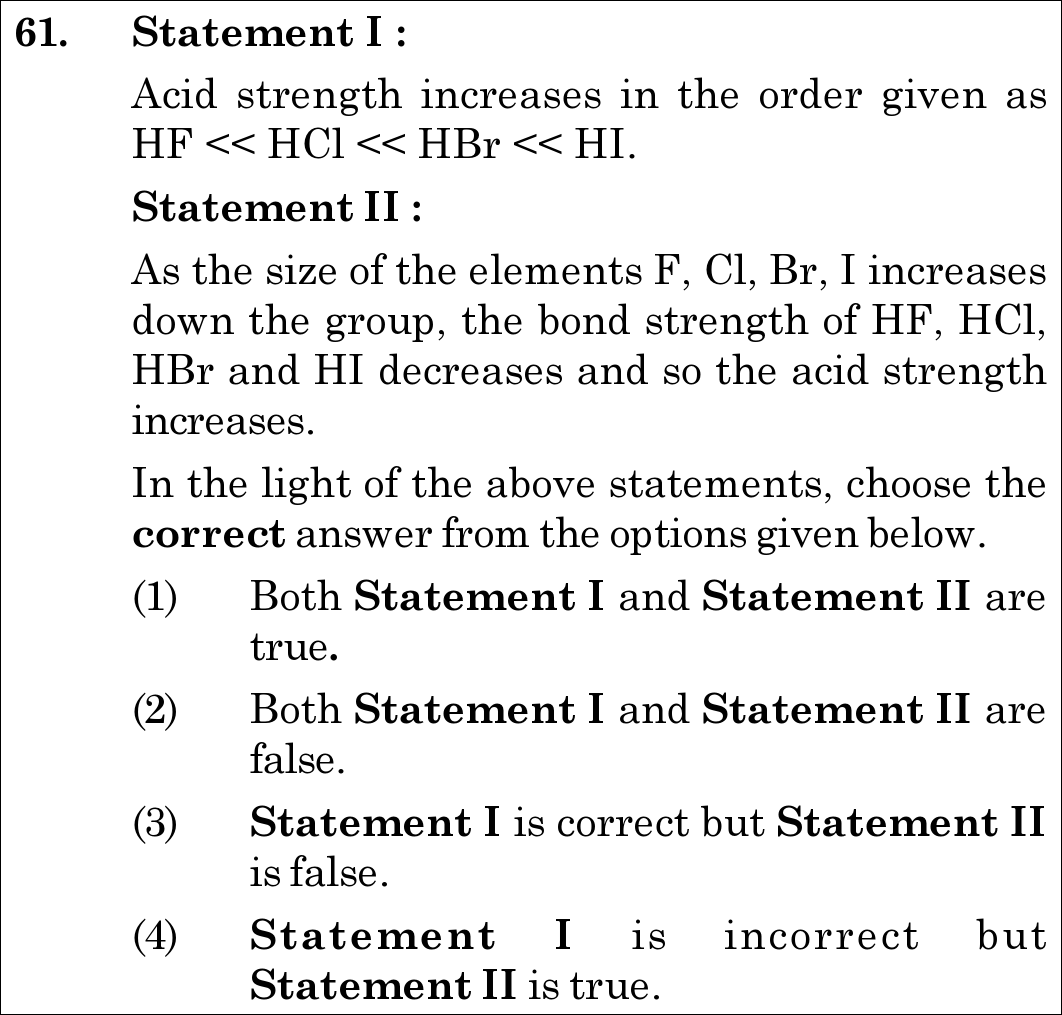
Statement I Acid strength increases in the order given as HF << HCl << HBr << HI.
Statement II As the size of the elements F, Cl, Br, I increases down the group, the bond strength of HF, HCl, HBr and HI decreases and so the acid strength increases.
⚡

The 30-Second Exam Hall Shortcut: ⚡ Acid Strength: HI is Strongest because H-I Bond is Weakest!

⏱️ Save ~20 seconds

Down Group 17, atomic radius increases (F<Cl<Br<IF < Cl < Br < I), so H−XH-X bond length increases and bond dissociation enthalpy drastically decreases (HF>HCl>HBr>HIHF > HCl > HBr > HI). A weaker bond releases H+H^+ most readily in water! Thus, acid strength increases (HF≪HCl≪HBr≪HIHF \ll HCl \ll HBr \ll HI). Both statements are completely true! Match Option (1)!

1 Check Statement I: Acid strength order is HF≪HCl<HBr<HIHF \ll HCl < HBr < HI (HF is weak acid, HI is strongest) -> True.
2 Check Statement II: Atomic size increases down the group (F→IF \to I), decreasing H−XH-X bond dissociation energy, which directly enhances proton donation and acidic strength -> True.
3 Both statements are true.
4 Match Option (1).
🛡️
Why You Can 100% Trust This Shortcut: Canonical NCERT Group 17 Elements trends in hydrides.
📐

Step-by-Step Rigorous Workflow & Mathematical Proof

Step 1

Evaluating Statement I: Order of Acidic Strength of Hydrogen Halides

Hydrogen halides in aqueous solution dissociate to produce hydronium ions and halide ions: HX+H2O⇌H3O++X−HX + H_2O \rightleftharpoons H_3O^+ + X^-. Their experimental acid dissociation constants (KaK_a) and pKapK_a values demonstrate that HFHF is a weak acid (pKa≈3.2pK_a \approx 3.2), whereas HClHCl (pKa≈−7pK_a \approx -7), HBrHBr (pKa≈−9pK_a \approx -9), and HIHI (pKa≈−10pK_a \approx -10) are strong acids:

HF≪HCl<HBr<HI  ⟹  Statement I is TRUEHF \ll HCl < HBr < HI \implies \mathbf{\text{Statement I is TRUE}}
Step 2

Evaluating Statement II: Periodic Trend in Bond Dissociation Enthalpy

As we descend Group 17 from Fluorine to Iodine, the atomic radius increases significantly (F:72 pm→I:133 pmF: 72\text{ pm} \to I: 133\text{ pm}). The overlap between the small 1s1s orbital of hydrogen and the increasingly diffuse valence pp orbitals of halogen weakens dramatically. The H−XH-X bond length increases and the bond dissociation enthalpy decreases sharply:

ΔdissH(kJ/mol):HF(574)>HCl(432)>HBr(366)>HI(295)\Delta_{\text{diss}}H (\text{kJ/mol}): \quad HF (574) > HCl (432) > HBr (366) > HI (295)
Step 3

Connecting Bond Strength to Acid Strength

Because the H−IH-I bond is the longest and weakest, it cleaves most readily to furnish H+H^+ ions in solution. Hence, the decrease in bond strength is the primary physical driving force behind the increase in acid strength. Statement II is scientifically true and correctly explains Statement I.

⭐

360° Option Elimination Engine Key Feature

Diagnose every choice: Know exactly why the right option works and why distractors fail.

4-Option Deep Scan
1 1
✓ 100% Correct
Verdict & Scientific Reason:

Both statements are indisputable textbook truths; Statement II provides the fundamental physical reason for Statement I.

💡
Why this is airtight: None; rigorous periodic trend knowledge.
2 2
✗ Incorrect
Verdict & Scientific Reason:

Both statements are fully verified and true.

⚠️
Student Fallacy (Why candidates pick this trap): Doubting the well-known acid strength order of halogen acids.
3 3
✗ Incorrect
Verdict & Scientific Reason:

Statement II accurately reflects the bond dissociation enthalpy decrease down the group.

⚠️
Student Fallacy (Why candidates pick this trap): Thinking electronegativity dictates acid strength instead of bond strength.
4 4
✗ Incorrect
Verdict & Scientific Reason:

Statement I is a verified experimental fact.

⚠️
Student Fallacy (Why candidates pick this trap): Assuming HF is the strongest acid due to high electronegativity.
⚠️

NTA Trap Alert: Electronegativity vs. Bond Dissociation Energy Trap

Students frequently think: "Fluorine is the most electronegative element, so H-F must be the most polar and hence the strongest acid". In hydrogen halides, bond dissociation enthalpy (bond strength) heavily outweighs electronegativity differences. The very high bond strength of H−FH-F (574 kJ/mol574\text{ kJ/mol}) prevents its ionization, making HFHF the weakest acid.

🛡️ How to avoid the -1 mark: Acid strength of binary hydrides in a GROUP is governed by BOND DISSOCIATION ENTHALPY, NOT electronegativity!
📖

Core NEET Syllabus Standard

NCERT Chemistry · The p-Block Elements Standard Benchmark
Core Scientific Principle Tested:

"The stability of the haloacids decreases down the group due to decrease in bond dissociation enthalpy; consequently, acidic strength increases: HF < HCl < HBr < HI."

Syllabus Focus: Group 17 Elements (Hydrides of Halogens)
✓ Core NEET UG Syllabus Anchor Syllabus & Academic Standards ↗
NEET 2021 · Q91 Medium
Official NEET 2021 Question 91 - The p-Block Elements
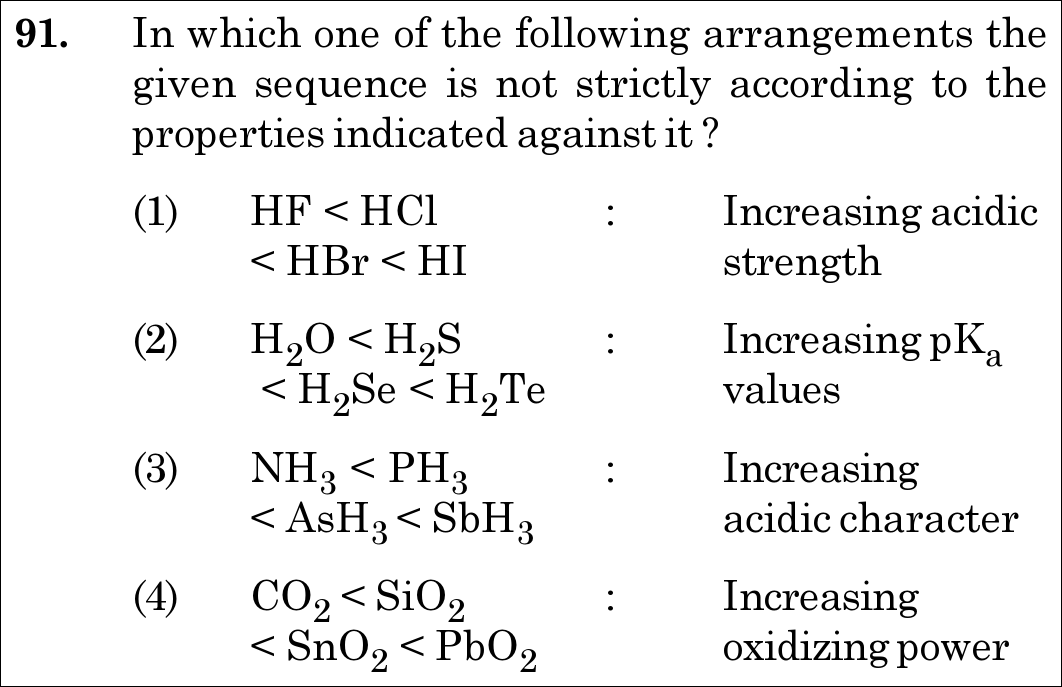
1 HF < HCl: Increasing acidic < HBr < HI strength
2 H2O < H2S: Increasing pKa < H2Se < H2Te values ✓ Key
3 NH3 < PH3: Increasing < AsH3 < SbH3 acidic character
4 CO2 < SiO2: Increasing < SnO2 < PbO2 oxidizing power
💡 Verified Solution & 30-Second Hack
✓
Verified Against NTA Final Answer Key
Option (2) : H2O < H2S < H2Se < H2Te : Increasing pKa values
📚 The p-Block Elements Medium
📋 Given Parameters & Problem Setup
Target Arrangement NOT strictly according to indicated property
⚡

The 30-Second Exam Hall Shortcut: ⚡ Acidic Strength Increases   ⟹  \implies Ka Increases   ⟹  \implies pKa Decreases!

⏱️ Save ~25 seconds

Down Group 16, E−HE-H bond dissociation enthalpy decreases rapidly (H2O>H2S>H2Se>H2TeH_2O > H_2S > H_2Se > H_2Te), making proton release easier: acidic strength INCREASES (H2O<H2S<H2Se<H2TeH_2O < H_2S < H_2Se < H_2Te). Because KaK_a increases, pKa=−log⁡KapK_a = -\log K_a must DECREASE! Therefore, H2O<H2S<H2Se<H2TeH_2O < H_2S < H_2Se < H_2Te represents DECREASING pKapK_a, NOT increasing pKapK_a! Match Option (2)!

1 Check arrangement (1): HF<HCl<HBr<HIHF < HCl < HBr < HI   ⟹  \implies Acidic strength increases down Group 17 (Correct).
2 Check arrangement (2): Down Group 16, acidic strength increases (H2O<H2S<H2Se<H2TeH_2O < H_2S < H_2Se < H_2Te). Since KaK_a increases, pKapK_a values DECREASE (pKa:14.0>7.0>3.89>2.6pK_a: 14.0 > 7.0 > 3.89 > 2.6). Claiming "increasing pKapK_a" is inverted (Incorrect sequence!).
3 Check arrangement (3): NH3<PH3<AsH3<SbH3NH_3 < PH_3 < AsH_3 < SbH_3   ⟹  \implies Increasing acidic character down Group 15 (Correct).
4 Check arrangement (4): CO2<SiO2<SnO2<PbO2CO_2 < SiO_2 < SnO_2 < PbO_2   ⟹  \implies Increasing oxidizing power of +4+4 dioxides due to inert pair effect (Correct).
5 Match Option (2).
🛡️
Why You Can 100% Trust This Shortcut: Canonical NCERT p-Block Elements Group 16 hydrides physical and chemical properties.
📐

Step-by-Step Rigorous Workflow & Mathematical Proof

Step 1

Analyzing Group 16 Hydride Acidic Behavior and pKa

For Group 16 hydrides (H2O,H2S,H2Se,H2TeH_2O, H_2S, H_2Se, H_2Te), the size of the central element EE increases down the group (O<S<Se<TeO < S < Se < Te), leading to longer E−HE-H bonds and decreasing E−HE-H bond dissociation enthalpies: H2O(463 kJ/mol)>H2S(347 kJ/mol)>H2Se(276 kJ/mol)>H2Te(238 kJ/mol)H_2O (463\text{ kJ/mol}) > H_2S (347\text{ kJ/mol}) > H_2Se (276\text{ kJ/mol}) > H_2Te (238\text{ kJ/mol}) Consequently, ease of proton release increases down the group, so acidic strength increases: Acidic Strength: H2O<H2S<H2Se<H2Te  ⟹  Ka(H2O)<Ka(H2S)<Ka(H2Se)<Ka(H2Te)\text{Acidic Strength: } H_2O < H_2S < H_2Se < H_2Te \implies K_a(H_2O) < K_a(H_2S) < K_a(H_2Se) < K_a(H_2Te)

Step 2

Relating Ka to pKa

Because pKa=−log⁡10KapK_a = -\log_{10} K_a, an increase in acid dissociation constant KaK_a strictly corresponds to a decrease in pKapK_a: - pKa(H2O)≈14.0pK_a(H_2O) \approx 14.0 (or 15.7415.74 auto-ionization) - pKa(H2S)≈7.0pK_a(H_2S) \approx 7.0 - pKa(H2Se)≈3.89pK_a(H_2Se) \approx 3.89 - pKa(H2Te)≈2.6pK_a(H_2Te) \approx 2.6 Thus, the sequence H2O<H2S<H2Se<H2TeH_2O < H_2S < H_2Se < H_2Te is the order of DECREASING pKa, making the label "Increasing pKapK_a values" false.

pKa(H2O)>pKa(H2S)>pKa(H2Se)>pKa(H2Te)(Decreasing pKa)pK_a(H_2O) > pK_a(H_2S) > pK_a(H_2Se) > pK_a(H_2Te) \quad (\mathbf{\text{Decreasing } pK_a})
Step 3

Verifying Other Sequences

- Option (1): HF<HCl<HBr<HIHF < HCl < HBr < HI correctly follows decreasing H−XH-X bond dissociation enthalpy, increasing acidic strength. - Option (3): NH3<PH3<AsH3<SbH3NH_3 < PH_3 < AsH_3 < SbH_3 correctly reflects decreasing E−HE-H bond stability, increasing acidic character. - Option (4): In Group 14, due to the inert pair effect, the stability of the +2+2 state increases relative to +4+4 down the column (Pb2+>Pb4+Pb^{2+} > Pb^{4+}). Thus, PbO2PbO_2 readily accepts electrons to reduce to Pb2+Pb^{2+}, functioning as a powerful oxidizing agent.

⭐

360° Option Elimination Engine Key Feature

Diagnose every choice: Know exactly why the right option works and why distractors fail.

4-Option Deep Scan
1 1
✗ Incorrect
Verdict & Scientific Reason:

This sequence is completely correct according to the indicated property.

⚠️
Student Fallacy (Why candidates pick this trap): Assuming HF is stronger acid due to high electronegativity.
2 2
✓ 100% Correct
Verdict & Scientific Reason:

NOT strictly according to indicated property: acidic strength increases, so pKapK_a DECREASES, not increases.

💡
Why this is airtight: None; rigorous KaK_a versus pKapK_a logarithmic inverse discrimination.
3 3
✗ Incorrect
Verdict & Scientific Reason:

This sequence is correct according to decreasing E−HE-H bond enthalpy.

⚠️
Student Fallacy (Why candidates pick this trap): Assuming NH3NH_3 is basic so other hydrides cannot be compared.
4 4
✗ Incorrect
Verdict & Scientific Reason:

This sequence is correct due to the inert pair effect favoring Pb(II)Pb(II) over Pb(IV)Pb(IV).

⚠️
Student Fallacy (Why candidates pick this trap): Assuming lighter group oxides are stronger oxidizing agents.
⚠️

NTA Trap Alert: Ka vs. pKa Inversion Trap

Students often read "pKa" and mentally process it as "acidic strength". Stronger acids have HIGHER KaK_a but LOWER pKapK_a. Because H2TeH_2Te is the strongest acid in the group, it has the LOWEST pKapK_a. The sequence H2O<H2S<H2Se<H2TeH_2O < H_2S < H_2Se < H_2Te is INCREASING acidic strength, but DECREASING pKapK_a.

🛡️ How to avoid the -1 mark: Remember: ↑\uparrow Acidic strength   ⟹  ↑Ka  ⟹  ↓pKa\implies \uparrow K_a \implies \downarrow pK_a.
📖

Core NEET Syllabus Standard

NCERT Chemistry · The p-Block Elements Standard Benchmark
Core Scientific Principle Tested:

"The acidic character of Group 16 hydrides increases down the group from H2O to H2Te, meaning Ka increases and pKa decreases."

Syllabus Focus: Group 16 Elements (Hydrides - Trends in Acidic Character)
✓ Core NEET UG Syllabus Anchor Syllabus & Academic Standards ↗
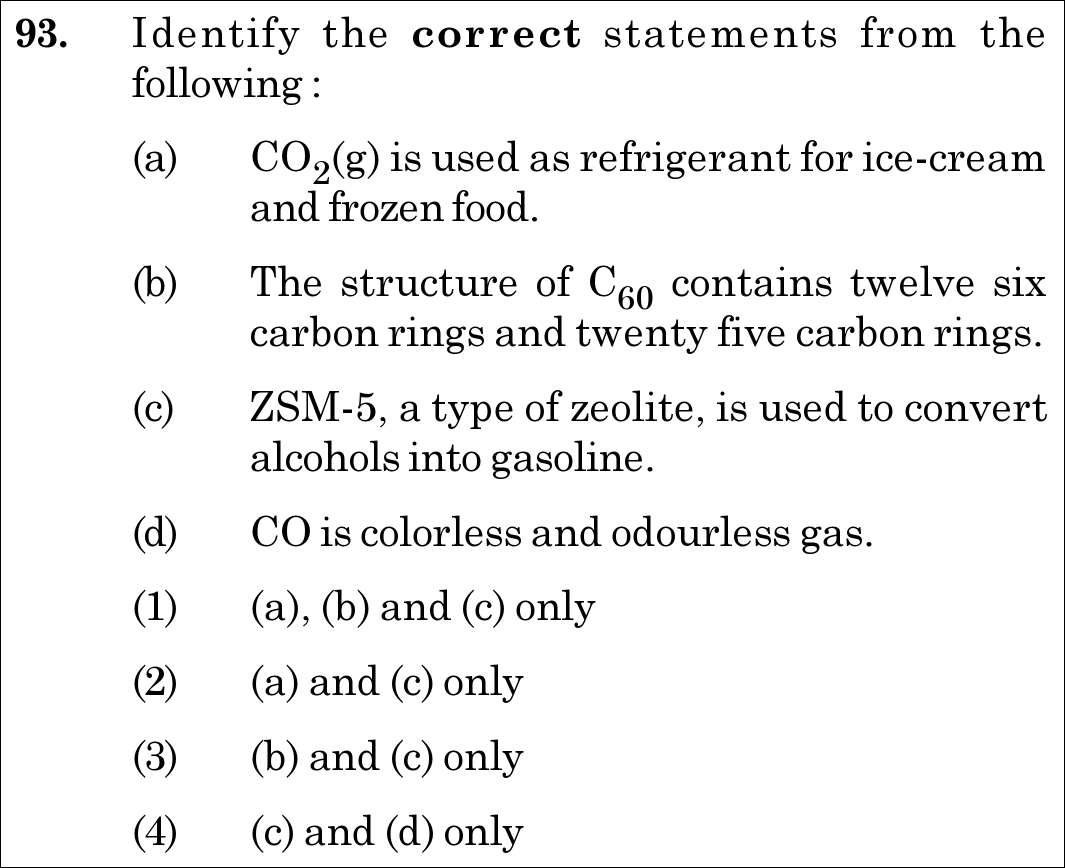
NEET 2020 · Q93 Medium
Official NEET 2020 Question 93 - The p-Block Elements
1 (a), (b) and (c) only
2 (a) and (c) only
3 (b) and (c) only
4 (c) and (d) only ✓ Key
💡 Verified Solution & 30-Second Hack
✓
Verified Against NTA Final Answer Key
Option (4) : (c) and (d) only
📚 The p-Block Elements (Group 14) Medium
📋 Given Parameters & Problem Setup
Statement (a) CO2(g) is used as refrigerant for ice-cream and frozen food
Statement (b) Structure of C60 contains 12 six-carbon rings and 20 five-carbon rings
Statement (c) ZSM-5, a type of zeolite, is used to convert alcohols into gasoline
Statement (d) CO is colorless and odourless gas
Question Objective Identify which statements are factually CORRECT
⚡

The 30-Second Exam Hall Shortcut: ⚡ "Dry Ice (SOLID CO2) is Refrigerant; C60 has 20 Six-Rings & 12 Five-Rings! (c) & (d) are True!"

⏱️ 30 seconds

Statement (a) is false because SOLID CO2 (dry ice), not gaseous CO2(g), is used as a refrigerant. Statement (b) is false because C60 contains TWENTY six-membered rings and TWELVE five-membered rings (the numbers are reversed!). Statements (c) and (d) are textbook true. Thus, (c) and (d) only (Option 4)!

1 Check (a): SOLID CO2 (dry ice) is the refrigerant, not CO2(g) -> (a) is FALSE.
2 Check (b): C60 fullerene has 20 six-membered rings and 12 five-membered rings -> (b) is FALSE (swapped!).
3 Check (c): ZSM-5 zeolite converts alcohols directly into gasoline -> (c) is TRUE.
4 Check (d): Carbon monoxide is a neutral, colorless, and odourless gas -> (d) is TRUE.
5 Correct statements: (c) and (d) only -> Option 4.
🛡️
Why You Can 100% Trust This Shortcut: NCERT Chemistry · The p-Block Elements (Group 14: Oxides of Carbon & Fullerenes)
📐

Step-by-Step Rigorous Workflow & Mathematical Proof

Step 1

Evaluate Statement (a): Refrigerant Use of CO2

SOLID carbon dioxide (dry ice) sublimes directly at −78.5∘C-78.5^\circ\text{C} without melting into liquid, making it ideal as a refrigerant for ice cream and frozen food. Statement (a) specifically claims "CO2(g)\text{CO}_2\text{(g)}" (gaseous carbon dioxide) is used as the refrigerant, which is technically incorrect.

Step 2

Evaluate Statement (b): Ring Topology of Buckminsterfullerene C60

Buckminsterfullerene (C60C_{60}) has a soccer-ball shape containing 60 carbon vertices. It consists of exactly TWENTY 6-membered hexagonal rings and TWELVE 5-membered pentagonal rings. Statement (b) deliberately inverts these numbers ("twelve six-carbon rings and twenty five-carbon rings"), making it blatantly false.

Step 3

Evaluate Statement (c): Shape-Selective Catalysis by ZSM-5

ZSM-5 (Zeolite Socony Mobil-5) is a microporous aluminosilicate shape-selective catalyst used in the petroleum industry to dehydrate alcohols directly into synthetic gasoline/petrol hydrocarbons (Alcohols→ZSM-5Gasoline\text{Alcohols} \xrightarrow{\text{ZSM-5}} \text{Gasoline}). This statement is completely accurate.

Step 4

Evaluate Statement (d): Physical Properties of CO

Carbon monoxide (CO\text{CO}) is a colorless, odorless, and virtually water-insoluble toxic gas formed by incomplete combustion of carbon. This statement is factually true.

Step 5

Synthesize True Statements

Only statements (c) and (d) are correct, corresponding to Option 4.

⭐

360° Option Elimination Engine Key Feature

Diagnose every choice: Know exactly why the right option works and why distractors fail.

4-Option Deep Scan
1 A
✗ Incorrect
Verdict & Scientific Reason:

Incorrect; statements (a) and (b) are both factually false.

⚠️
Student Fallacy (Why candidates pick this trap): Failing to catch that solid CO2 is needed for refrigerant and ring numbers in C60 are reversed.
2 B
✗ Incorrect
Verdict & Scientific Reason:

Incorrect; statement (a) states CO2(g) rather than dry ice (solid CO2).

⚠️
Student Fallacy (Why candidates pick this trap): Overlooking the physical state "(g)" in CO2(g).
3 C
✗ Incorrect
Verdict & Scientific Reason:

Incorrect; statement (b) has the pentagon and hexagon counts inverted.

⚠️
Student Fallacy (Why candidates pick this trap): Flipping 20 hexagons and 12 pentagons in C60 fullerene.
4 D
✓ 100% Correct
Verdict & Scientific Reason:

Factually exact; ZSM-5 converts alcohols to gasoline, and CO is a colorless and odorless gas.

💡
Why this is airtight: None; rigorous precision across inorganic chemistry concepts.
⚠️

NTA Trap Alert: Fullerene C60 Ring Numbers & Dry Ice Physical State

C60 has: 20 HEXAGONS (6-membered) and 12 PENTAGONS (5-membered). Dry ice = SOLID CO2, not CO2 gas!

🛡️ How to avoid the -1 mark: Mnemonic: "20 Sixes, 12 Fives" (Hexagons are always more numerous in fullerenes!).
📖

Core NEET Syllabus Standard

Chemistry · The p-Block Elements Standard Benchmark
Core Scientific Principle Tested:

""

Syllabus Focus: Allotropes and Compounds of Carbon: Dry Ice, Fullerenes, Zeolites & Carbon Monoxide
✓ Core NEET UG Syllabus Anchor Syllabus & Academic Standards ↗
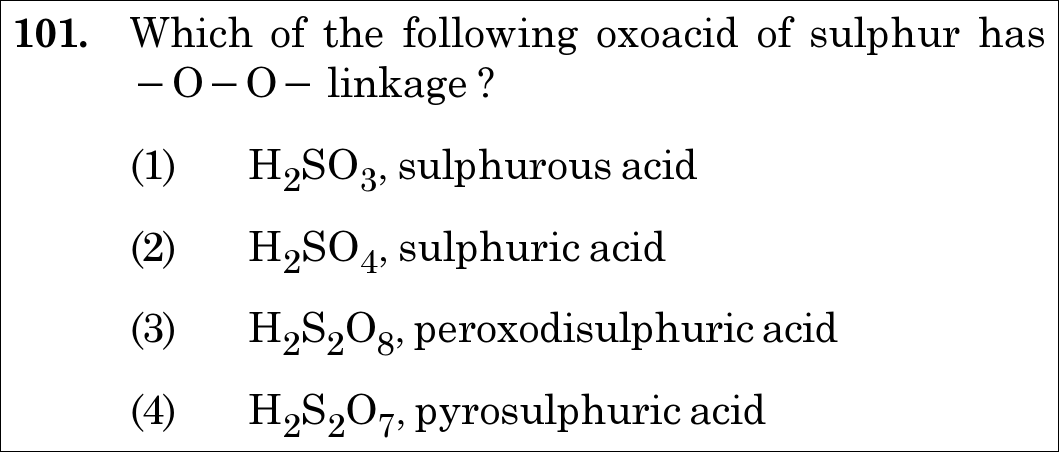
NEET 2020 · Q101 Easy
Official NEET 2020 Question 101 - The p-Block Elements
1
2
3 ✓ Key
4
💡 Verified Solution & 30-Second Hack
✓
Verified Against NTA Final Answer Key
Option (3) : H2S2O8, peroxodisulphuric acid
📚 The p-Block Elements (Group 16) Easy
📋 Given Parameters & Problem Setup
Structural Motif Peroxide linkage (-O-O- bond)
Chemical Family Oxoacids of sulphur
Candidate Compounds H2SO3, H2SO4, H2S2O8, H2S2O7
⚡

The 30-Second Exam Hall Shortcut: ⚡ "PEROXO-disulphuric Acid (H2S2O8, Marshall's Acid) Contains -O-O- Linkage!"

⏱️ 20 seconds

The name itself gives it away: "PEROXO"-disulphuric acid (H2S2O8H_2S_2O_8, Marshall's acid) contains a peroxy bridge (HO3S−O−O−SO3HHO_3S-O-O-SO_3H) between the two sulphur atoms! Pyrosulphuric acid (H2S2O7H_2S_2O_7, oleum) contains an -S-O-S- bridge. Mark H2S2O8 (Option 3) in 5 seconds!

1 Check prefix: "Peroxo" denotes the presence of a peroxide linkage (-O-O-).
2 Formula of Marshall's acid = H2S2O8 (Peroxodisulphuric acid).
3 Structure: HO-SO2-O-O-SO2-OH (contains one -O-O- bond).
4 H2S2O7 (oleum) has S-O-S bond; H2SO4 has no peroxy bond; H2SO3 has S=O, S-OH.
5 Select Option (3) H2S2O8, peroxodisulphuric acid.
🛡️
Why You Can 100% Trust This Shortcut: NCERT Chemistry · The p-Block Elements (Group 16: Oxoacids of Sulphur)
📐

Step-by-Step Rigorous Workflow & Mathematical Proof

Step 1

Analyze Chemical Structures of Sulphur Oxoacids

Sulphur forms several oxoacids where sulphur exhibits tetrahedral coordination with oxygen: 1. Sulphurous acid (H2SO3\text{H}_2\text{SO}_3): Contains one S=O\text{S}=\text{O}, two S−OH\text{S}-\text{OH}, and one lone pair (oxidation state +4). 2. Sulphuric acid (H2SO4\text{H}_2\text{SO}_4): Contains two S=O\text{S}=\text{O} and two S−OH\text{S}-\text{OH} bonds (oxidation state +6).

Step 2

Analyze Pyrosulphuric Acid (Oleum, H2S2O7)

Pyrosulphuric acid (H2S2O7\text{H}_2\text{S}_2\text{O}_7) contains two SO3H\text{SO}_3\text{H} groups linked through a single oxygen bridge: HO−SO2−O−SO2−OH\text{HO}-\text{SO}_2-\text{O}-\text{SO}_2-\text{OH}. It has an S−O−S\text{S}-\text{O}-\text{S} linkage, NOT a peroxide linkage.

Step 3

Analyze Peroxodisulphuric Acid (H2S2O8)

Peroxodisulphuric acid (Marshall's acid, H2S2O8\text{H}_2\text{S}_2\text{O}_8) is formed by joining two sulphuric acid moieties through a peroxy (peroxide) bridge: HO−SO2−O−O−SO2−OH\text{HO}-\text{SO}_2-\text{O}-\text{O}-\text{SO}_2-\text{OH} The two central oxygen atoms are covalently linked by an -O-O-\text{-O-O-} single bond, each having an oxidation state of −1-1, allowing both sulphur atoms to retain the maximum +6 oxidation state.

Step 4

Conclude Correct Option

Therefore, H2S2O8\text{H}_2\text{S}_2\text{O}_8 uniquely possesses the -O-O-\text{-O-O-} peroxide linkage.

⭐

360° Option Elimination Engine Key Feature

Diagnose every choice: Know exactly why the right option works and why distractors fail.

4-Option Deep Scan
1 A
✗ Incorrect
Verdict & Scientific Reason:

Incorrect; sulphurous acid contains only S=O and S-OH bonds without any peroxy linkage.

⚠️
Student Fallacy (Why candidates pick this trap): Random choice.
2 B
✗ Incorrect
Verdict & Scientific Reason:

Incorrect; sulphuric acid contains two S=O and two S-OH bonds, no peroxy linkage.

⚠️
Student Fallacy (Why candidates pick this trap): Confusing standard oxoacid with peroxoacid.
3 C
✓ 100% Correct
Verdict & Scientific Reason:

Factually and structurally exact; Marshall's acid (H2S2O8H_2S_2O_8) contains a central peroxy -O-O-\text{-O-O-} linkage.

💡
Why this is airtight: None; famous oxoacid structure.
4 D
✗ Incorrect
Verdict & Scientific Reason:

Incorrect; pyrosulphuric acid (oleum) contains an S−O−S\text{S}-\text{O}-\text{S} bridging linkage, not an -O-O-\text{-O-O-} linkage.

⚠️
Student Fallacy (Why candidates pick this trap): Confusing pyrosulphuric acid (H2S2O7H_2S_2O_7, S-O-S) with peroxodisulphuric acid (H2S2O8H_2S_2O_8, S-O-O-S).
⚠️

NTA Trap Alert: Oleum (H2S2O7) vs Marshall's Acid (H2S2O8)

- H2S2O7H_2S_2O_7 (Pyrosulphuric acid / Oleum) has an S-O-S linkage. - H2S2O8H_2S_2O_8 (Peroxodisulphuric acid / Marshall's acid) has an -O-O- (peroxy) linkage.

🛡️ How to avoid the -1 mark: Look at the oxygen count: 7 oxygens = S-O-S; 8 oxygens = S-O-O-S (Peroxy)!
📖

Core NEET Syllabus Standard

Chemistry · The p-Block Elements Standard Benchmark
Core Scientific Principle Tested:

""

Syllabus Focus: Oxoacids of Sulphur: Peroxide Linkage (-O-O-) in Peroxodisulphuric Acid (H2S2O8)
✓ Core NEET UG Syllabus Anchor Syllabus & Academic Standards ↗
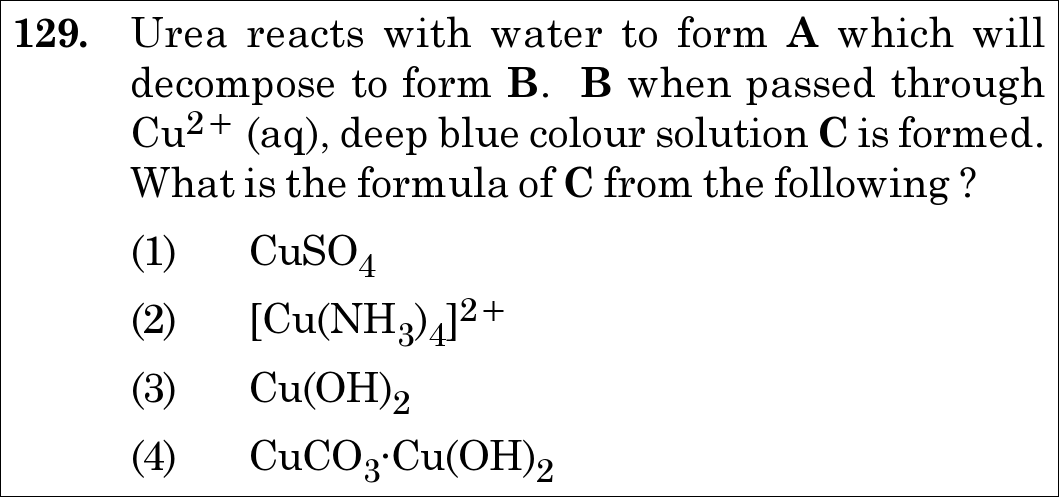
NEET 2020 · Q129 Easy
Official NEET 2020 Question 129 - The p-Block Elements
1
2 ✓ Key
3
4
💡 Verified Solution & 30-Second Hack
✓
Verified Against NTA Final Answer Key
Option (2) : [Cu(NH3)4]2+
📚 The p-Block Elements (Group 15) Easy
📋 Given Parameters & Problem Setup
Step 1 Reactant Urea (NH2CONH2) + H2O -> A
Step 2 Decomposition A decomposes to form B (Ammonia gas)
Step 3 Complexation B passed through Cu2+(aq) -> Deep blue solution C
Question Objective Identify the chemical formula of compound C
⚡

The 30-Second Exam Hall Shortcut: ⚡ "Urea -> (NH4)2CO3 -> NH3; Cu2+ + 4NH3 -> [Cu(NH3)4]2+ (Deep Blue Solution)!"

⏱️ 20 seconds

Urea on hydrolysis forms ammonium carbonate (A=(NH4)2CO3A = (NH_4)_2CO_3), which decomposes to release ammonia gas (B=NH3B = NH_3). When NH3NH_3 is passed through aqueous Cu2+Cu^{2+}, it forms the classic deep blue coordination complex ion [Cu(NH3)4]2+[Cu(NH_3)_4]^{2+} (tetraamminecopper(II) cation)! Mark [Cu(NH3)4]2+ (Option 2) in 5 seconds.

1 Hydrolysis of urea: NH2CONH2 + 2H2O -> (NH4)2CO3 (Compound A).
2 Decomposition of A: (NH4)2CO3 -> 2NH3 + H2O + CO2 (Gas B is NH3).
3 Complexation: Cu2+ (aq) + 4NH3 (aq) -> [Cu(NH3)4]2+ (aq) (Deep blue solution C).
4 Match with Option (2) [Cu(NH3)4]2+.
🛡️
Why You Can 100% Trust This Shortcut: NCERT Chemistry · The p-Block Elements (Group 15: Ammonia - Preparation and Complex Formation)
📐

Step-by-Step Rigorous Workflow & Mathematical Proof

Step 1

Hydrolysis of Urea to Ammonium Carbonate (A)

On a small scale, ammonia is prepared from urea. Urea reacts with water to form ammonium carbonate (AA): NH2CONH2+2H2O→(NH4)2CO3 (Compound A)\text{NH}_2\text{CONH}_2 + 2\text{H}_2\text{O} \to (\text{NH}_4)_2\text{CO}_3 \text{ (Compound A)}

Step 2

Thermal Decomposition of Compound A to Gas B

Ammonium carbonate is unstable and readily decomposes into ammonia, water, and carbon dioxide: (NH4)2CO3⇌2NH3 (Gas B)+H2O+CO2(\text{NH}_4)_2\text{CO}_3 \rightleftharpoons 2\text{NH}_3\text{ (Gas B)} + \text{H}_2\text{O} + \text{CO}_2 Thus, component BB is ammonia (NH3\text{NH}_3).

Step 3

Complex Formation with Aqueous Cu2+

Due to the presence of a lone pair of electrons on the nitrogen atom, ammonia acts as a Lewis base and donates electron pairs to transition metal cations to form coordination complexes. When ammonia solution is added to pale blue aqueous copper sulphate, it initially precipitates pale blue Cu(OH)2\text{Cu(OH)}_2, which dissolves in excess ammonia to form an intense DEEP BLUE solution (CC): Cu2+(aq, pale blue)+4NH3(aq)⇌[Cu(NH3)4]2+(aq, deep blue)\text{Cu}^{2+} \text{(aq, pale blue)} + 4\text{NH}_3 \text{(aq)} \rightleftharpoons [\text{Cu}(\text{NH}_3)_4]^{2+} \text{(aq, deep blue)}

Step 4

Conclude Chemical Formula

The deep blue species CC is the tetraamminecopper(II) complex ion, [Cu(NH3)4]2+[\text{Cu}(\text{NH}_3)_4]^{2+}.

⭐

360° Option Elimination Engine Key Feature

Diagnose every choice: Know exactly why the right option works and why distractors fail.

4-Option Deep Scan
1 A
✗ Incorrect
Verdict & Scientific Reason:

Incorrect; copper sulphate solution is pale blue, not the intense deep blue ammine coordination complex.

⚠️
Student Fallacy (Why candidates pick this trap): Thinking of starting copper salt.
2 B
✓ 100% Correct
Verdict & Scientific Reason:

Factually and chemically exact; ammonia coordinates to copper(II) to form the deep blue square planar tetraamminecopper(II) complex ion.

💡
Why this is airtight: None; classic inorganic qualitative and p-block test.
3 C
✗ Incorrect
Verdict & Scientific Reason:

Incorrect; Cu(OH)2Cu(OH)_2 is an insoluble pale blue precipitate, which dissolves in excess ammonia to form the soluble deep blue complex.

⚠️
Student Fallacy (Why candidates pick this trap): Confusing transient precipitate with the final deep blue soluble complex.
4 D
✗ Incorrect
Verdict & Scientific Reason:

Incorrect; basic copper carbonate (malachite) is a green insoluble solid, not a deep blue solution.

⚠️
Student Fallacy (Why candidates pick this trap): Assuming carbonate ion from urea forms a precipitate with copper.
⚠️

NTA Trap Alert: Transient Precipitate vs Soluble Complex

Pale blue precipitate is Cu(OH)2Cu(OH)_2. DEEP BLUE solution in excess ammonia is the complex ion [Cu(NH3)4]2+[Cu(NH_3)_4]^{2+}!

🛡️ How to avoid the -1 mark: Deep blue solution with Cu2+Cu^{2+} and NH3NH_3 = [Cu(NH3)4]2+[Cu(NH_3)_4]^{2+}!
📖

Core NEET Syllabus Standard

Chemistry · The p-Block Elements Standard Benchmark
Core Scientific Principle Tested:

""

Syllabus Focus: Hydrolysis of Urea, Ammonia Formation and Deep Blue Tetraamminecopper(II) Complex
✓ Core NEET UG Syllabus Anchor Syllabus & Academic Standards ↗

Solve 4 NEET Questions a Day — One per Subject

Cover all 1,140 official NEET questions in 285 days at your own pace. Progress is saved on your device. No login needed.