MyCompetitiveExams Logo MyCompetitiveExams
Search 1,140+ Questions
Chapters, formulas, speed tricks
→
⚡ Brahmastra NEET 2027
720 MARKS

Dynamic 180-question full-length simulator mixed dynamically from all 6 years for 2027 & 2026 aspirants.

Launch Brahmastra 2027 Test →
Start Practice →
100% Free · No Login Required
🧪 Chemistry 🔥 High-Yield Core Topic (~3–4 Qs/Year)

NEET Aldehydes, Ketones and Carboxylic Acids Previous Year Questions with Solutions

Complete repository of official NTA NEET questions for Aldehydes, Ketones and Carboxylic Acids from 2020 to 2026. Every question includes 30-second elimination tricks, step-by-step NCERT solutions, option-by-option traps, and official answer keys.

19 Questions 6 Exam Years (2026, 2025, 2024, 2023, 2021, 2020) 11 Easy · 7 Medium · 1 Challenging
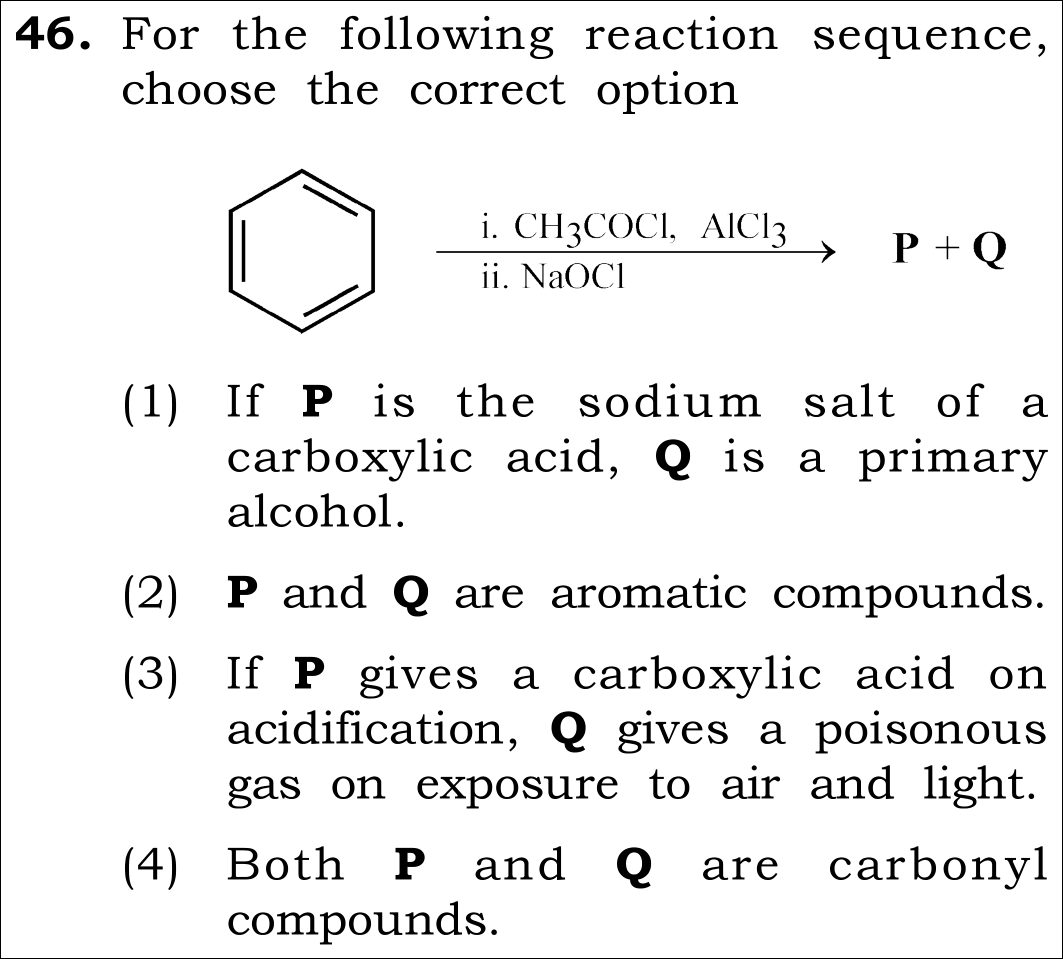
NEET 2026 · Q46 Medium
Official NEET 2026 Question 46 - Aldehydes, Ketones and Carboxylic Acids
1
2
3 ✓ Key
4
💡 Verified Solution & 30-Second Hack
✓
Verified Against NTA Final Answer Key
Option (3) : If P gives a carboxylic acid on acidification, Q gives a poisonous gas on exposure to air and light.
📚 Aldehydes, Ketones and Carboxylic Acids & Haloalkanes Medium
📋 Given Parameters & Problem Setup
Starting Material Benzene (C₆H₆)
Reagent (i) CH₃COCl + Anhydrous AlCl₃ (Friedel-Crafts Acylation)
Reagent (ii) NaOCl (Sodium Hypochlorite / Haloform reagent)
Products P (carboxylate salt) + Q (haloform)
⚡

The 30-Second Exam Hall Shortcut: ⚡ The Methyl Ketone + Hypochlorite Fingerprint

⏱️ Save ~95 seconds

Spot the tandem: Benzene + Acetyl Chloride = Acetophenone (a methyl ketone). NaOCl is the textbook Haloform reagent!

1 Identify Intermediate: Benzene + CH₃COCl/AlCl₃ → Acetophenone (Ph-CO-CH₃).
2 Recognize Haloform Reagent: NaOCl = Cl₂ + NaOH. It cleaves the methyl ketone group into Sodium Benzoate (P) and Chloroform (Q = CHCl₃).
3 Direct Link to Statement 3: Chloroform (CHCl₃) when exposed to air and sunlight oxidizes into deadly Phosgene gas (COCl₂)! P upon acidification gives Benzoic Acid.
4 Zero doubt: Pick Option (3) immediately in 15 seconds!
🛡️
Why You Can 100% Trust This Shortcut: In standard organic chemistry, NaOCl is the definitive chlorinating oxidizer for haloform cleavage. The conversion of chloroform into poisonous phosgene (COCl₂) under sunlight is an established canonical reaction.
📐

Step-by-Step Rigorous Workflow & Mathematical Proof

Step 1

Electrophilic Aromatic Substitution: Friedel-Crafts Acylation

Benzene reacts with acetyl chloride in the presence of anhydrous aluminium chloride (Lewis acid catalyst). An acylium ion (CH₃-C⁺=O) is generated, which attacks the benzene ring to yield acetophenone.

C6H6+CH3COCl→anh. AlCl3C6H5COCH3+HCl\text{C}_6\text{H}_6 + \text{CH}_3\text{COCl} \xrightarrow{\text{anh. AlCl}_3} \text{C}_6\text{H}_5\text{COCH}_3 + \text{HCl}
  • • Electrophile: CH₃-C⁺=O (resonance-stabilized acylium cation).
  • • Product: Acetophenone (methyl phenyl ketone).
Step 2

Haloform Reaction with Sodium Hypochlorite (NaOCl)

Acetophenone contains the characteristic -COCH₃ group attached to carbon. Sodium hypochlorite (NaOCl), an aqueous mixture of chlorine and sodium hydroxide, oxidizes and halogenates the methyl ketone. Tri-alpha chlorination occurs followed by hydroxide attack and cleavage of the C-C bond to yield Sodium Benzoate (P) and Chloroform (Q).

C6H5COCH3+3NaOCl→C6H5COONa(P)+CHCl3(Q)+2NaOH\text{C}_6\text{H}_5\text{COCH}_3 + 3\text{NaOCl} \to \text{C}_6\text{H}_5\text{COONa} (P) + \text{CHCl}_3 (Q) + 2\text{NaOH}
  • • Product P: Sodium benzoate (C₆H₅COONa).
  • • Product Q: Chloroform / trichloromethane (CHCl₃).
Step 3

Chemical Properties of P and Q (Acidification & Atmospheric Oxidation)

Acidification of sodium benzoate (P) yields Benzoic Acid (C₆H₅COOH). When chloroform (Q) is exposed to atmospheric oxygen in the presence of sunlight, it undergoes slow photochemical oxidation to form carbonyl chloride (Phosgene, COCl₂), an extremely poisonous gas.

2CHCl3+O2→light2COCl2 (Phosgene, poisonous)+2HCl2\text{CHCl}_3 + \text{O}_2 \xrightarrow{\text{light}} 2\text{COCl}_2\text{ (Phosgene, poisonous)} + 2\text{HCl}
  • • Acidification: C₆H₅COONa + H⁺ → C₆H₅COOH (Benzoic acid).
  • • Safety protocol in labs: Chloroform is stored in dark amber bottles filled to the brim with 1% ethanol added as a stabilizer.
⭐

360° Option Elimination Engine Key Feature

Diagnose every choice: Know exactly why the right option works and why distractors fail.

4-Option Deep Scan
1 A
✗ Incorrect
Verdict & Scientific Reason:

Completely false. P is sodium benzoate (C₇H₅O₂Na) and Q is chloroform (CHCl₃); their molecular weights and atom compositions are entirely different.

⚠️
Student Fallacy (Why candidates pick this trap): Confusing functional group cleavage with a rearrangement reaction.
2 B
✗ Incorrect
Verdict & Scientific Reason:

Incorrect. Neither an alcohol nor an ether is generated in haloform cleavage of a methyl ketone.

⚠️
Student Fallacy (Why candidates pick this trap): Assuming reduction or substitution rather than haloform cleavage.
3 C
✓ 100% Correct
Verdict & Scientific Reason:

Scientifically rigorous. P = Sodium benzoate (acidifies to Benzoic Acid) and Q = Chloroform (oxidizes to poisonous Phosgene gas COCl₂).

💡
Why this is airtight: None; matches the textbook oxidation mechanism of chloroform.
4 D
✗ Incorrect
Verdict & Scientific Reason:

Incorrect. Chloroform (CHCl₃) with base undergoes alpha-elimination to generate dichlorocarbene (:CCl₂), or hydrolyzes to sodium formate (HCOONa), not an alkene.

⚠️
Student Fallacy (Why candidates pick this trap): Thinking of dehydrohalogenation of an alkyl halide to form an alkene (which requires at least 2 carbon atoms).
⚠️

NTA Trap Alert: Forgetting the Storage Danger of Chloroform

Students frequently remember the haloform mechanism but forget the industrial toxicology of chloroform (photochemical oxidation to phosgene COCl₂).

🛡️ How to avoid the -1 mark: Always remember: Chloroform (CHCl₃) + sunlight + air = deadly Phosgene (COCl₂). That is why 1% ethanol is added to commercial chloroform.
📖

Core NEET Syllabus Standard

NEET Chemistry Core Syllabus · Aldehydes, Ketones & Haloalkanes Standard Benchmark
Core Scientific Principle Tested:

"Methyl ketones undergo hypohalite cleavage to yield carboxylate salts and trihalomethanes. Chloroform photochemically oxidizes to phosgene."
Syllabus Focus: Haloform reaction and oxidation of polyhalogen compounds
✓ Core NEET UG Syllabus Anchor Syllabus & Academic Standards ↗
Methyl ketone + Hypochlorite = Benzoate (P) + Chloroform (Q). Chloroform + Sun = Phosgene poison!
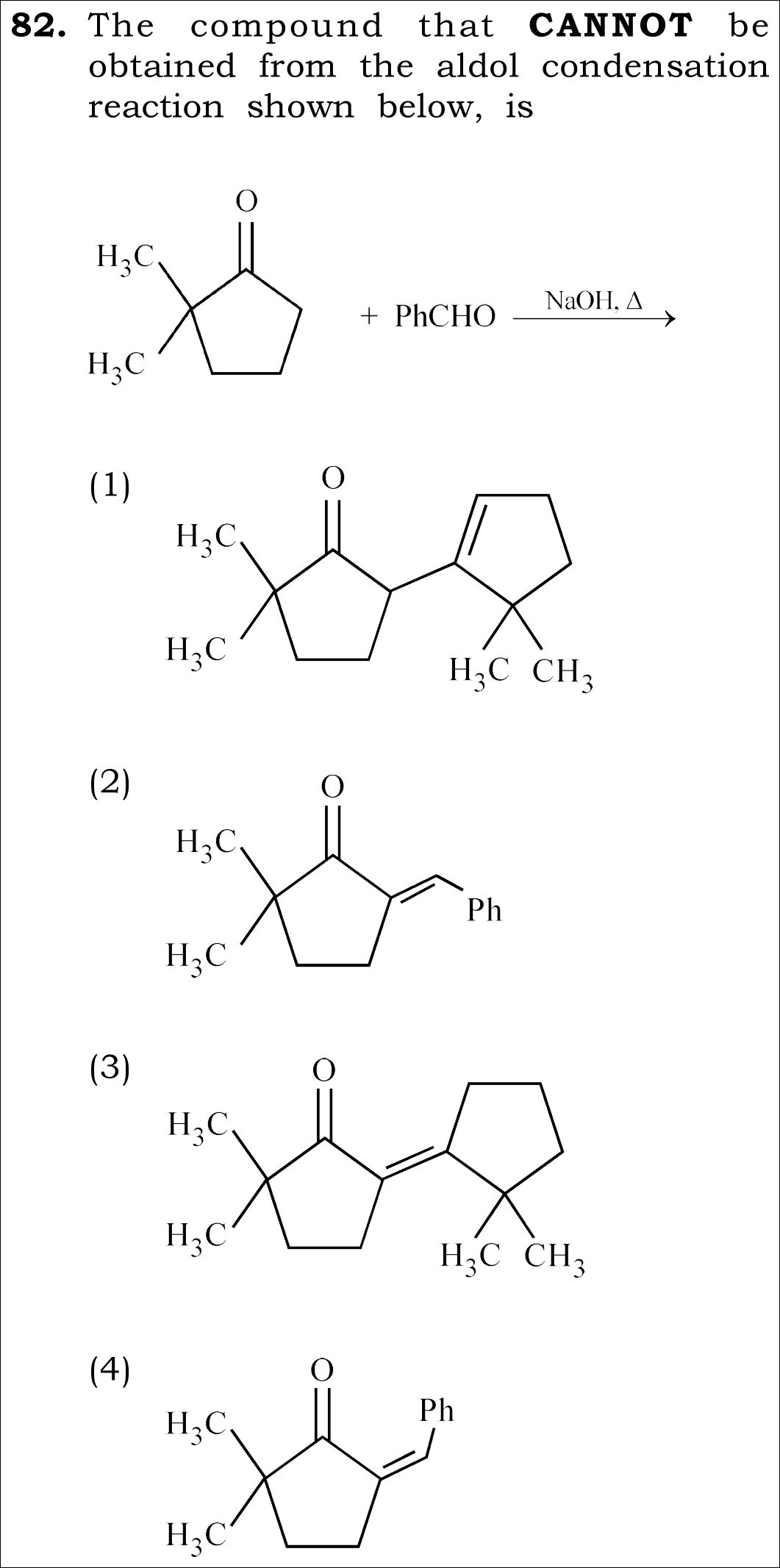
NEET 2026 · Q82 Challenging
Official NEET 2026 Question 82 - Aldehydes, Ketones and Carboxylic Acids
1 ✓ Key
2
3
4
💡 Verified Solution & 30-Second Hack
✓
Verified Against NTA Final Answer Key
Option (1) : Structure (1)
📚 Aldehydes, Ketones and Carboxylic Acids Challenging
📋 Given Parameters & Problem Setup
Ketone 2,2-dimethylcyclopentan-1-one (only one α-carbon with hydrogens: C5)
Aldehyde Benzaldehyde (PhCHO, non-enolizable aldehyde)
Reagent NaOH, Δ (Base-catalyzed aldol condensation with dehydration)
Target The compound that CANNOT be obtained
⚡

The 30-Second Exam Hall Shortcut: ⚡ Conjugation Requirement in Aldol Dehydration

⏱️ Save ~80 seconds

Aldol dehydration ALWAYS produces an α,β-unsaturated carbonyl! Structure (1) is NOT conjugated with the carbonyl!

1 Enolate can only form at C5 (C2 is blocked by two methyl groups, no α-H).
2 Cross-aldol with PhCHO gives E and Z α,β-unsaturated ketones (Structures 2 and 4) -> Formed!
3 Self-aldol of two molecules of 2,2-dimethylcyclopentanone dehydrates across C5=C1' to yield the conjugated α,β-unsaturated enone (Structure 3) -> Formed!
4 Examine Structure (1): The double bond is inside the second ring (between C2' and C3') and isolated by a single bond from the carbonyl! Aldol dehydration can NEVER form an isolated, non-conjugated β,γ-alkene under heating!
5 Structure (1) CANNOT be formed -> Option (1) in 25 seconds!
🛡️
Why You Can 100% Trust This Shortcut: Thermodynamic driving force of aldol condensation: Dehydration under base and heat selectively eliminates water to form the resonance-stabilized conjugated α,β-unsaturated carbonyl system.
📐

Step-by-Step Rigorous Workflow & Mathematical Proof

Step 1

Analyze Enolate Formation on 2,2-Dimethylcyclopentan-1-one

2,2-dimethylcyclopentan-1-one has two α-carbons: - C2: fully substituted with two methyl groups (quaternary carbon, 0 α-hydrogens). - C5: secondary carbon with two acidic α-hydrogens. Therefore, deprotonation by hydroxide base occurs exclusively at C5 to form a single regioselective enolate.

Enolate: Deprotonation strictly at C5\text{Enolate: } \text{Deprotonation strictly at C5}
  • • Benzaldehyde (PhCHO) has zero α-hydrogens and cannot form an enolate.
Step 2

Identify Possible Reaction Pathways

1. Cross-Aldol Condensation with PhCHO: C5 enolate attacks the carbonyl of PhCHO. Subsequent dehydration eliminates the remaining C5 α-hydrogen and the β-hydroxyl group to give an exocyclic conjugated C=CH-Ph double bond. This yields the E-isomer (Structure 2) and Z-isomer (Structure 4). 2. Self-Aldol Condensation: C5 enolate attacks the carbonyl of another 2,2-dimethylcyclopentanone molecule. Dehydration of the resulting β-hydroxyketone occurs between C5 and C1' of the newly attached ring to yield the fully conjugated enone (Structure 3).

Products formed: Structure 2 (Cross E), Structure 4 (Cross Z), Structure 3 (Self enone)\text{Products formed: Structure 2 (Cross E), Structure 4 (Cross Z), Structure 3 (Self enone)}
  • • Structures 2, 3, and 4 are standard feasible products.
Step 3

Analyze Structure (1) and Identify Why It Cannot Form

In Structure (1), the double bond is endocyclic in the second ring (between C1' and C2' or C2' and C3'), leaving the inter-ring bond as a C-C single bond. This fails to eliminate the C5 α-hydrogen, producing a non-conjugated, thermodynamically unstable β,γ-unsaturated framework. Elimination in aldol condensation always proceeds toward the carbonyl to achieve resonance stabilization of the α,β-unsaturated system.

Structure (1) lacks α,β-conjugation with C=O  ⟹  Cannot be obtained\text{Structure (1) lacks } \alpha,\beta\text{-conjugation with C=O} \implies \text{Cannot be obtained}
  • • Matches Option (1).
⭐

360° Option Elimination Engine Key Feature

Diagnose every choice: Know exactly why the right option works and why distractors fail.

4-Option Deep Scan
1 A
✓ 100% Correct
Verdict & Scientific Reason:

Accurate: Structure (1) has an endocyclic double bond lacking conjugation with the carbonyl, which violates the aldol E1cB elimination mechanism.

💡
Why this is airtight: None; deep mechanistic insight.
2 B
✗ Incorrect
Verdict & Scientific Reason:

Incorrect. Structure (2) is the major E-isomer of the cross-aldol condensation with benzaldehyde.

⚠️
Student Fallacy (Why candidates pick this trap): Failing to recognize standard cross-aldol condensation.
3 C
✗ Incorrect
Verdict & Scientific Reason:

Incorrect. Structure (3) is the conjugated self-aldol condensation product formed between two cyclopentanone units.

⚠️
Student Fallacy (Why candidates pick this trap): Forgetting that self-aldol condensation competes in cross-aldol mixtures.
4 D
✗ Incorrect
Verdict & Scientific Reason:

Incorrect. Structure (4) is the geometric Z-isomer of the cross-aldol condensation.

⚠️
Student Fallacy (Why candidates pick this trap): Thinking geometrical isomers cannot both be formed.
⚠️

NTA Trap Alert: Forgetting that Self-Aldol Can Always Occur

Students frequently look only for reactions between cyclopentanone and benzaldehyde and mistakenly think Structure (3) cannot form because it lacks phenyl. However, self-condensation of the ketone readily occurs!

🛡️ How to avoid the -1 mark: Cross aldol reactions always allow self-condensation of the enolizable ketone (Structure 3). The impossible product is the unconjugated isomer (Structure 1).
📖

Core NEET Syllabus Standard

NEET Chemistry Core Syllabus · Aldehydes, Ketones and Carboxylic Acids Standard Benchmark
Core Scientific Principle Tested:

"Base-catalyzed aldol dehydration proceeds via E1cB to form thermodynamically favored α,β-unsaturated carbonyls."

Syllabus Focus: Aldol condensation, cross-aldol condensation, and dehydration selectivity
✓ Core NEET UG Syllabus Anchor Syllabus & Academic Standards ↗
Aldol loves conjugation so strong: Unconjugated Structure 1 is chemically wrong!
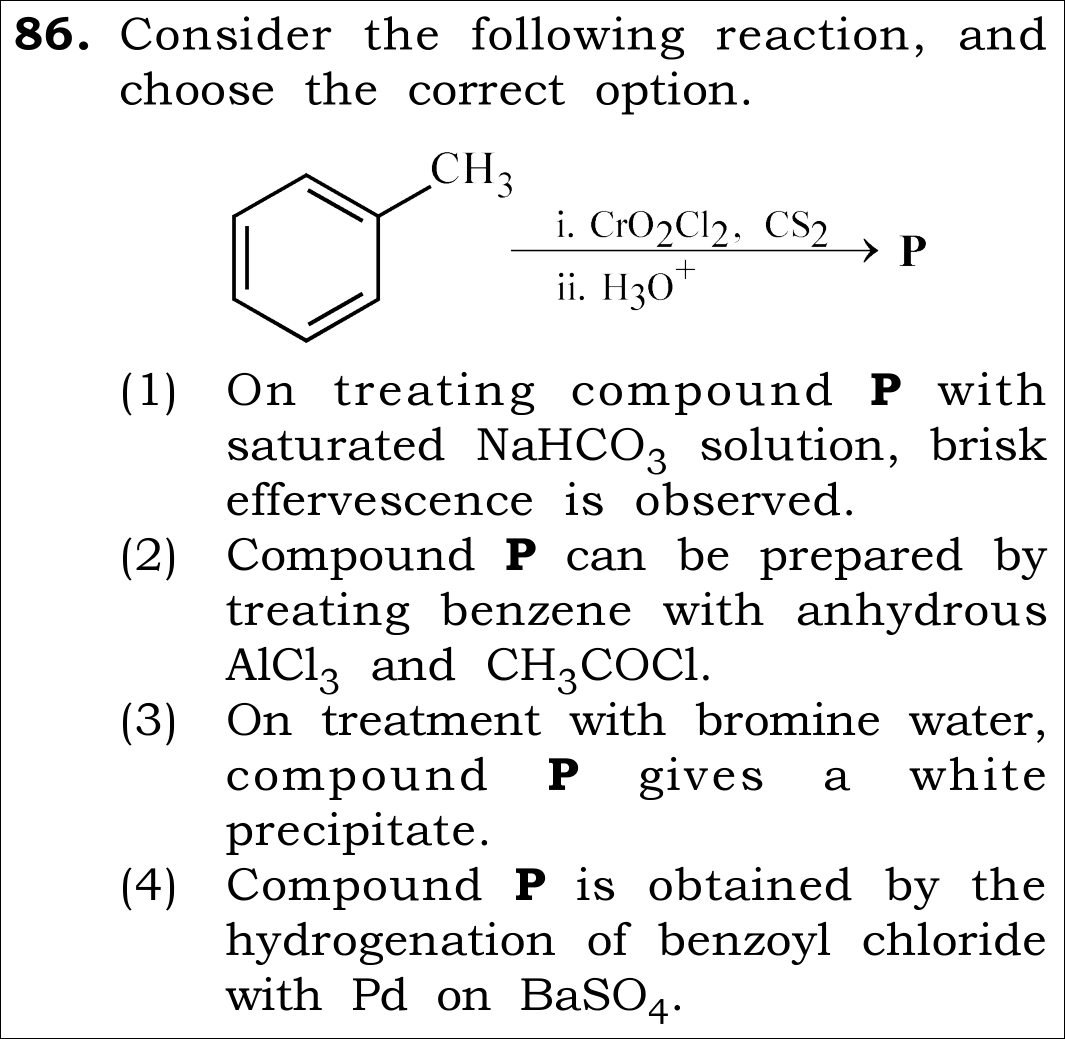
NEET 2026 · Q86 Medium
Official NEET 2026 Question 86 - Aldehydes, Ketones and Carboxylic Acids
1
2
3
4 ✓ Key
💡 Verified Solution & 30-Second Hack
✓
Verified Against NTA Final Answer Key
Option (4) : Compound P is obtained by the hydrogenation of benzoyl chloride with Pd on BaSO₄.
📚 Aldehydes, Ketones and Carboxylic Acids Medium
📋 Given Parameters & Problem Setup
Reaction Toluene + (i. CrO₂Cl₂, CS₂; ii. H₃O⁺) → Compound P
Reactant Toluene (methylbenzene)
⚡

The 30-Second Exam Hall Shortcut: ⚡ The Étard Reaction Identifier

⏱️ Save ~70 seconds

Toluene + Chromyl Chloride (CrO₂Cl₂) = Étard Reaction producing BENZALDEHYDE (P)!

1 Identify named reaction: Oxidation of methylbenzene with CrO₂Cl₂ in CS₂ followed by hydrolysis is the textbook ÉTARD REACTION.
2 The product P is unequivocally BENZALDEHYDE (Ph-CHO)!
3 Scan Options for Benzaldehyde reactions:
4 Option (1): Gives brisk effervescence with NaHCO₃? FALSE (that requires carboxylic acid, -COOH).
5 Option (2): Benzene + CH₃COCl/AlCl₃? FALSE (that gives Acetophenone, Ph-CO-CH₃).
6 Option (3): White precipitate with bromine water? FALSE (that is Phenol / Aniline).
7 Option (4): Hydrogenation of benzoyl chloride with Pd on BaSO₄ (Rosenmund Reduction)? TRUE! Ph-COCl + H₂ → Ph-CHO!
8 Option (4) is undeniably correct in 15 seconds!
🛡️
Why You Can 100% Trust This Shortcut: Both the Étard reaction and Rosenmund reduction are premier canonical named reactions for the preparation of aromatic aldehydes in NCERT Chemistry.
📐

Step-by-Step Rigorous Workflow & Mathematical Proof

Step 1

Identify Compound P via the Étard Reaction

Chromyl chloride (CrO₂Cl₂) in a non-polar solvent like CS₂ oxidizes the methyl group of toluene into a brown chromium complex [C₆H₅CH(OCrOHCl₂)₂]. Hydrolysis of this intermediate yields benzaldehyde.

C6H5CH3→ii. H3O+i. CrO2Cl2, CS2C6H5CHO  (P=Benzaldehyde)\text{C}_6\text{H}_5\text{CH}_3 \xrightarrow[\text{ii. } \text{H}_3\text{O}^+]{\text{i. } \text{CrO}_2\text{Cl}_2, \text{ CS}_2} \text{C}_6\text{H}_5\text{CHO} \;(\mathbf{P} = \text{Benzaldehyde})
  • • Compound P is Benzaldehyde (C₆H₅CHO).
Step 2

Evaluate Statement (4): Rosenmund Reduction

Rosenmund reduction involves catalytic hydrogenation of an acyl chloride (benzoyl chloride) over palladium catalyst supported on barium sulfate (Pd/BaSO₄), partially poisoned with sulfur or quinoline to prevent over-reduction to an alcohol.

C6H5COCl+H2→Pd/BaSO4C6H5CHO  (P)+HCl\text{C}_6\text{H}_5\text{COCl} + \text{H}_2 \xrightarrow{\text{Pd/BaSO}_4} \text{C}_6\text{H}_5\text{CHO} \;(\mathbf{P}) + \text{HCl}
  • • This independently synthesizes Compound P (Benzaldehyde).
  • • Statement (4) is scientifically correct.
Step 3

Demonstrate Invalidation of Statements (1), (2), and (3)

1. Statement (1): Benzaldehyde is an aldehyde, not a carboxylic acid; it does NOT release CO₂ gas with NaHCO₃ (no brisk effervescence). 2. Statement (2): Benzene + CH₃COCl/AlCl₃ is Friedel-Crafts acylation, producing Acetophenone (PhCOCH₃), not benzaldehyde. 3. Statement (3): Bromine water gives white precipitates with phenol (2,4,6-tribromophenol) or aniline, not benzaldehyde.

Option (4) is the only true statement\text{Option (4) is the only true statement}
  • • Matches Option (4).
⭐

360° Option Elimination Engine Key Feature

Diagnose every choice: Know exactly why the right option works and why distractors fail.

4-Option Deep Scan
1 A
✗ Incorrect
Verdict & Scientific Reason:

Incorrect. Benzaldehyde is not acidic enough to decompose bicarbonate to CO₂.

⚠️
Student Fallacy (Why candidates pick this trap): Confusing benzaldehyde with benzoic acid.
2 B
✗ Incorrect
Verdict & Scientific Reason:

Incorrect. Friedel-Crafts acylation of benzene with acetyl chloride yields acetophenone, not benzaldehyde.

⚠️
Student Fallacy (Why candidates pick this trap): Confusing benzaldehyde with acetophenone.
3 C
✗ Incorrect
Verdict & Scientific Reason:

Incorrect. White precipitate with bromine water is a test for phenol or aniline, not benzaldehyde.

⚠️
Student Fallacy (Why candidates pick this trap): Confusing benzaldehyde with phenol.
4 D
✓ 100% Correct
Verdict & Scientific Reason:

Exact match: Rosenmund reduction of benzoyl chloride over Pd/BaSO₄ gives benzaldehyde (Compound P).

💡
Why this is airtight: None; flawless cross-connection of named synthetic pathways.
⚠️

NTA Trap Alert: Thinking Toluene Oxidation Gives Benzoic Acid Directly

Vigorous oxidizers like alkaline KMnO₄ oxidize toluene to benzoic acid. But CrO₂Cl₂ (Étard reaction) is specifically designed to STOP at the aldehyde stage (Benzaldehyde)!

🛡️ How to avoid the -1 mark: CrO₂Cl₂ stops at Benzaldehyde; KMnO₄ goes all the way to Benzoic Acid.
📖

Core NEET Syllabus Standard

NEET Chemistry Core Syllabus · Aldehydes, Ketones and Carboxylic Acids Standard Benchmark
Core Scientific Principle Tested:

"Toluene + CrO₂Cl₂ yields benzaldehyde; Benzoyl chloride + H₂/Pd-BaSO₄ also yields benzaldehyde."

Syllabus Focus: Preparation of aromatic aldehydes - Étard reaction and Rosenmund reduction
✓ Core NEET UG Syllabus Anchor Syllabus & Academic Standards ↗
Étard stops at Benzaldehyde; Rosenmund reduces acid chloride to the same aldehyde!
NEET 2025 · Q70 Easy
Official NEET 2025 Question 70 - Aldehydes, Ketones and Carboxylic Acids
1
2
3 ✓ Key
4
💡 Verified Solution & 30-Second Hack
✓
Verified Against NTA Final Answer Key
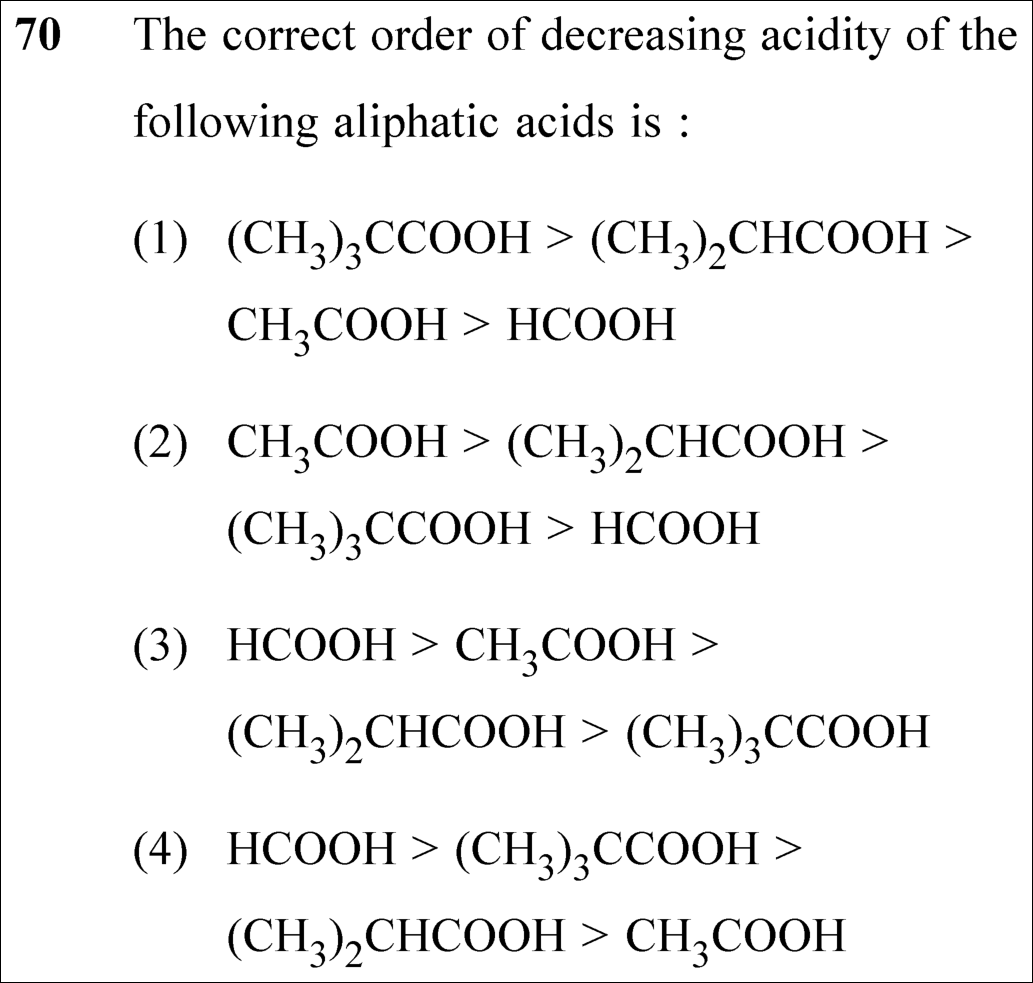
Option (3) : HCOOH > CH₃COOH > (CH₃)₂CHCOOH > (CH₃)₃CCOOH
📚 Aldehydes, Ketones and Carboxylic Acids Easy
📋 Given Parameters & Problem Setup
Acid 1 HCOOH (Formic acid / Methanoic acid)
Acid 2 CH₃COOH (Acetic acid / Ethanoic acid)
Acid 3 (CH₃)₂CHCOOH (Isobutyric acid / 2-Methylpropanoic acid)
Acid 4 (CH₃)₃CCOOH (Pivalic acid / 2,2-Dimethylpropanoic acid)
⚡

The 30-Second Exam Hall Shortcut: ⚡ +I Inductive Charge Destabilization Rule

⏱️ Save ~30 seconds

Acidity ∝ 1 / (+I effect)! Alkyl groups push electron density into -COO⁻, destabilizing the conjugate base and reducing acidity! HCOOH has zero alkyl groups (STRONGEST). CH₃ has 1 methyl. (CH₃)₂CH has 2 methyls. (CH₃)₃C has 3 methyls (WEAKEST)! ⟹ HCOOH > CH₃COOH > (CH₃)₂CHCOOH > (CH₃)₃CCOOH!

1 Recall acidity determinant: Stronger acid produces a more stable conjugate base (carboxylate anion R-COO⁻).
2 Electron-donating groups (+I effect) intensify negative charge on the carboxylate oxygen, destabilizing the anion and decreasing acid strength.
3 Order of +I inductive effect: -C(CH₃)₃ (tertiary butyl) > -CH(CH₃)₂ (isopropyl) > -CH₃ (methyl) > -H.
4 Invert for acid strength: HCOOH > CH₃COOH > (CH₃)₂CHCOOH > (CH₃)₃CCOOH.
5 Select Option (3) in under 10 seconds!
🛡️
Why You Can 100% Trust This Shortcut: Electron-Withdrawing Substituent Effects on Carboxylic Acid Acidity (NCERT Chemistry · Aldehydes, Ketones and Carboxylic Acids).
📐

Step-by-Step Rigorous Workflow & Mathematical Proof

Step 1

Role of Inductive Effect in Carboxylate Anion Stability

Carboxylic acids dissociate in water to generate carboxylate anions and hydronium ions:

R-COOH+H2O⇌R-COO−+H3O+\text{R-COOH} + \text{H}_2\text{O} \rightleftharpoons \text{R-COO}^- + \text{H}_3\text{O}^+
  • • Any factor that disperses the negative charge stabilizes the carboxylate anion and increases acidity.
  • • Any factor that concentrates or intensifies the negative charge destabilizes the anion and decreases acidity.
Step 2

Compare +I Power of Alkyl Substituents

Alkyl groups are electron-releasing (+I) groups. As the size and branching of the alkyl group increases, its +I electron-donating power increases dramatically:

+I effect: −C(CH3)3>−CH(CH3)2>−CH3>−H+I \text{ effect: } -\text{C(CH}_3)_3 > -\text{CH(CH}_3)_2 > -\text{CH}_3 > -\text{H}
  • • In (CH₃)₃CCOOH, three electron-releasing methyl groups pump electron density into the carboxylate group, creating maximum destabilization of the anion (weakest acid).
  • • In HCOOH, there is no alkyl group attached to the carboxyl carbon, so there is no +I destabilization (strongest acid).
Step 3

Synthesize the Complete Acidity Order

Invert the +I hierarchy to obtain the decreasing acidity series:

Decreasing Acidity: HCOOH>CH3COOH>(CH3)2CHCOOH>(CH3)3CCOOH\text{Decreasing Acidity: } \text{HCOOH} > \text{CH}_3\text{COOH} > (\text{CH}_3)_2\text{CHCOOH} > (\text{CH}_3)_3\text{CCOOH}
  • • pK_a values: HCOOH (3.75) < CH₃COOH (4.76) < (CH₃)₂CHCOOH (4.86) < (CH₃)₃CCOOH (5.05).
  • • Matches Option (3) perfectly.
⭐

360° Option Elimination Engine Key Feature

Diagnose every choice: Know exactly why the right option works and why distractors fail.

4-Option Deep Scan
1 A
✗ Incorrect
Verdict & Scientific Reason:

Incorrect. Completely inverts the acidity order, treating +I groups as acid-strengthening.

⚠️
Student Fallacy (Why candidates pick this trap): Confusing electron-donating groups with electron-withdrawing groups.
2 B
✗ Incorrect
Verdict & Scientific Reason:

Incorrect. Falsely places formic acid (HCOOH) as the weakest acid.

⚠️
Student Fallacy (Why candidates pick this trap): Thinking formic acid is weaker than acetic acid.
3 C
✓ 100% Correct
Verdict & Scientific Reason:

100% correct. HCOOH is strongest, followed by acetic, isobutyric, and pivalic acid.

💡
Why this is airtight: None; flawless mastery of inductive effects.
4 D
✗ Incorrect
Verdict & Scientific Reason:

Incorrect. Scrambled middle order.

⚠️
Student Fallacy (Why candidates pick this trap): Inverting the branched alkyl sequence.
⚠️

NTA Trap Alert: Placing Acetic Acid Ahead of Formic Acid

Some students memorize that substituted acids can be stronger and mistakenly think CH₃COOH is stronger than HCOOH. In reality, HCOOH is significantly stronger than acetic acid (pK_a 3.75 vs 4.76) because H does not donate electrons by +I effect!

🛡️ How to avoid the -1 mark: Formic acid is ALWAYS the strongest among unsubstituted simple aliphatic acids!
📖

Core NEET Syllabus Standard

NEET Chemistry Core Syllabus · Aldehydes, Ketones and Carboxylic Acids Standard Benchmark
Core Scientific Principle Tested:

"+I electron donating groups decrease acidity: HCOOH > CH₃COOH > R₂CHCOOH > R₃CCOOH."

Syllabus Focus: Acidity of Carboxylic Acids & Effect of Substituents
✓ Core NEET UG Syllabus Anchor Syllabus & Academic Standards ↗
Less Alkyl = Stronger Acid: Formic > Acetic > Isobutyric > Pivalic (Option 3)!
NEET 2025 · Q78 Medium
Official NEET 2025 Question 78 - Aldehydes, Ketones and Carboxylic Acids
1
2 ✓ Key
3
4
💡 Verified Solution & 30-Second Hack
✓
Verified Against NTA Final Answer Key
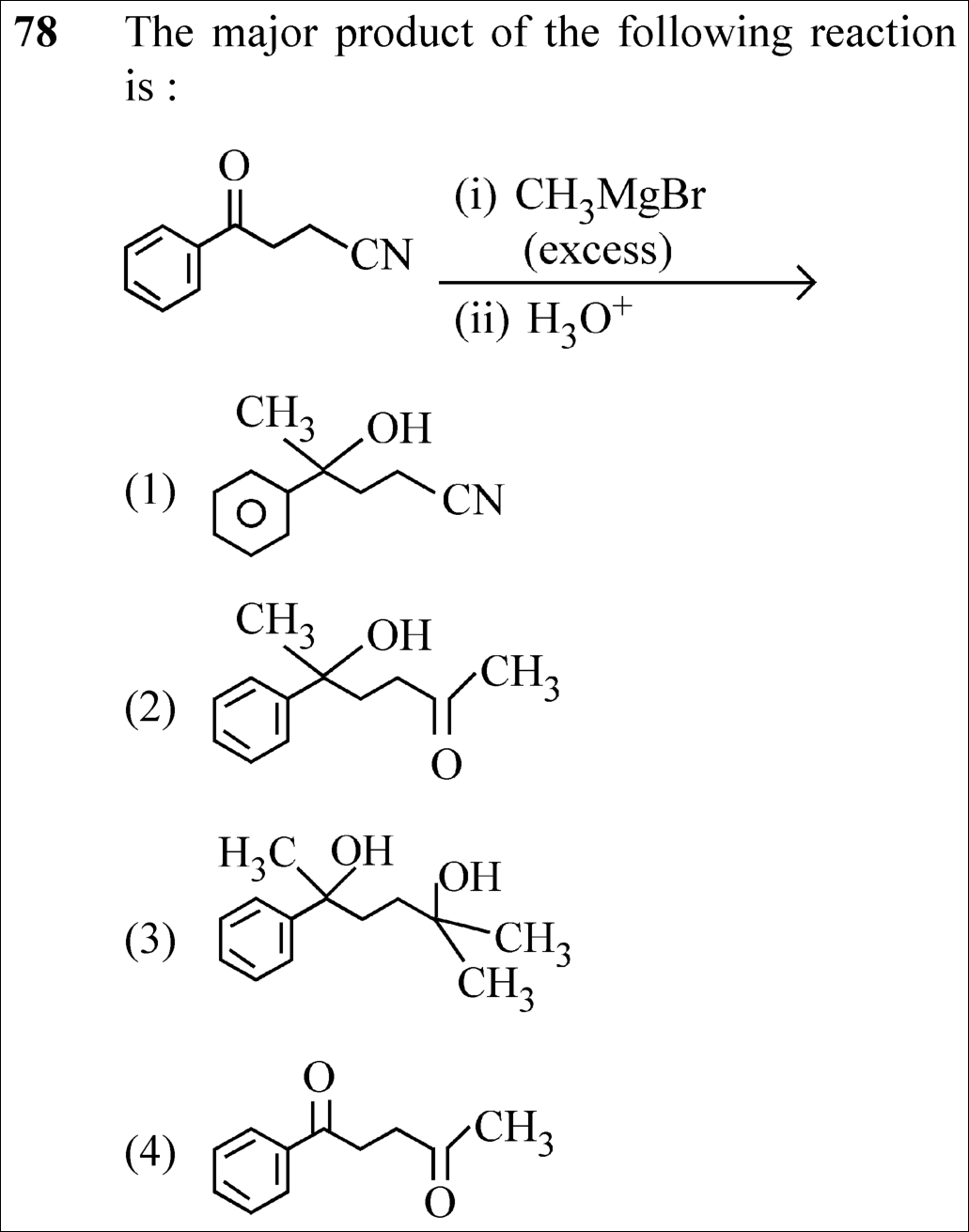
Option (2) : Ph-C(CH₃)(OH)-CH₂-CH₂-CO-CH₃ (Tertiary alcohol at C4, methyl ketone at C1)
📚 Aldehydes, Ketones and Carboxylic Acids & Amines Medium
📋 Given Parameters & Problem Setup
Substrate 4-Oxo-4-phenylbutanenitrile (Ph-CO-CH₂-CH₂-CN)
Step (i) Reagents CH₃MgBr (excess)
Step (ii) Reagent H₃O⁺ (Acidic hydrolysis workup)
⚡

The 30-Second Exam Hall Shortcut: ⚡ Grignard on Ketone + Nitrile Fingerprint

⏱️ Save ~45 seconds

CH₃MgBr adds to Ketone (Ph-CO-) ⟹ Tertiary Alcohol Ph-C(CH₃)(OH)-! CH₃MgBr adds to Nitrile (-CN) to form imine salt, which on H₃O⁺ hydrolyzes to Methyl Ketone -CO-CH₃! Combining both gives Ph-C(CH₃)(OH)-CH₂-CH₂-CO-CH₃ (Option 2)!

1 Identify functional groups: Ph-CO- (ketone) and -CN (nitrile).
2 Reaction of Ketone with CH₃MgBr: Nucleophilic attack of methyl carbanion gives magnesium alkoxide, which upon H₃O⁺ workup yields a tertiary alcohol: Ph-C(CH₃)(OH)-.
3 Reaction of Nitrile with CH₃MgBr: Nucleophilic addition yields magnesium ketimine salt R-C(CH₃)=N-MgBr.
4 Crucial point: The imine magnesium salt does NOT add a second Grignard reagent under standard conditions.
5 Upon acidic aqueous workup (H₃O⁺), the ketimine hydrolyzes to a methyl ketone: -C(=O)-CH₃.
6 The final molecule has a tertiary alcohol on the phenyl side and a methyl ketone on the aliphatic chain.
7 Match Option (2) in under 20 seconds!
🛡️
Why You Can 100% Trust This Shortcut: Grignard Addition to Nitriles and Carbonyls (NCERT Chemistry · Aldehydes, Ketones and Carboxylic Acids).
📐

Step-by-Step Rigorous Workflow & Mathematical Proof

Step 1

Grignard Addition to the Ketone Carbonyl

The methyl Grignard reagent (CH₃MgBr) acts as a strong nucleophile, attacking the electrophilic carbonyl carbon of the ketone:

Ph−C(=O)−CH2−+CH3MgBr⟶Ph−C(CH3)(O−MgBr+)−CH2−\text{Ph}-\text{C}(=\text{O})-\text{CH}_2- + \text{CH}_3\text{MgBr} \longrightarrow \text{Ph}-\text{C}(\text{CH}_3)(\text{O}^-\text{MgBr}^+)-\text{CH}_2-
  • • Subsequent protonation during acidic workup (H₃O⁺) affords a tertiary alcohol: Ph-C(CH₃)(OH)-.
Step 2

Grignard Addition to the Nitrile Group and Imine Hydrolysis

Nitriles react with Grignard reagents by nucleophilic attack on the carbon-nitrogen triple bond to form an imine intermediate salt:

−CH2−C≡N+CH3MgBr⟶−CH2−C(CH3)=N−MgBr-\text{CH}_2-\text{C}\equiv\text{N} + \text{CH}_3\text{MgBr} \longrightarrow -\text{CH}_2-\text{C}(\text{CH}_3)=\text{N}-\text{MgBr}
  • • The negative charge on the imine nitrogen prevents a second Grignard addition.
  • • Upon acidic hydrolysis (H₃O⁺), the imine bond is cleaved to liberate a methyl ketone group:
  • • -\text{CH}_2-\text{C}(\text{CH}_3)=\text{N-MgBr} \xrightarrow{\text{H}_3\text{O}^+} -\text{CH}_2-\text{C}(=\text{O})-\text{CH}_3 + \text{NH}_4^+ + \text{Mg}^{2+} + \text{Br}^-.
Step 3

Consolidate the Major Product Structure

Combine the modified functionalities at both ends of the molecule:

Major Product=Ph−C(CH3)(OH)−CH2−CH2−C(=O)−CH3\text{Major Product} = \text{Ph}-\text{C}(\text{CH}_3)(\text{OH})-\text{CH}_2-\text{CH}_2-\text{C}(=\text{O})-\text{CH}_3
  • • This structure corresponds exactly to Option (2).
⭐

360° Option Elimination Engine Key Feature

Diagnose every choice: Know exactly why the right option works and why distractors fail.

4-Option Deep Scan
1 A
✗ Incorrect
Verdict & Scientific Reason:

Incorrect. Leaves the nitrile group completely unreacted despite excess Grignard reagent.

⚠️
Student Fallacy (Why candidates pick this trap): Assuming Grignard reagent does not react with nitriles.
2 B
✓ 100% Correct
Verdict & Scientific Reason:

100% correct. Ketone becomes 3° alcohol; nitrile becomes methyl ketone on hydrolysis.

💡
Why this is airtight: None; rigorous multi-functional organic synthesis.
3 C
✗ Incorrect
Verdict & Scientific Reason:

Incorrect. Falsely assumes a second addition of Grignard to the nitrile to form a diol.

⚠️
Student Fallacy (Why candidates pick this trap): Treating nitrile like an ester and adding two equivalents of Grignard.
4 D
✗ Incorrect
Verdict & Scientific Reason:

Incorrect. Leaves ketone unreduced and only reacts nitrile.

⚠️
Student Fallacy (Why candidates pick this trap): Assuming nitrile is more reactive than ketone towards Grignard reagent.
⚠️

NTA Trap Alert: Treating Nitriles Like Esters (The Diol Trap)

Esters react with TWO equivalents of Grignard reagent to form tertiary alcohols (Option 3). But nitriles react with ONLY ONE equivalent because the imine magnesium salt cannot undergo elimination to regenerate a carbonyl in situ! Hydrolysis gives a KETONE, not a tertiary alcohol!

🛡️ How to avoid the -1 mark: Remember: Ester + excess Grignard = 3° Alcohol; Nitrile + Grignard + H₃O⁺ = KETONE!
📖

Core NEET Syllabus Standard

NEET Chemistry Core Syllabus · Aldehydes, Ketones and Carboxylic Acids Standard Benchmark
Core Scientific Principle Tested:

"R-CN + R'MgBr followed by H₃O⁺ yields ketone R-CO-R'."

Syllabus Focus: Preparation of Ketones from Nitriles & Reactions of Carbonyls with Grignard Reagent
✓ Core NEET UG Syllabus Anchor Syllabus & Academic Standards ↗
Ketone becomes 3° Alcohol; Nitrile stops at Ketone ⟹ Ph-C(OH)(Me)...CO-Me (Option 2)!
NEET 2025 · Q83 Easy
Official NEET 2025 Question 83 - Aldehydes, Ketones and Carboxylic Acids
1
2 ✓ Key
3
4
💡 Verified Solution & 30-Second Hack
✓
Verified Against NTA Final Answer Key
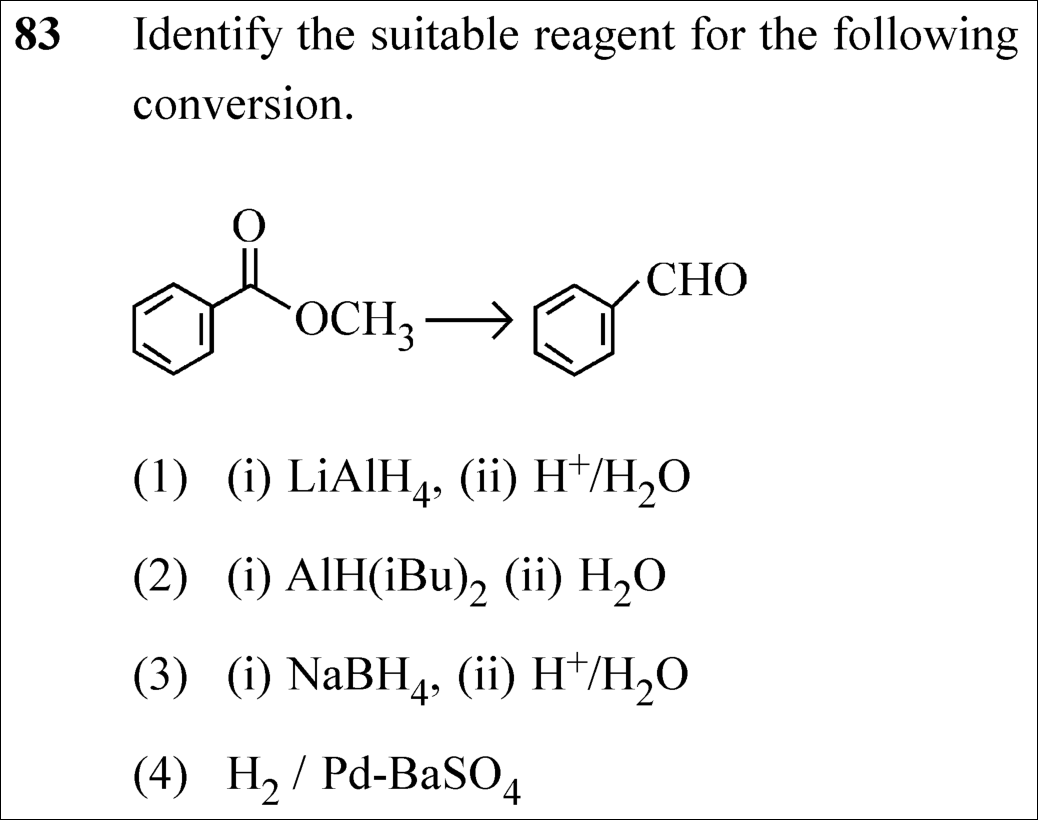
Option (2) : (i) AlH(iBu)₂ (ii) H₂O
📚 Aldehydes, Ketones and Carboxylic Acids Easy
📋 Given Parameters & Problem Setup
Substrate Methyl benzoate (Ph-COOCH₃, aromatic ester)
Target Product Benzaldehyde (Ph-CHO, aromatic aldehyde)
⚡

The 30-Second Exam Hall Shortcut: ⚡ DIBAL-H Ester-to-Aldehyde Trademark

⏱️ Save ~30 seconds

Ester ⟶ Aldehyde requires DIBAL-H [AlH(iBu)₂]! LiAlH₄ over-reduces esters all the way to primary alcohols (Ph-CH₂OH). NaBH₄ does not reduce esters. H₂/Pd-BaSO₄ reduces acid chlorides, not esters! ⟹ (i) AlH(iBu)₂ (ii) H₂O!

1 Notice transformation: Ester (Ph-COOCH₃) is selectively reduced to an Aldehyde (Ph-CHO).
2 Recall canonical reagent: Diisobutylaluminium hydride, DIBAL-H or AlH(iBu)₂, selectively reduces esters to aldehydes at low temperature followed by hydrolysis.
3 Evaluate alternatives:
4 - LiAlH₄: Powerful reducing agent; completely reduces esters to primary alcohol (benzyl alcohol Ph-CH₂OH).
5 - NaBH₄: Mild reducing agent; unreactive towards esters.
6 - H₂ / Pd-BaSO₄: Rosenmund reduction, specifically reduces acyl chlorides (R-COCl) to aldehydes, not esters.
7 Only DIBAL-H [AlH(iBu)₂] accomplishes selective reduction of esters to aldehydes.
8 Select Option (2) in under 10 seconds!
🛡️
Why You Can 100% Trust This Shortcut: Selective DIBAL-H Reduction of Esters and Nitriles (NCERT Chemistry · Aldehydes, Ketones and Carboxylic Acids).
📐

Step-by-Step Rigorous Workflow & Mathematical Proof

Step 1

Mechanism of DIBAL-H Selective Reduction of Esters

Diisobutylaluminium hydride, [(CH₃)₂CH-CH₂]₂AlH or AlH(iBu)₂, delivers exactly one hydride ion to the carbonyl carbon of the ester at low temperature (-78 °C):

Ph-COOCH3+AlH(iBu)2→−78∘CPh−CH(OCH3)(O−Al(iBu)2) (Stable hemiacetal intermediate)\text{Ph-COOCH}_3 + \text{AlH}(i\text{Bu})_2 \xrightarrow{-78^\circ\text{C}} \text{Ph}-\text{CH}(\text{OCH}_3)(\text{O}-\text{Al}(i\text{Bu})_2) \text{ (Stable hemiacetal intermediate)}
  • • The tetrahedral intermediate is stable at low temperatures, preventing further hydride attack.
Step 2

Aqueous Hydrolysis to Aldehyde

Upon addition of water (H₂O workup), the tetrahedral aluminium intermediate collapses, releasing the aldehyde and methanol:

Ph−CH(OCH3)(OAlR2)→H2OPh-CHO+CH3OH+Al(OH)R2\text{Ph}-\text{CH}(\text{OCH}_3)(\text{OAlR}_2) \xrightarrow{\text{H}_2\text{O}} \text{Ph-CHO} + \text{CH}_3\text{OH} + \text{Al(OH)R}_2
  • • The reaction stops cleanly at benzaldehyde without over-reduction.
Step 3

Contrast with Other Reagents

Verify why the other reagents fail for this specific transformation:

LiAlH4:  Ph-COOCH3⟶Ph-CH2OH(Over-reduction to alcohol)\text{LiAlH}_4: \; \text{Ph-COOCH}_3 \longrightarrow \text{Ph-CH}_2\text{OH} \quad (\text{Over-reduction to alcohol})
  • • NaBH₄ does not react with esters at a measurable rate.
  • • H₂/Pd-BaSO₄ requires an acid chloride (Ph-COCl), not an ester.
  • • Therefore, (i) AlH(iBu)₂ (ii) H₂O is the unique correct reagent, matching Option (2).
⭐

360° Option Elimination Engine Key Feature

Diagnose every choice: Know exactly why the right option works and why distractors fail.

4-Option Deep Scan
1 A
✗ Incorrect
Verdict & Scientific Reason:

Incorrect. LiAlH₄ reduces esters completely to primary alcohols (benzyl alcohol Ph-CH₂OH).

⚠️
Student Fallacy (Why candidates pick this trap): Thinking LiAlH₄ stops at the aldehyde stage.
2 B
✓ 100% Correct
Verdict & Scientific Reason:

100% correct. DIBAL-H specifically reduces esters to aldehydes.

💡
Why this is airtight: None; textbook organic synthesis reaction.
3 C
✗ Incorrect
Verdict & Scientific Reason:

Incorrect. NaBH₄ cannot reduce esters.

⚠️
Student Fallacy (Why candidates pick this trap): Believing NaBH₄ reduces esters.
4 D
✗ Incorrect
Verdict & Scientific Reason:

Incorrect. Rosenmund catalyst reduces acyl chlorides, not esters.

⚠️
Student Fallacy (Why candidates pick this trap): Confusing ester substrate with acid chloride.
⚠️

NTA Trap Alert: Choosing LiAlH₄ for Aldehyde Preparation

LiAlH₄ is too reactive to prepare aldehydes from carboxylic acids or esters—it inevitably reduces the carbonyl all the way down to a primary alcohol. DIBAL-H is specifically designed to stop at the aldehyde!

🛡️ How to avoid the -1 mark: Ester to Aldehyde = DIBAL-H [AlH(iBu)₂]!
📖

Core NEET Syllabus Standard

NEET Chemistry Core Syllabus · Aldehydes, Ketones and Carboxylic Acids Standard Benchmark
Core Scientific Principle Tested:

"DIBAL-H selectively reduces esters to aldehydes upon hydrolysis."

Syllabus Focus: Preparation of Aldehydes by Reduction of Esters
✓ Core NEET UG Syllabus Anchor Syllabus & Academic Standards ↗
DIBAL-H = Die (Stop) at ALdehyde: Ester ⟶ Aldehyde (Option 2)!
NEET 2024 · Q71 Easy
Official NEET 2024 Question 71 - Aldehydes, Ketones and Carboxylic Acids
1 ✓ Key
2
3
4
💡 Verified Solution & 30-Second Hack
✓
Verified Against NTA Final Answer Key
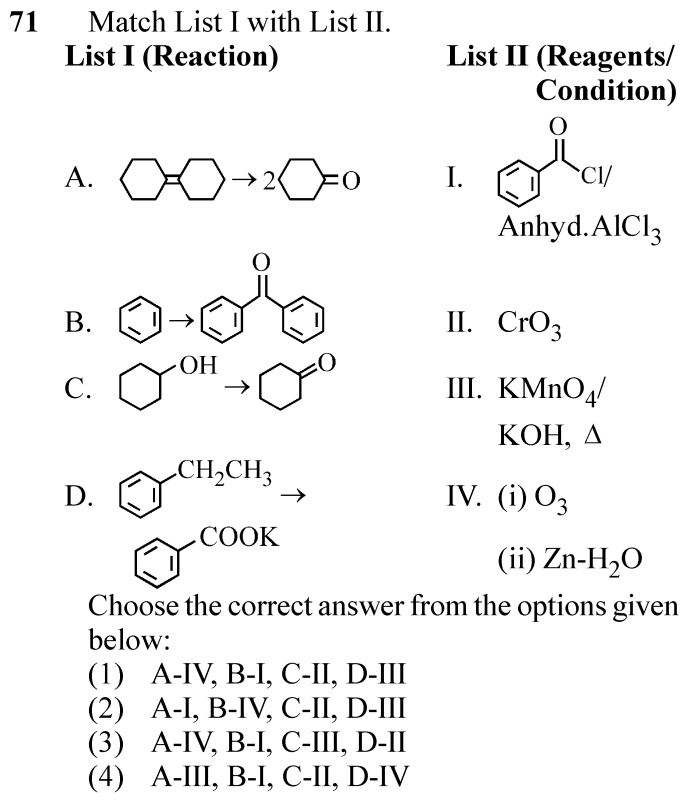
Option (1) : A-IV, B-I, C-II, D-III
📚 Aldehydes, Ketones and Carboxylic Acids Easy
📋 Given Parameters & Problem Setup
Reaction A Bicyclohexylidene -> 2 Cyclohexanone
Reaction B Benzene -> Benzophenone
Reaction C Cyclohexanol -> Cyclohexanone
Reaction D Ethylbenzene -> Potassium benzoate
⚡

The 30-Second Exam Hall Shortcut: ⚡ Reagent Function Matching Hack

⏱️ Save ~40 seconds

Alkene cleavage -> Ozonolysis (IV); Benzene to ketone -> PhCOCl/AlCl3 (I); 2° alcohol to ketone -> CrO3 (II); Side-chain alkylbenzene to benzoate -> KMnO4/KOH, Δ (III)!

1 Bicyclohexylidene is cleaved across the C=C double bond into two ketone rings -> Reductive Ozonolysis: (i) O3, (ii) Zn-H2O (A-IV).
2 Benzene + Benzoyl chloride with anhydrous AlCl3 gives benzophenone via Friedel-Crafts acylation -> PhCOCl / Anhyd. AlCl3 (B-I).
3 Cyclohexanol (2° alcohol) is oxidized to cyclohexanone -> Chromic anhydride CrO3 (C-II).
4 Ethylbenzene heated with alkaline potassium permanganate oxidizes the benzylic carbon to potassium benzoate -> KMnO4 / KOH, Δ (D-III).
5 Match: A-IV, B-I, C-II, D-III -> Option (1) in 5 seconds!
🛡️
Why You Can 100% Trust This Shortcut: NCERT Chemistry · Aldehydes, Ketones and Carboxylic Acids (Preparation of aldehydes and ketones by ozonolysis, acylation, oxidation of alcohols, and oxidation of alkylbenzenes).
📐

Step-by-Step Rigorous Workflow & Mathematical Proof

Step 1

Ozonolysis of Symmetrical Alkene (Reaction A)

Bicyclohexylidene is an alkene where two cyclohexyl rings are joined by an endocyclic/exocyclic double bond. Reductive ozonolysis cleaves the double bond with ozone followed by zinc dust reduction, yielding two equivalents of cyclohexanone:

Alkene→(i) O3,  (ii) Zn-H2O2  Cyclohexanone(IV)\text{Alkene} \xrightarrow{\text{(i) } \text{O}_3, \; \text{(ii) } \text{Zn-H}_2\text{O}} 2\;\text{Cyclohexanone} \quad (\text{IV})
Step 2

Friedel-Crafts Acylation of Benzene (Reaction B)

Benzene reacts with benzoyl chloride (C6H5COCl) in the presence of anhydrous aluminum chloride (Lewis acid catalyst) to form diphenylmethanone (benzophenone):

C6H6+C6H5COCl→Anhyd. AlCl3C6H5−CO−C6H5+HCl(I)\text{C}_6\text{H}_6 + \text{C}_6\text{H}_5\text{COCl} \xrightarrow{\text{Anhyd. AlCl}_3} \text{C}_6\text{H}_5{-}\text{CO}{-}\text{C}_6\text{H}_5 + \text{HCl} \quad (\text{I})
Step 3

Mild Oxidation of Secondary Alcohol (Reaction C)

Cyclohexanol is a secondary (2°) alcohol. Oxidation with chromium trioxide (CrO3 in aqueous acetone / Jones-type conditions) cleanly yields the corresponding cyclic ketone, cyclohexanone:

Cyclohexanol→CrO3Cyclohexanone(II)\text{Cyclohexanol} \xrightarrow{\text{CrO}_3} \text{Cyclohexanone} \quad (\text{II})
Step 4

Vigorous Side-Chain Oxidation of Alkylbenzene (Reaction D)

Regardless of the length of the alkyl side chain (provided it contains at least one benzylic hydrogen), vigorous oxidation with alkaline KMnO4 cleaves the side chain, converting it into the potassium salt of benzoic acid:

C6H5CH2CH3→KMnO4/KOH,  ΔC6H5COOK(III)\text{C}_6\text{H}_5\text{CH}_2\text{CH}_3 \xrightarrow{\text{KMnO}_4 / \text{KOH}, \; \Delta} \text{C}_6\text{H}_5\text{COOK} \quad (\text{III})
⭐

360° Option Elimination Engine Key Feature

Diagnose every choice: Know exactly why the right option works and why distractors fail.

4-Option Deep Scan
1 (1)
✓ 100% Correct
Verdict & Scientific Reason:

Exact match with all canonical reagent-reaction pairings.

💡
Why this is airtight: None.
2 (2)
✗ Incorrect
Verdict & Scientific Reason:

Mismatches ozonolysis with acylation.

⚠️
Student Fallacy (Why candidates pick this trap): Confusing alkene cleavage with Friedel-Crafts.
3 (3)
✗ Incorrect
Verdict & Scientific Reason:

Swaps reagents for reactions C and D.

⚠️
Student Fallacy (Why candidates pick this trap): Using KMnO4 for mild alcohol oxidation.
4 (4)
✗ Incorrect
Verdict & Scientific Reason:

Uses alkaline KMnO4 for alkene ozonolysis.

⚠️
Student Fallacy (Why candidates pick this trap): Confusing ozonolysis with permanganate cleavage.
⚠️

NTA Trap Alert: Confusing Side-Chain Oxidation with Ring Oxidation

In ethylbenzene, KMnO4/KOH oxidizes ONLY the benzylic side chain to -COOK, leaving the aromatic benzene ring completely intact.

🛡️ How to avoid the -1 mark: Remember: Aromatic rings with benzylic hydrogens always oxidize to benzoic acid/benzoate under hot alkaline KMnO4.
📖

Core NEET Syllabus Standard

Chemistry Core Organic Chemistry · Aldehydes, Ketones and Carboxylic Acids Standard Benchmark
Core Scientific Principle Tested:

"Ozonolysis cleaves C=C into carbonyls; PhCOCl/AlCl3 acylates benzene; CrO3 oxidizes 2° alcohols to ketones; alkaline KMnO4 oxidizes alkylbenzenes to benzoates."

Syllabus Focus: Methods of Preparation of Carbonyl Compounds and Carboxylic Acids
✓ Core NEET UG Syllabus Anchor Syllabus & Academic Standards ↗
Ozone splits the double bond in two; Benzoyl chloride gives ketone through and through!
NEET 2024 · Q72 Medium
Official NEET 2024 Question 72 - Aldehydes, Ketones and Carboxylic Acids
1
2
3
4 ✓ Key
💡 Verified Solution & 30-Second Hack
✓
Verified Against NTA Final Answer Key
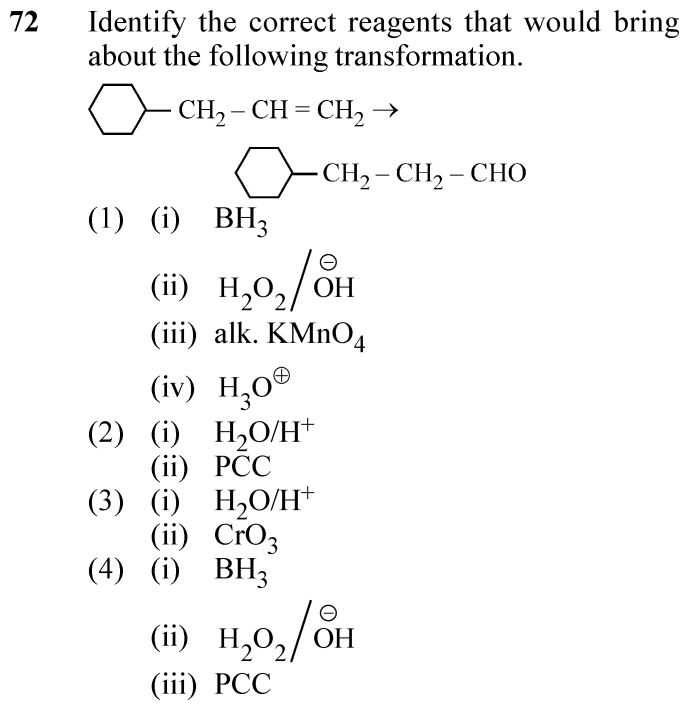
Option (4) : (i) BH3, (ii) H2O2 / OH⁻, (iii) PCC
📚 Aldehydes, Ketones and Carboxylic Acids Medium
📋 Given Parameters & Problem Setup
Starting material 3-cyclohexylprop-1-ene (Cyclohexyl-CH2-CH=CH2)
Target product 3-cyclohexylpropanal (Cyclohexyl-CH2-CH2-CHO)
⚡

The 30-Second Exam Hall Shortcut: ⚡ Anti-Markovnikov Hydration + Mild Oxidation Route

⏱️ Save ~45 seconds

Terminal Alkene -> Primary Alcohol via Hydroboration-Oxidation (BH3, then H2O2/OH⁻), followed by PCC to halt oxidation at the ALDEHYDE stage!

1 The transformation converts a terminal alkene (-CH=CH2) into an aldehyde (-CH2-CHO).
2 Step 1 must install an -OH group at the TERMINAL carbon (anti-Markovnikov addition of water).
3 Acid-catalyzed hydration (H2O / H⁺) would give a secondary alcohol via Markovnikov rule (ruling out Options 2 and 3).
4 Hydroboration-oxidation: (i) BH3 followed by (ii) alkaline H2O2 produces the primary alcohol 3-cyclohexylpropan-1-ol.
5 Step 2 requires selective oxidation of the 1° alcohol to an aldehyde. Alkaline KMnO4 in Option (1) over-oxidizes it to a carboxylic acid!
6 Pyridinium chlorochromate (PCC) cleanly stops oxidation at the aldehyde.
7 Sequence: (i) BH3, (ii) H2O2/OH⁻, (iii) PCC -> Option (4) in 10 seconds!
🛡️
Why You Can 100% Trust This Shortcut: NCERT Chemistry · Aldehydes, Ketones and Carboxylic Acids (Preparation of aldehydes by oxidation of primary alcohols using PCC and hydroboration-oxidation).
📐

Step-by-Step Rigorous Workflow & Mathematical Proof

Step 1

Regioselective Anti-Markovnikov Hydration

Reaction of 3-cyclohexylprop-1-ene with borane (BH3) proceeds with syn-addition across the double bond, with boron attaching to the less hindered terminal carbon. Subsequent oxidation with alkaline hydrogen peroxide (H2O2 / OH⁻) replaces boron with a hydroxyl group with retention of stereochemistry, yielding the primary alcohol 3-cyclohexylpropan-1-ol:

R−CH2−CH=CH2→(i) BH3,  (ii) H2O2/OH⊖R−CH2−CH2−CH2OHR{-}\text{CH}_2{-}\text{CH}=\text{CH}_2 \xrightarrow{\text{(i) } \text{BH}_3, \; \text{(ii) } \text{H}_2\text{O}_2/\text{OH}^\ominus} R{-}\text{CH}_2{-}\text{CH}_2{-}\text{CH}_2\text{OH}
Step 2

Controlled Oxidation to Aldehyde using PCC

Primary alcohols are easily over-oxidized to carboxylic acids in aqueous acidic or alkaline media. Pyridinium chlorochromate (PCC, C5H5NH⁺ ClCrO3⁻) in anhydrous dichloromethane (CH2Cl2) selectively oxidizes primary alcohols to aldehydes without further oxidation:

R−CH2−CH2−CH2OH→PCCR−CH2−CH2−CHOR{-}\text{CH}_2{-}\text{CH}_2{-}\text{CH}_2\text{OH} \xrightarrow{\text{PCC}} R{-}\text{CH}_2{-}\text{CH}_2{-}\text{CHO}
Step 3

Evaluating Failure of Distractor Reagent Pathways

Option (1) uses alkaline KMnO4 which oxidizes primary alcohols completely to carboxylic acids (-COOH). Options (2) and (3) use H2O/H⁺ which follows Markovnikov addition to yield a secondary alcohol, which upon oxidation produces a ketone rather than an aldehyde.

H2O/H⊕  ⟹  Markovnikov 2° alcohol→PCCKetone (wrong product)\text{H}_2\text{O}/\text{H}^\oplus \implies \text{Markovnikov 2° alcohol} \xrightarrow{\text{PCC}} \text{Ketone (wrong product)}
⭐

360° Option Elimination Engine Key Feature

Diagnose every choice: Know exactly why the right option works and why distractors fail.

4-Option Deep Scan
1 (1)
✗ Incorrect
Verdict & Scientific Reason:

Alkaline KMnO4 vigorously oxidizes primary alcohols to carboxylic acids, not aldehydes.

⚠️
Student Fallacy (Why candidates pick this trap): Overlooking that KMnO4 is too strong to stop at the aldehyde.
2 (2)
✗ Incorrect
Verdict & Scientific Reason:

Acid-catalyzed hydration gives a secondary alcohol, which oxidizes to a ketone.

⚠️
Student Fallacy (Why candidates pick this trap): Forgetting Markovnikov regioselectivity.
3 (3)
✗ Incorrect
Verdict & Scientific Reason:

Produces a ketone due to Markovnikov hydration.

⚠️
Student Fallacy (Why candidates pick this trap): Ignoring carbocation rearrangement and Markovnikov addition.
4 (4)
✓ 100% Correct
Verdict & Scientific Reason:

Anti-Markovnikov hydration yields 1° alcohol; anhydrous PCC mildly oxidizes it to aldehyde.

💡
Why this is airtight: None.
⚠️

NTA Trap Alert: Markovnikov vs Anti-Markovnikov Choice

To obtain an aldehyde from an alkene, the oxygen must attach to the terminal carbon. Only hydroboration-oxidation gives anti-Markovnikov addition of water.

🛡️ How to avoid the -1 mark: Terminal alkene -> Aldehyde requires BH3/H2O2 + PCC. Terminal alkene -> Ketone uses H3O+ + oxidant.
📖

Core NEET Syllabus Standard

Chemistry Core Organic Chemistry · Aldehydes, Ketones and Carboxylic Acids Standard Benchmark
Core Scientific Principle Tested:

"Hydroboration-oxidation converts terminal alkenes into primary alcohols, which are selectively converted into aldehydes using PCC in non-aqueous medium."

Syllabus Focus: Selective Oxidation of Alcohols to Aldehydes (PCC Reagent)
✓ Core NEET UG Syllabus Anchor Syllabus & Academic Standards ↗
Hydroborate to terminal OH, PCC stops oxidation at the CHO!
NEET 2024 · Q74 Easy
Official NEET 2024 Question 74 - Aldehydes, Ketones and Carboxylic Acids
1
2
3 ✓ Key
4
💡 Verified Solution & 30-Second Hack
✓
Verified Against NTA Final Answer Key
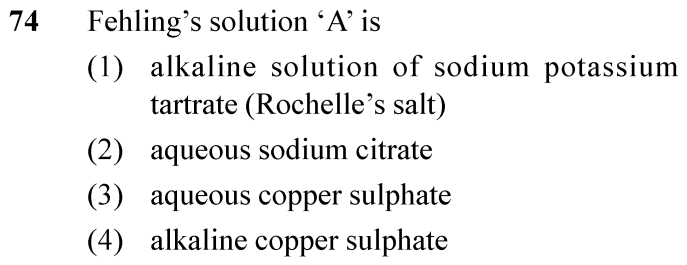
Option (3) : aqueous copper sulphate
📚 Aldehydes, Ketones and Carboxylic Acids Easy
📋 Given Parameters & Problem Setup
Reagent Fehling’s solution ‘A’
⚡

The 30-Second Exam Hall Shortcut: ⚡ Fehling A & B Direct Definition

⏱️ Save ~25 seconds

Fehling A = Aqueous Copper Sulphate (CuSO4)! Fehling B = Alkaline Sodium Potassium Tartrate (Rochelle’s salt)!

1 Fehling’s reagent is supplied as two separate stable stock solutions mixed in equal volumes prior to testing.
2 Fehling’s solution A is an aqueous solution of copper(II) sulphate (blue, CuSO4·5H2O).
3 Fehling’s solution B is an alkaline solution of sodium potassium tartrate (Rochelle’s salt + NaOH).
4 The question specifically asks for Fehling’s solution ‘A’ -> aqueous copper sulphate.
5 Option (3) in 2 seconds!
🛡️
Why You Can 100% Trust This Shortcut: NCERT Chemistry · Aldehydes, Ketones and Carboxylic Acids (Chemical tests to distinguish aldehydes: Fehling’s test).
📐

Step-by-Step Rigorous Workflow & Mathematical Proof

Step 1

Definition and Composition of Fehling’s Reagents

Fehling’s test is a standard diagnostic test used to detect aliphatic aldehydes and reducing sugars. The reagent comprises two separate solutions: - Fehling’s solution A: Aqueous copper(II) sulphate (CuSO4 · 5H2O), imparting a bright blue colour. - Fehling’s solution B: An alkaline solution containing sodium potassium tartrate (Rochelle’s salt, KOOC-CH(OH)-CH(OH)-COONa) and sodium hydroxide (NaOH).

Fehling’s A=aq. CuSO4,Fehling’s B=Alkaline Rochelle’s Salt\text{Fehling's A} = \text{aq. CuSO}_4, \quad \text{Fehling's B} = \text{Alkaline Rochelle's Salt}
Step 2

Role of Tartrate in Fehling’s Solution

When solutions A and B are mixed just prior to use, tartrate acts as a bidentate/chelating ligand for Cu²⁺ ions. This chelation prevents the premature precipitation of copper(II) hydroxide (Cu(OH)2) in strongly alkaline medium:

Cu2++2  Tartrate2−⇌[Cu(tartrate)2]2−  (Deep blue soluble complex)\text{Cu}^{2+} + 2\;\text{Tartrate}^{2-} \rightleftharpoons [\text{Cu}(\text{tartrate})_2]^{2-} \; (\text{Deep blue soluble complex})
Step 3

Redox Reaction with Aldehydes

Upon heating with an aliphatic aldehyde, Cu²⁺ is reduced to Cu⁺, forming a characteristic red-brown precipitate of copper(I) oxide (Cu2O):

R−CHO+2Cu2++5OH⊖⟶R−COO⊖+Cu2O↓(red)+3H2OR{-}\text{CHO} + 2\text{Cu}^{2+} + 5\text{OH}^\ominus \longrightarrow R{-}\text{COO}^\ominus + \text{Cu}_2\text{O}\downarrow (\text{red}) + 3\text{H}_2\text{O}
⭐

360° Option Elimination Engine Key Feature

Diagnose every choice: Know exactly why the right option works and why distractors fail.

4-Option Deep Scan
1 (1)
✗ Incorrect
Verdict & Scientific Reason:

This is the exact definition of Fehling’s solution B, not A.

⚠️
Student Fallacy (Why candidates pick this trap): Swapping solution A with solution B.
2 (2)
✗ Incorrect
Verdict & Scientific Reason:

Citrate is the complexing agent in Benedict’s reagent, not Fehling’s.

⚠️
Student Fallacy (Why candidates pick this trap): Confusing Fehling’s reagent with Benedict’s reagent.
3 (3)
✓ 100% Correct
Verdict & Scientific Reason:

Verbatim NCERT definition of Fehling’s solution A.

💡
Why this is airtight: None.
4 (4)
✗ Incorrect
Verdict & Scientific Reason:

Copper sulphate alone in alkali precipitates immediately as Cu(OH)2; alkali is in solution B with tartrate.

⚠️
Student Fallacy (Why candidates pick this trap): Assuming copper sulphate is alkaline in bottle A.
⚠️

NTA Trap Alert: Swapping Fehling A and Fehling B

Option (1) describes Fehling B (Rochelle’s salt). Solution A is always the simple blue copper sulphate solution.

🛡️ How to avoid the -1 mark: A is Aqua/Blue (CuSO4); B is Basic/Buffer (Rochelle’s salt + Base).
📖

Core NEET Syllabus Standard

Chemistry Core Organic Chemistry · Aldehydes, Ketones and Carboxylic Acids Standard Benchmark
Core Scientific Principle Tested:

"Fehling’s solution A is aqueous copper sulphate; Fehling’s solution B is alkaline sodium potassium tartrate."

Syllabus Focus: Oxidation Reactions of Aldehydes: Fehling’s Test
✓ Core NEET UG Syllabus Anchor Syllabus & Academic Standards ↗
A is Aqueous Copper blue; B is Basic Rochelle through!
NEET 2024 · Q92 Easy
Official NEET 2024 Question 92 - Aldehydes, Ketones and Carboxylic Acids
1
2
3
4 ✓ Key
💡 Verified Solution & 30-Second Hack
✓
Verified Against NTA Final Answer Key
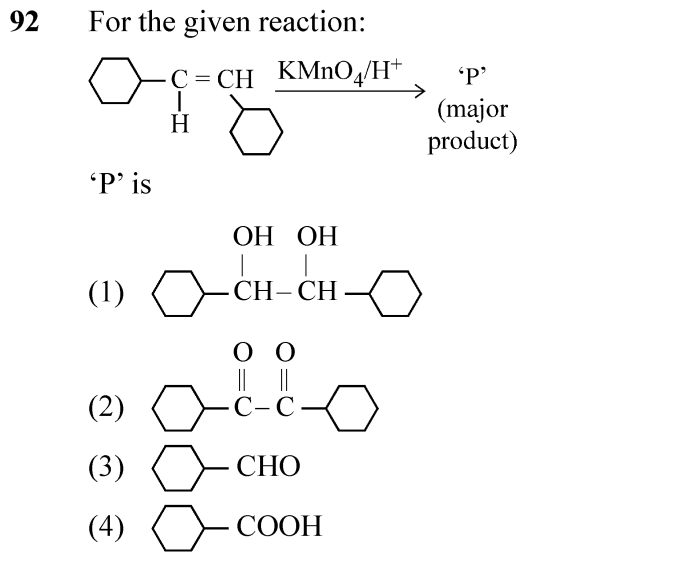
Option (4) : Cyclohexanecarboxylic acid (Cyclohexyl-COOH)
📚 Aldehydes, Ketones and Carboxylic Acids Easy
📋 Given Parameters & Problem Setup
Starting reactant 1,2-dicyclohexylethene (Cyclohexyl-CH=CH-Cyclohexyl)
Reagent Hot acidic potassium permanganate (KMnO4 / H⁺)
⚡

The 30-Second Exam Hall Shortcut: ⚡ Alkene Oxidative Cleavage Rule

⏱️ Save ~35 seconds

Hot acidic KMnO4 completely cleaves C=C! =CH-R groups oxidize to carboxylic acid (-COOH)! Symmetrical Cyclohexyl-CH=CH-Cyclohexyl cleaves into 2 molecules of Cyclohexanecarboxylic acid!

1 Identify the alkene: Cyclohexyl-CH=CH-Cyclohexyl (symmetrical 1,2-disubstituted alkene).
2 Recall vigorous oxidation with hot acidic KMnO4 / H⁺:
3 - =CH2 oxidizes to CO2 + H2O.
4 - =CH-R oxidizes to carboxylic acid (R-COOH).
5 - =CR2 oxidizes to ketone (R-CO-R).
6 Here, each side of the double bond is a -CH(Cyclohexyl) group.
7 Cleavage of the double bond oxidizes both halves to cyclohexanecarboxylic acid (Cyclohexyl-COOH).
8 Match Option (4) in 5 seconds!
🛡️
Why You Can 100% Trust This Shortcut: NCERT Chemistry · Aldehydes, Ketones and Carboxylic Acids (Preparation of carboxylic acids by oxidation of alkenes using acidic potassium permanganate).
📐

Step-by-Step Rigorous Workflow & Mathematical Proof

Step 1

Nature of the Oxidizing Reagent

Acidic potassium permanganate (KMnO4 / H⁺) is a potent, vigorous oxidizing agent that causes oxidative cleavage of carbon-carbon double bonds. Unlike cold dilute alkaline KMnO4 (Baeyer’s reagent) which performs syn-dihydroxylation, hot acidic KMnO4 completely ruptures both the σ and π components of the alkene:

R−CH=CH−R→KMnO4/H⊕,  Δ2  R−COOHR{-}\text{CH}=\text{CH}{-}R \xrightarrow{\text{KMnO}_4 / \text{H}^\oplus, \; \Delta} 2\; R{-}\text{COOH}
Step 2

Oxidative Fate of Alkene Carbon Atoms

The products of oxidative cleavage depend on the substitution of the alkene carbons: 1. Disubstituted carbon (=CR2) yields a ketone (R2C=O). 2. Monosubstituted carbon (=CHR) is oxidized past the aldehyde stage directly to a carboxylic acid (R-COOH). 3. Terminal methylene (=CH2) is oxidized to formic acid, which is rapidly oxidized further to CO2 and H2O.

=CH−R→[O]R−CHO→fast [O]R−COOH=\text{CH}{-}\text{R} \xrightarrow{[\text{O}]} R{-}\text{CHO} \xrightarrow{\text{fast } [\text{O}]} R{-}\text{COOH}
Step 3

Application to 1,2-Dicyclohexylethene

The substrate possesses two identical monosubstituted alkene carbons bonded to cyclohexyl rings. Cleavage of the central double bond produces two equivalents of cyclohexanecarboxylic acid:

Cyclohexyl−CH=CH−Cyclohexyl→KMnO4/H⊕2  Cyclohexyl−COOH(Product P)\text{Cyclohexyl}{-}\text{CH}=\text{CH}{-}\text{Cyclohexyl} \xrightarrow{\text{KMnO}_4 / \text{H}^\oplus} 2\;\text{Cyclohexyl}{-}\text{COOH} \quad (\text{Product P})
⭐

360° Option Elimination Engine Key Feature

Diagnose every choice: Know exactly why the right option works and why distractors fail.

4-Option Deep Scan
1 (1)
✗ Incorrect
Verdict & Scientific Reason:

Formed with cold alkaline KMnO4 (Baeyer’s reagent), not hot acidic KMnO4.

⚠️
Student Fallacy (Why candidates pick this trap): Confusing hot acidic KMnO4 with Baeyer’s dihydroxylation.
2 (2)
✗ Incorrect
Verdict & Scientific Reason:

Mild oxidation intermediate; under acidic KMnO4, the C-C bond cleaves completely.

⚠️
Student Fallacy (Why candidates pick this trap): Assuming C-C bond remains intact.
3 (3)
✗ Incorrect
Verdict & Scientific Reason:

Formed by reductive ozonolysis (O3 / Zn-H2O); KMnO4 over-oxidizes aldehydes to carboxylic acids.

⚠️
Student Fallacy (Why candidates pick this trap): Confusing KMnO4 oxidation with reductive ozonolysis.
4 (4)
✓ 100% Correct
Verdict & Scientific Reason:

Exact product of vigorous permanganate cleavage of a 1,2-disubstituted alkene.

💡
Why this is airtight: None.
⚠️

NTA Trap Alert: Confusing Acidic KMnO4 with Ozonolysis or Baeyer’s Reagent

O3/Zn gives aldehyde (Option 3); cold KMnO4 gives diol (Option 1); hot acidic KMnO4 gives carboxylic acid (Option 4)!

🛡️ How to avoid the -1 mark: Hot acidic KMnO4 = Total double bond cleavage all the way to carboxylic acid.
📖

Core NEET Syllabus Standard

Chemistry Core Organic Chemistry · Aldehydes, Ketones and Carboxylic Acids Standard Benchmark
Core Scientific Principle Tested:

"Alkenes with =CH-R groups undergo oxidative cleavage by acidic potassium permanganate to yield carboxylic acids R-COOH."

Syllabus Focus: Preparation of Carboxylic Acids: Oxidative Cleavage of Alkenes
✓ Core NEET UG Syllabus Anchor Syllabus & Academic Standards ↗
Acidic permanganate cuts the bond clean: =CH-R turns to acid unseen!
NEET 2023 · Q64 Medium
Official NEET 2023 Question 64 - Aldehydes, Ketones and Carboxylic Acids
1 ✓ Key
2
3
4
💡 Verified Solution & 30-Second Hack
✓
Verified Against NTA Final Answer Key
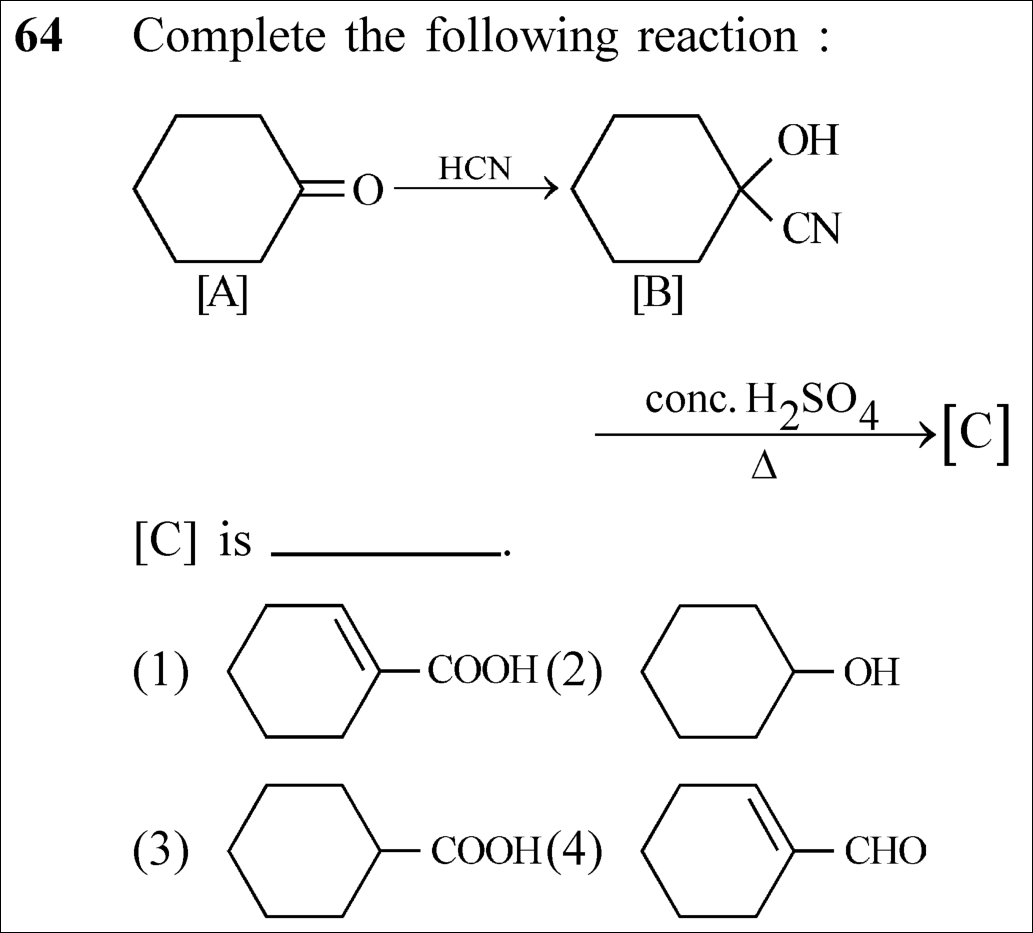
Option (1) : Cyclohex-1-enecarboxylic acid
📚 Aldehydes, Ketones and Carboxylic Acids Medium
📋 Given Parameters & Problem Setup
Substrate [A] Cyclohexanone
Reagent 1 HCN (Nucleophilic addition)
Intermediate [B] 1-Hydroxycyclohexanecarbonitrile (Cyanohydrin)
Reagent 2 Conc. H₂SO₄, heat (Hydrolysis + Dehydration)
⚡

The 30-Second Exam Hall Shortcut: ⚡ Dual Transformation Hack: -CN ⟶ -COOH and -OH ⟶ C=C

⏱️ Save ~45 seconds

HCN adds to cyclohexanone to form cyanohydrin [B]. Hot conc. H₂SO₄ accomplishes TWO things at once: hydrolyzes -CN to -COOH AND dehydrates -OH to an endocyclic double bond ⟹ Cyclohex-1-enecarboxylic acid in 15 seconds!

1 Step 1: Nucleophilic addition of HCN across the carbonyl group of cyclohexanone yields 1-hydroxycyclohexanecarbonitrile (cyanohydrin [B]).
2 Step 2: Reaction with hot concentrated sulfuric acid (conc. H₂SO₄, Δ) causes two simultaneous reactions:
3 - Acidic hydrolysis: The nitrile group -CN is completely hydrolyzed into a carboxylic acid group -COOH.
4 - Acid-catalyzed dehydration: Conc. H₂SO₄ is a powerful dehydrating agent that removes the tertiary -OH group and an adjacent ring α-hydrogen (H₂O loss) to form a conjugated C=C double bond.
5 The product is an α,β-unsaturated carboxylic acid: cyclohex-1-enecarboxylic acid.
6 Lock Option (1) immediately!
🛡️
Why You Can 100% Trust This Shortcut: Organic Reaction Mechanisms · Nitrile Hydrolysis and Alcohol Dehydration (Conc. H₂SO₄ with heat simultaneously converts nitriles into carboxylic acids and secondary/tertiary alcohols into alkenes).
📐

Step-by-Step Rigorous Workflow & Mathematical Proof

Step 1

Nucleophilic Addition of HCN to Cyclohexanone (Formation of [B])

Cyanide ion (:CN⁻) attacks the electrophilic carbonyl carbon of cyclohexanone, followed by protonation of the alkoxide intermediate to yield the cyanohydrin, 1-hydroxycyclohexanecarbonitrile [B]:

C6H10O+HCN⟶C6H10(OH)(CN)(Intermediate [B])\text{C}_6\text{H}_{10}\text{O} + \text{HCN} \longrightarrow \text{C}_6\text{H}_{10}(\text{OH})(\text{CN}) \quad (\text{Intermediate }[B])
Step 2

Acidic Hydrolysis of the Nitrile Functionality

In the presence of concentrated sulfuric acid and water at elevated temperature, the nitrile group undergoes complete hydrolysis through an amide intermediate to a carboxylic acid (-COOH):

−C≡N+2H2O+H+→Δ−COOH+NH4+-\text{C}\equiv\text{N} + 2\text{H}_2\text{O} + \text{H}^+ \xrightarrow{\Delta} -\text{COOH} + \text{NH}_4^+
Step 3

Acid-Catalyzed Dehydration by Concentrated H₂SO₄

Under the hot, strongly acidic conditions of concentrated H₂SO₄, the tertiary alcohol hydroxyl group is protonated to form -OH₂⁺ and departs. Concurrently, a proton is eliminated from an adjacent ring carbon (C-2) to yield a thermodynamically stabilized α,β-unsaturated carboxylic acid:

C6H10(OH)(COOH)→conc. H2SO4, ΔCyclohex-1-enecarboxylic acid+H2O\text{C}_6\text{H}_{10}(\text{OH})(\text{COOH}) \xrightarrow{\text{conc. } \text{H}_2\text{SO}_4, \, \Delta} \text{Cyclohex-1-enecarboxylic acid} + \text{H}_2\text{O}
Step 4

Identification of Final Product [C]

The structure of product [C] consists of a cyclohexene ring with the carboxylic acid group directly attached to the sp²-hybridized alkene carbon, matching Option (1).

[C]=Cyclohex-1-enecarboxylic acid[C] = \text{Cyclohex-1-enecarboxylic acid}
⭐

360° Option Elimination Engine Key Feature

Diagnose every choice: Know exactly why the right option works and why distractors fail.

4-Option Deep Scan
1 (1)
✓ 100% Correct
Verdict & Scientific Reason:

Accurate product resulting from both nitrile hydrolysis to -COOH and ring dehydration to an alkene.

💡
Why this is airtight: None. Candidate accounted for both hydrolysis and dehydration.
2 (2)
✗ Incorrect
Verdict & Scientific Reason:

Corresponds to simple reduction of cyclohexanone, completely ignoring HCN and H₂SO₄.

⚠️
Student Fallacy (Why candidates pick this trap): Wild guess unrelated to the chemical reagents.
3 (3)
✗ Incorrect
Verdict & Scientific Reason:

Saturated acid: assumes hydrolysis occurred but dehydration of -OH was overlooked.

⚠️
Student Fallacy (Why candidates pick this trap): Candidate forgot that hot concentrated H₂SO₄ is a powerful dehydrating agent that eliminates -OH.
4 (4)
✗ Incorrect
Verdict & Scientific Reason:

Contains an aldehyde (-CHO) group instead of a carboxylic acid (-COOH).

⚠️
Student Fallacy (Why candidates pick this trap): Candidate confused full acidic hydrolysis of nitrile with partial DIBAL-H reduction.
⚠️

NTA Trap Alert: Forgetting Dehydration by Concentrated Sulfuric Acid

Many candidates remember that nitriles hydrolyze to carboxylic acids, but forget that CONCENTRATED H₂SO₄ WITH HEAT is a classic dehydrating agent. Overlooking dehydration leads to picking saturated cyclohexanecarboxylic acid (Option 3).

🛡️ How to avoid the -1 mark: Whenever you see "conc. H₂SO₄ + Δ" with an alcohol, eliminate water to form an alkene!
📖

Core NEET Syllabus Standard

National Eligibility cum Entrance Test (NEET UG) · Aldehydes, Ketones and Carboxylic Acids Standard Benchmark
Core Scientific Principle Tested:

"Cyanohydrins undergo acid hydrolysis to give α-hydroxy acids, which readily undergo dehydration under hot conc. H₂SO₄ to give α,β-unsaturated acids."

Syllabus Focus: Reactions of Carbonyl Compounds – Cyanohydrin Formation and Reactions
Preserved in Rationalized Curriculum Syllabus & Academic Standards ↗
NEET 2023 · Q71 Easy
Official NEET 2023 Question 71 - Aldehydes, Ketones and Carboxylic Acids
1
2 ✓ Key
3
4
💡 Verified Solution & 30-Second Hack
✓
Verified Against NTA Final Answer Key
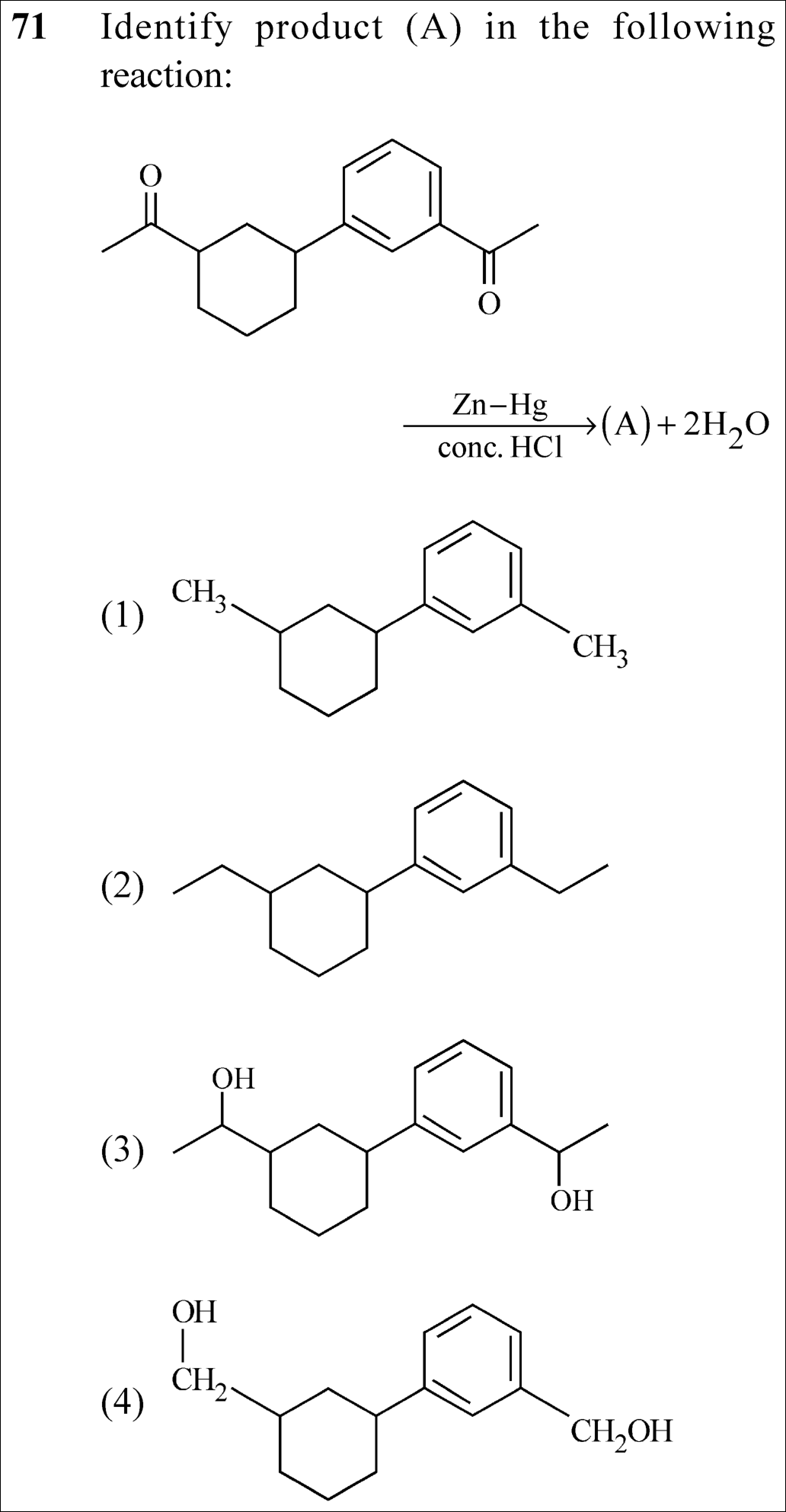
Option (2) : Di-ethyl substituted product (Both -COCH₃ reduced to -CH₂CH₃)
📚 Aldehydes, Ketones and Carboxylic Acids Easy
📋 Given Parameters & Problem Setup
Substrate Compound containing two acetyl groups (–COCH₃): one on cyclohexyl ring, one on benzene ring
Reagent Zn–Hg / conc. HCl (Clemmensen reduction)
Byproduct stated 2 H₂O
⚡

The 30-Second Exam Hall Shortcut: ⚡ Clemmensen Carbonyl-to-Methylene Rule: >C=O ⟶ >CH₂

⏱️ Save ~35 seconds

Clemmensen reduction (Zn-Hg / conc. HCl) converts every ketone group >C=O into a methylene group >CH₂! Thus both –COCH₃ (acetyl) groups become –CH₂CH₃ (ethyl) groups in 10 seconds! (Option 2)

1 Identify the reducing reagent: Zn-Hg in concentrated HCl is the classic CLEMMENSEN REDUCTION.
2 Recall what Clemmensen reduction does: It selectively deoxygenates aldehydes and ketones into hydrocarbons: >C=O ⟶ >CH₂.
3 Inspect the functional groups in the substrate:
4 - Acetyl group on cyclohexyl ring: –COCH₃ ⟶ –CH₂CH₃ (ethyl group).
5 - Acetyl group on benzene ring: –COCH₃ ⟶ –CH₂CH₃ (ethyl group).
6 Carbon count per group: Each –COCH₃ has 2 carbons and becomes an ethyl group –CH₂CH₃ (2 carbons).
7 Option (1) has methyl groups (lost a carbon, wrong). Option (3) has alcohol groups (wrong reagent).
8 Option (2) contains both ethyl groups and is the exact correct product!
9 Lock Option (2) immediately!
🛡️
Why You Can 100% Trust This Shortcut: Organic Functional Group Transformations · Clemmensen Reduction (Zinc amalgam and hydrochloric acid reduce the carbonyl group of aldehydes and ketones to a CH₂ group with loss of H₂O).
📐

Step-by-Step Rigorous Workflow & Mathematical Proof

Step 1

Identification of Reaction Type and Mechanism

The reaction utilizes zinc amalgam in concentrated hydrochloric acid (Zn–Hg / conc. HCl), which is the standard protocol for the Clemmensen reduction. This heterogeneous single-electron transfer reduction converts carbonyl groups (>C=O) of aldehydes and ketones directly into methylene groups (>CH₂):

R−CO−R′+4[H]→Zn-Hg / conc. HClR−CH2−R′+H2O\text{R}-\overset{\text{O}}{\text{C}}-\text{R}' + 4[\text{H}] \xrightarrow{\text{Zn-Hg / conc. HCl}} \text{R}-\text{CH}_2-\text{R}' + \text{H}_2\text{O}
Step 2

Transformation of the Alicyclic Carbonyl Group

The acetyl group attached to the cyclohexyl ring is converted into an ethyl group:

−C(=O)CH3→Zn-Hg / conc. HCl−CH2CH3(Ethyl substituent)-\text{C}(=\text{O})\text{CH}_3 \xrightarrow{\text{Zn-Hg / conc. HCl}} -\text{CH}_2\text{CH}_3 \quad (\text{Ethyl substituent})
Step 3

Transformation of the Aromatic Carbonyl Group

Similarly, the acetyl group attached to the meta position of the benzene ring is reduced to an ethyl group:

−C(=O)CH3→Zn-Hg / conc. HCl−CH2CH3(Ethyl substituent)-\text{C}(=\text{O})\text{CH}_3 \xrightarrow{\text{Zn-Hg / conc. HCl}} -\text{CH}_2\text{CH}_3 \quad (\text{Ethyl substituent})
Step 4

Overall Stoichiometry and Final Product Formula

Both ketone groups are fully reduced, producing 2 moles of H₂O as explicitly stated in the balanced equation. The final product features ethyl groups at both positions on the unchanged ring skeletons, corresponding identically to Option (2).

Product (A)=1-ethyl-3-(3-ethylcyclohexyl)benzene\text{Product (A)} = \text{1-ethyl-3-(3-ethylcyclohexyl)benzene}
⭐

360° Option Elimination Engine Key Feature

Diagnose every choice: Know exactly why the right option works and why distractors fail.

4-Option Deep Scan
1 (1)
✗ Incorrect
Verdict & Scientific Reason:

Loss of a carbon atom: –COCH₃ contains 2 carbons, so it cannot become a 1-carbon –CH₃ group.

⚠️
Student Fallacy (Why candidates pick this trap): Candidate forgot that the carbonyl carbon itself is reduced to CH₂, retaining both carbons as –CH₂CH₃.
2 (2)
✓ 100% Correct
Verdict & Scientific Reason:

Accurate product: Clemmensen reduction transforms both –COCH₃ groups into –CH₂CH₃ groups.

💡
Why this is airtight: None. Candidate tracked carbon counts and Clemmensen selectivity.
3 (3)
✗ Incorrect
Verdict & Scientific Reason:

Represents partial reduction by NaBH₄ or LiAlH₄, not complete deoxygenation by Zn-Hg/HCl.

⚠️
Student Fallacy (Why candidates pick this trap): Candidate confused Clemmensen reduction with hydride reduction to alcohols.
4 (4)
✗ Incorrect
Verdict & Scientific Reason:

Incorrect structure with wrong carbon count and wrong oxidation state.

⚠️
Student Fallacy (Why candidates pick this trap): Candidate drew an unphysical partial reduction product.
⚠️

NTA Trap Alert: Counting Carbons: Turning –COCH₃ into –CH₃ Instead of –CH₂CH₃

A common slip is thinking the ketone "disappears" leaving only the methyl group (Option 1). Remember that the carbonyl carbon does NOT leave; it gets hydrogenated into a –CH₂– group, forming –CH₂–CH₃ (ethyl).

🛡️ How to avoid the -1 mark: Count total carbons: –C(=O)CH₃ has TWO carbons. In the product, it must have TWO carbons: –CH₂CH₃!
📖

Core NEET Syllabus Standard

National Eligibility cum Entrance Test (NEET UG) · Aldehydes, Ketones and Carboxylic Acids Standard Benchmark
Core Scientific Principle Tested:

"The carbonyl group of aldehydes and ketones is reduced to CH₂ group on treatment with zinc amalgam and concentrated hydrochloric acid."

Syllabus Focus: Reduction of Carbonyl Compounds – Clemmensen Reduction
Preserved in Rationalized Curriculum Syllabus & Academic Standards ↗
NEET 2023 · Q92 Medium
Official NEET 2023 Question 92 - Aldehydes, Ketones and Carboxylic Acids
1
2
3
4 ✓ Key
💡 Verified Solution & 30-Second Hack
✓
Verified Against NTA Final Answer Key
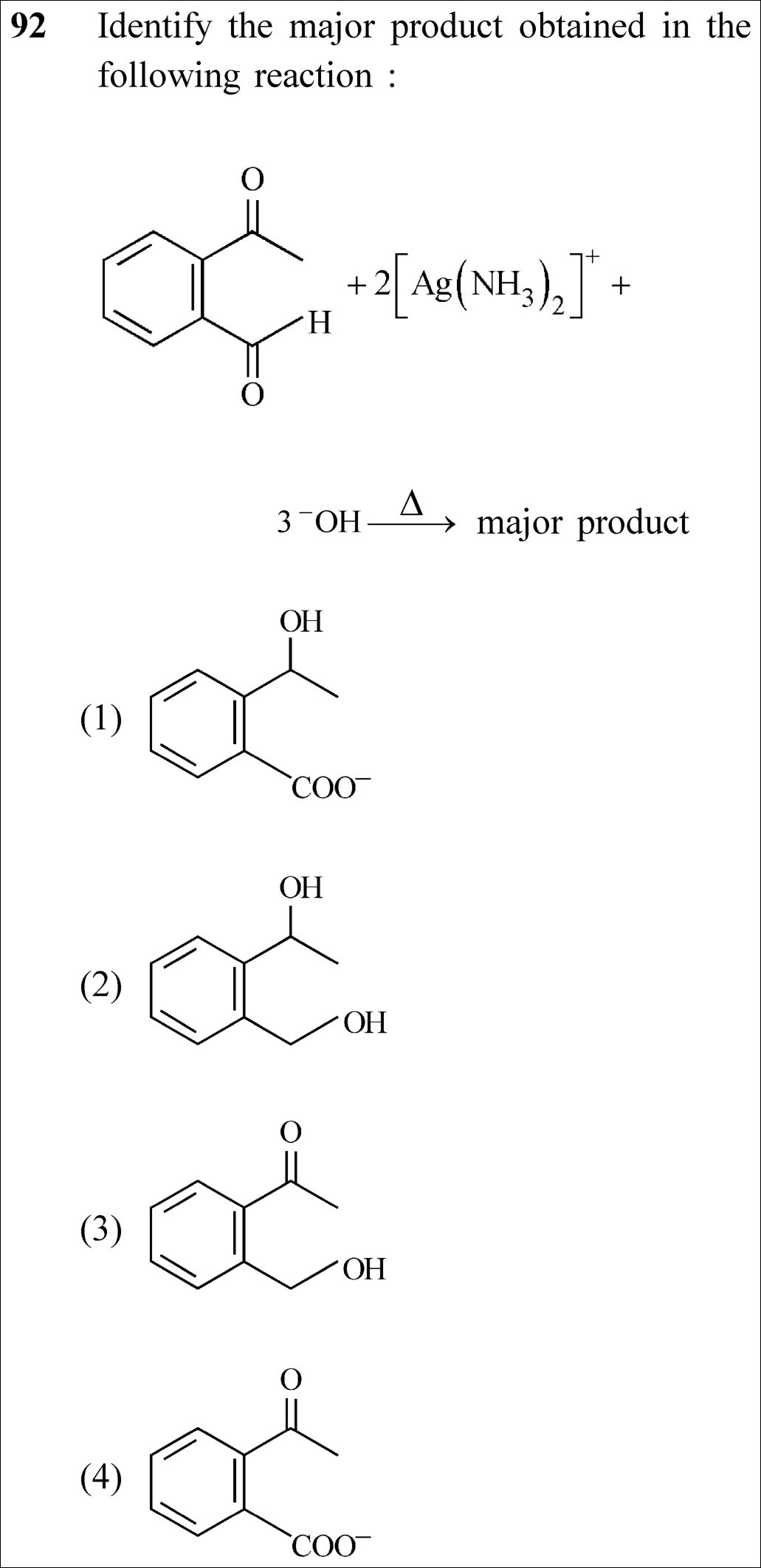
Option (4) : Ortho-acetylbenzoate (ketone unchanged, aldehyde oxidized to -COO⁻)
📚 Aldehydes, Ketones and Carboxylic Acids Medium
📋 Given Parameters & Problem Setup
Substrate Ortho-formylacetophenone (benzene ring with ortho -COCH₃ and -CHO)
Reagent 2 [Ag(NH₃)₂]⁺ + 3 OH⁻ (Tollens’ reagent) with heat
Reaction type Mild chemoselective oxidation
⚡

The 30-Second Exam Hall Shortcut: ⚡ Chemoselective Reagent Filter: Tollens’ Oxidizes –CHO to –COO⁻, Leaves Ketone (–COCH₃) Untouched!

⏱️ Save ~35 seconds

Tollens’ reagent [Ag(NH₃)₂]⁺ is a mild, selective oxidizing agent that oxidizes aldehydes (–CHO ⟶ –COO⁻) but cannot oxidize ketones! Therefore, the –CHO group becomes –COO⁻, and the –COCH₃ group remains 100% intact. Option (4) is immediately selected in 5 seconds!

1 Identify functional groups on benzene ring: one ketone (–COCH₃) and one aldehyde (–CHO).
2 Identify reagent: [Ag(NH₃)₂]⁺ in alkaline medium is Tollens’ reagent.
3 Recall selectivity: Tollens’ reagent selectively oxidizes –CHO to carboxylate –COO⁻.
4 Ketones (aliphatic or aromatic) do NOT react with Tollens’ reagent.
5 Expected product retains –COCH₃ and has –COO⁻ (Option 4).
🛡️
Why You Can 100% Trust This Shortcut: Classical carbonyl differentiation test and mild oxidation selectivity in NCERT Organic Chemistry.
📐

Step-by-Step Rigorous Workflow & Mathematical Proof

Step 1

Identify Functional Groups of the Reactant

The reactant is 2-acetylbenzaldehyde, containing two different carbonyl functional groups on adjacent positions of a benzene ring: an aldehyde (–CHO) and a methyl ketone (–COCH₃):

Reactant: o-C6H4(COCH3)(CHO)\text{Reactant: } o\text{-}\text{C}_6\text{H}_4(\text{COCH}_3)(\text{CHO})
Step 2

Evaluate Reagent and Reaction Conditions

Ammoniacal silver nitrate solution [Ag(NH₃)₂]⁺ in the presence of base (OH⁻) is Tollens’ reagent, a classic mild oxidizing agent:

2[Ag(NH3)2]++3OH−(Tollens’ Reagent)2[\text{Ag}(\text{NH}_3)_2]^+ + 3\text{OH}^- \quad (\text{Tollens' Reagent})
Step 3

Chemoselective Oxidation Mechanism

Tollens’ reagent readily oxidizes the formyl group (–CHO) to the corresponding carboxylate anion (–COO⁻) while metallic silver is precipitated as a silver mirror:

R–CHO+2[Ag(NH3)2]++3OH−→ΔR–COO−+2Ag↓+4NH3+2H2O\text{R–CHO} + 2[\text{Ag}(\text{NH}_3)_2]^+ + 3\text{OH}^- \xrightarrow{\Delta} \text{R–COO}^- + 2\text{Ag}\downarrow + 4\text{NH}_3 + 2\text{H}_2\text{O}
Step 4

Inertness of the Ketone Carbonyl Group

Under these mild basic oxidizing conditions, ketones do not have an oxidizable hydrogen atom on the carbonyl carbon and remain completely unreacted. The –COCH₃ group persists unchanged in the product:

Product: o-C6H4(COCH3)(COO−)(Matching Option 4)\text{Product: } o\text{-}\text{C}_6\text{H}_4(\text{COCH}_3)(\text{COO}^-) \quad (\text{Matching Option 4})
⭐

360° Option Elimination Engine Key Feature

Diagnose every choice: Know exactly why the right option works and why distractors fail.

4-Option Deep Scan
1 (1)
✗ Incorrect
Verdict & Scientific Reason:

The ketone is not reduced under Tollens’ oxidation conditions.

⚠️
Student Fallacy (Why candidates pick this trap): Candidate incorrectly assumed Tollens’ reagent reduces ketones to alcohols.
2 (2)
✗ Incorrect
Verdict & Scientific Reason:

Neither group undergoes reduction; Tollens’ is an oxidizing agent, not a reducing hydride.

⚠️
Student Fallacy (Why candidates pick this trap): Candidate confused Tollens’ reagent with LiAlH₄ reduction.
3 (3)
✗ Incorrect
Verdict & Scientific Reason:

Aldehyde is oxidized to carboxylate, not reduced to primary alcohol.

⚠️
Student Fallacy (Why candidates pick this trap): Candidate treated the aldehyde as being reduced to alcohol.
4 (4)
✓ 100% Correct
Verdict & Scientific Reason:

Accurate: Chemoselective oxidation of aldehyde to carboxylate while ketone remains completely intact.

💡
Why this is airtight: None. Candidate correctly recognized the chemoselectivity of Tollens’ reagent.
⚠️

NTA Trap Alert: Confusing Redox Reagents (Oxidation vs Reduction)

Some students see [Ag(NH₃)₂]⁺ and confuse it with complex metal hydrides (NaBH₄ or LiAlH₄), mistakenly drawing reduced alcohol groups. Tollens’ is an OXIDIZING agent that converts –CHO to –COO⁻.

🛡️ How to avoid the -1 mark: Remember: Tollens’ reagent oxidizes aldehydes to carboxylate; it never reduces carbonyl groups!
📖

Core NEET Syllabus Standard

National Eligibility cum Entrance Test (NEET UG) · Aldehydes, Ketones and Carboxylic Acids Standard Benchmark
Core Scientific Principle Tested:

"Tollens’ reagent selectively oxidizes aldehydes to carboxylate anions without affecting ketonic carbonyls."

Syllabus Focus: Oxidation of Aldehydes and Ketones – Tollens’ Test
Preserved in Rationalized Curriculum Syllabus & Academic Standards ↗
NEET 2021 · Q92 Easy
Official NEET 2021 Question 92 - Aldehydes, Ketones and Carboxylic Acids
1 ✓ Key
2
3
4
💡 Verified Solution & 30-Second Hack
✓
Verified Against NTA Final Answer Key
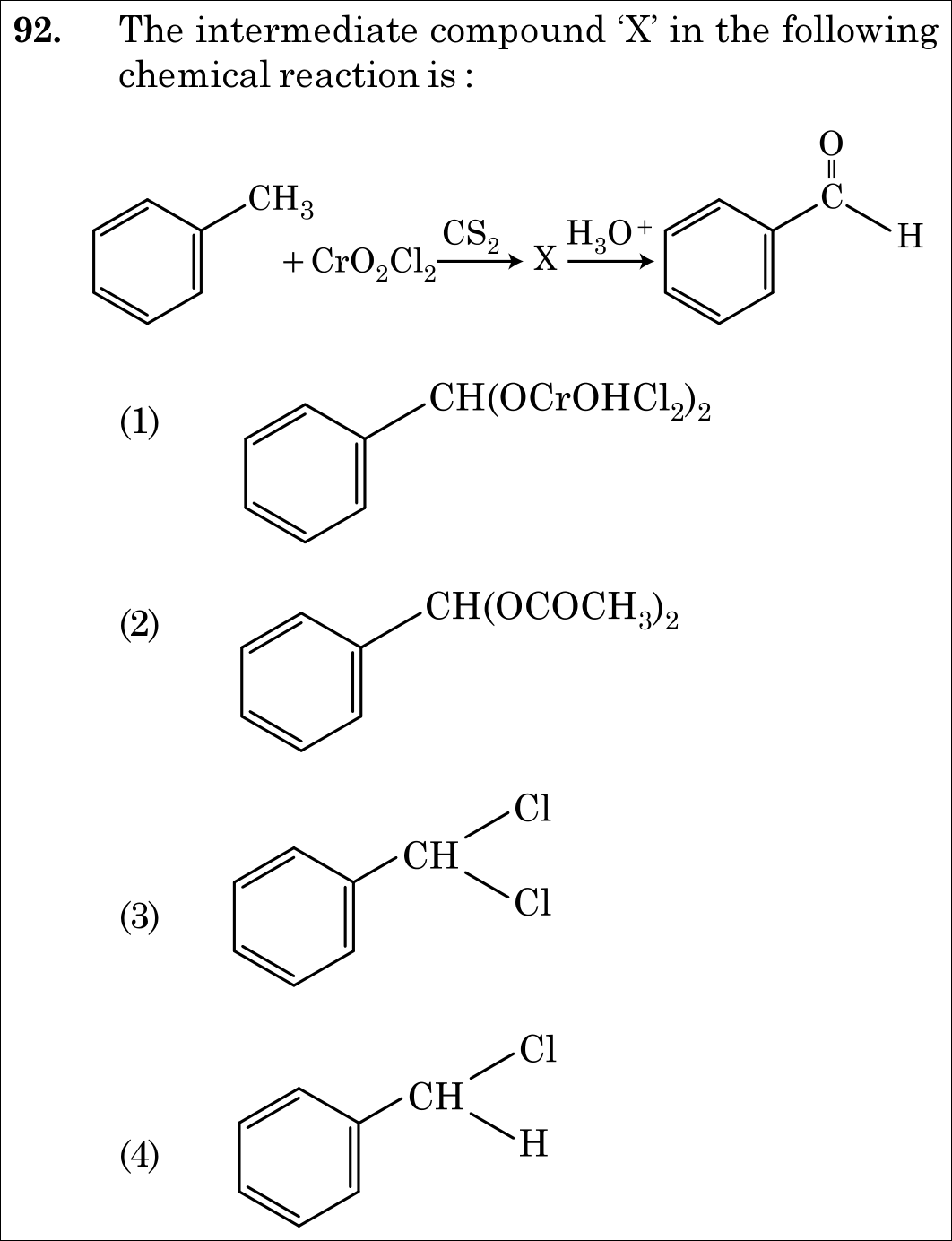
Option (1) : Ph-CH(OCrOHCl2)2 (Structure 1)
📚 Aldehydes, Ketones and Carboxylic Acids Easy
📋 Given Parameters & Problem Setup
Substrate Toluene (C6H5CH3)
Reagent Chromyl chloride (CrO2Cl2) in CS2
Final Product Benzaldehyde (C6H5CHO) upon aqueous hydrolysis (H3O+)
⚡

The 30-Second Exam Hall Shortcut: ⚡ Étard Reaction Intermediate: Brown Chromium Complex Ph-CH(OCrOHCl2)2

⏱️ Save ~20 seconds

Verbatim NCERT Aldehydes: Chromyl chloride (CrO2Cl2CrO_2Cl_2) oxidizes the methyl group of toluene in CS2CS_2 solvent to form a brown chromium complex intermediate C6H5−CH(OCrOHCl2)2C_6H_5-CH(OCrOHCl_2)_2, which upon acidic hydrolysis yields benzaldehyde. This uniquely matches Structure (1)! Match Option (1)!

1 Recognize the classic Étard reaction: Toluene →CrO2Cl2/CS2X→H3O+C6H5CHO\xrightarrow{CrO_2Cl_2 / CS_2} X \xrightarrow{H_3O^+} C_6H_5CHO.
2 Chromyl chloride (CrO2Cl2CrO_2Cl_2) reacts with the methyl group to insert into two C−HC-H bonds.
3 The structure of the intermediate is the brown chromium complex: C6H5−CH(OCrOHCl2)2C_6H_5-CH(OCrOHCl_2)_2.
4 Match Structure (1).
5 Structure (2) is benzylidene diacetate formed with CrO3/(CH3CO)2OCrO_3 / (CH_3CO)_2O; Structure (3) is benzal chloride.
🛡️
Why You Can 100% Trust This Shortcut: Canonical NCERT Aldehydes, Ketones and Carboxylic Acids named reaction (Étard Reaction).
📐

Step-by-Step Rigorous Workflow & Mathematical Proof

Step 1

Identification of the Named Reaction

The oxidation of toluene to benzaldehyde using chromyl chloride (CrO2Cl2CrO_2Cl_2) dissolved in carbon disulfide (CS2CS_2) or carbon tetrachloride (CCl4CCl_4), followed by aqueous hydrolysis, is the Étard Reaction.

Step 2

Mechanism of Formation of Intermediate X

Chromyl chloride is a mild oxidizing agent that selectively oxidizes the benzylic methyl group without over-oxidizing the ring to benzoic acid. Two moles of CrO2Cl2CrO_2Cl_2 react with one mole of toluene to form a distinctive brown precipitated chromium complex:

C6H5CH3+2 CrO2Cl2→CS2C6H5−CH(OCrOHCl2)2(Intermediate X)C_6H_5CH_3 + 2\,\text{CrO}_2\text{Cl}_2 \xrightarrow{\text{CS}_2} C_6H_5-\text{CH}(\text{OCrOHCl}_2)_2 \quad (\mathbf{\text{Intermediate X}})
Step 3

Aqueous Acid Hydrolysis to Benzaldehyde

Hydrolysis of this complex in acidic water (H3O+H_3O^+) cleaves the Cr−OCr-O and C−OC-O bonds, releasing chromium(III) inorganic salts and furnishing benzaldehyde:

C6H5−CH(OCrOHCl2)2→H3O+C6H5CHO+2 Cr(OH)2Cl2C_6H_5-\text{CH}(\text{OCrOHCl}_2)_2 \xrightarrow{\text{H}_3\text{O}^+} C_6H_5\text{CHO} + 2\,\text{Cr(OH)}_2\text{Cl}_2
⭐

360° Option Elimination Engine Key Feature

Diagnose every choice: Know exactly why the right option works and why distractors fail.

4-Option Deep Scan
1 1
✓ 100% Correct
Verdict & Scientific Reason:

Verbatim NCERT formula and structure for the Étard reaction chromium complex.

💡
Why this is airtight: None; textbook organic named reaction intermediate recall.
2 2
✗ Incorrect
Verdict & Scientific Reason:

This gem-diacetate intermediate is formed when toluene is oxidized by chromium trioxide in acetic anhydride (CrO3/Ac2OCrO_3 / Ac_2O), not chromyl chloride.

⚠️
Student Fallacy (Why candidates pick this trap): Confusing Étard reaction with CrO3/Ac2OCrO_3 / Ac_2O oxidation.
3 3
✗ Incorrect
Verdict & Scientific Reason:

Benzal chloride, formed by side-chain free-radical chlorination (Cl2/hνCl_2 / h\nu), not Étard oxidation.

⚠️
Student Fallacy (Why candidates pick this trap): Confusing Étard reaction with photochemical chlorination.
4 4
✗ Incorrect
Verdict & Scientific Reason:

Benzyl chloride, not formed in the Étard reaction.

⚠️
Student Fallacy (Why candidates pick this trap): Assuming single chlorination of benzylic carbon.
⚠️

NTA Trap Alert: Étard Complex vs. Gem-Diacetate Intermediate Trap

NCERT presents two methods for commercial preparation of benzaldehyde from toluene: 1. CrO2Cl2CrO_2Cl_2 in CS2  ⟹  C6H5CH(OCrOHCl2)2CS_2 \implies C_6H_5CH(OCrOHCl_2)_2 (Étard reaction, Option 1). 2. CrO3CrO_3 in (CH3CO)2O  ⟹  C6H5CH(OCOCH3)2(CH_3CO)_2O \implies C_6H_5CH(OCOCH_3)_2 (Benzylidene diacetate, Option 2). Candidates who mix up the reagents select Option 2.

🛡️ How to avoid the -1 mark: CrO2Cl2CrO_2Cl_2 contains chromium and chlorine   ⟹  \implies intermediate MUST contain CrCr and ClCl: C6H5CH(OCrOHCl2)2C_6H_5CH(OCrOHCl_2)_2.
📖

Core NEET Syllabus Standard

NCERT Chemistry · Aldehydes, Ketones and Carboxylic Acids Standard Benchmark
Core Scientific Principle Tested:

"Chromyl chloride oxidizes the methyl group to a brown chromium complex C6H5CH(OCrOHCl2)2, which on hydrolysis yields benzaldehyde."

Syllabus Focus: Preparation of Aldehydes (From Hydrocarbons - Étard Reaction)
✓ Core NEET UG Syllabus Anchor Syllabus & Academic Standards ↗
NEET 2021 · Q95 Easy
Official NEET 2021 Question 95 - Aldehydes, Ketones and Carboxylic Acids
1
2
3 ✓ Key
4
💡 Verified Solution & 30-Second Hack
✓
Verified Against NTA Final Answer Key
Option (3) : CaO
📚 Aldehydes, Ketones and Carboxylic Acids Easy
📋 Given Parameters & Problem Setup
Reactant Sodium propanoate (CH3CH2COO- Na+)
Reagent Combination NaOH + ? / Heat
Products Ethane (CH3CH3) + Na2CO3
⚡

The 30-Second Exam Hall Shortcut: ⚡ Soda Lime = NaOH + CaO in 3:1 Ratio

⏱️ Save ~15 seconds

Decarboxylation of sodium salts of carboxylic acids to alkanes requires heating with soda lime, which is a 3:13:1 solid mixture of sodium hydroxide (NaOH\text{NaOH}) and calcium oxide (CaO\text{CaO}). The prompt presents NaOH+?→ΔEthane+Na2CO3\text{NaOH} + ? \xrightarrow{\Delta} \text{Ethane} + Na_2CO_3. The missing component is CaO! Match Option (3)!

1 Inspect reaction: CH3CH2COONa→NaOH+?/ΔCH3CH3+Na2CO3CH_3CH_2COONa \xrightarrow{\text{NaOH} + ? / \Delta} CH_3CH_3 + Na_2CO_3.
2 The carboxylate carbon is eliminated as carbonate (Na2CO3Na_2CO_3), producing an alkane with one fewer carbon atom.
3 This is the classic soda-lime decarboxylation reaction (Dumas reaction).
4 Soda lime is composed of NaOH\text{NaOH} and CaO\text{CaO}.
5 Therefore, the missing chemical is CaO\text{CaO} (calcium oxide / quicklime).
6 Match Option (3).
🛡️
Why You Can 100% Trust This Shortcut: Canonical NCERT Carboxylic Acids and Hydrocarbons preparation of alkanes.
📐

Step-by-Step Rigorous Workflow & Mathematical Proof

Step 1

Identifying the Decarboxylation Reaction

When sodium salts of carboxylic acids are heated strongly with soda lime, they undergo decarboxylation (loss of carbon dioxide) to form an alkane containing one less carbon atom than the parent carboxylic acid: R−COO−Na++NaOH→CaO,ΔR−H+Na2CO3R-COO^-Na^+ + \text{NaOH} \xrightarrow{\text{CaO}, \Delta} R-H + Na_2CO_3

Step 2

Applying to Sodium Propanoate

Here, sodium propanoate (CH3CH2COONaCH_3CH_2COONa, 3 carbons) is heated to produce ethane (CH3CH3CH_3CH_3, 2 carbons) and sodium carbonate:

CH3CH2COO−Na++NaOH→ΔCaOCH3CH3+Na2CO3CH_3CH_2COO^-Na^+ + \text{NaOH} \xrightarrow[\Delta]{\mathbf{CaO}} CH_3CH_3 + Na_2CO_3
Step 3

Role of Calcium Oxide (CaO) in Soda Lime

In soda lime (3NaOH:1CaO3\text{NaOH} : 1\text{CaO}): 1. CaO\text{CaO} keeps the reaction mixture dry by absorbing atmospheric moisture (NaOH\text{NaOH} is deliquescent and would turn into a sticky liquid). 2. It raises the fusion temperature, allowing the reaction mixture to be heated to high temperatures without melting glass containers.

⭐

360° Option Elimination Engine Key Feature

Diagnose every choice: Know exactly why the right option works and why distractors fail.

4-Option Deep Scan
1 1
✗ Incorrect
Verdict & Scientific Reason:

Diborane is a reducing agent that reduces carboxylic acids to primary alcohols, not soda lime component.

⚠️
Student Fallacy (Why candidates pick this trap): Confusing reduction with decarboxylation.
2 2
✗ Incorrect
Verdict & Scientific Reason:

Red phosphorus is used with HIHI for reduction or with X2X_2 in the Hell-Volhard-Zelinsky (HVZ) α\alpha-halogenation reaction.

⚠️
Student Fallacy (Why candidates pick this trap): Confusing HVZ reaction with decarboxylation.
3 3
✓ 100% Correct
Verdict & Scientific Reason:

Exact partner of NaOH\text{NaOH} constituting soda lime (NaOH+CaO\text{NaOH} + \text{CaO}) for decarboxylation.

💡
Why this is airtight: None; textbook organic synthesis recall.
4 4
✗ Incorrect
Verdict & Scientific Reason:

Diisobutylaluminium hydride reduces esters/nitriles to aldehydes at low temperature (−78∘C-78^\circ\text{C}).

⚠️
Student Fallacy (Why candidates pick this trap): Confusing organoaluminium hydride with soda lime.
⚠️

NTA Trap Alert: Decarboxylation Reagents vs. HVZ Reagents Trap

Students frequently mix up the reagents for carboxylic acid reactions: - Decarboxylation: NaOH+CaO\text{NaOH} + \text{CaO} (Soda lime) - α\alpha-Halogenation (HVZ): X2/Red PX_2 / \text{Red P} - Reduction to alkane: HI/Red PHI / \text{Red P} at 200∘C200^\circ\text{C}

🛡️ How to avoid the -1 mark: NaOH+⋯  ⟹  \text{NaOH} + \dots \implies Soda Lime   ⟹  \implies Missing reagent is CaO\text{CaO}.
📖

Core NEET Syllabus Standard

NCERT Chemistry · Aldehydes, Ketones and Carboxylic Acids Standard Benchmark
Core Scientific Principle Tested:

"Carboxylic acids lose carbon dioxide to form hydrocarbons when their sodium salts are heated with soda lime (NaOH and CaO in the ratio 3:1)."

Syllabus Focus: Chemical Reactions of Carboxylic Acids (Decarboxylation)
✓ Core NEET UG Syllabus Anchor Syllabus & Academic Standards ↗
NEET 2021 · Q96 Easy
Official NEET 2021 Question 96 - Aldehydes, Ketones and Carboxylic Acids
1
2
3
4 ✓ Key
💡 Verified Solution & 30-Second Hack
✓
Verified Against NTA Final Answer Key
Option (4) : (a)-(ii), (b)-(iii), (c)-(iv), (d)-(i)
📚 Aldehydes, Ketones and Carboxylic Acids Easy
📋 Given Parameters & Problem Setup
Reaction (a) Benzene + CO, HCl / Anhyd. AlCl3, CuCl -> Benzaldehyde
Reaction (b) R-CO-CH3 + NaOX -> RCOONa + CHX3
Reaction (c) R-CH2-OH + R'COOH / Conc. H2SO4 -> R'COOCH2R + H2O
Reaction (d) R-CH2COOH / (i) X2, Red P (ii) H2O -> R-CH(X)COOH
⚡

The 30-Second Exam Hall Shortcut: ⚡ 4-Second Named Reaction Mapping

⏱️ Save ~25 seconds

(a) Benzene + CO,HCl/AlCl3  ⟹  CO, HCl / AlCl_3 \implies Gattermann-Koch reaction (ii). (b) Methyl ketone + NaOX  ⟹  NaOX \implies Haloform reaction (iii). (c) Alcohol + Carboxylic acid / H2SO4  ⟹  H_2SO_4 \implies Esterification (iv). (d) α\alpha-Halogenation of acid via X2/Red P  ⟹  X_2 / \text{Red P} \implies Hell-Volhard-Zelinsky (HVZ) reaction (i). Sequence: (a)-(ii), (b)-(iii), (c)-(iv), (d)-(i)   ⟹  \implies Option (4)!

1 Reaction (a): Formylation of benzene with CO+HClCO + HCl catalyzed by AlCl3/CuClAlCl_3 / CuCl is the Gattermann-Koch reaction -> (ii).
2 Reaction (b): Oxidation of methyl ketone by sodium hypohalite (NaOXNaOX) to haloform (CHX3CHX_3) is the Haloform reaction -> (iii).
3 Reaction (c): Acid-catalyzed condensation of alcohol and carboxylic acid to ester is Fischer Esterification -> (iv).
4 Reaction (d): Halogenation at the α\alpha-position of carboxylic acid with X2/Red PX_2 / \text{Red P} followed by hydrolysis is the Hell-Volhard-Zelinsky (HVZ) reaction -> (i).
5 Match (a)-(ii), (b)-(iii), (c)-(iv), (d)-(i).
6 Match Option (4).
🛡️
Why You Can 100% Trust This Shortcut: Canonical named reactions in NCERT Aldehydes, Ketones and Carboxylic Acids.
📐

Step-by-Step Rigorous Workflow & Mathematical Proof

Step 1

Analyzing Reaction (a): Gattermann-Koch Reaction

When benzene or its derivative is treated with carbon monoxide (COCO) and hydrogen chloride (HClHCl) in the presence of anhydrous aluminium chloride (AlCl3AlCl_3) and cuprous chloride (CuClCuCl), benzaldehyde is formed. This is the Gattermann-Koch reaction: C6H6+CO+HCl→Anhyd. AlCl3/CuClC6H5CHO+HCl  ⟹  (a)-(ii)deliveryC_6H_6 + CO + HCl \xrightarrow{\text{Anhyd. } AlCl_3 / CuCl} C_6H_5CHO + HCl \implies \mathbf{\text{(a)-(ii)}} delivery

Step 2

Analyzing Reaction (b): Haloform Reaction

Aldehydes and ketones having at least one methyl group linked to the carbonyl carbon atom (methyl ketones, RCOCH3RCOCH_3) are oxidized by sodium hypohalite (NaOXNaOX) to sodium salts of corresponding carboxylic acids having one carbon atom less, while the methyl group is converted to haloform (CHX3CHX_3). This is the Haloform reaction: R−CO−CH3+3 NaOX⟶RCOONa+CHX3↓+2 NaOH  ⟹  (b)-(iii)R-CO-CH_3 + 3\,NaOX \longrightarrow RCOONa + CHX_3\downarrow + 2\,NaOH \implies \mathbf{\text{(b)-(iii)}}

Step 3

Analyzing Reaction (c): Esterification

Carboxylic acids react with alcohols in the presence of a mineral acid catalyst (such as concentrated sulfuric acid) to form esters with elimination of water. This is Esterification: R′COOH+R−CH2−OH⇌Conc. H2SO4R′COOCH2R+H2O  ⟹  (c)-(iv)R'COOH + R-CH_2-OH \xrightleftharpoons{\text{Conc. } H_2SO_4} R'COOCH_2R + H_2O \implies \mathbf{\text{(c)-(iv)}}

Step 4

Analyzing Reaction (d): Hell-Volhard-Zelinsky (HVZ) Reaction

Carboxylic acids having an α\alpha-hydrogen are halogenated at the α\alpha-position on treatment with chlorine or bromine in the presence of a small amount of red phosphorus, followed by hydrolysis, yielding α\alpha-halocarboxylic acids. This is the Hell-Volhard-Zelinsky reaction: R−CH2−COOH→(ii) H2O(i) X2/Red PR−CH(X)−COOH  ⟹  (d)-(i)R-CH_2-COOH \xrightarrow[\text{(ii) } H_2O]{\text{(i) } X_2 / \text{Red P}} R-CH(X)-COOH \implies \mathbf{\text{(d)-(i)}}

⭐

360° Option Elimination Engine Key Feature

Diagnose every choice: Know exactly why the right option works and why distractors fail.

4-Option Deep Scan
1 1
✗ Incorrect
Verdict & Scientific Reason:

Mismatches all reactions completely.

⚠️
Student Fallacy (Why candidates pick this trap): Random guessing.
2 2
✗ Incorrect
Verdict & Scientific Reason:

Pairs benzene formylation with haloform reaction.

⚠️
Student Fallacy (Why candidates pick this trap): Inverting reaction labels.
3 3
✗ Incorrect
Verdict & Scientific Reason:

Pairs Gattermann-Koch with HVZ reaction.

⚠️
Student Fallacy (Why candidates pick this trap): Confusing formylation with α\alpha-halogenation.
4 4
✓ 100% Correct
Verdict & Scientific Reason:

Flawless 1-to-1 match of all four named reactions with their canonical textbook definitions.

💡
Why this is airtight: None; rigorous organic named reaction mastery.
⚠️

NTA Trap Alert: Gattermann vs. Gattermann-Koch Reaction Trap

Do not confuse Gattermann reaction (diazonium salt +Cu/HCl→Ar−Cl+ Cu / HCl \to Ar-Cl) with Gattermann-Koch reaction (benzene +CO+HCl/AlCl3→Ar−CHO+ CO + HCl / AlCl_3 \to Ar-CHO). The presence of carbon monoxide (COCO) confirms Gattermann-Koch.

🛡️ How to avoid the -1 mark: COCO is present   ⟹  \implies Gattermann-KOCH reaction.
📖

Core NEET Syllabus Standard

NCERT Chemistry · Aldehydes, Ketones and Carboxylic Acids Standard Benchmark
Core Scientific Principle Tested:

"Gattermann-Koch introduces formyl group onto benzene; Haloform oxidizes methyl ketones; Esterification forms esters; HVZ halogenates alpha-position of carboxylic acids."

Syllabus Focus: Named Organic Reactions of Carbonyl Compounds and Carboxylic Acids
✓ Core NEET UG Syllabus Anchor Syllabus & Academic Standards ↗
NEET 2021 · Q97 Medium
Official NEET 2021 Question 97 - Aldehydes, Ketones and Carboxylic Acids
1
2
3
4 ✓ Key
💡 Verified Solution & 30-Second Hack
✓
Verified Against NTA Final Answer Key
Option (4) : Structure (4) (Ketone reduced to secondary alcohol; ester intact)
📚 Aldehydes, Ketones and Carboxylic Acids Medium
📋 Given Parameters & Problem Setup
Substrate Bifunctional compound with cyclohexanone (ketone) and methyl ester (-CH2COOCH3)
Reducing Agent NaBH4 in C2H5OH
⚡

The 30-Second Exam Hall Shortcut: ⚡ NaBH4 Reduces Aldehydes & Ketones ONLY — Esters Are Immune!

⏱️ Save ~20 seconds

Sodium borohydride (NaBH4NaBH_4) is a mild, chemoselective reducing agent that readily reduces ketones to secondary alcohols (−OH-OH) but is completely unreactive toward esters (−COOCH3-COOCH_3), carboxylic acids, and amides under standard conditions! Thus, the cyclohexanone C=OC=O reduces to −OH-OH, while the −CH2COOCH3-CH_2COOCH_3 ester group remains completely intact! This corresponds to Structure (4)! Match Option (4)!

1 Identify functional groups on the substrate: - Ring ketone (C=OC=O on cyclohexanone ring) - Side-chain methyl ester (−CH2−COOCH3-CH_2-COOCH_3).
2 Identify reagent selectivity: NaBH4NaBH_4 in ethanol is a selective reducing agent. - Aldehydes →1∘\to 1^\circ alcohols - Ketones →2∘\to 2^\circ alcohols - Esters →\to NO REACTION.
3 Ring ketone reduces to secondary alcohol (−OH-OH).
4 Ester group (−CH2−COOCH3-CH_2-COOCH_3) remains completely untouched.
5 Match Structure (4).
🛡️
Why You Can 100% Trust This Shortcut: Canonical NCERT chemoselectivity principle: NaBH4 reduces aldehydes/ketones, not esters.
📐

Step-by-Step Rigorous Workflow & Mathematical Proof

Step 1

Identifying Functional Groups and Their Electrophilicity

The reactant molecule contains two carbonyl-containing functional groups: 1. A cyclic ketone group located on the cyclohexane ring. 2. An aliphatic methyl ester group (−CH2COOCH3-CH_2COOCH_3) on the side chain. The carbonyl carbon of a ketone is significantly more electrophilic than the carbonyl carbon of an ester because the ester oxygen atom donates electron density through resonance into the carbonyl π∗\pi^* orbital (R−C(=O)−OCH3↔R−C(O−)=O+CH3R-C(=O)-OCH_3 \leftrightarrow R-C(O^-)=O^+CH_3).

Step 2

Reactivity Profile of Sodium Borohydride (NaBH4)

Sodium borohydride (NaBH4NaBH_4) is a mild hydride donor. Due to the lower nucleophilicity of the [BH4]−[BH_4]^- ion compared to [AlH4]−[AlH_4]^- (LiAlH4LiAlH_4): - NaBH4NaBH_4 readily reduces aldehydes and ketones to primary and secondary alcohols, respectively. - Under standard conditions in alcoholic solvent (C2H5OHC_2H_5OH), NaBH4NaBH_4 does not reduce esters, carboxylic acids, or amides.

Step 3

Determining the Structure of the Product

- The cyclic ketone (C=OC=O) is smoothly converted to a secondary alcohol group (−OH-OH). - The ester group (−CH2COOCH3-CH_2COOCH_3) survives untouched. - This chemoselective transformation corresponds precisely to Structure (4).

⭐

360° Option Elimination Engine Key Feature

Diagnose every choice: Know exactly why the right option works and why distractors fail.

4-Option Deep Scan
1 1
✗ Incorrect
Verdict & Scientific Reason:

Shows reduction of the ester group into a geminal hydroxy ether / hemiacetal, which does not occur with NaBH4NaBH_4.

⚠️
Student Fallacy (Why candidates pick this trap): Assuming NaBH4NaBH_4 reduces esters partially.
2 2
✗ Incorrect
Verdict & Scientific Reason:

Shows the ketone untouched while the ester is reduced to an alcohol, which is the exact inverse of true chemical selectivity.

⚠️
Student Fallacy (Why candidates pick this trap): Inverting functional group reactivity.
3 3
✗ Incorrect
Verdict & Scientific Reason:

Shows an impossible methylated diol product with loss of oxygen.

⚠️
Student Fallacy (Why candidates pick this trap): Confusing hydride reduction with Grignard alkylation.
4 4
✓ 100% Correct
Verdict & Scientific Reason:

Exact chemoselective product: cyclic ketone reduced to secondary alcohol (−OH-OH), ester (−COOCH3-COOCH_3) intact.

💡
Why this is airtight: None; rigorous hydride chemoselectivity mastery.
⚠️

NTA Trap Alert: LiAlH4 vs. NaBH4 Chemoselectivity Trap

Lithium aluminium hydride (LiAlH4LiAlH_4) is a powerful non-selective reducing agent that reduces BOTH ketones and esters (producing a diol). Sodium borohydride (NaBH4NaBH_4) is milder and strictly SELECTIVE: it reduces the ketone but LEAVES THE ESTER INTACT.

🛡️ How to avoid the -1 mark: NaBH4NaBH_4 + Ester   ⟹  \implies NO REACTION! Only the ketone reacts.
📖

Core NEET Syllabus Standard

NCERT Chemistry · Aldehydes, Ketones and Carboxylic Acids Standard Benchmark
Core Scientific Principle Tested:

"NaBH4 selectively reduces aldehydes and ketones to alcohols without affecting esters or carboxylic acids."

Syllabus Focus: Reduction of Carbonyl Compounds (Chemoselectivity of NaBH4 vs LiAlH4)
✓ Core NEET UG Syllabus Anchor Syllabus & Academic Standards ↗
NEET 2020 · Q95 Easy
Official NEET 2020 Question 95 - Aldehydes, Ketones and Carboxylic Acids
1
2
3 ✓ Key
4
💡 Verified Solution & 30-Second Hack
✓
Verified Against NTA Final Answer Key
Option (3) : C6H5-CHCl2 (Benzal chloride)
📚 Aldehydes, Ketones and Carboxylic Acids Easy
📋 Given Parameters & Problem Setup
Starting Material Toluene (C6H5-CH3)
Step 1 Reagents Cl2 / hν (Free radical side-chain chlorination)
Step 2 Reagents H2O at 373 K (Aqueous hydrolysis)
Final Product Benzaldehyde (C6H5-CHO)
Question Objective Identify compound X in the reaction sequence
⚡

The 30-Second Exam Hall Shortcut: ⚡ "Toluene + Cl2/hν -> C6H5-CHCl2 (Benzal Chloride) -> H2O/373K -> Benzaldehyde!"

⏱️ 20 seconds

Commercial preparation of Benzaldehyde: Side chain chlorination of toluene gives Benzal chloride (C6H5−CHCl2C_6H_5-CHCl_2). Hydrolysis of benzal chloride gives an unstable gem-diol (C6H5−CH(OH)2C_6H_5-CH(OH)_2), which spontaneously loses water to yield Benzaldehyde (C6H5−CHOC_6H_5-CHO). Thus, intermediate X is Benzal chloride! Mark Option (3) in 5 seconds.

1 Toluene + Cl2 / hν -> C6H5-CH2Cl (Benzyl chloride) with 1 eq Cl2.
2 Controlled chlorination with 2 eq Cl2 -> C6H5-CHCl2 (Benzal chloride) = Intermediate X.
3 Hydrolysis: C6H5-CHCl2 + 2 H2O -> [C6H5-CH(OH)2] -> C6H5-CHO + H2O.
4 Thus, X is Benzal chloride (C6H5-CHCl2).
5 Select Option (3).
🛡️
Why You Can 100% Trust This Shortcut: NCERT Chemistry · Aldehydes, Ketones and Carboxylic Acids (Preparation of Aldehydes: By Side Chain Chlorination Followed by Hydrolysis)
📐

Step-by-Step Rigorous Workflow & Mathematical Proof

Step 1

Side Chain Chlorination of Toluene

Under photochemical conditions (light/heat), toluene undergoes free radical substitution at the benzylic methyl group rather than electrophilic ring chlorination: C6H5-CH3+2Cl2→hνC6H5-CHCl2+2HCl\text{C}_6\text{H}_5\text{-CH}_3 + 2\text{Cl}_2 \xrightarrow{h\nu} \text{C}_6\text{H}_5\text{-CHCl}_2 + 2\text{HCl} The compound formed is benzal chloride (benzylidene chloride, XX).

Step 2

Hydrolysis of Benzal Chloride

Nucleophilic substitution of the two geminal chlorine atoms by water at 373 K yields an unstable gem-diol intermediate: C6H5-CHCl2+2H2O→373 K[C6H5-CH(OH)2]+2HCl\text{C}_6\text{H}_5\text{-CHCl}_2 + 2\text{H}_2\text{O} \xrightarrow{373\text{ K}} [\text{C}_6\text{H}_5\text{-CH(OH)}_2] + 2\text{HCl}

Step 3

Spontaneous Dehydration to Benzaldehyde

Geminal diols attached to the same carbon are thermodynamically unstable and spontaneously undergo elimination of a water molecule: [C6H5-CH(OH)2]→−H2OC6H5-CHO (Benzaldehyde)[\text{C}_6\text{H}_5\text{-CH(OH)}_2] \xrightarrow{-\text{H}_2\text{O}} \text{C}_6\text{H}_5\text{-CHO (Benzaldehyde)}

Step 4

Identify Candidate Structure

Option (1) is Benzotrichloride (C6H5−CCl3C_6H_5-CCl_3, which would give Benzoic acid upon hydrolysis); Option (2) is Benzyl chloride (C6H5−CH2ClC_6H_5-CH_2Cl, which yields Benzyl alcohol); Option (3) is Benzal chloride (C6H5−CHCl2C_6H_5-CHCl_2). Hence, X is Option (3).

⭐

360° Option Elimination Engine Key Feature

Diagnose every choice: Know exactly why the right option works and why distractors fail.

4-Option Deep Scan
1 A
✗ Incorrect
Verdict & Scientific Reason:

Incorrect; hydrolysis of benzotrichloride gives benzoic acid (C6H5−COOHC_6H_5-COOH), not benzaldehyde.

⚠️
Student Fallacy (Why candidates pick this trap): Assuming exhaustive chlorination occurs.
2 B
✗ Incorrect
Verdict & Scientific Reason:

Incorrect; hydrolysis of benzyl chloride gives benzyl alcohol (C6H5−CH2OHC_6H_5-CH_2OH), not benzaldehyde.

⚠️
Student Fallacy (Why candidates pick this trap): Stopping at mono-chlorination.
3 C
✓ 100% Correct
Verdict & Scientific Reason:

Factually exact; dichlorination at the benzylic carbon yields benzal chloride, which hydrolyzes directly to benzaldehyde.

💡
Why this is airtight: None; standard industrial synthesis of benzaldehyde described in NCERT.
4 D
✗ Incorrect
Verdict & Scientific Reason:

Incorrect; ring chlorination occurs in presence of Lewis acids (FeCl3FeCl_3) in the dark, not under hνh\nu light irradiation.

⚠️
Student Fallacy (Why candidates pick this trap): Confusing free-radical side-chain chlorination with electrophilic aromatic substitution.
⚠️

NTA Trap Alert: Monochlorination vs Dichlorination vs Trichlorination

- Mono: C6H5CH2ClC_6H_5CH_2Cl -> Hydrolysis gives Benzyl ALCOHOL. - Di: C6H5CHCl2C_6H_5CHCl_2 -> Hydrolysis gives BENZALDEHYDE. - Tri: C6H5CCl3C_6H_5CCl_3 -> Hydrolysis gives BENZOIC ACID.

🛡️ How to avoid the -1 mark: Benzaldehyde requires TWO chlorines on the benzylic carbon: Benzal chloride (C6H5−CHCl2C_6H_5-CHCl_2)!
📖

Core NEET Syllabus Standard

Chemistry · Aldehydes, Ketones and Carboxylic Acids Standard Benchmark
Core Scientific Principle Tested:

""

Syllabus Focus: Side-Chain Chlorination of Toluene Followed by Hydrolysis: Benzal Chloride Intermediate
✓ Core NEET UG Syllabus Anchor Syllabus & Academic Standards ↗
NEET 2020 · Q107 Easy
Official NEET 2020 Question 107 - Aldehydes, Ketones and Carboxylic Acids
1 Aldol condensation
2 Cannizzaro's reaction
3 Cross Cannizzaro's reaction
4 Cross Aldol condensation ✓ Key
💡 Verified Solution & 30-Second Hack
✓
Verified Against NTA Final Answer Key
Option (4) : Cross Aldol condensation
📚 Aldehydes, Ketones and Carboxylic Acids Easy
📋 Given Parameters & Problem Setup
Reactant 1 Benzaldehyde (C6H5-CHO, aldehyde with no α-H)
Reactant 2 Acetophenone (C6H5-CO-CH3, ketone with 3 α-H)
Catalyst Dilute NaOH (basic medium)
Question Objective Identify the name of this organic reaction
⚡

The 30-Second Exam Hall Shortcut: ⚡ "Two Different Carbonyl Compounds + Dilute Base = CROSS ALDOL CONDENSATION!"

⏱️ 20 seconds

Benzaldehyde has no α-hydrogen atoms, while acetophenone has α-hydrogen atoms on its methyl group. In the presence of dilute base (NaOH), acetophenone forms an enolate ion that attacks the carbonyl carbon of benzaldehyde. Condensation between two DIFFERENT carbonyl compounds is by definition CROSS ALDOL CONDENSATION (Claisen-Schmidt reaction)! Mark Option (4) in 5 seconds.

1 Reactants: Benzaldehyde (aldehyde) + Acetophenone (ketone).
2 Base: Dilute NaOH.
3 Benzaldehyde has no α-H; Acetophenone has 3 α-H.
4 Reaction between two different carbonyls in dilute base = Cross Aldol Condensation.
5 Product formed upon heating: 1,3-diphenylprop-2-en-1-one (benzalacetophenone / chalcone).
6 Select Option (4) Cross Aldol condensation.
🛡️
Why You Can 100% Trust This Shortcut: NCERT Chemistry · Aldehydes, Ketones and Carboxylic Acids (Chemical Reactions: Cross Aldol Condensation)
📐

Step-by-Step Rigorous Workflow & Mathematical Proof

Step 1

Identify Reaction Partners and α-Hydrogens

Benzaldehyde (C6H5CHO\text{C}_6\text{H}_5\text{CHO}) is an aromatic aldehyde with zero α\alpha-hydrogens on the formyl carbon. Acetophenone (C6H5COCH3\text{C}_6\text{H}_5\text{COCH}_3) is an aromatic methyl ketone with three active α\alpha-hydrogens on the methyl group.

Step 2

Enolate Formation and Nucleophilic Addition

Dilute NaOH\text{NaOH} abstracts an α\alpha-proton from the methyl group of acetophenone to generate a resonance-stabilized carbanion/enolate: C6H5−CO−CH2−+C6H5−CHO→C6H5−CH(O−)−CH2−CO−C6H5\text{C}_6\text{H}_5-\text{CO}-\text{CH}_2^- + \text{C}_6\text{H}_5-\text{CHO} \to \text{C}_6\text{H}_5-\text{CH(O}^-) - \text{CH}_2-\text{CO}-\text{C}_6\text{H}_5 Proton transfer yields a β\beta-hydroxy ketone: C6H5−CH(OH)−CH2−CO−C6H5\text{C}_6\text{H}_5-\text{CH(OH)}-\text{CH}_2-\text{CO}-\text{C}_6\text{H}_5

Step 3

Dehydration to Chalcone

The β\beta-hydroxy ketone readily undergoes dehydration (loss of H2O\text{H}_2\text{O}) to form an α,β\alpha,\beta-unsaturated ketone with an extended conjugated system, 1,3-diphenylprop-2-en-1-one (benzalacetophenone / chalcone): C6H5−CH=CH−CO−C6H5\text{C}_6\text{H}_5-\text{CH}=\text{CH}-\text{CO}-\text{C}_6\text{H}_5

Step 4

Classify Reaction Name

Because aldol condensation occurs between two DIFFERENT carbonyl compounds (an aldehyde and a ketone), it is specifically termed Cross Aldol Condensation (or the Claisen-Schmidt reaction).

⭐

360° Option Elimination Engine Key Feature

Diagnose every choice: Know exactly why the right option works and why distractors fail.

4-Option Deep Scan
1 A
✗ Incorrect
Verdict & Scientific Reason:

Incorrect; simple aldol condensation refers to self-condensation between two identical molecules of an aldehyde or ketone.

⚠️
Student Fallacy (Why candidates pick this trap): Omitting the "Cross" designation when two different carbonyls react.
2 B
✗ Incorrect
Verdict & Scientific Reason:

Incorrect; Cannizzaro's reaction is a disproportionation of aldehydes lacking α-H in CONCENTRATED alkali, producing alcohol and carboxylate salt.

⚠️
Student Fallacy (Why candidates pick this trap): Thinking benzaldehyde lacks α-H so it must be Cannizzaro.
3 C
✗ Incorrect
Verdict & Scientific Reason:

Incorrect; Cross Cannizzaro occurs between two different aldehydes BOTH lacking α-H (e.g. benzaldehyde and formaldehyde). Here, acetophenone has α-H.

⚠️
Student Fallacy (Why candidates pick this trap): Assuming presence of benzaldehyde forces a Cannizzaro pathway.
4 D
✓ 100% Correct
Verdict & Scientific Reason:

Factually and mechanistically exact; base-catalyzed reaction between an aldehyde and a ketone with α-H is Cross Aldol condensation.

💡
Why this is airtight: None; explicit textbook reaction example.
⚠️

NTA Trap Alert: Aldol vs Cannizzaro Decision Rule

If AT LEAST ONE reactant has an α-hydrogen (acetophenone has 3 α-H), ALDOL CONDENSATION occurs! Cannizzaro reaction only occurs when NEITHER reactant possesses α-hydrogens in concentrated alkali.

🛡️ How to avoid the -1 mark: Look at acetophenone: Has α-hydrogens -> CANNOT be Cannizzaro! Must be CROSS ALDOL!
📖

Core NEET Syllabus Standard

Chemistry · Aldehydes, Ketones and Carboxylic Acids Standard Benchmark
Core Scientific Principle Tested:

""

Syllabus Focus: Claisen-Schmidt Reaction: Cross Aldol Condensation between Benzaldehyde and Acetophenone
✓ Core NEET UG Syllabus Anchor Syllabus & Academic Standards ↗

Solve 4 NEET Questions a Day — One per Subject

Cover all 1,140 official NEET questions in 285 days at your own pace. Progress is saved on your device. No login needed.