MyCompetitiveExams Logo MyCompetitiveExams
Search 1,140+ Questions
Chapters, formulas, speed tricks
→
⚡ Brahmastra NEET 2027
720 MARKS

Dynamic 180-question full-length simulator mixed dynamically from all 6 years for 2027 & 2026 aspirants.

Launch Brahmastra 2027 Test →
Start Practice →
100% Free · No Login Required
Q.92 Chemistry · Section B ⭐ 360° Option Elimination Active
Vault ↗

NEET 2024 Chemistry Question 92 Solution

Topic: Aldehydes, Ketones and Carboxylic Acids · Official NTA Booklet Code T1
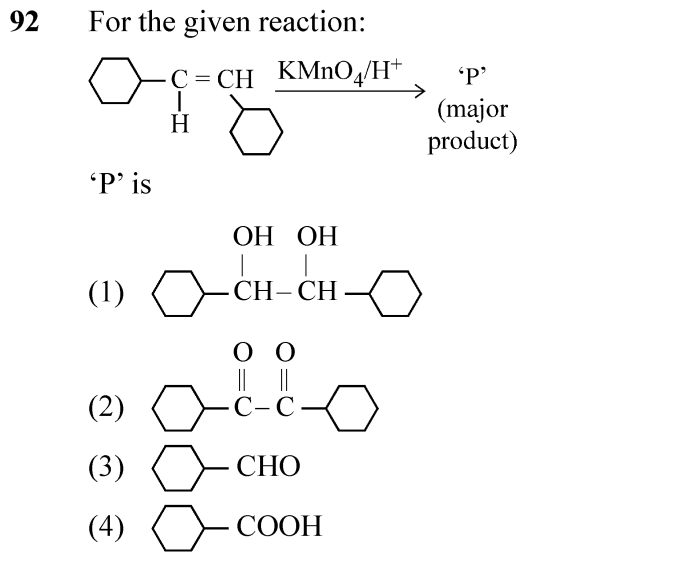
NEET 2024 Chemistry Question 92: Vigorous Permanganate Oxidative Cleavage of Symmetrical Alkenes

Question

For the given reaction: C₆H₁₁−CH=CH−C₆H₁₁ (C₆H₁₁ = cyclohexyl) → (KMnO₄/H⁺) 'P' (major product). 'P' is

✓
Verified Against NTA Final Answer Key
Option (4) : Cyclohexanecarboxylic acid (Cyclohexyl-COOH)
📚 Aldehydes, Ketones and Carboxylic Acids Easy
📋 Given Parameters & Problem Setup
Starting reactant 1,2-dicyclohexylethene (Cyclohexyl-CH=CH-Cyclohexyl)
Reagent Hot acidic potassium permanganate (KMnO4 / H⁺)
⚡

The 30-Second Exam Hall Shortcut: ⚡ Alkene Oxidative Cleavage Rule

⏱️ Save ~35 seconds

Hot acidic KMnO4 completely cleaves C=C! =CH-R groups oxidize to carboxylic acid (-COOH)! Symmetrical Cyclohexyl-CH=CH-Cyclohexyl cleaves into 2 molecules of Cyclohexanecarboxylic acid!

1 Identify the alkene: Cyclohexyl-CH=CH-Cyclohexyl (symmetrical 1,2-disubstituted alkene).
2 Recall vigorous oxidation with hot acidic KMnO4 / H⁺:
3 - =CH2 oxidizes to CO2 + H2O.
4 - =CH-R oxidizes to carboxylic acid (R-COOH).
5 - =CR2 oxidizes to ketone (R-CO-R).
6 Here, each side of the double bond is a -CH(Cyclohexyl) group.
7 Cleavage of the double bond oxidizes both halves to cyclohexanecarboxylic acid (Cyclohexyl-COOH).
8 Match Option (4) in 5 seconds!
🛡️
Why You Can 100% Trust This Shortcut: NCERT Chemistry · Aldehydes, Ketones and Carboxylic Acids (Preparation of carboxylic acids by oxidation of alkenes using acidic potassium permanganate).
📐

Step-by-Step Rigorous Workflow & Mathematical Proof

Step 1

Nature of the Oxidizing Reagent

Acidic potassium permanganate (KMnO4 / H⁺) is a potent, vigorous oxidizing agent that causes oxidative cleavage of carbon-carbon double bonds. Unlike cold dilute alkaline KMnO4 (Baeyer’s reagent) which performs syn-dihydroxylation, hot acidic KMnO4 completely ruptures both the σ and π components of the alkene:

R−CH=CH−R→KMnO4/H⊕,  Δ2  R−COOHR{-}\text{CH}=\text{CH}{-}R \xrightarrow{\text{KMnO}_4 / \text{H}^\oplus, \; \Delta} 2\; R{-}\text{COOH}
Step 2

Oxidative Fate of Alkene Carbon Atoms

The products of oxidative cleavage depend on the substitution of the alkene carbons: 1. Disubstituted carbon (=CR2) yields a ketone (R2C=O). 2. Monosubstituted carbon (=CHR) is oxidized past the aldehyde stage directly to a carboxylic acid (R-COOH). 3. Terminal methylene (=CH2) is oxidized to formic acid, which is rapidly oxidized further to CO2 and H2O.

=CH−R→[O]R−CHO→fast [O]R−COOH=\text{CH}{-}\text{R} \xrightarrow{[\text{O}]} R{-}\text{CHO} \xrightarrow{\text{fast } [\text{O}]} R{-}\text{COOH}
Step 3

Application to 1,2-Dicyclohexylethene

The substrate possesses two identical monosubstituted alkene carbons bonded to cyclohexyl rings. Cleavage of the central double bond produces two equivalents of cyclohexanecarboxylic acid:

Cyclohexyl−CH=CH−Cyclohexyl→KMnO4/H⊕2  Cyclohexyl−COOH(Product P)\text{Cyclohexyl}{-}\text{CH}=\text{CH}{-}\text{Cyclohexyl} \xrightarrow{\text{KMnO}_4 / \text{H}^\oplus} 2\;\text{Cyclohexyl}{-}\text{COOH} \quad (\text{Product P})
⭐

360° Option Elimination Engine Key Feature

Diagnose every choice: Know exactly why the right option works and why distractors fail.

4-Option Deep Scan
1 (1)
✗ Incorrect
Verdict & Scientific Reason:

Formed with cold alkaline KMnO4 (Baeyer’s reagent), not hot acidic KMnO4.

⚠️
Student Fallacy (Why candidates pick this trap): Confusing hot acidic KMnO4 with Baeyer’s dihydroxylation.
2 (2)
✗ Incorrect
Verdict & Scientific Reason:

Mild oxidation intermediate; under acidic KMnO4, the C-C bond cleaves completely.

⚠️
Student Fallacy (Why candidates pick this trap): Assuming C-C bond remains intact.
3 (3)
✗ Incorrect
Verdict & Scientific Reason:

Formed by reductive ozonolysis (O3 / Zn-H2O); KMnO4 over-oxidizes aldehydes to carboxylic acids.

⚠️
Student Fallacy (Why candidates pick this trap): Confusing KMnO4 oxidation with reductive ozonolysis.
4 (4)
✓ 100% Correct
Verdict & Scientific Reason:

Exact product of vigorous permanganate cleavage of a 1,2-disubstituted alkene.

💡
Why this is airtight: None.
⚠️

NTA Trap Alert: Confusing Acidic KMnO4 with Ozonolysis or Baeyer’s Reagent

O3/Zn gives aldehyde (Option 3); cold KMnO4 gives diol (Option 1); hot acidic KMnO4 gives carboxylic acid (Option 4)!

🛡️ How to avoid the -1 mark: Hot acidic KMnO4 = Total double bond cleavage all the way to carboxylic acid.
📖

Core NEET Syllabus Standard

Chemistry Core Organic Chemistry · Aldehydes, Ketones and Carboxylic Acids Standard Benchmark
Core Scientific Principle Tested:

"Alkenes with =CH-R groups undergo oxidative cleavage by acidic potassium permanganate to yield carboxylic acids R-COOH."

Syllabus Focus: Preparation of Carboxylic Acids: Oxidative Cleavage of Alkenes
✓ Core NEET UG Syllabus Anchor Syllabus & Academic Standards ↗
Acidic permanganate cuts the bond clean: =CH-R turns to acid unseen!

Ready to attempt under real exam pressure?

Test your speed and accuracy in the authentic 200-minute timed NTA simulator.

Launch NEET 2024 CBT Test →

Spotted a mistake in this solution? Report an error ([email protected])

⚖️ Legal & Fair Dealing Notice: Sourced from publicly released NEET 2024 question papers and NEET answer keys for private study, research, and non-commercial educational practice under Fair Dealing (Section 52(1)(a) of the Indian Copyright Act, 1957). Not affiliated with or endorsed by NTA or NMC.

Solve 4 NEET Questions a Day — One per Subject

Cover all 1,140 official NEET questions in 285 days at your own pace. Progress is saved on your device. No login needed.