MyCompetitiveExams Logo MyCompetitiveExams
Search 1,140+ Questions
Chapters, formulas, speed tricks
→
⚡ Brahmastra NEET 2027
720 MARKS

Dynamic 180-question full-length simulator mixed dynamically from all 6 years for 2027 & 2026 aspirants.

Launch Brahmastra 2027 Test →
Start Practice →
100% Free · No Login Required
Q.93 Chemistry · Section B ⭐ 360° Option Elimination Active
Vault ↗

NEET 2024 Chemistry Question 93 Solution

Topic: Solutions · Official NTA Booklet Code T1
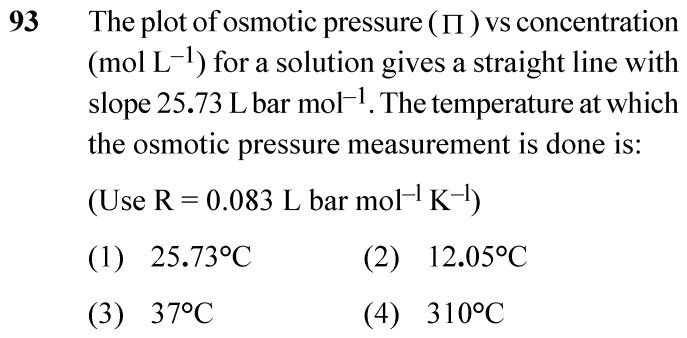
NEET 2024 Chemistry Question 93: Determination of Temperature from Osmotic Pressure Slope

Question

The plot of osmotic pressure (Π) vs concentration (mol L⁻¹) for a solution gives a straight line with slope 25.73 L bar mol⁻¹. The temperature at which the osmotic pressure measurement is done is: (Use R = 0.083 L bar mol⁻¹ K⁻¹)

✓
Verified Against NTA Final Answer Key
Option (3) : 37°C
📚 Solutions Easy
📋 Given Parameters & Problem Setup
Graph Plot of osmotic pressure (Π) vs concentration (C in mol L^-1)
Slope of straight line 25.73 L bar mol^-1
Universal gas constant (R) 0.083 L bar mol^-1 K^-1
⚡

The 30-Second Exam Hall Shortcut: ⚡ Kelvin to Celsius Temperature Trap

⏱️ Save ~30 seconds

Π = C · R · T -> Slope = R · T -> T = Slope / R = 25.73 / 0.083 = 310 K! Convert to Celsius: 310 - 273 = 37°C! Don’t pick 310°C (Option 4 trap)!

1 Van ’t Hoff equation for osmotic pressure: Π = C R T.
2 Comparing with y = mx: y = Π, x = C, Slope m = R T.
3 Solve for absolute temperature: T = Slope / R = 25.73 / 0.083 = 310 K.
4 Convert absolute temperature T in Kelvin to Celsius: t(°C) = 310 - 273 = 37°C.
5 Option (4) gives 310°C as a trap; the correct Celsius answer is 37°C.
6 Option (3) in 10 seconds!
🛡️
Why You Can 100% Trust This Shortcut: NCERT Chemistry · Solutions (Colligative properties: Van ’t Hoff equation for osmotic pressure Π = CRT).
📐

Step-by-Step Rigorous Workflow & Mathematical Proof

Step 1

Van ’t Hoff Equation for Osmotic Pressure

For a dilute solution of a non-electrolyte, the osmotic pressure Π is directly proportional to the molar concentration C and absolute temperature T:

Π=CRT\Pi = C R T
Step 2

Identification of Graphical Slope

Plotting Π on the y-axis against concentration C on the x-axis gives a straight line passing through the origin: y = mx ⟹ Π = (RT) · C. Therefore, the slope of the line equals the product of the gas constant R and absolute temperature T:

Slope=R⋅T\text{Slope} = R \cdot T
Step 3

Calculation of Temperature in Kelvin

Given Slope = 25.73 L bar mol⁻¹ and R = 0.083 L bar mol⁻¹ K⁻¹:

T=SlopeR=25.73  L bar mol−10.083  L bar mol−1K−1=310  KT = \frac{\text{Slope}}{R} = \frac{25.73\;\text{L bar mol}^{-1}}{0.083\;\text{L bar mol}^{-1}\text{K}^{-1}} = 310\;\text{K}
Step 4

Conversion from Kelvin to Celsius

Converting the temperature from Kelvin to degrees Celsius:

t(∘C)=T(K)−273.15=310−273=37∘Ct(^\circ\text{C}) = T(\text{K}) - 273.15 = 310 - 273 = 37^\circ\text{C}
⭐

360° Option Elimination Engine Key Feature

Diagnose every choice: Know exactly why the right option works and why distractors fail.

4-Option Deep Scan
1 (1)
✗ Incorrect
Verdict & Scientific Reason:

Blindly copies the numerical value of the slope as the temperature.

⚠️
Student Fallacy (Why candidates pick this trap): Assuming slope equals temperature in Celsius directly.
2 (2)
✗ Incorrect
Verdict & Scientific Reason:

Calculation error from improper division.

⚠️
Student Fallacy (Why candidates pick this trap): Arithmetic miscalculation.
3 (3)
✓ 100% Correct
Verdict & Scientific Reason:

Exact conversion: 310 K - 273 = 37°C (normal human body temperature).

💡
Why this is airtight: None.
4 (4)
✗ Incorrect
Verdict & Scientific Reason:

Classic unit trap: 310 is the temperature in KELVIN, not Celsius!

⚠️
Student Fallacy (Why candidates pick this trap): Forgetting to convert Kelvin to Celsius.
⚠️

NTA Trap Alert: Option (4) 310°C Kelvin vs Celsius Unit Trap

310 K is calculated directly. Option (4) writes 310°C to trick students who forget to subtract 273. 310°C = 583 K, which is far too hot!

🛡️ How to avoid the -1 mark: The formula Π = CRT ALWAYS yields temperature in KELVIN. Always subtract 273 when options are in °C!
📖

Core NEET Syllabus Standard

Chemistry Core Physical Chemistry · Solutions Standard Benchmark
Core Scientific Principle Tested:

"Osmotic pressure is given by Π = CRT; the slope of Π vs C is RT, giving T in Kelvin."

Syllabus Focus: Colligative Properties: Osmotic Pressure and Molecular Mass Determination
✓ Core NEET UG Syllabus Anchor Syllabus & Academic Standards ↗
Divide slope by R to find the Kelvin pace: Subtract two-seventy-three to take body temp’s place (37°C)!

Ready to attempt under real exam pressure?

Test your speed and accuracy in the authentic 200-minute timed NTA simulator.

Launch NEET 2024 CBT Test →

Spotted a mistake in this solution? Report an error ([email protected])

⚖️ Legal & Fair Dealing Notice: Sourced from publicly released NEET 2024 question papers and NEET answer keys for private study, research, and non-commercial educational practice under Fair Dealing (Section 52(1)(a) of the Indian Copyright Act, 1957). Not affiliated with or endorsed by NTA or NMC.

Solve 4 NEET Questions a Day — One per Subject

Cover all 1,140 official NEET questions in 285 days at your own pace. Progress is saved on your device. No login needed.