MyCompetitiveExams Logo MyCompetitiveExams
Search 1,140+ Questions
Chapters, formulas, speed tricks
→
⚡ Brahmastra NEET 2027
720 MARKS

Dynamic 180-question full-length simulator mixed dynamically from all 6 years for 2027 & 2026 aspirants.

Launch Brahmastra 2027 Test →
Start Practice →
100% Free · No Login Required
Q.94 Chemistry · Section B ⭐ 360° Option Elimination Active
Vault ↗

NEET 2024 Chemistry Question 94 Solution

Topic: Amines · Official NTA Booklet Code T1
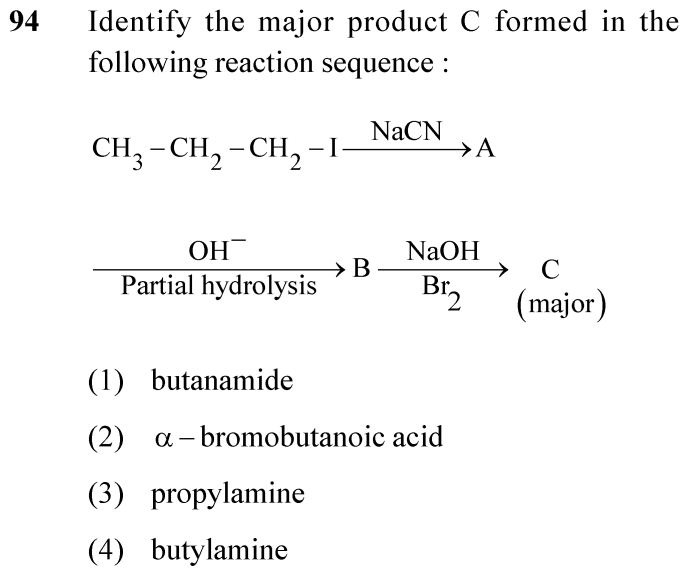
NEET 2024 Chemistry Question 94: Multistep Synthesis: Cyanation, Partial Hydrolysis, and Hoffmann Degradation

Question

Identify the major product C formed in the following reaction sequence: CH₃−CH₂−CH₂−I → (NaCN) A → (OH⁻, partial hydrolysis) B → (NaOH, Br₂) C (major)

✓
Verified Against NTA Final Answer Key
Option (3) : propylamine (propan-1-amine)
📚 Amines Medium
📋 Given Parameters & Problem Setup
Starting reactant 1-iodopropane (CH3-CH2-CH2-I)
Step 1 reagent NaCN -> Compound A
Step 2 reagent Partial hydrolysis with OH⁻ -> Compound B
Step 3 reagent Br2 / NaOH -> Major Product C
⚡

The 30-Second Exam Hall Shortcut: ⚡ Hoffmann Carbon Count Degradation Hack

⏱️ Save ~40 seconds

Propyl iodide (3C) + NaCN -> Butanenitrile (4C). Partial hydrolysis -> Butanamide (4C). Hoffmann degradation (Br2/NaOH) removes the C=O carbon -> Propylamine (3C)!

1 Step 1: 1-iodopropane (3 carbons) reacts with NaCN via SN2 displacement to form butanenitrile CH3CH2CH2CN (Compound A, 4 carbons).
2 Step 2: Partial alkaline hydrolysis of a nitrile converts -CN cleanly into an amide (-CONH2), giving butanamide CH3CH2CH2CONH2 (Compound B, 4 carbons).
3 Step 3: Treatment of an amide with Br2 and NaOH is the famous Hoffmann bromamide degradation reaction.
4 Hoffmann degradation excises the carbonyl carbon (-CO-) as carbonate, yielding a primary amine with ONE LESS CARBON atom than the amide.
5 4-carbon butanamide degrades to 3-carbon propylamine (CH3CH2CH2NH2).
6 Match Option (3) in 10 seconds!
🛡️
Why You Can 100% Trust This Shortcut: NCERT Chemistry · Amines (Preparation of amines: Hoffmann bromamide degradation reaction and partial hydrolysis of nitriles).
📐

Step-by-Step Rigorous Workflow & Mathematical Proof

Step 1

Nucleophilic Substitution with Cyanide (Formation of A)

1-Iodopropane is a primary alkyl halide. Nucleophilic substitution with sodium cyanide (NaCN) in aqueous ethanol proceeds smoothly via an SN2 mechanism, adding one carbon to the chain to form butanenitrile:

CH3CH2CH2−I+NaCN⟶CH3CH2CH2−CN+NaI(Compound A)\text{CH}_3\text{CH}_2\text{CH}_2{-}\text{I} + \text{NaCN} \longrightarrow \text{CH}_3\text{CH}_2\text{CH}_2{-}\text{CN} + \text{NaI} \quad (\text{Compound A})
Step 2

Partial Hydrolysis of Nitrile to Amide (Formation of B)

Partial alkaline hydrolysis of nitriles in the presence of dilute base (or alkaline H2O2) stops at the primary amide stage, yielding butanamide:

CH3CH2CH2−CN→OH⊖,  partial hydrolysisCH3CH2CH2−CONH2(Compound B)\text{CH}_3\text{CH}_2\text{CH}_2{-}\text{CN} \xrightarrow{\text{OH}^\ominus, \; \text{partial hydrolysis}} \text{CH}_3\text{CH}_2\text{CH}_2{-}\text{CONH}_2 \quad (\text{Compound B})
Step 3

Hoffmann Bromamide Degradation (Formation of C)

Heating butanamide with bromine in aqueous sodium hydroxide results in the Hoffmann bromamide degradation. The alkyl group migrates from carbonyl carbon to nitrogen via an isocyanate intermediate, eliminating the carbonyl group as sodium carbonate and yielding propan-1-amine (propylamine):

CH3CH2CH2CONH2+Br2+4NaOH⟶CH3CH2CH2NH2+Na2CO3+2NaBr+2H2O\text{CH}_3\text{CH}_2\text{CH}_2\text{CONH}_2 + \text{Br}_2 + 4\text{NaOH} \longrightarrow \text{CH}_3\text{CH}_2\text{CH}_2\text{NH}_2 + \text{Na}_2\text{CO}_3 + 2\text{NaBr} + 2\text{H}_2\text{O}
⭐

360° Option Elimination Engine Key Feature

Diagnose every choice: Know exactly why the right option works and why distractors fail.

4-Option Deep Scan
1 (1)
✗ Incorrect
Verdict & Scientific Reason:

This is intermediate Compound B, not the final product C.

⚠️
Student Fallacy (Why candidates pick this trap): Stopping the reaction sequence after step 2.
2 (2)
✗ Incorrect
Verdict & Scientific Reason:

Result of Hell-Volhard-Zelinsky (HVZ) bromination on a carboxylic acid, not Hoffmann degradation.

⚠️
Student Fallacy (Why candidates pick this trap): Confusing Br2/NaOH on amides with HVZ reaction.
3 (3)
✓ 100% Correct
Verdict & Scientific Reason:

Exact product of Hoffmann bromamide degradation of butanamide.

💡
Why this is airtight: None.
4 (4)
✗ Incorrect
Verdict & Scientific Reason:

Retains 4 carbons; would be formed by LiAlH4 reduction of butanamide, not Hoffmann degradation.

⚠️
Student Fallacy (Why candidates pick this trap): Forgetting that Hoffmann degradation loses one carbon.
⚠️

NTA Trap Alert: Forgetting the Carbon Loss in Hoffmann Degradation

Option (4) is butylamine (4 carbons). Students frequently forget that Hoffmann bromamide degradation LOSES the carbonyl carbon atom, producing an amine with one less carbon (3 carbons = propylamine).

🛡️ How to avoid the -1 mark: Hoffmann degradation ALWAYS shortens the carbon chain by 1: 4-carbon amide -> 3-carbon amine.
📖

Core NEET Syllabus Standard

Chemistry Core Organic Chemistry · Amines Standard Benchmark
Core Scientific Principle Tested:

"Hoffmann bromamide degradation converts primary amides into primary amines containing one less carbon atom: R-CONH2 + Br2 + 4NaOH -> R-NH2 + Na2CO3."

Syllabus Focus: Preparation of Amines: Hoffmann Bromamide Degradation Reaction
✓ Core NEET UG Syllabus Anchor Syllabus & Academic Standards ↗
Nitrile adds one, Hoffmann steals one back: Propyl stays propyl at the end of the track!

Ready to attempt under real exam pressure?

Test your speed and accuracy in the authentic 200-minute timed NTA simulator.

Launch NEET 2024 CBT Test →

Spotted a mistake in this solution? Report an error ([email protected])

⚖️ Legal & Fair Dealing Notice: Sourced from publicly released NEET 2024 question papers and NEET answer keys for private study, research, and non-commercial educational practice under Fair Dealing (Section 52(1)(a) of the Indian Copyright Act, 1957). Not affiliated with or endorsed by NTA or NMC.

Solve 4 NEET Questions a Day — One per Subject

Cover all 1,140 official NEET questions in 285 days at your own pace. Progress is saved on your device. No login needed.