MyCompetitiveExams Logo MyCompetitiveExams
Search 1,140+ Questions
Chapters, formulas, speed tricks
→
⚡ Brahmastra NEET 2027
720 MARKS

Dynamic 180-question full-length simulator mixed dynamically from all 6 years for 2027 & 2026 aspirants.

Launch Brahmastra 2027 Test →
Start Practice →
100% Free · No Login Required
Q.79 Chemistry ⭐ 360° Option Elimination Active
Vault ↗

NEET 2026 Chemistry Question 79 Solution

Topic: Amines · Official NTA Booklet Code 50
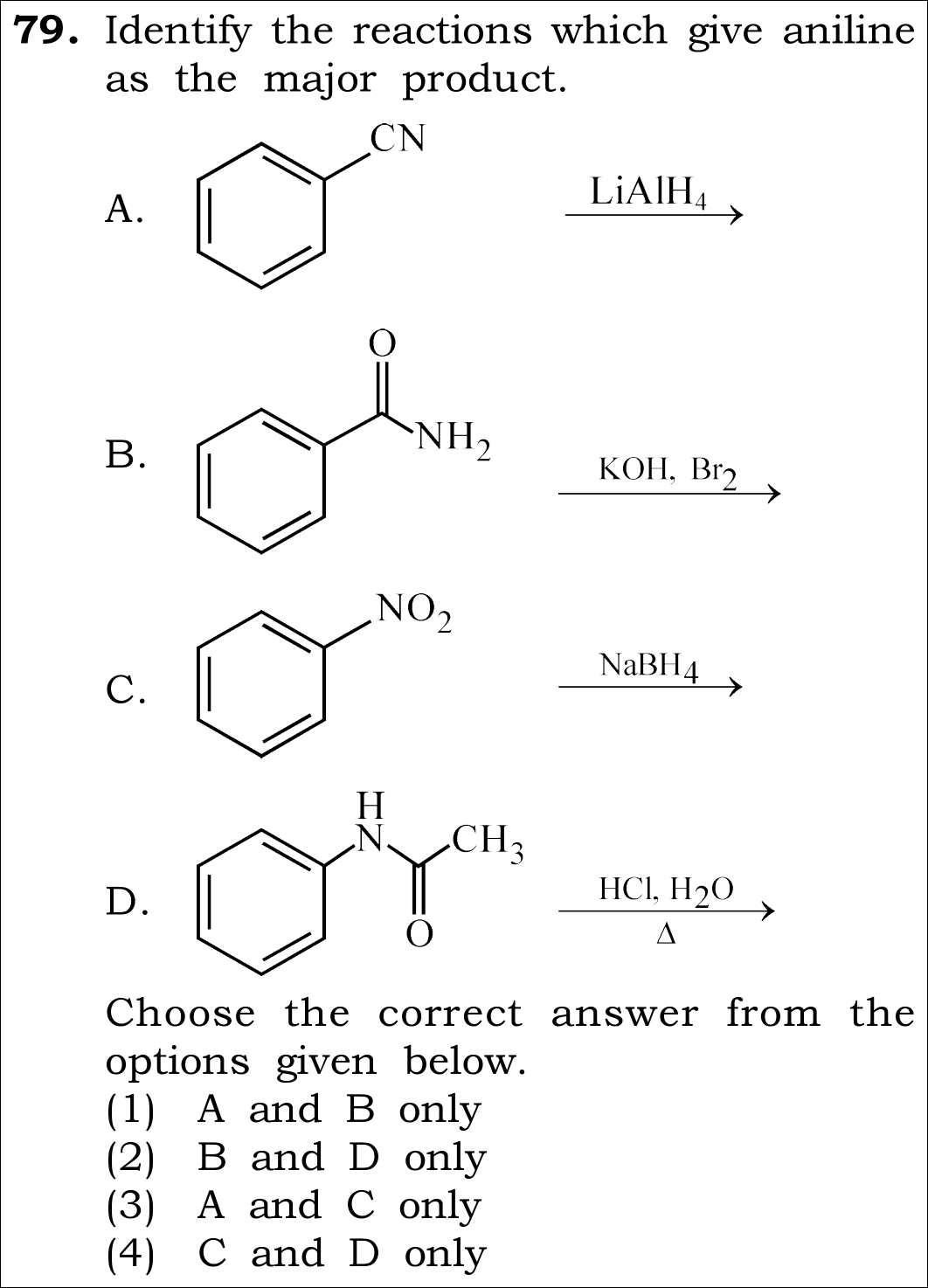
NEET 2026 Chemistry Question 79: Preparation Methods of Primary Aromatic Amines (Aniline)

Question

Identify the reactions which give aniline as the major product. A. Benzonitrile → (LiAlH₄) B. Benzamide → (KOH, Br₂) C. Nitrobenzene → (NaBH₄) D. Acetanilide → (HCl, H₂O, Δ) Choose the correct answer from the options given below.

✓
Verified Against NTA Final Answer Key
Option (2) : B and D only
📚 Amines Medium
📋 Given Parameters & Problem Setup
Reaction A Benzonitrile (Ph-CN) + LiAlH₄
Reaction B Benzamide (Ph-CONH₂) + KOH, Br₂ (Hoffmann Bromamide)
Reaction C Nitrobenzene (Ph-NO₂) + NaBH₄
Reaction D Acetanilide (Ph-NH-CO-CH₃) + aqueous HCl, Δ
⚡

The 30-Second Exam Hall Shortcut: ⚡ Aniline Product Scan

⏱️ Save ~60 seconds

Reaction B is classic Hoffmann bromamide; Reaction D is amide hydrolysis -> Both give Aniline!

1 A. Benzonitrile + LiAlH₄: Nitrile (-CN) reduces to primary alkylamine: Ph-CH₂-NH₂ (BENZYLAMINE, not aniline!).
2 B. Benzamide + Br₂/KOH: Hoffmann bromamide degradation cleanly drops the carbonyl carbon to yield ANILINE (Ph-NH₂) -> Gives Aniline!
3 C. Nitrobenzene + NaBH₄: NaBH₄ is a mild hydride donor that does NOT reduce aromatic nitro groups to amines.
4 D. Acetanilide + HCl/H₂O (Δ): Acid-catalyzed hydrolysis of the amide bond regenerates ANILINE (Ph-NH₂) and acetic acid -> Gives Aniline!
5 Reactions B and D yield aniline as major product -> Option (2) locked in 20 seconds!
🛡️
Why You Can 100% Trust This Shortcut: Canonical named reactions: Hoffmann bromamide degradation of benzamide and deprotection/hydrolysis of acetanilide are cornerstone methods to prepare aniline.
📐

Step-by-Step Rigorous Workflow & Mathematical Proof

Step 1

Analyze Reaction A (Reduction of Benzonitrile)

Lithium aluminium hydride (LiAlH₄) is a powerful reducing agent that reduces the cyano group (-C≡N) to a -CH₂-NH₂ group. Reduction of benzonitrile produces benzylamine, which contains an extra aliphatic methylene carbon, NOT aniline.

C6H5−C≡N+4[H]→LiAlH4C6H5−CH2−NH2(Benzylamine≠Aniline)\text{C}_6\text{H}_5-\text{C}\equiv\text{N} + 4[\text{H}] \xrightarrow{\text{LiAlH}_4} \text{C}_6\text{H}_5-\text{CH}_2-\text{NH}_2 \quad (\text{Benzylamine} \neq \text{Aniline})
  • • Reaction A does not give aniline.
Step 2

Analyze Reaction B (Hoffmann Bromamide Degradation)

When benzamide is treated with bromine in aqueous or ethanolic potassium hydroxide, it undergoes Hoffmann bromamide degradation with loss of the carbonyl carbon as carbonate, yielding aniline containing one carbon less.

C6H5−CONH2+Br2+4KOH⟶C6H5−NH2  (Aniline)+K2CO3+2KBr+2H2O\text{C}_6\text{H}_5-\text{CONH}_2 + \text{Br}_2 + 4\text{KOH} \longrightarrow \text{C}_6\text{H}_5-\text{NH}_2 \;(\text{Aniline}) + \text{K}_2\text{CO}_3 + 2\text{KBr} + 2\text{H}_2\text{O}
  • • Reaction B produces aniline as the major product.
Step 3

Analyze Reaction C (Attempted Reduction with NaBH₄)

Sodium borohydride (NaBH₄) is a selective, mild reducing agent capable of reducing aldehydes and ketones. It lacks the reducing power to reduce aromatic nitro groups (-NO₂) to amino groups (-NH₂). (Catalytic hydrogenation or active metals like Fe/HCl or Sn/HCl are required).

C6H5−NO2+NaBH4⟶No reaction to form Aniline\text{C}_6\text{H}_5-\text{NO}_2 + \text{NaBH}_4 \longrightarrow \text{No reaction to form Aniline}
  • • Reaction C does not give aniline.
Step 4

Analyze Reaction D (Acidic Hydrolysis of Acetanilide)

Acetanilide is prepared by protecting the amino group of aniline. Upon heating with aqueous mineral acid (HCl) followed by neutralization, the amide linkage undergoes nucleophilic acyl substitution/hydrolysis to regenerate free aniline and acetic acid.

C6H5−NHCOCH3+H2O→HCl, ΔC6H5−NH2  (Aniline)+CH3COOH\text{C}_6\text{H}_5-\text{NHCOCH}_3 + \text{H}_2\text{O} \xrightarrow{\text{HCl, } \Delta} \text{C}_6\text{H}_5-\text{NH}_2 \;(\text{Aniline}) + \text{CH}_3\text{COOH}
  • • Reaction D produces aniline as the major product.
  • • Therefore, B and D only yield aniline.
⭐

360° Option Elimination Engine Key Feature

Diagnose every choice: Know exactly why the right option works and why distractors fail.

4-Option Deep Scan
1 A
✗ Incorrect
Verdict & Scientific Reason:

Incorrect. Reaction A gives benzylamine (Ph-CH₂-NH₂), not aniline.

⚠️
Student Fallacy (Why candidates pick this trap): Confusing benzylamine with aniline.
2 B
✓ 100% Correct
Verdict & Scientific Reason:

Exact match: Hoffmann bromamide degradation (B) and amide hydrolysis (D) both yield pure aniline.

💡
Why this is airtight: None; rigorous knowledge of amine preparation and protecting groups.
3 C
✗ Incorrect
Verdict & Scientific Reason:

Incorrect. Neither A nor C produces aniline.

⚠️
Student Fallacy (Why candidates pick this trap): Assuming NaBH₄ reduces nitro groups.
4 D
✗ Incorrect
Verdict & Scientific Reason:

Incorrect. Reaction C fails to reduce nitrobenzene to aniline.

⚠️
Student Fallacy (Why candidates pick this trap): Believing NaBH₄ is equivalent to LiAlH₄ or Fe/HCl.
⚠️

NTA Trap Alert: Confusing Benzonitrile Reduction with Aniline Formation

Students frequently forget that benzonitrile has a carbon in the -CN group. Reducing -CN adds four hydrogens to give -CH₂-NH₂ (Benzylamine, 7 carbons). Aniline has only 6 carbons directly attached to -NH₂!

🛡️ How to avoid the -1 mark: Count carbons: Benzonitrile has 7 carbons -> Benzylamine (7 carbons); Aniline has 6 carbons.
📖

Core NEET Syllabus Standard

NEET Chemistry Core Syllabus · Amines Standard Benchmark
Core Scientific Principle Tested:

"Amides undergo degradation (Hoffmann) or hydrolysis to yield amines; nitriles reduce with retention of carbon count."

Syllabus Focus: Methods of preparation of amines - Hoffmann degradation and reduction reactions
✓ Core NEET UG Syllabus Anchor Syllabus & Academic Standards ↗
Hoffmann drops the carbonyl (B); Acid frees protected amine (D) -> Aniline pure as can be!

Ready to attempt under real exam pressure?

Test your speed and accuracy in the authentic 180-minute timed NTA simulator.

Launch NEET 2026 CBT Test →

Spotted a mistake in this solution? Report an error ([email protected])

⚖️ Legal & Fair Dealing Notice: Sourced from publicly released NEET 2026 question papers and NEET answer keys for private study, research, and non-commercial educational practice under Fair Dealing (Section 52(1)(a) of the Indian Copyright Act, 1957). Not affiliated with or endorsed by NTA or NMC.

Solve 4 NEET Questions a Day — One per Subject

Cover all 1,140 official NEET questions in 285 days at your own pace. Progress is saved on your device. No login needed.