MyCompetitiveExams Logo MyCompetitiveExams
Search 1,140+ Questions
Chapters, formulas, speed tricks
→
⚡ Brahmastra NEET 2027
720 MARKS

Dynamic 180-question full-length simulator mixed dynamically from all 6 years for 2027 & 2026 aspirants.

Launch Brahmastra 2027 Test →
Start Practice →
100% Free · No Login Required
🧪 Chemistry ⭐ High Weightage (~2–3 Qs/Year)

NEET Amines Previous Year Questions with Solutions

Complete repository of official NTA NEET questions for Amines from 2020 to 2026. Every question includes 30-second elimination tricks, step-by-step NCERT solutions, option-by-option traps, and official answer keys.

9 Questions 6 Exam Years (2026, 2025, 2024, 2023, 2021, 2020) 5 Easy · 4 Medium · 0 Challenging
NEET 2026 · Q79 Medium
Official NEET 2026 Question 79 - Amines
1
2 ✓ Key
3
4
💡 Verified Solution & 30-Second Hack
✓
Verified Against NTA Final Answer Key
Option (2) : B and D only
📚 Amines Medium
📋 Given Parameters & Problem Setup
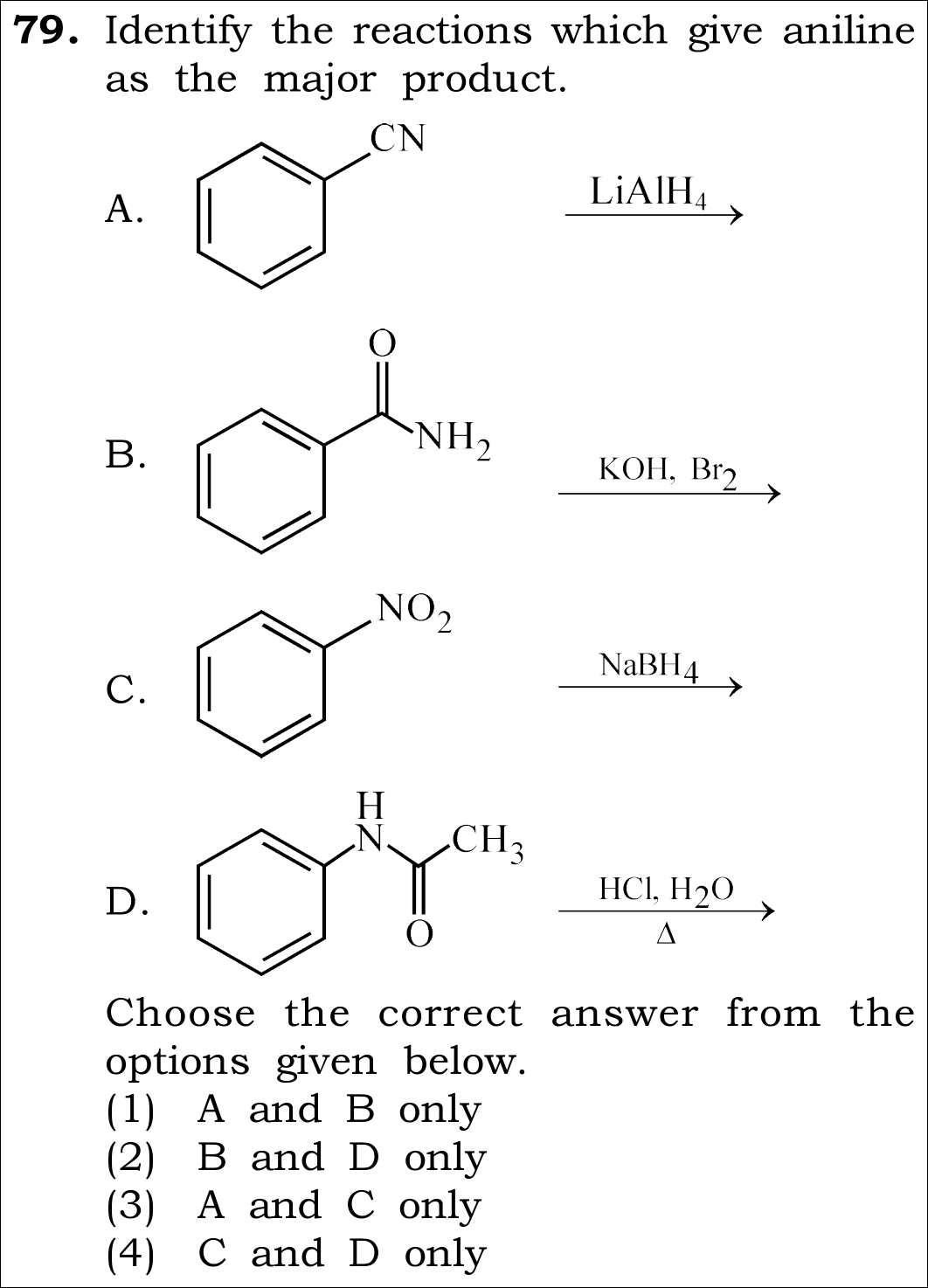
Reaction A Benzonitrile (Ph-CN) + LiAlH₄
Reaction B Benzamide (Ph-CONH₂) + KOH, Br₂ (Hoffmann Bromamide)
Reaction C Nitrobenzene (Ph-NO₂) + NaBH₄
Reaction D Acetanilide (Ph-NH-CO-CH₃) + aqueous HCl, Δ
⚡

The 30-Second Exam Hall Shortcut: ⚡ Aniline Product Scan

⏱️ Save ~60 seconds

Reaction B is classic Hoffmann bromamide; Reaction D is amide hydrolysis -> Both give Aniline!

1 A. Benzonitrile + LiAlH₄: Nitrile (-CN) reduces to primary alkylamine: Ph-CH₂-NH₂ (BENZYLAMINE, not aniline!).
2 B. Benzamide + Br₂/KOH: Hoffmann bromamide degradation cleanly drops the carbonyl carbon to yield ANILINE (Ph-NH₂) -> Gives Aniline!
3 C. Nitrobenzene + NaBH₄: NaBH₄ is a mild hydride donor that does NOT reduce aromatic nitro groups to amines.
4 D. Acetanilide + HCl/H₂O (Δ): Acid-catalyzed hydrolysis of the amide bond regenerates ANILINE (Ph-NH₂) and acetic acid -> Gives Aniline!
5 Reactions B and D yield aniline as major product -> Option (2) locked in 20 seconds!
🛡️
Why You Can 100% Trust This Shortcut: Canonical named reactions: Hoffmann bromamide degradation of benzamide and deprotection/hydrolysis of acetanilide are cornerstone methods to prepare aniline.
📐

Step-by-Step Rigorous Workflow & Mathematical Proof

Step 1

Analyze Reaction A (Reduction of Benzonitrile)

Lithium aluminium hydride (LiAlH₄) is a powerful reducing agent that reduces the cyano group (-C≡N) to a -CH₂-NH₂ group. Reduction of benzonitrile produces benzylamine, which contains an extra aliphatic methylene carbon, NOT aniline.

C6H5−C≡N+4[H]→LiAlH4C6H5−CH2−NH2(Benzylamine≠Aniline)\text{C}_6\text{H}_5-\text{C}\equiv\text{N} + 4[\text{H}] \xrightarrow{\text{LiAlH}_4} \text{C}_6\text{H}_5-\text{CH}_2-\text{NH}_2 \quad (\text{Benzylamine} \neq \text{Aniline})
  • • Reaction A does not give aniline.
Step 2

Analyze Reaction B (Hoffmann Bromamide Degradation)

When benzamide is treated with bromine in aqueous or ethanolic potassium hydroxide, it undergoes Hoffmann bromamide degradation with loss of the carbonyl carbon as carbonate, yielding aniline containing one carbon less.

C6H5−CONH2+Br2+4KOH⟶C6H5−NH2  (Aniline)+K2CO3+2KBr+2H2O\text{C}_6\text{H}_5-\text{CONH}_2 + \text{Br}_2 + 4\text{KOH} \longrightarrow \text{C}_6\text{H}_5-\text{NH}_2 \;(\text{Aniline}) + \text{K}_2\text{CO}_3 + 2\text{KBr} + 2\text{H}_2\text{O}
  • • Reaction B produces aniline as the major product.
Step 3

Analyze Reaction C (Attempted Reduction with NaBH₄)

Sodium borohydride (NaBH₄) is a selective, mild reducing agent capable of reducing aldehydes and ketones. It lacks the reducing power to reduce aromatic nitro groups (-NO₂) to amino groups (-NH₂). (Catalytic hydrogenation or active metals like Fe/HCl or Sn/HCl are required).

C6H5−NO2+NaBH4⟶No reaction to form Aniline\text{C}_6\text{H}_5-\text{NO}_2 + \text{NaBH}_4 \longrightarrow \text{No reaction to form Aniline}
  • • Reaction C does not give aniline.
Step 4

Analyze Reaction D (Acidic Hydrolysis of Acetanilide)

Acetanilide is prepared by protecting the amino group of aniline. Upon heating with aqueous mineral acid (HCl) followed by neutralization, the amide linkage undergoes nucleophilic acyl substitution/hydrolysis to regenerate free aniline and acetic acid.

C6H5−NHCOCH3+H2O→HCl, ΔC6H5−NH2  (Aniline)+CH3COOH\text{C}_6\text{H}_5-\text{NHCOCH}_3 + \text{H}_2\text{O} \xrightarrow{\text{HCl, } \Delta} \text{C}_6\text{H}_5-\text{NH}_2 \;(\text{Aniline}) + \text{CH}_3\text{COOH}
  • • Reaction D produces aniline as the major product.
  • • Therefore, B and D only yield aniline.
⭐

360° Option Elimination Engine Key Feature

Diagnose every choice: Know exactly why the right option works and why distractors fail.

4-Option Deep Scan
1 A
✗ Incorrect
Verdict & Scientific Reason:

Incorrect. Reaction A gives benzylamine (Ph-CH₂-NH₂), not aniline.

⚠️
Student Fallacy (Why candidates pick this trap): Confusing benzylamine with aniline.
2 B
✓ 100% Correct
Verdict & Scientific Reason:

Exact match: Hoffmann bromamide degradation (B) and amide hydrolysis (D) both yield pure aniline.

💡
Why this is airtight: None; rigorous knowledge of amine preparation and protecting groups.
3 C
✗ Incorrect
Verdict & Scientific Reason:

Incorrect. Neither A nor C produces aniline.

⚠️
Student Fallacy (Why candidates pick this trap): Assuming NaBH₄ reduces nitro groups.
4 D
✗ Incorrect
Verdict & Scientific Reason:

Incorrect. Reaction C fails to reduce nitrobenzene to aniline.

⚠️
Student Fallacy (Why candidates pick this trap): Believing NaBH₄ is equivalent to LiAlH₄ or Fe/HCl.
⚠️

NTA Trap Alert: Confusing Benzonitrile Reduction with Aniline Formation

Students frequently forget that benzonitrile has a carbon in the -CN group. Reducing -CN adds four hydrogens to give -CH₂-NH₂ (Benzylamine, 7 carbons). Aniline has only 6 carbons directly attached to -NH₂!

🛡️ How to avoid the -1 mark: Count carbons: Benzonitrile has 7 carbons -> Benzylamine (7 carbons); Aniline has 6 carbons.
📖

Core NEET Syllabus Standard

NEET Chemistry Core Syllabus · Amines Standard Benchmark
Core Scientific Principle Tested:

"Amides undergo degradation (Hoffmann) or hydrolysis to yield amines; nitriles reduce with retention of carbon count."
Syllabus Focus: Methods of preparation of amines - Hoffmann degradation and reduction reactions
✓ Core NEET UG Syllabus Anchor Syllabus & Academic Standards ↗
Hoffmann drops the carbonyl (B); Acid frees protected amine (D) -> Aniline pure as can be!
NEET 2025 · Q67 Medium
Official NEET 2025 Question 67 - Amines
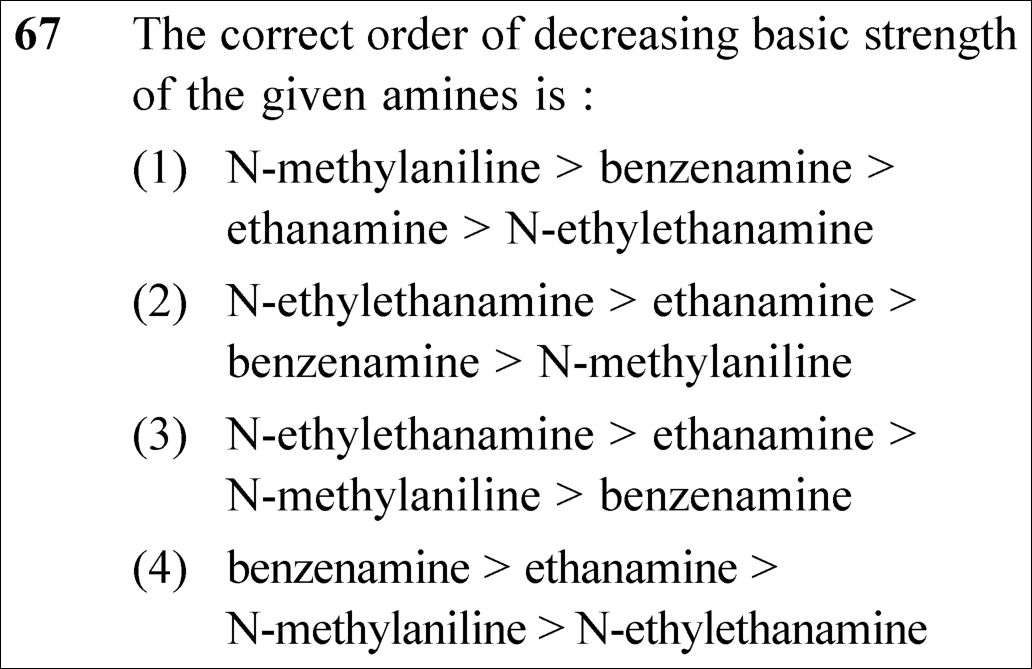
1 N-methylaniline > benzenamine > ethanamine > N-ethylethanamine
2 N-ethylethanamine > ethanamine > benzenamine > N-methylaniline
3 N-ethylethanamine > ethanamine > N-methylaniline > benzenamine ✓ Key
4 benzenamine > ethanamine > N-methylaniline > N-ethylethanamine
💡 Verified Solution & 30-Second Hack
✓
Verified Against NTA Final Answer Key
Option (3) : N-ethylethanamine > ethanamine > N-methylaniline > benzenamine
📚 Amines Medium
📋 Given Parameters & Problem Setup
Amine 1 N-ethylethanamine (Diethylamine, (CH₃CH₂)₂NH, 2° aliphatic amine)
Amine 2 Ethanamine (Ethylamine, CH₃CH₂NH₂, 1° aliphatic amine)
Amine 3 N-methylaniline (C₆H₅NH(CH₃), secondary aromatic-aliphatic amine)
Amine 4 Benzenamine (Aniline, C₆H₅NH₂, 1° aromatic amine)
⚡

The 30-Second Exam Hall Shortcut: ⚡ Aliphatic Beats Aromatic Basicity Rule

⏱️ Save ~45 seconds

Rule 1: Aliphatic amines are 10⁶ times more basic than aromatic amines (resonance delocalizes nitrogen lone pair into benzene ring). Rule 2: In ethyl amines, 2° > 1° (Diethylamine > Ethylamine). Rule 3: N-methylaniline has +I methyl pushing electron density into N > Aniline! Order: N-ethylethanamine > ethanamine > N-methylaniline > benzenamine!

1 Classify amines: Aliphatic (N-ethylethanamine, ethanamine) vs Aromatic (N-methylaniline, benzenamine).
2 Aliphatic amines have localized nitrogen lone pairs (+I alkyl groups), making them far more basic than aromatic amines (where the lone pair is delocalized into the aromatic π-system).
3 Compare aliphatic pair: In aqueous solution, ethyl-substituted amines follow the canonical 231 order: 2° > 1° ⟹ N-ethylethanamine > ethanamine.
4 Compare aromatic pair: N-methylaniline contains an electron-donating methyl group (+I effect) attached to nitrogen, which increases electron density on N relative to unsubstituted benzenamine (aniline). Thus N-methylaniline > benzenamine.
5 Combined decreasing basicity: N-ethylethanamine > ethanamine > N-methylaniline > benzenamine.
6 Matches Option (3) in under 15 seconds!
🛡️
Why You Can 100% Trust This Shortcut: Inductive, Steric, and Solvation Effects on Amine Basicity (NCERT Chemistry · Amines).
📐

Step-by-Step Rigorous Workflow & Mathematical Proof

Step 1

Contrast Aliphatic vs. Aromatic Amines

In aromatic amines (benzenamine and N-methylaniline), the lone pair of electrons on the nitrogen atom is conjugated with the aromatic π-electron system and delocalized over the ortho and para positions:

pKb(Aliphatic)≈3.0−3.3≪pKb(Aromatic)≈9.3−9.4pK_b(\text{Aliphatic}) \approx 3.0 - 3.3 \ll pK_b(\text{Aromatic}) \approx 9.3 - 9.4
  • • Because lower pK_b corresponds to stronger basicity, aliphatic amines are over six orders of magnitude more basic than aromatic amines.
  • • Therefore, both aliphatic amines stand ahead of both aromatic amines in basic strength.
Step 2

Compare Aliphatic Amines (Inductive, Steric & Solvation Effects)

In aqueous medium, the basic strength of alkylamines is governed by a balance of inductive (+I), steric hindrance, and hydration of the conjugate cation:

For ethyl group: 2∘>3∘>1∘>NH3  ⟹  (C2H5)2NH>C2H5NH2\text{For ethyl group: } 2^\circ > 3^\circ > 1^\circ > \text{NH}_3 \implies (\text{C}_2\text{H}_5)_2\text{NH} > \text{C}_2\text{H}_5\text{NH}_2
  • • N-ethylethanamine (pK_b = 3.00) is a stronger base than ethanamine (pK_b = 3.29).
Step 3

Compare Aromatic Amines and Synthesize the Hierarchy

In N-methylaniline, the methyl group exerts an electron-releasing (+I) inductive effect, increasing electron density on the nitrogen atom and stabilizing the protonated anilinium ion compared to aniline:

pKb(N-methylaniline)=9.30<pKb(benzenamine)=9.38  ⟹  N-methylaniline>benzenaminepK_b(\text{N-methylaniline}) = 9.30 < pK_b(\text{benzenamine}) = 9.38 \implies \text{N-methylaniline} > \text{benzenamine}
  • • Full decreasing order of basic strength:
  • • \text{N-ethylethanamine} > \text{ethanamine} > \text{N-methylaniline} > \text{benzenamine}.
  • • Matches Option (3) perfectly.
⭐

360° Option Elimination Engine Key Feature

Diagnose every choice: Know exactly why the right option works and why distractors fail.

4-Option Deep Scan
1 A
✗ Incorrect
Verdict & Scientific Reason:

Incorrect. Falsely claims aromatic amines are more basic than aliphatic amines.

⚠️
Student Fallacy (Why candidates pick this trap): Ignoring resonance delocalization of aromatic nitrogen lone pairs.
2 B
✗ Incorrect
Verdict & Scientific Reason:

Incorrect. Inverts the relative basicity of benzenamine and N-methylaniline.

⚠️
Student Fallacy (Why candidates pick this trap): Ignoring the electron-donating +I effect of the methyl group in N-methylaniline.
3 C
✓ 100% Correct
Verdict & Scientific Reason:

100% correct. 2° aliphatic > 1° aliphatic > substituted aromatic (+I) > unsubstituted aromatic.

💡
Why this is airtight: None; textbook mastery of organic basicity.
4 D
✗ Incorrect
Verdict & Scientific Reason:

Incorrect. Scrambled order with aniline ahead of aliphatic amines.

⚠️
Student Fallacy (Why candidates pick this trap): Total misunderstanding of amine basicity.
⚠️

NTA Trap Alert: Aniline vs N-Methylaniline Basicity Trap

Option 2 is identical to Option 3 except it places benzenamine ahead of N-methylaniline. Remember that the methyl group in N-methylaniline supplies electron density (+I effect), making N-methylaniline slightly MORE basic than aniline (pK_b 9.30 vs 9.38)!

🛡️ How to avoid the -1 mark: Electron donating groups on nitrogen increase basicity: N-methylaniline > Aniline!
📖

Core NEET Syllabus Standard

NEET Chemistry Core Syllabus · Amines Standard Benchmark
Core Scientific Principle Tested:

"Aliphatic amines are stronger bases than aromatic amines; ethyl amines follow 2° > 1°; +I groups increase aromatic amine basicity."

Syllabus Focus: Structure-Basicity Relationships of Amines
✓ Core NEET UG Syllabus Anchor Syllabus & Academic Standards ↗
Aliphatic beats Aromatic: 2° > 1° > N-methyl > Aniline (Option 3)!
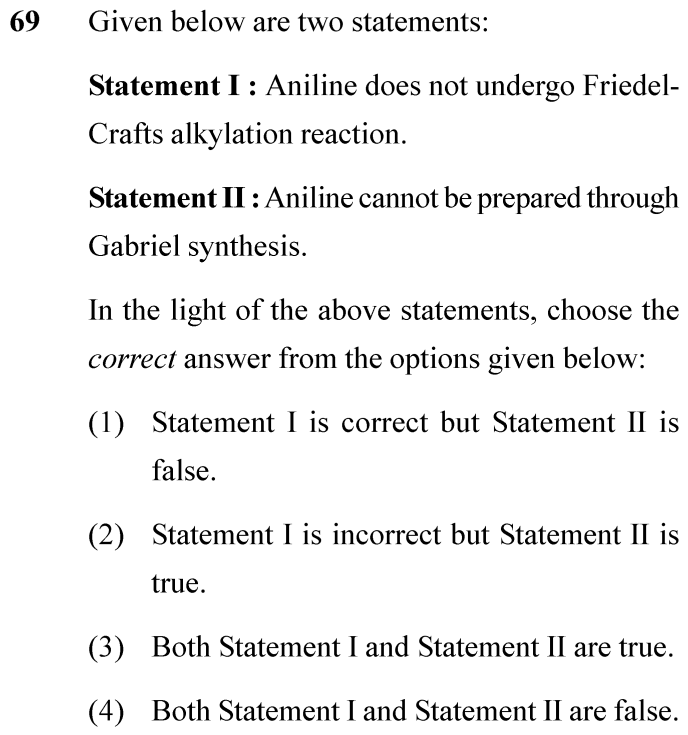
NEET 2024 · Q69 Easy
Official NEET 2024 Question 69 - Amines
1
2
3 ✓ Key
4
💡 Verified Solution & 30-Second Hack
✓
Verified Against NTA Final Answer Key
Option (3) : Both Statement I and Statement II are true.
📚 Amines Easy
📋 Given Parameters & Problem Setup
Target compound Aniline (C6H5NH2)
Statement I Aniline does not undergo Friedel-Crafts alkylation reaction.
Statement II Aniline cannot be prepared through Gabriel synthesis.
⚡

The 30-Second Exam Hall Shortcut: ⚡ Classic Aniline Limitations Rule

⏱️ Save ~35 seconds

Aniline complexes with AlCl3 catalyst (killing Friedel-Crafts) AND aryl halides cannot do SN2 with phthalimide (killing Gabriel synthesis) -> Both are TRUE!

1 Statement I: Aniline is a Lewis base (-NH2 lone pair). It reacts with the Lewis acid catalyst AlCl3 to form a salt [Ph-NH2⁺-AlCl3⁻]. The positive charge strongly deactivates the ring, preventing Friedel-Crafts alkylation/acylation -> Statement I is TRUE.
2 Statement II: Gabriel phthalimide synthesis requires an SN2 nucleophilic attack by the phthalimide anion on a halide. Aryl halides do not undergo SN2 due to partial double bond character and steric repulsion -> Aniline CANNOT be prepared -> Statement II is TRUE.
3 Both statements are true -> Option (3) in 5 seconds!
🛡️
Why You Can 100% Trust This Shortcut: NCERT Chemistry · Amines (Chemical reactions of amines: Friedel-Crafts limitation and Gabriel phthalimide synthesis limitation for aromatic amines).
📐

Step-by-Step Rigorous Workflow & Mathematical Proof

Step 1

Analysis of Statement I (Friedel-Crafts Failure)

Friedel-Crafts alkylation requires an anhydrous Lewis acid catalyst like AlCl3 to generate carbocation electrophiles. Aniline has a basic lone pair on nitrogen that donates to the electron-deficient AlCl3, forming a coordinate adduct. The resulting positive formal charge on nitrogen (-NH2⁺-AlCl3⁻) exerts a potent electron-withdrawing (-I) effect, severely deactivating the benzene ring against electrophilic aromatic substitution:

C6H5N¨H2+AlCl3⟶C6H5N⊕H2−Al⊖Cl3(Deactivated ring, no FC reaction)\text{C}_6\text{H}_5\ddot{\text{N}}\text{H}_2 + \text{AlCl}_3 \longrightarrow \text{C}_6\text{H}_5\overset{\oplus}{\text{N}}\text{H}_2{-}\overset{\ominus}{\text{Al}}\text{Cl}_3 \quad (\text{Deactivated ring, no FC reaction})
Step 2

Analysis of Statement II (Gabriel Synthesis Failure)

Gabriel phthalimide synthesis is exclusively designed for the preparation of primary aliphatic amines. In the key step, potassium phthalimide acts as a nucleophile in an SN2 displacement of halide from an alkyl halide. Because aryl halides (like bromobenzene) have partial double bond character due to resonance and the aryl ring repels backside nucleophilic attack, they do not undergo SN2 reactions:

Phthalimide⊖+Ar−X  ⟶  Ar−N(phthaloyl)(No SN2 on aryl halides)\text{Phthalimide}^\ominus + \text{Ar}-\text{X} \;\cancel{\longrightarrow}\; \text{Ar}-\text{N(phthaloyl)} \quad (\text{No } S_N2 \text{ on aryl halides})
⭐

360° Option Elimination Engine Key Feature

Diagnose every choice: Know exactly why the right option works and why distractors fail.

4-Option Deep Scan
1 (1)
✗ Incorrect
Verdict & Scientific Reason:

Statement II is completely true: aromatic 1° amines cannot be prepared by Gabriel synthesis.

⚠️
Student Fallacy (Why candidates pick this trap): Assuming Gabriel synthesis works for all primary amines including aromatic ones.
2 (2)
✗ Incorrect
Verdict & Scientific Reason:

Statement I is completely true: aniline fails Friedel-Crafts reactions.

⚠️
Student Fallacy (Why candidates pick this trap): Thinking aniline undergoes normal Friedel-Crafts alkylation.
3 (3)
✓ 100% Correct
Verdict & Scientific Reason:

Both canonical limitations of aniline reactions are 100% verified by NCERT.

💡
Why this is airtight: None.
4 (4)
✗ Incorrect
Verdict & Scientific Reason:

Both statements are well-known fundamental principles of amine chemistry.

⚠️
Student Fallacy (Why candidates pick this trap): Rejecting both statements.
⚠️

NTA Trap Alert: Believing Gabriel Synthesis Works for All Primary Amines

Gabriel phthalimide synthesis produces ONLY primary aliphatic amines (R-NH2). It completely fails for aromatic primary amines (Ar-NH2) because aryl halides cannot undergo SN2 substitution.

🛡️ How to avoid the -1 mark: Remember the golden rule: Gabriel synthesis = Aliphatic 1° amines ONLY.
📖

Core NEET Syllabus Standard

Chemistry Core Organic Chemistry · Amines Standard Benchmark
Core Scientific Principle Tested:

"Aniline does not undergo Friedel-Crafts reaction due to salt formation with AlCl3; aromatic primary amines cannot be prepared by Gabriel synthesis because aryl halides do not undergo SN2."

Syllabus Focus: Preparation and Electrophilic Substitution of Amines
✓ Core NEET UG Syllabus Anchor Syllabus & Academic Standards ↗
AlCl3 locks the amine tight; Aryl halides won’t do SN2 in Gabriel’s sight!
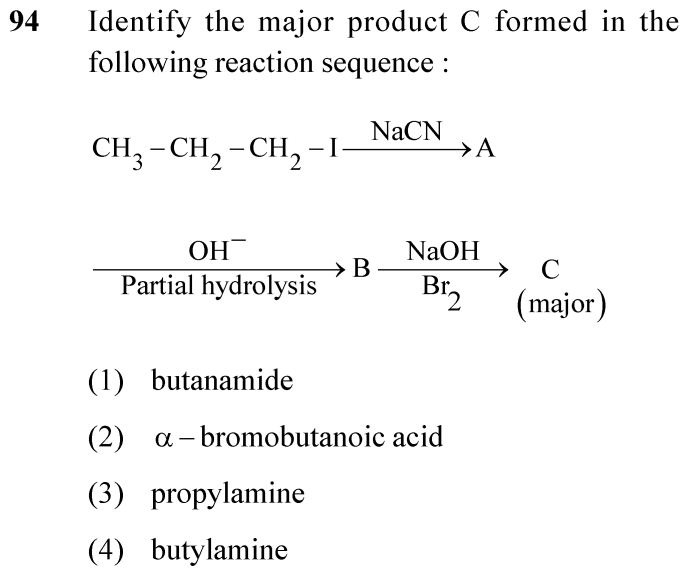
NEET 2024 · Q94 Medium
Official NEET 2024 Question 94 - Amines
1
2
3 ✓ Key
4
💡 Verified Solution & 30-Second Hack
✓
Verified Against NTA Final Answer Key
Option (3) : propylamine (propan-1-amine)
📚 Amines Medium
📋 Given Parameters & Problem Setup
Starting reactant 1-iodopropane (CH3-CH2-CH2-I)
Step 1 reagent NaCN -> Compound A
Step 2 reagent Partial hydrolysis with OH⁻ -> Compound B
Step 3 reagent Br2 / NaOH -> Major Product C
⚡

The 30-Second Exam Hall Shortcut: ⚡ Hoffmann Carbon Count Degradation Hack

⏱️ Save ~40 seconds

Propyl iodide (3C) + NaCN -> Butanenitrile (4C). Partial hydrolysis -> Butanamide (4C). Hoffmann degradation (Br2/NaOH) removes the C=O carbon -> Propylamine (3C)!

1 Step 1: 1-iodopropane (3 carbons) reacts with NaCN via SN2 displacement to form butanenitrile CH3CH2CH2CN (Compound A, 4 carbons).
2 Step 2: Partial alkaline hydrolysis of a nitrile converts -CN cleanly into an amide (-CONH2), giving butanamide CH3CH2CH2CONH2 (Compound B, 4 carbons).
3 Step 3: Treatment of an amide with Br2 and NaOH is the famous Hoffmann bromamide degradation reaction.
4 Hoffmann degradation excises the carbonyl carbon (-CO-) as carbonate, yielding a primary amine with ONE LESS CARBON atom than the amide.
5 4-carbon butanamide degrades to 3-carbon propylamine (CH3CH2CH2NH2).
6 Match Option (3) in 10 seconds!
🛡️
Why You Can 100% Trust This Shortcut: NCERT Chemistry · Amines (Preparation of amines: Hoffmann bromamide degradation reaction and partial hydrolysis of nitriles).
📐

Step-by-Step Rigorous Workflow & Mathematical Proof

Step 1

Nucleophilic Substitution with Cyanide (Formation of A)

1-Iodopropane is a primary alkyl halide. Nucleophilic substitution with sodium cyanide (NaCN) in aqueous ethanol proceeds smoothly via an SN2 mechanism, adding one carbon to the chain to form butanenitrile:

CH3CH2CH2−I+NaCN⟶CH3CH2CH2−CN+NaI(Compound A)\text{CH}_3\text{CH}_2\text{CH}_2{-}\text{I} + \text{NaCN} \longrightarrow \text{CH}_3\text{CH}_2\text{CH}_2{-}\text{CN} + \text{NaI} \quad (\text{Compound A})
Step 2

Partial Hydrolysis of Nitrile to Amide (Formation of B)

Partial alkaline hydrolysis of nitriles in the presence of dilute base (or alkaline H2O2) stops at the primary amide stage, yielding butanamide:

CH3CH2CH2−CN→OH⊖,  partial hydrolysisCH3CH2CH2−CONH2(Compound B)\text{CH}_3\text{CH}_2\text{CH}_2{-}\text{CN} \xrightarrow{\text{OH}^\ominus, \; \text{partial hydrolysis}} \text{CH}_3\text{CH}_2\text{CH}_2{-}\text{CONH}_2 \quad (\text{Compound B})
Step 3

Hoffmann Bromamide Degradation (Formation of C)

Heating butanamide with bromine in aqueous sodium hydroxide results in the Hoffmann bromamide degradation. The alkyl group migrates from carbonyl carbon to nitrogen via an isocyanate intermediate, eliminating the carbonyl group as sodium carbonate and yielding propan-1-amine (propylamine):

CH3CH2CH2CONH2+Br2+4NaOH⟶CH3CH2CH2NH2+Na2CO3+2NaBr+2H2O\text{CH}_3\text{CH}_2\text{CH}_2\text{CONH}_2 + \text{Br}_2 + 4\text{NaOH} \longrightarrow \text{CH}_3\text{CH}_2\text{CH}_2\text{NH}_2 + \text{Na}_2\text{CO}_3 + 2\text{NaBr} + 2\text{H}_2\text{O}
⭐

360° Option Elimination Engine Key Feature

Diagnose every choice: Know exactly why the right option works and why distractors fail.

4-Option Deep Scan
1 (1)
✗ Incorrect
Verdict & Scientific Reason:

This is intermediate Compound B, not the final product C.

⚠️
Student Fallacy (Why candidates pick this trap): Stopping the reaction sequence after step 2.
2 (2)
✗ Incorrect
Verdict & Scientific Reason:

Result of Hell-Volhard-Zelinsky (HVZ) bromination on a carboxylic acid, not Hoffmann degradation.

⚠️
Student Fallacy (Why candidates pick this trap): Confusing Br2/NaOH on amides with HVZ reaction.
3 (3)
✓ 100% Correct
Verdict & Scientific Reason:

Exact product of Hoffmann bromamide degradation of butanamide.

💡
Why this is airtight: None.
4 (4)
✗ Incorrect
Verdict & Scientific Reason:

Retains 4 carbons; would be formed by LiAlH4 reduction of butanamide, not Hoffmann degradation.

⚠️
Student Fallacy (Why candidates pick this trap): Forgetting that Hoffmann degradation loses one carbon.
⚠️

NTA Trap Alert: Forgetting the Carbon Loss in Hoffmann Degradation

Option (4) is butylamine (4 carbons). Students frequently forget that Hoffmann bromamide degradation LOSES the carbonyl carbon atom, producing an amine with one less carbon (3 carbons = propylamine).

🛡️ How to avoid the -1 mark: Hoffmann degradation ALWAYS shortens the carbon chain by 1: 4-carbon amide -> 3-carbon amine.
📖

Core NEET Syllabus Standard

Chemistry Core Organic Chemistry · Amines Standard Benchmark
Core Scientific Principle Tested:

"Hoffmann bromamide degradation converts primary amides into primary amines containing one less carbon atom: R-CONH2 + Br2 + 4NaOH -> R-NH2 + Na2CO3."

Syllabus Focus: Preparation of Amines: Hoffmann Bromamide Degradation Reaction
✓ Core NEET UG Syllabus Anchor Syllabus & Academic Standards ↗
Nitrile adds one, Hoffmann steals one back: Propyl stays propyl at the end of the track!
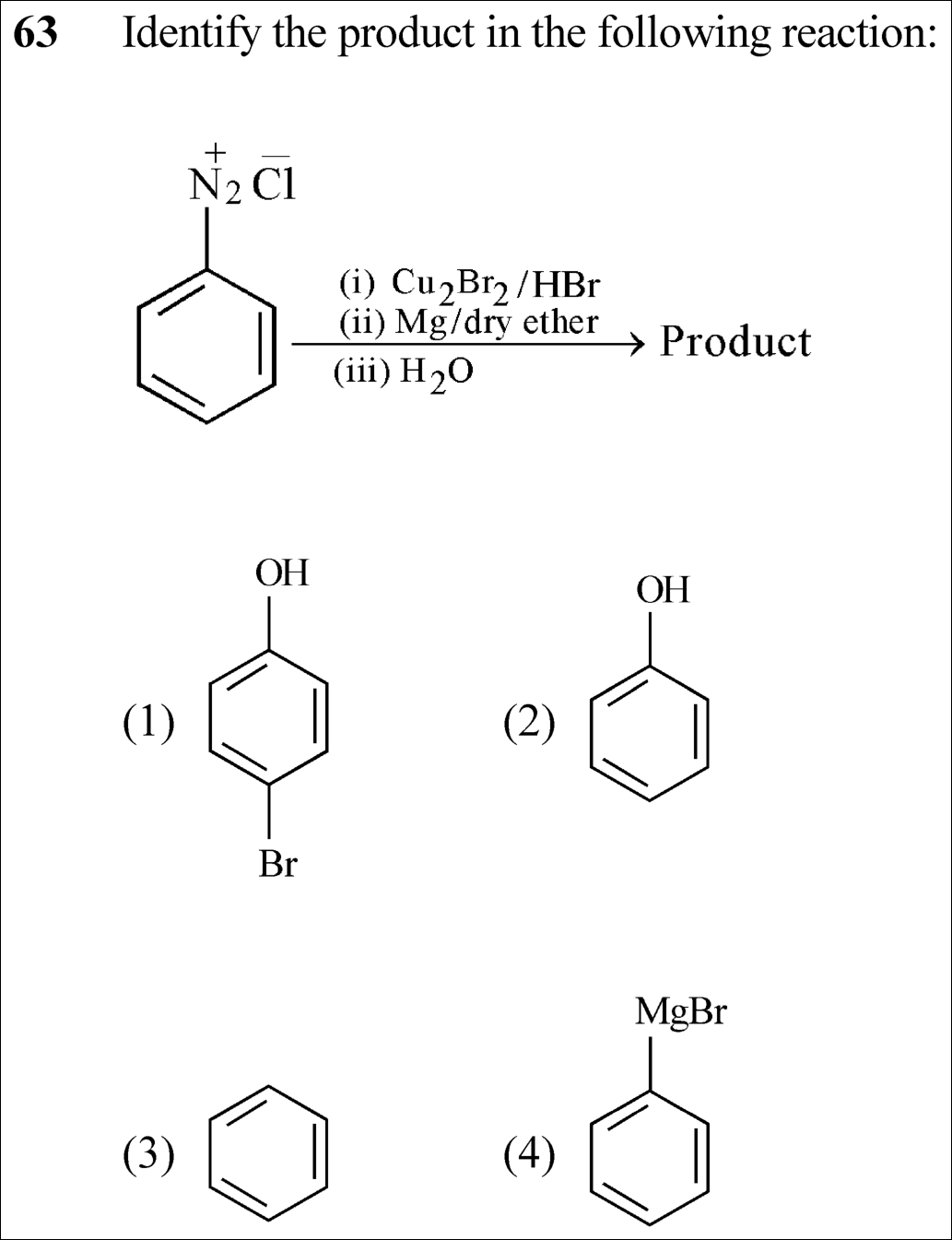
NEET 2023 · Q63 Easy
Official NEET 2023 Question 63 - Amines
1
2
3 ✓ Key
4
💡 Verified Solution & 30-Second Hack
✓
Verified Against NTA Final Answer Key
Option (3) : Benzene
📚 Amines Easy
📋 Given Parameters & Problem Setup
Starting material Benzenediazonium chloride, C₆H₅N₂⁺ Cl⁻
Reagent (i) Cu₂Br₂ / HBr (Sandmeyer reaction)
Reagent (ii) Mg / dry ether (Grignard reagent preparation)
Reagent (iii) H₂O (Protonation of Grignard reagent)
⚡

The 30-Second Exam Hall Shortcut: ⚡ 3-Step Reaction Roadmap: Diazonium ⟶ Bromobenzene ⟶ Grignard ⟶ Benzene

⏱️ Save ~40 seconds

(i) Cu₂Br₂/HBr gives Bromobenzene. (ii) Mg/ether gives Phenylmagnesium bromide (C₆H₅MgBr). (iii) H₂O protonates Grignard to yield pure BENZENE in 10 seconds!

1 Step (i): Benzenediazonium chloride undergoes Sandmeyer reaction with Cu₂Br₂/HBr to replace the diazonium group with bromine ⟶ Bromobenzene (C₆H₅Br).
2 Step (ii): Bromobenzene reacts with magnesium turnings in dry ether to form a Grignard reagent ⟶ Phenylmagnesium bromide (C₆H₅MgBr).
3 Step (iii): Grignard reagents are extremely strong bases/nucleophiles. Addition of water (H₂O) protonates the carbanionic phenyl group: C₆H₅⁻ + H⁺ ⟶ C₆H₆ (Benzene).
4 Final product is Benzene!
5 Lock Option (3) Benzene immediately!
🛡️
Why You Can 100% Trust This Shortcut: Organic Synthetic Conversions · Grignard Hydrolysis (Organomagnesium halides react instantaneously with active hydrogen compounds like H₂O to generate the parent hydrocarbon).
📐

Step-by-Step Rigorous Workflow & Mathematical Proof

Step 1

Step (i): Sandmeyer Reaction to Form Bromobenzene

Benzenediazonium chloride treated with cuprous bromide in hydrobromic acid (Cu₂Br₂ / HBr) undergoes replacement of the diazonium group by bromine with evolution of nitrogen gas (Sandmeyer reaction):

C6H5N2+Cl−→Cu2Br2/HBrC6H5Br+N2↑\text{C}_6\text{H}_5\text{N}_2^+\text{Cl}^- \xrightarrow{\text{Cu}_2\text{Br}_2 / \text{HBr}} \text{C}_6\text{H}_5\text{Br} + \text{N}_2 \uparrow
Step 2

Step (ii): Preparation of Phenylmagnesium Bromide

The resulting bromobenzene is treated with magnesium turnings in anhydrous dry ether to insert magnesium into the carbon-bromine bond, forming the Grignard reagent:

C6H5Br+Mg→dry etherC6H5MgBr(Phenylmagnesium bromide)\text{C}_6\text{H}_5\text{Br} + \text{Mg} \xrightarrow{\text{dry ether}} \text{C}_6\text{H}_5\text{MgBr} \quad (\text{Phenylmagnesium bromide})
Step 3

Step (iii): Hydrolysis of the Organometallic Intermediate

Grignard reagents are highly reactive toward protic sources. Water hydrolyzes phenylmagnesium bromide, transferring a proton to the highly basic phenyl carbon to produce benzene and basic magnesium bromide:

C6H5MgBr+H2O⟶C6H6+Mg(OH)Br\text{C}_6\text{H}_5\text{MgBr} + \text{H}_2\text{O} \longrightarrow \text{C}_6\text{H}_6 + \text{Mg}(\text{OH})\text{Br}
Step 4

Identification of Final Product

The final product obtained after all three sequential transformations is benzene (C₆H₆).

Product=Benzene\text{Product} = \text{Benzene}
⭐

360° Option Elimination Engine Key Feature

Diagnose every choice: Know exactly why the right option works and why distractors fail.

4-Option Deep Scan
1 (1)
✗ Incorrect
Verdict & Scientific Reason:

Phenol does not form under these conditions; water does not substitute on bromobenzene.

⚠️
Student Fallacy (Why candidates pick this trap): Candidate thought H₂O displaced Br by nucleophilic aromatic substitution.
2 (2)
✗ Incorrect
Verdict & Scientific Reason:

Phenol would only form if diazonium salt were directly warmed with water without steps (i) and (ii).

⚠️
Student Fallacy (Why candidates pick this trap): Candidate ignored the Cu₂Br₂ and Mg steps.
3 (3)
✓ 100% Correct
Verdict & Scientific Reason:

Accurate product resulting from complete hydrolysis of phenylmagnesium bromide.

💡
Why this is airtight: None. Candidate traced all three reaction steps accurately.
4 (4)
✗ Incorrect
Verdict & Scientific Reason:

Intermediate formed after step (ii), which reacts further with water in step (iii).

⚠️
Student Fallacy (Why candidates pick this trap): Candidate forgot to carry out the third step (hydrolysis).
⚠️

NTA Trap Alert: Stopping at Step (ii) and Choosing Phenylmagnesium Bromide (Option 4)

Many students recognize the Grignard formation in step (ii) and hastily pick Option (4) without completing step (iii) H₂O, which destroys the Grignard reagent to form benzene.

🛡️ How to avoid the -1 mark: Always cross off each step as you execute it: (i) Done ⟶ C₆H₅Br, (ii) Done ⟶ C₆H₅MgBr, (iii) Done ⟶ C₆H₆.
📖

Core NEET Syllabus Standard

National Eligibility cum Entrance Test (NEET UG) · Amines Standard Benchmark
Core Scientific Principle Tested:

"Diazonium salts undergo Sandmeyer substitution to aryl halides; Grignard reagents protonate with water to yield hydrocarbons."

Syllabus Focus: Synthetic Importance of Diazonium Salts and Grignard Reactions
Preserved in Rationalized Curriculum Syllabus & Academic Standards ↗
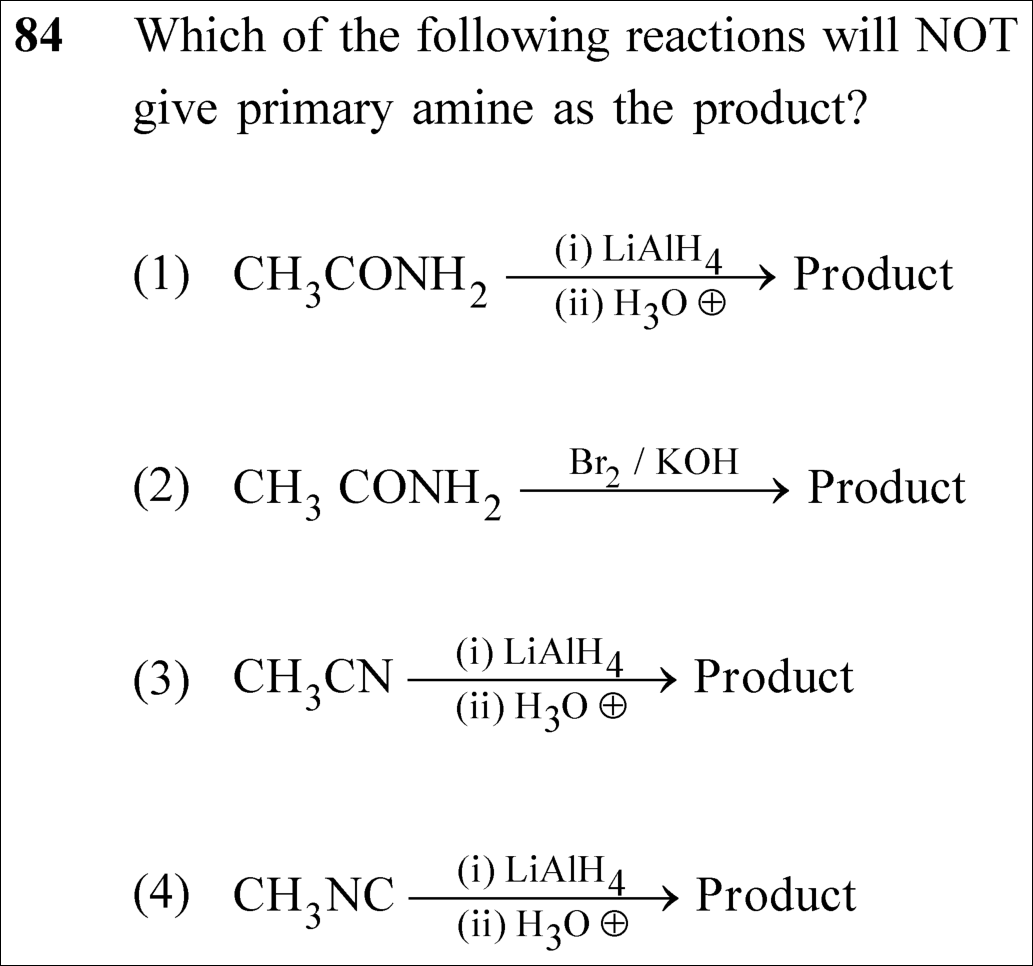
NEET 2023 · Q84 Medium
Official NEET 2023 Question 84 - Amines
1
2
3
4 ✓ Key
💡 Verified Solution & 30-Second Hack
✓
Verified Against NTA Final Answer Key
Option (4) : CH₃NC —( (i) LiAlH₄ / (ii) H₂O )→ Product
📚 Amines Medium
📋 Given Parameters & Problem Setup
Reaction 1 CH₃CONH₂ + LiAlH₄ / H₂O
Reaction 2 CH₃CONH₂ + Br₂ / KOH
Reaction 3 CH₃CN + LiAlH₄ / H₂O
Reaction 4 CH₃NC + LiAlH₄ / H₂O
⚡

The 30-Second Exam Hall Shortcut: ⚡ Isonitrile Functional Rule: Reduction of R–NC Yields 2° Amine (R–NH–CH₃)

⏱️ Save ~30 seconds

Nitriles (R–CN) reduce to 1° primary amines (R–CH₂–NH₂), but isonitriles (R–NC) reduce to 2° secondary amines (R–NH–CH₃)! Acetamide reduces with LiAlH₄ to ethylamine (1°), and with Br₂/KOH undergoes Hoffmann degradation to methylamine (1°). Thus, ONLY Reaction (4) produces a secondary amine!

1 Option 1: CH₃CONH₂ + LiAlH₄ → CH₃CH₂NH₂ (1° amine).
2 Option 2: CH₃CONH₂ + Br₂/KOH → CH₃NH₂ (1° amine, Hoffmann degradation).
3 Option 3: CH₃CN + LiAlH₄ → CH₃CH₂NH₂ (1° amine).
4 Option 4: CH₃NC + LiAlH₄ → CH₃–NH–CH₃ (Dimethylamine, 2° amine).
5 Question asks which does NOT give primary amine: Option (4)!
🛡️
Why You Can 100% Trust This Shortcut: Standard textbook organic functional group reduction of nitrogen compounds.
📐

Step-by-Step Rigorous Workflow & Mathematical Proof

Step 1

Analyze Reaction (1): LiAlH₄ Reduction of Amide

Reduction of acetamide by lithium aluminium hydride reduces the carbonyl group to a methylene group, producing ethanamine (1° amine):

CH3CONH2→(i) LiAlH4,  (ii) H2OCH3CH2NH2(1∘ amine)\text{CH}_3\text{CONH}_2 \xrightarrow{(i)\text{ LiAlH}_4,\; (ii)\text{ H}_2\text{O}} \text{CH}_3\text{CH}_2\text{NH}_2 \quad (1^\circ\text{ amine})
Step 2

Analyze Reaction (2): Hoffmann Bromamide Degradation

Degradation of an aliphatic primary amide with bromine in alkaline KOH eliminates the carbonyl carbon, producing methanamine (1° amine):

CH3CONH2+Br2+4KOH→CH3NH2+K2CO3+2KBr+2H2O(1∘ amine)\text{CH}_3\text{CONH}_2 + \text{Br}_2 + 4\text{KOH} \rightarrow \text{CH}_3\text{NH}_2 + \text{K}_2\text{CO}_3 + 2\text{KBr} + 2\text{H}_2\text{O} \quad (1^\circ\text{ amine})
Step 3

Analyze Reaction (3): LiAlH₄ Reduction of Nitrile

Reduction of acetonitrile converts the cyano group into a primary amine with the same carbon count:

CH3C≡N→(i) LiAlH4,  (ii) H2OCH3CH2NH2(1∘ amine)\text{CH}_3\text{C}\equiv\text{N} \xrightarrow{(i)\text{ LiAlH}_4,\; (ii)\text{ H}_2\text{O}} \text{CH}_3\text{CH}_2\text{NH}_2 \quad (1^\circ\text{ amine})
Step 4

Analyze Reaction (4): LiAlH₄ Reduction of Isocyanide

Reduction of an alkyl isocyanide (methyl isonitrile) adds hydrogens across the coordinate bond, yielding a secondary amine:

CH3−N⊕≡C⊖→(i) LiAlH4,  (ii) H2OCH3−NH−CH3(2∘ secondary amine)\text{CH}_3-\text{N}^\oplus\equiv\text{C}^\ominus \xrightarrow{(i)\text{ LiAlH}_4,\; (ii)\text{ H}_2\text{O}} \text{CH}_3-\text{NH}-\text{CH}_3 \quad (2^\circ\text{ secondary amine})
⭐

360° Option Elimination Engine Key Feature

Diagnose every choice: Know exactly why the right option works and why distractors fail.

4-Option Deep Scan
1 (1)
✗ Incorrect
Verdict & Scientific Reason:

Produces ethanamine (CH₃CH₂NH₂), which is a primary amine.

⚠️
Student Fallacy (Why candidates pick this trap): Candidate forgot that LiAlH₄ reduces amides to primary amines without loss of carbon.
2 (2)
✗ Incorrect
Verdict & Scientific Reason:

Produces methanamine (CH₃NH₂), which is the benchmark primary amine of Hoffmann bromamide degradation.

⚠️
Student Fallacy (Why candidates pick this trap): Candidate misidentified the product of the Hoffmann bromamide reaction.
3 (3)
✗ Incorrect
Verdict & Scientific Reason:

Produces ethanamine (CH₃CH₂NH₂), which is a primary amine.

⚠️
Student Fallacy (Why candidates pick this trap): Candidate confused the reduction of nitriles with the reduction of isonitriles.
4 (4)
✓ 100% Correct
Verdict & Scientific Reason:

Accurate: Reduction of methyl isonitrile gives dimethylamine (CH₃-NH-CH₃), a 2° amine.

💡
Why this is airtight: None. Candidate correctly distinguished nitrile (-CN) from isonitrile (-NC) reduction products.
⚠️

NTA Trap Alert: Confusing Cyanide (-CN) with Isocyanide (-NC)

Nitriles (R-CN) have nitrogen at the terminus, so reduction gives R-CH₂-NH₂ (1° amine). Isocyanides (R-NC) have nitrogen in the middle between two carbon atoms, so reduction gives R-NH-CH₃ (2° amine)!

🛡️ How to avoid the -1 mark: Remember: Cyanide → 1° Amine; Isocyanide → 2° Amine.
📖

Core NEET Syllabus Standard

National Eligibility cum Entrance Test (NEET UG) · Amines Standard Benchmark
Core Scientific Principle Tested:

"Reduction of alkyl nitriles yields primary amines, whereas reduction of alkyl isonitriles yields secondary amines."

Syllabus Focus: Preparation of Amines – Reduction of Nitriles and Isonitriles
Preserved in Rationalized Curriculum Syllabus & Academic Standards ↗
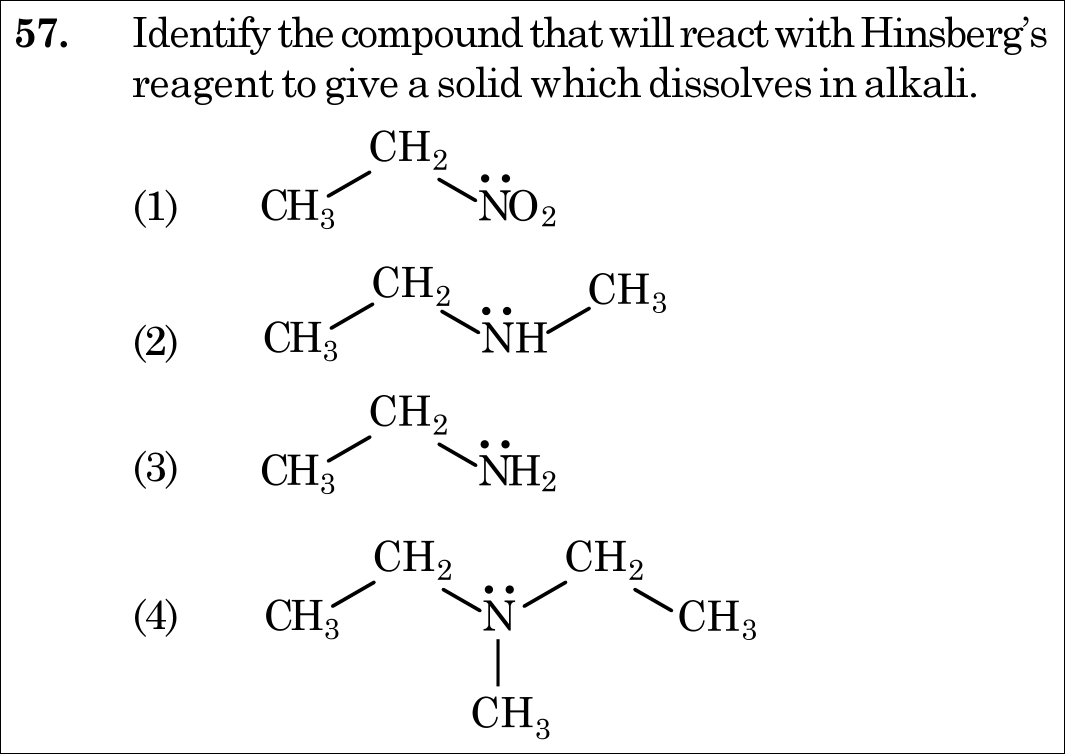
NEET 2021 · Q57 Easy
Official NEET 2021 Question 57 - Amines
1
2
3 ✓ Key
4
💡 Verified Solution & 30-Second Hack
✓
Verified Against NTA Final Answer Key
Option (3) : CH3 - CH2 - NH2
📚 Amines Easy
📋 Given Parameters & Problem Setup
Reagent Hinsberg's reagent (benzenesulfonyl chloride, C6H5SO2Cl)
Observation Forms a solid which dissolves in alkali (aqueous KOH/NaOH)
⚡

The 30-Second Exam Hall Shortcut: ⚡ Hinsberg Signature: 1° Amine Dissolves in Alkali!

⏱️ Save ~20 seconds

Primary amines (1∘1^\circ, R−NH2R-NH_2) react with Hinsberg's reagent to form N-alkylbenzenesulfonamides that retain an acidic hydrogen on nitrogen, dissolving readily in aqueous alkali. Secondary amines lack this acidic proton and remain insoluble. Tertiary amines do not react. The only primary amine among the choices is ethylamine (CH3−CH2−NH2CH_3-CH_2-NH_2)! Match Option (3)!

1 1∘1^\circ Amine (R−NH2R-NH_2) + C6H5SO2Cl→C6H5SO2−NH−RC_6H_5SO_2Cl \to C_6H_5SO_2-NH-R (solid with acidic H attached to N) →KOH\xrightarrow{\text{KOH}} soluble salt.
2 2∘2^\circ Amine (R2NHR_2NH) + C6H5SO2Cl→C6H5SO2−NR2C_6H_5SO_2Cl \to C_6H_5SO_2-NR_2 (no acidic H attached to N) →KOH\xrightarrow{\text{KOH}} insoluble.
3 3∘3^\circ Amine (R3NR_3N) + C6H5SO2Cl→C_6H_5SO_2Cl \to No reaction.
4 Identify the 1∘1^\circ amine: Option (3) is CH3−CH2−N¨H2CH_3-CH_2-\ddot{N}H_2 (ethylamine).
5 Match Option (3).
🛡️
Why You Can 100% Trust This Shortcut: Canonical Hinsberg test chemistry from NCERT Amines.
📐

Step-by-Step Rigorous Workflow & Mathematical Proof

Step 1

Chemistry of Hinsberg's Reagent

Hinsberg's reagent is benzenesulfonyl chloride (C6H5SO2ClC_6H_5SO_2Cl). It is used to distinguish and separate primary (1∘1^\circ), secondary (2∘2^\circ), and tertiary (3∘3^\circ) amines based on the presence of replaceable hydrogen atoms on nitrogen.

Step 2

Reaction with a Primary Amine (CH3CH2NH2)

Ethylamine (CH3CH2NH2CH_3CH_2NH_2, a primary amine) reacts with benzenesulfonyl chloride to yield N-ethylbenzenesulfonamide:

C6H5SO2Cl+H2N−CH2CH3⟶C6H5SO2−NH−CH2CH3+HClC_6H_5SO_2Cl + H_2N-CH_2CH_3 \longrightarrow C_6H_5SO_2-NH-CH_2CH_3 + HCl
Step 3

Acidity and Solubility in Aqueous Alkali

The hydrogen atom attached to the nitrogen atom in N-ethylbenzenesulfonamide is strongly acidic because of the strong electron-withdrawing inductive and resonance effects of the sulfonyl (−SO2−-SO_2-) group. In the presence of base (alkali, such as aqueous KOHKOH or NaOHNaOH), it readily deprotonates to form a water-soluble potassium/sodium sulfonamide salt:

C6H5SO2−Nδ−H−CH2CH3+KOH⟶[C6H5SO2−Nˉ−CH2CH3]K++H2O(Soluble in alkali)C_6H_5SO_2-\overset{\delta-}{N}H-CH_2CH_3 + KOH \longrightarrow [C_6H_5SO_2-\bar{N}-CH_2CH_3] K^+ + H_2O \quad (\mathbf{\text{Soluble in alkali}})
⭐

360° Option Elimination Engine Key Feature

Diagnose every choice: Know exactly why the right option works and why distractors fail.

4-Option Deep Scan
1 1
✗ Incorrect
Verdict & Scientific Reason:

Nitroethane is a nitro compound, not an amine; does not participate in the Hinsberg amine test.

⚠️
Student Fallacy (Why candidates pick this trap): Confusing nitroalkanes with primary amines.
2 2
✗ Incorrect
Verdict & Scientific Reason:

Secondary amine (NN-methylethanamine): forms N-ethyl-N-methylbenzenesulfonamide which has NO acidic hydrogen on nitrogen and remains INSOLUBLE in alkali.

⚠️
Student Fallacy (Why candidates pick this trap): Forgetting that secondary amine sulfonamides lack acidic protons.
3 3
✓ 100% Correct
Verdict & Scientific Reason:

Primary amine (1circ1^circ): forms N-ethylbenzenesulfonamide containing an acidic hydrogen that dissolves in aqueous alkali.

💡
Why this is airtight: None; textbook Hinsberg test reaction.
4 4
✗ Incorrect
Verdict & Scientific Reason:

Tertiary amine (3circ3^circ): has no hydrogen on nitrogen and does not react with Hinsberg's reagent at all.

⚠️
Student Fallacy (Why candidates pick this trap): Assuming tertiary amines react with benzenesulfonyl chloride.
⚠️

NTA Trap Alert: Secondary Amine Insoluble Precipitate Trap

Students frequently remember that secondary amines (Option 2) also react with Hinsberg's reagent, but forget that the resulting product has NO proton on nitrogen and is completely INSOLUBLE in alkali. Only primary amine sulfonamides dissolve in alkali.

🛡️ How to avoid the -1 mark: Soluble in alkali   ⟹  1∘\implies 1^\circ amine. Insoluble in alkali   ⟹  2∘\implies 2^\circ amine. No reaction   ⟹  3∘\implies 3^\circ amine.
📖

Core NEET Syllabus Standard

NCERT Chemistry · Amines Standard Benchmark
Core Scientific Principle Tested:

"Primary amines react with benzenesulfonyl chloride to form N-alkylbenzenesulfonamides, which dissolve in alkali due to the presence of an acidic hydrogen on nitrogen."

Syllabus Focus: Reaction with Arylsulphonyl Chloride (Hinsberg's Test)
✓ Core NEET UG Syllabus Anchor Syllabus & Academic Standards ↗
NEET 2021 · Q87 Easy
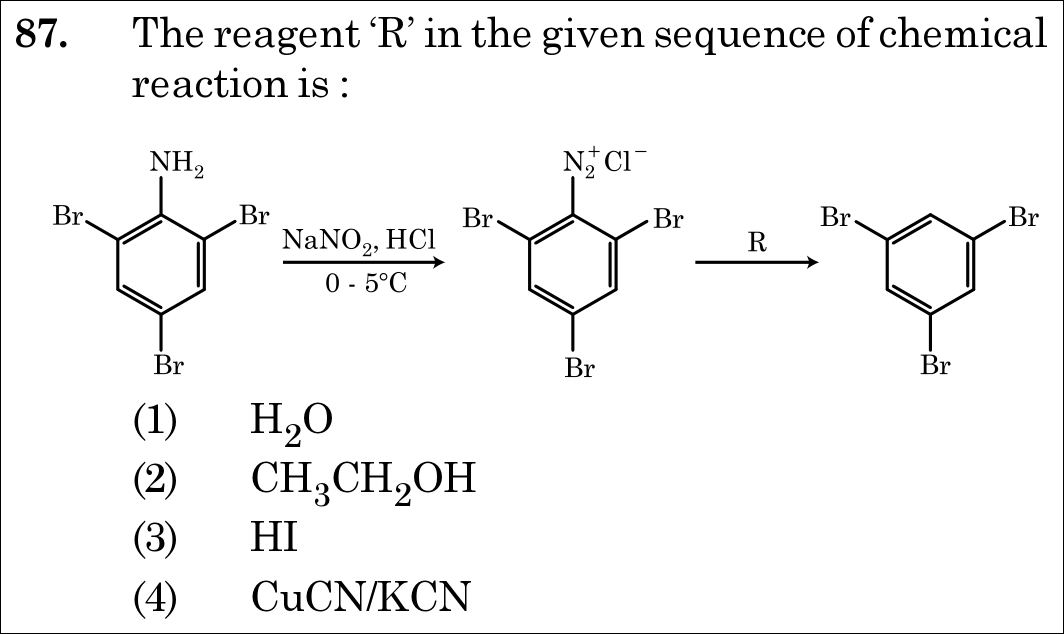
Official NEET 2021 Question 87 - Amines
1 H2O
2 CH3CH2OH ✓ Key
3 HI
4 CuCN/KCN
💡 Verified Solution & 30-Second Hack
✓
Verified Against NTA Final Answer Key
Option (2) : CH3CH2OH
📚 Amines Easy
📋 Given Parameters & Problem Setup
Substrate 2,4,6-Tribromobenzenediazonium chloride
Reagent R Mild reducing agent for replacement of -N2+Cl- by -H
Product 1,3,5-Tribromobenzene (symmetrical tribromobenzene)
⚡

The 30-Second Exam Hall Shortcut: ⚡ Deamination of -N2⁺Cl⁻ to -H: Use H3PO2 or CH3CH2OH!

⏱️ Save ~20 seconds

Replacement of the diazonium group (−N2+Cl−-N_2^+Cl^-) by hydrogen (−H-H) requires a mild reducing agent. Verbatim NCERT Amines: "Certain mild reducing agents like hypophosphorous acid (H3PO2H_3PO_2) or ethanol (CH3CH2OHCH_3CH_2OH) reduce diazonium salts to arenes and themselves get oxidised to phosphorous acid and ethanal, respectively." Among the choices, the reducing agent is ethanol (CH3CH2OHCH_3CH_2OH)! Match Option (2)!

1 Inspect conversion: The diazonium group (−N2+Cl−-N_2^+Cl^-) at position 1 is replaced by hydrogen (−H-H).
2 This reductive deamination reaction is carried out using mild reducing agents: H3PO2/H2OH_3PO_2 / H_2O or CH3CH2OHCH_3CH_2OH.
3 Ethanol acts as hydride donor, reducing the diazonium arene to the parent hydrocarbon while being oxidized to acetaldehyde (CH3CHOCH_3CHO).
4 Reaction: Ar−N2+Cl−+CH3CH2OH⟶Ar−H+N2↑+HCl+CH3CHOAr-N_2^+Cl^- + CH_3CH_2OH \longrightarrow Ar-H + N_2\uparrow + HCl + CH_3CHO.
5 Match Option (2) CH3CH2OH.
6 Other reagents: H2OH_2O with heat gives phenol; HIHI gives aryl iodide; CuCN/KCNCuCN/KCN gives benzonitrile (Sandmeyer).
🛡️
Why You Can 100% Trust This Shortcut: Canonical NCERT Amines section on Reactions Involving Displacement of Nitrogen (Reduction).
📐

Step-by-Step Rigorous Workflow & Mathematical Proof

Step 1

Identifying the Target Chemical Transformation

The reaction sequence shows: 1. 2,4,6-tribromoaniline undergoes diazotization with nitrous acid (NaNO2+HCl\text{NaNO}_2 + \text{HCl} at 0−5∘C0-5^\circ\text{C}) to form 2,4,6-tribromobenzenediazonium chloride. 2. The diazonium chloride reacts with reagent 'R' to lose the diazonium function, yielding 1,3,5-tribromobenzene. This is a classic reductive deamination where the −N2+Cl−-N_2^+Cl^- group is replaced by a hydrogen atom (−H-H).

Step 2

Evaluating Reducing Agents for Diazonium Salts in NCERT

According to NCERT Chapter on Amines: *"Certain mild reducing agents like hypophosphorous acid (H3PO2H_3PO_2) or ethanol (CH3CH2OHCH_3CH_2OH) reduce diazonium salts to arenes and themselves get oxidised to phosphorous acid and ethanal, respectively."* The balanced chemical equation for the reduction by ethanol is:

Ar−N2+Cl−+CH3CH2OH⟶Ar−H+N2↑+HCl+CH3CHOAr-N_2^+Cl^- + CH_3CH_2OH \longrightarrow Ar-H + N_2\uparrow + HCl + CH_3CHO
Step 3

Eliminating Alternative Reagents

- H2OH_2O (Option 1): Warming diazonium salts with water leads to hydrolysis, replacing −N2+Cl−-N_2^+Cl^- with a phenolic −OH-OH group (forming 2,4,6-tribromophenol). - HIHI (Option 3): Replaces −N2+Cl−-N_2^+Cl^- with an iodine atom (forming 1-iodo-2,4,6-tribromobenzene). - CuCN/KCNCuCN/KCN (Option 4): Sandmeyer reaction replacing −N2+Cl−-N_2^+Cl^- with a cyano group (−CN-CN). Therefore, reagent 'R' is uniquely ethanol (CH3CH2OHCH_3CH_2OH).

⭐

360° Option Elimination Engine Key Feature

Diagnose every choice: Know exactly why the right option works and why distractors fail.

4-Option Deep Scan
1 1
✗ Incorrect
Verdict & Scientific Reason:

Hydrolyzes the diazonium group into a phenol (−OH-OH), not a hydrocarbon (−H-H).

⚠️
Student Fallacy (Why candidates pick this trap): Assuming water simply protonates the ring.
2 2
✓ 100% Correct
Verdict & Scientific Reason:

Exact reducing agent specified in NCERT that reduces diazonium salts to arenes, forming ethanal byproduct.

💡
Why this is airtight: None; textbook diazonium reduction.
3 3
✗ Incorrect
Verdict & Scientific Reason:

Converts diazonium salt to iodobenzene derivative.

⚠️
Student Fallacy (Why candidates pick this trap): Confusing reduction to arene with iodination.
4 4
✗ Incorrect
Verdict & Scientific Reason:

Sandmeyer cyanation reaction yielding a nitrile.

⚠️
Student Fallacy (Why candidates pick this trap): Confusing reduction with cyanation.
⚠️

NTA Trap Alert: Water Hydrolysis vs. Ethanol Reduction Trap

Students frequently remember that diazonium salts react with water, and assume water provides the HH to make the benzene ring. Water introduces an −OH-OH group to make phenol! Only ETHANOL (CH3CH2OHCH_3CH_2OH) or H3PO2H_3PO_2 reduces the diazonium salt to the hydrocarbon.

🛡️ How to avoid the -1 mark: −N2+Cl−→H2O,Δ−OH-N_2^+Cl^- \xrightarrow{H_2O, \Delta} -OH (Phenol). −N2+Cl−→CH3CH2OH−H-N_2^+Cl^- \xrightarrow{CH_3CH_2OH} -H (Arene).
📖

Core NEET Syllabus Standard

NCERT Chemistry · Amines Standard Benchmark
Core Scientific Principle Tested:

"Ethanol reduces diazonium salts to arenes while being oxidized to ethanal."

Syllabus Focus: Chemical Reactions of Diazonium Salts (Reduction / Replacement by H)
✓ Core NEET UG Syllabus Anchor Syllabus & Academic Standards ↗
NEET 2020 · Q102 Easy
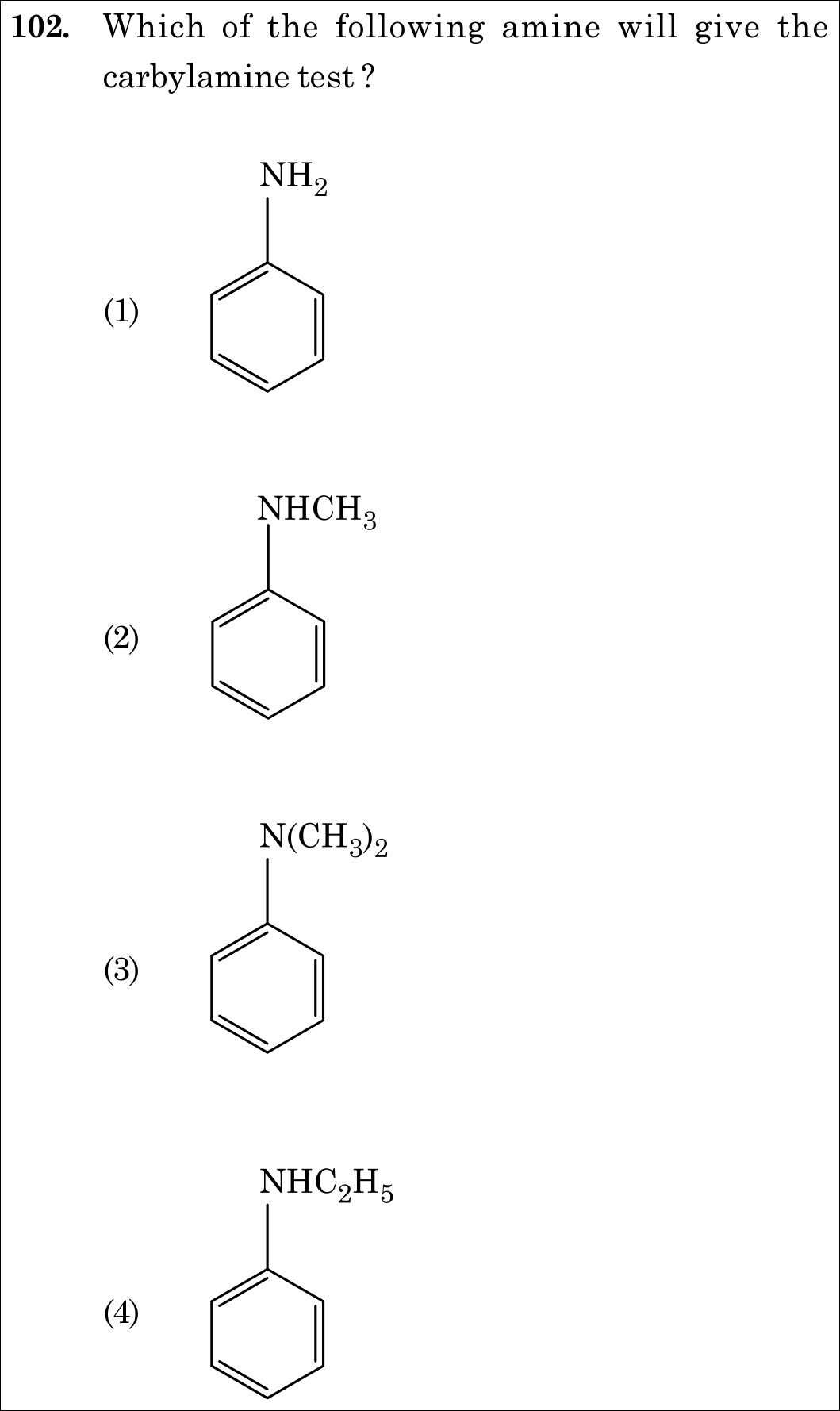
Official NEET 2020 Question 102 - Amines
1 ✓ Key
2
3
4
💡 Verified Solution & 30-Second Hack
✓
Verified Against NTA Final Answer Key
Option (1) : Aniline (C6H5-NH2)
📚 Amines Easy
📋 Given Parameters & Problem Setup
Diagnostic Chemical Test Carbylamine test (Isocyanide test: CHCl3 + alc. KOH / Δ)
Criterion Must be a primary (1°) amine (aliphatic or aromatic)
Question Objective Identify which amine gives the carbylamine test
⚡

The 30-Second Exam Hall Shortcut: ⚡ "Carbylamine Test = ONLY Primary (1°) Amines! Aniline (C6H5-NH2) is 1°!"

⏱️ 20 seconds

Carbylamine reaction is given exclusively by PRIMARY amines (R−NH2R-NH_2 or Ar−NH2Ar-NH_2) when heated with chloroform and alcoholic KOH, producing extremely foul-smelling isocyanides (R−NCR-NC). Secondary and tertiary amines DO NOT show this test. Among the choices, Aniline (C6H5−NH2C_6H_5-NH_2) is a primary amine! Mark Aniline (Option 1) in 5 seconds.

1 Principle: Only primary (1°) amines undergo carbylamine reaction.
2 Reaction: R-NH2 + CHCl3 + 3KOH (alc.) -> R-NC (foul smell) + 3KCl + 3H2O.
3 Analyze options: - Option (1): Aniline (C6H5-NH2) -> Primary amine (1°). - Option (2): N-Methylaniline (C6H5-NH-CH3) -> Secondary amine (2°). - Option (3): N,N-Dimethylaniline (C6H5-N(CH3)2) -> Tertiary amine (3°). - Option (4): Secondary aliphatic amine.
4 Thus, only Aniline gives the carbylamine test.
5 Select Option (1).
🛡️
Why You Can 100% Trust This Shortcut: NCERT Chemistry · Amines (Chemical Reactions: Carbylamine Reaction / Isocyanide Test)
📐

Step-by-Step Rigorous Workflow & Mathematical Proof

Step 1

Understand the Carbylamine Reaction

When aliphatic or aromatic primary amines are heated with chloroform (CHCl3\text{CHCl}_3) and alcoholic potassium hydroxide (KOH\text{KOH}), they form carbylamines or isocyanides (R-NC\text{R-NC}), which possess an intensely foul, offensive smell: R-NH2+CHCl3+3KOH→ΔR-NC+3KCl+3H2O\text{R-NH}_2 + \text{CHCl}_3 + 3\text{KOH} \xrightarrow{\Delta} \text{R-NC} + 3\text{KCl} + 3\text{H}_2\text{O}

Step 2

Specificity for Primary Amines

Secondary (2∘2^\circ) and tertiary (3∘3^\circ) amines do not give this reaction because they lack the required two hydrogen atoms on the nitrogen atom to form the isocyanide (−N≡C-\text{N}\equiv\text{C}) functional group.

Step 3

Classify the Given Amines

- Option (1): Aniline (C6H5−NH2\text{C}_6\text{H}_5-\text{NH}_2) has an -NH2\text{-NH}_2 group attached to a phenyl ring, making it a primary (1∘1^\circ) aromatic amine. - Option (2): NN-methylaniline (C6H5−NH−CH3\text{C}_6\text{H}_5-\text{NH}-\text{CH}_3) is a secondary (2∘2^\circ) amine. - Option (3): N,NN,N-dimethylaniline (C6H5−N(CH3)2\text{C}_6\text{H}_5-\text{N}(\text{CH}_3)_2) is a tertiary (3∘3^\circ) amine. - Option (4): Diethylamine ((C2H5)2NH(\text{C}_2\text{H}_5)_2\text{NH}) is a secondary (2∘2^\circ) amine.

Step 4

Conclude Aniline

Aniline is the only primary amine among the choices, and thus it alone gives the carbylamine test.

⭐

360° Option Elimination Engine Key Feature

Diagnose every choice: Know exactly why the right option works and why distractors fail.

4-Option Deep Scan
1 A
✓ 100% Correct
Verdict & Scientific Reason:

Factually exact; aniline is a primary amine (1∘1^\circ) and reacts to produce foul-smelling phenyl isocyanide (C6H5−NCC_6H_5-NC).

💡
Why this is airtight: None; textbook distinction between 1°, 2°, and 3° amines.
2 B
✗ Incorrect
Verdict & Scientific Reason:

Incorrect; NN-methylaniline is a secondary amine (2∘2^\circ), which does not respond to the carbylamine test.

⚠️
Student Fallacy (Why candidates pick this trap): Assuming all aromatic amines give carbylamine test regardless of degree.
3 C
✗ Incorrect
Verdict & Scientific Reason:

Incorrect; N,NN,N-dimethylaniline is a tertiary amine (3∘3^\circ) and does not undergo isocyanide formation.

⚠️
Student Fallacy (Why candidates pick this trap): Failing to check degree of nitrogen substitution.
4 D
✗ Incorrect
Verdict & Scientific Reason:

Incorrect; secondary aliphatic amines do not give the carbylamine test.

⚠️
Student Fallacy (Why candidates pick this trap): Confusing Hinsberg test reactivity with carbylamine test.
⚠️

NTA Trap Alert: Aromatic vs Aliphatic in Carbylamine Test

Carbylamine test is given by BOTH ALIPHATIC AND AROMATIC primary amines! The only requirement is that it must be PRIMARY (−NH2-\text{NH}_2).

🛡️ How to avoid the -1 mark: Look for the −NH2-NH_2 group! Only 1∘1^\circ amine gives carbylamine test!
📖

Core NEET Syllabus Standard

Chemistry · Amines Standard Benchmark
Core Scientific Principle Tested:

""

Syllabus Focus: Carbylamine Reaction: Exclusive Diagnostic Test for Primary Amines
✓ Core NEET UG Syllabus Anchor Syllabus & Academic Standards ↗

Solve 4 NEET Questions a Day — One per Subject

Cover all 1,140 official NEET questions in 285 days at your own pace. Progress is saved on your device. No login needed.