MyCompetitiveExams Logo MyCompetitiveExams
Search 1,140+ Questions
Chapters, formulas, speed tricks
→
⚡ Brahmastra NEET 2027
720 MARKS

Dynamic 180-question full-length simulator mixed dynamically from all 6 years for 2027 & 2026 aspirants.

Launch Brahmastra 2027 Test →
Start Practice →
100% Free · No Login Required
Q.63 Chemistry ⭐ 360° Option Elimination Active
Vault ↗

NEET 2023 Chemistry Question 63 Solution

Topic: Amines · Official NTA Booklet Code G5
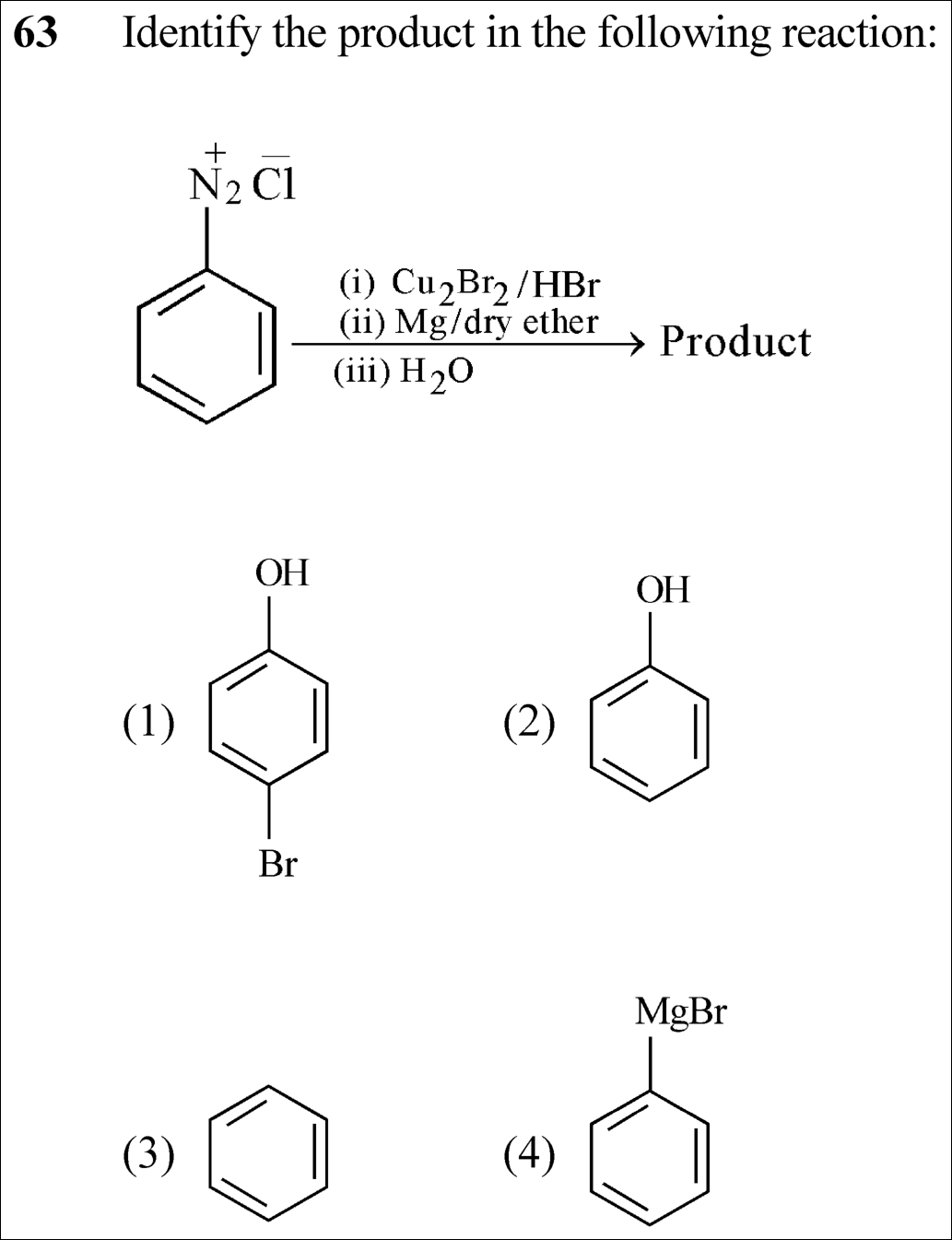
NEET 2023 Chemistry Question 63: Sandmeyer Reaction Followed by Grignard Hydrolysis to Benzene

Question

Identify the product in the following reaction: Benzenediazonium chloride (C₆H₅N₂⁺Cl⁻) → (i) Cu₂Br₂/HBr (ii) Mg/dry ether (iii) H₂O → Product

✓
Verified Against NTA Final Answer Key
Option (3) : Benzene
📚 Amines Easy
📋 Given Parameters & Problem Setup
Starting material Benzenediazonium chloride, C₆H₅N₂⁺ Cl⁻
Reagent (i) Cu₂Br₂ / HBr (Sandmeyer reaction)
Reagent (ii) Mg / dry ether (Grignard reagent preparation)
Reagent (iii) H₂O (Protonation of Grignard reagent)
⚡

The 30-Second Exam Hall Shortcut: ⚡ 3-Step Reaction Roadmap: Diazonium ⟶ Bromobenzene ⟶ Grignard ⟶ Benzene

⏱️ Save ~40 seconds

(i) Cu₂Br₂/HBr gives Bromobenzene. (ii) Mg/ether gives Phenylmagnesium bromide (C₆H₅MgBr). (iii) H₂O protonates Grignard to yield pure BENZENE in 10 seconds!

1 Step (i): Benzenediazonium chloride undergoes Sandmeyer reaction with Cu₂Br₂/HBr to replace the diazonium group with bromine ⟶ Bromobenzene (C₆H₅Br).
2 Step (ii): Bromobenzene reacts with magnesium turnings in dry ether to form a Grignard reagent ⟶ Phenylmagnesium bromide (C₆H₅MgBr).
3 Step (iii): Grignard reagents are extremely strong bases/nucleophiles. Addition of water (H₂O) protonates the carbanionic phenyl group: C₆H₅⁻ + H⁺ ⟶ C₆H₆ (Benzene).
4 Final product is Benzene!
5 Lock Option (3) Benzene immediately!
🛡️
Why You Can 100% Trust This Shortcut: Organic Synthetic Conversions · Grignard Hydrolysis (Organomagnesium halides react instantaneously with active hydrogen compounds like H₂O to generate the parent hydrocarbon).
📐

Step-by-Step Rigorous Workflow & Mathematical Proof

Step 1

Step (i): Sandmeyer Reaction to Form Bromobenzene

Benzenediazonium chloride treated with cuprous bromide in hydrobromic acid (Cu₂Br₂ / HBr) undergoes replacement of the diazonium group by bromine with evolution of nitrogen gas (Sandmeyer reaction):

C6H5N2+Cl−→Cu2Br2/HBrC6H5Br+N2↑\text{C}_6\text{H}_5\text{N}_2^+\text{Cl}^- \xrightarrow{\text{Cu}_2\text{Br}_2 / \text{HBr}} \text{C}_6\text{H}_5\text{Br} + \text{N}_2 \uparrow
Step 2

Step (ii): Preparation of Phenylmagnesium Bromide

The resulting bromobenzene is treated with magnesium turnings in anhydrous dry ether to insert magnesium into the carbon-bromine bond, forming the Grignard reagent:

C6H5Br+Mg→dry etherC6H5MgBr(Phenylmagnesium bromide)\text{C}_6\text{H}_5\text{Br} + \text{Mg} \xrightarrow{\text{dry ether}} \text{C}_6\text{H}_5\text{MgBr} \quad (\text{Phenylmagnesium bromide})
Step 3

Step (iii): Hydrolysis of the Organometallic Intermediate

Grignard reagents are highly reactive toward protic sources. Water hydrolyzes phenylmagnesium bromide, transferring a proton to the highly basic phenyl carbon to produce benzene and basic magnesium bromide:

C6H5MgBr+H2O⟶C6H6+Mg(OH)Br\text{C}_6\text{H}_5\text{MgBr} + \text{H}_2\text{O} \longrightarrow \text{C}_6\text{H}_6 + \text{Mg}(\text{OH})\text{Br}
Step 4

Identification of Final Product

The final product obtained after all three sequential transformations is benzene (C₆H₆).

Product=Benzene\text{Product} = \text{Benzene}
⭐

360° Option Elimination Engine Key Feature

Diagnose every choice: Know exactly why the right option works and why distractors fail.

4-Option Deep Scan
1 (1)
✗ Incorrect
Verdict & Scientific Reason:

Phenol does not form under these conditions; water does not substitute on bromobenzene.

⚠️
Student Fallacy (Why candidates pick this trap): Candidate thought H₂O displaced Br by nucleophilic aromatic substitution.
2 (2)
✗ Incorrect
Verdict & Scientific Reason:

Phenol would only form if diazonium salt were directly warmed with water without steps (i) and (ii).

⚠️
Student Fallacy (Why candidates pick this trap): Candidate ignored the Cu₂Br₂ and Mg steps.
3 (3)
✓ 100% Correct
Verdict & Scientific Reason:

Accurate product resulting from complete hydrolysis of phenylmagnesium bromide.

💡
Why this is airtight: None. Candidate traced all three reaction steps accurately.
4 (4)
✗ Incorrect
Verdict & Scientific Reason:

Intermediate formed after step (ii), which reacts further with water in step (iii).

⚠️
Student Fallacy (Why candidates pick this trap): Candidate forgot to carry out the third step (hydrolysis).
⚠️

NTA Trap Alert: Stopping at Step (ii) and Choosing Phenylmagnesium Bromide (Option 4)

Many students recognize the Grignard formation in step (ii) and hastily pick Option (4) without completing step (iii) H₂O, which destroys the Grignard reagent to form benzene.

🛡️ How to avoid the -1 mark: Always cross off each step as you execute it: (i) Done ⟶ C₆H₅Br, (ii) Done ⟶ C₆H₅MgBr, (iii) Done ⟶ C₆H₆.
📖

Core NEET Syllabus Standard

National Eligibility cum Entrance Test (NEET UG) · Amines Standard Benchmark
Core Scientific Principle Tested:

"Diazonium salts undergo Sandmeyer substitution to aryl halides; Grignard reagents protonate with water to yield hydrocarbons."

Syllabus Focus: Synthetic Importance of Diazonium Salts and Grignard Reactions
Preserved in Rationalized Curriculum Syllabus & Academic Standards ↗

Ready to attempt under real exam pressure?

Test your speed and accuracy in the authentic 200-minute timed NTA simulator.

Launch NEET 2023 CBT Test →

Spotted a mistake in this solution? Report an error ([email protected])

⚖️ Legal & Fair Dealing Notice: Sourced from publicly released NEET 2023 question papers and NEET answer keys for private study, research, and non-commercial educational practice under Fair Dealing (Section 52(1)(a) of the Indian Copyright Act, 1957). Not affiliated with or endorsed by NTA or NMC.

Solve 4 NEET Questions a Day — One per Subject

Cover all 1,140 official NEET questions in 285 days at your own pace. Progress is saved on your device. No login needed.