NEET 2023 Chemistry Question 64 Solution
Question
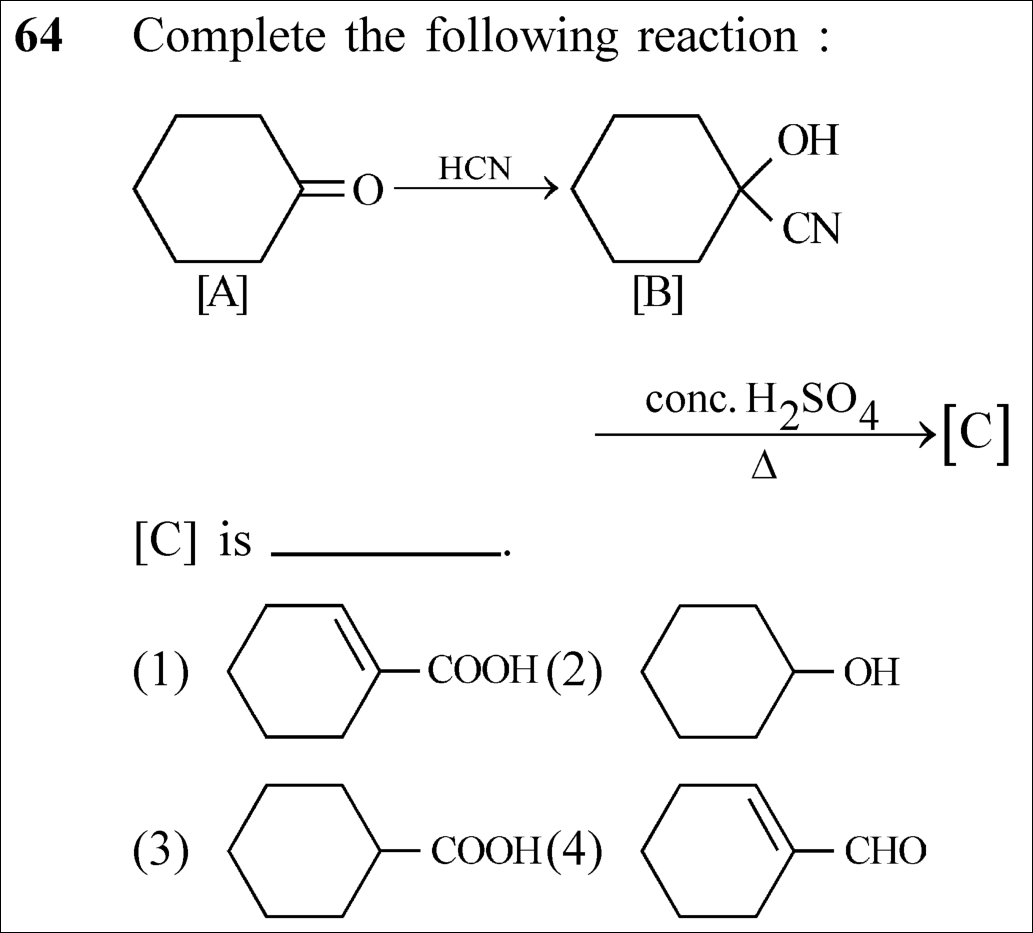
Complete the following reaction: Cyclohexanone [A] → (HCN) 1-hydroxycyclohexane-1-carbonitrile [B] → (conc. H₂SO₄, Δ) [C]. [C] is ___.
Dynamic 180-question full-length simulator mixed dynamically from all 6 years for 2027 & 2026 aspirants.
Complete the following reaction: Cyclohexanone [A] → (HCN) 1-hydroxycyclohexane-1-carbonitrile [B] → (conc. H₂SO₄, Δ) [C]. [C] is ___.
HCN adds to cyclohexanone to form cyanohydrin [B]. Hot conc. H₂SO₄ accomplishes TWO things at once: hydrolyzes -CN to -COOH AND dehydrates -OH to an endocyclic double bond ⟹ Cyclohex-1-enecarboxylic acid in 15 seconds!
Cyanide ion (:CN⁻) attacks the electrophilic carbonyl carbon of cyclohexanone, followed by protonation of the alkoxide intermediate to yield the cyanohydrin, 1-hydroxycyclohexanecarbonitrile [B]:
In the presence of concentrated sulfuric acid and water at elevated temperature, the nitrile group undergoes complete hydrolysis through an amide intermediate to a carboxylic acid (-COOH):
Under the hot, strongly acidic conditions of concentrated H₂SO₄, the tertiary alcohol hydroxyl group is protonated to form -OH₂⁺ and departs. Concurrently, a proton is eliminated from an adjacent ring carbon (C-2) to yield a thermodynamically stabilized α,β-unsaturated carboxylic acid:
The structure of product [C] consists of a cyclohexene ring with the carboxylic acid group directly attached to the sp²-hybridized alkene carbon, matching Option (1).
Diagnose every choice: Know exactly why the right option works and why distractors fail.
Accurate product resulting from both nitrile hydrolysis to -COOH and ring dehydration to an alkene.
Corresponds to simple reduction of cyclohexanone, completely ignoring HCN and H₂SO₄.
Saturated acid: assumes hydrolysis occurred but dehydration of -OH was overlooked.
Contains an aldehyde (-CHO) group instead of a carboxylic acid (-COOH).
Many candidates remember that nitriles hydrolyze to carboxylic acids, but forget that CONCENTRATED H₂SO₄ WITH HEAT is a classic dehydrating agent. Overlooking dehydration leads to picking saturated cyclohexanecarboxylic acid (Option 3).
"Cyanohydrins undergo acid hydrolysis to give α-hydroxy acids, which readily undergo dehydration under hot conc. H₂SO₄ to give α,β-unsaturated acids."
Test your speed and accuracy in the authentic 200-minute timed NTA simulator.
Spotted a mistake in this solution? Report an error ([email protected])
Cover all 1,140 official NEET questions in 285 days at your own pace. Progress is saved on your device. No login needed.