MyCompetitiveExams Logo MyCompetitiveExams
Search 1,140+ Questions
Chapters, formulas, speed tricks
→
⚡ Brahmastra NEET 2027
720 MARKS

Dynamic 180-question full-length simulator mixed dynamically from all 6 years for 2027 & 2026 aspirants.

Launch Brahmastra 2027 Test →
Start Practice →
100% Free · No Login Required
Q.97 Chemistry ⭐ 360° Option Elimination Active
Vault ↗

NEET 2021 Chemistry Question 97 Solution

Topic: Aldehydes, Ketones and Carboxylic Acids · Official NTA Booklet Code M1
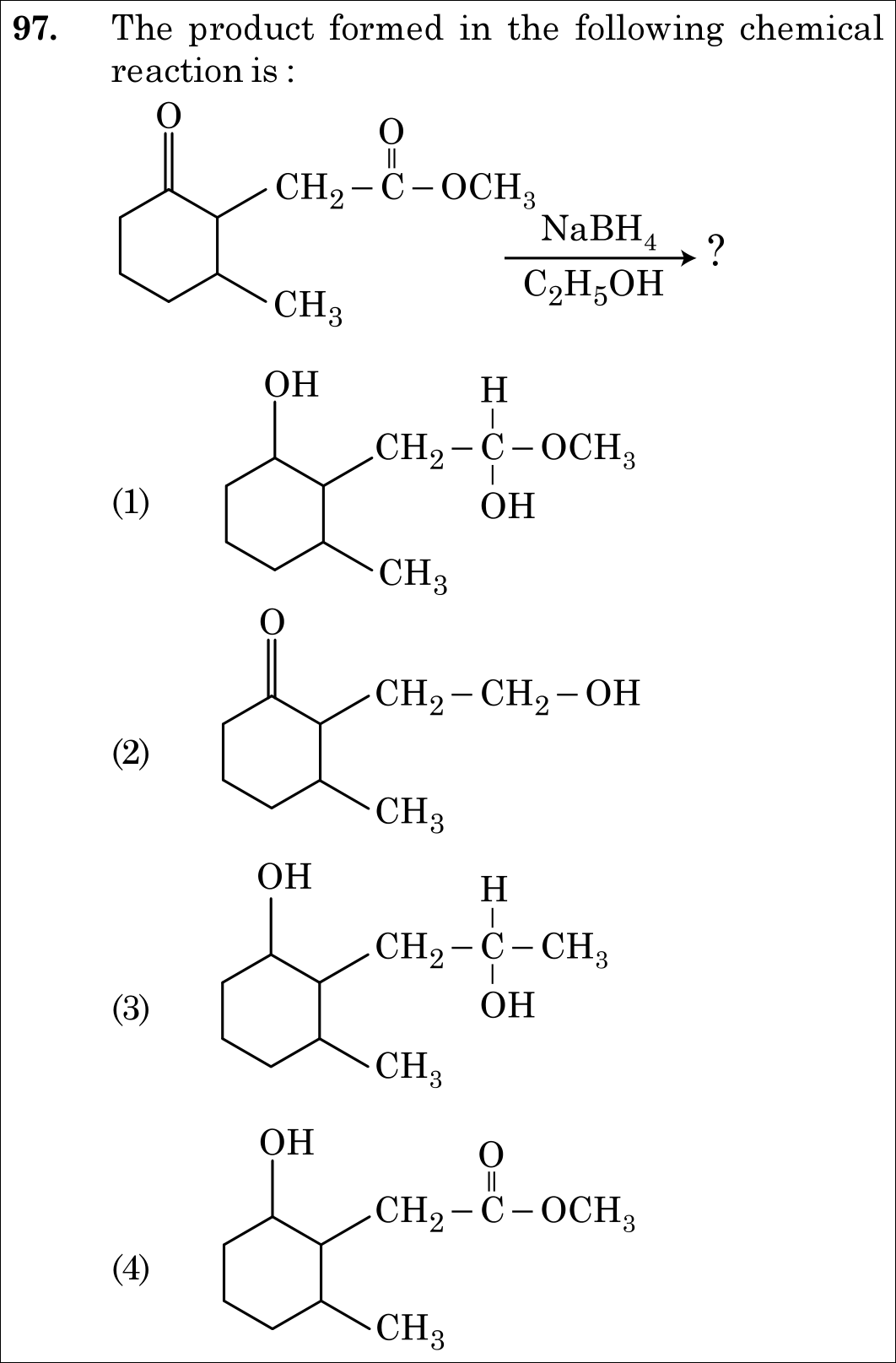
NEET 2021 Chemistry Question 97: Chemoselective Reduction: NaBH4 Reduces Ketone While Preserving Ester

Question

The product formed in the following chemical reaction is:

✓
Verified Against NTA Final Answer Key
Option (4) : Structure (4) (Ketone reduced to secondary alcohol; ester intact)
📚 Aldehydes, Ketones and Carboxylic Acids Medium
📋 Given Parameters & Problem Setup
Substrate Bifunctional compound with cyclohexanone (ketone) and methyl ester (-CH2COOCH3)
Reducing Agent NaBH4 in C2H5OH
⚡

The 30-Second Exam Hall Shortcut: ⚡ NaBH4 Reduces Aldehydes & Ketones ONLY — Esters Are Immune!

⏱️ Save ~20 seconds

Sodium borohydride (NaBH4NaBH_4) is a mild, chemoselective reducing agent that readily reduces ketones to secondary alcohols (−OH-OH) but is completely unreactive toward esters (−COOCH3-COOCH_3), carboxylic acids, and amides under standard conditions! Thus, the cyclohexanone C=OC=O reduces to −OH-OH, while the −CH2COOCH3-CH_2COOCH_3 ester group remains completely intact! This corresponds to Structure (4)! Match Option (4)!

1 Identify functional groups on the substrate: - Ring ketone (C=OC=O on cyclohexanone ring) - Side-chain methyl ester (−CH2−COOCH3-CH_2-COOCH_3).
2 Identify reagent selectivity: NaBH4NaBH_4 in ethanol is a selective reducing agent. - Aldehydes →1∘\to 1^\circ alcohols - Ketones →2∘\to 2^\circ alcohols - Esters →\to NO REACTION.
3 Ring ketone reduces to secondary alcohol (−OH-OH).
4 Ester group (−CH2−COOCH3-CH_2-COOCH_3) remains completely untouched.
5 Match Structure (4).
🛡️
Why You Can 100% Trust This Shortcut: Canonical NCERT chemoselectivity principle: NaBH4 reduces aldehydes/ketones, not esters.
📐

Step-by-Step Rigorous Workflow & Mathematical Proof

Step 1

Identifying Functional Groups and Their Electrophilicity

The reactant molecule contains two carbonyl-containing functional groups: 1. A cyclic ketone group located on the cyclohexane ring. 2. An aliphatic methyl ester group (−CH2COOCH3-CH_2COOCH_3) on the side chain. The carbonyl carbon of a ketone is significantly more electrophilic than the carbonyl carbon of an ester because the ester oxygen atom donates electron density through resonance into the carbonyl π∗\pi^* orbital (R−C(=O)−OCH3↔R−C(O−)=O+CH3R-C(=O)-OCH_3 \leftrightarrow R-C(O^-)=O^+CH_3).

Step 2

Reactivity Profile of Sodium Borohydride (NaBH4)

Sodium borohydride (NaBH4NaBH_4) is a mild hydride donor. Due to the lower nucleophilicity of the [BH4]−[BH_4]^- ion compared to [AlH4]−[AlH_4]^- (LiAlH4LiAlH_4): - NaBH4NaBH_4 readily reduces aldehydes and ketones to primary and secondary alcohols, respectively. - Under standard conditions in alcoholic solvent (C2H5OHC_2H_5OH), NaBH4NaBH_4 does not reduce esters, carboxylic acids, or amides.

Step 3

Determining the Structure of the Product

- The cyclic ketone (C=OC=O) is smoothly converted to a secondary alcohol group (−OH-OH). - The ester group (−CH2COOCH3-CH_2COOCH_3) survives untouched. - This chemoselective transformation corresponds precisely to Structure (4).

⭐

360° Option Elimination Engine Key Feature

Diagnose every choice: Know exactly why the right option works and why distractors fail.

4-Option Deep Scan
1 1
✗ Incorrect
Verdict & Scientific Reason:

Shows reduction of the ester group into a geminal hydroxy ether / hemiacetal, which does not occur with NaBH4NaBH_4.

⚠️
Student Fallacy (Why candidates pick this trap): Assuming NaBH4NaBH_4 reduces esters partially.
2 2
✗ Incorrect
Verdict & Scientific Reason:

Shows the ketone untouched while the ester is reduced to an alcohol, which is the exact inverse of true chemical selectivity.

⚠️
Student Fallacy (Why candidates pick this trap): Inverting functional group reactivity.
3 3
✗ Incorrect
Verdict & Scientific Reason:

Shows an impossible methylated diol product with loss of oxygen.

⚠️
Student Fallacy (Why candidates pick this trap): Confusing hydride reduction with Grignard alkylation.
4 4
✓ 100% Correct
Verdict & Scientific Reason:

Exact chemoselective product: cyclic ketone reduced to secondary alcohol (−OH-OH), ester (−COOCH3-COOCH_3) intact.

💡
Why this is airtight: None; rigorous hydride chemoselectivity mastery.
⚠️

NTA Trap Alert: LiAlH4 vs. NaBH4 Chemoselectivity Trap

Lithium aluminium hydride (LiAlH4LiAlH_4) is a powerful non-selective reducing agent that reduces BOTH ketones and esters (producing a diol). Sodium borohydride (NaBH4NaBH_4) is milder and strictly SELECTIVE: it reduces the ketone but LEAVES THE ESTER INTACT.

🛡️ How to avoid the -1 mark: NaBH4NaBH_4 + Ester   ⟹  \implies NO REACTION! Only the ketone reacts.
📖

Core NEET Syllabus Standard

NCERT Chemistry · Aldehydes, Ketones and Carboxylic Acids Standard Benchmark
Core Scientific Principle Tested:

"NaBH4 selectively reduces aldehydes and ketones to alcohols without affecting esters or carboxylic acids."

Syllabus Focus: Reduction of Carbonyl Compounds (Chemoselectivity of NaBH4 vs LiAlH4)
✓ Core NEET UG Syllabus Anchor Syllabus & Academic Standards ↗

Ready to attempt under real exam pressure?

Test your speed and accuracy in the authentic 200-minute timed NTA simulator.

Launch NEET 2021 CBT Test →

Spotted a mistake in this solution? Report an error ([email protected])

⚖️ Legal & Fair Dealing Notice: Sourced from publicly released NEET 2021 question papers and NEET answer keys for private study, research, and non-commercial educational practice under Fair Dealing (Section 52(1)(a) of the Indian Copyright Act, 1957). Not affiliated with or endorsed by NTA or NMC.

Solve 4 NEET Questions a Day — One per Subject

Cover all 1,140 official NEET questions in 285 days at your own pace. Progress is saved on your device. No login needed.