MyCompetitiveExams Logo MyCompetitiveExams
Search 1,140+ Questions
Chapters, formulas, speed tricks
→
⚡ Brahmastra NEET 2027
720 MARKS

Dynamic 180-question full-length simulator mixed dynamically from all 6 years for 2027 & 2026 aspirants.

Launch Brahmastra 2027 Test →
Start Practice →
100% Free · No Login Required
Q.72 Chemistry · Section A ⭐ 360° Option Elimination Active
Vault ↗

NEET 2024 Chemistry Question 72 Solution

Topic: Aldehydes, Ketones and Carboxylic Acids · Official NTA Booklet Code T1
NEET 2024 Chemistry Question 72: Multistep Synthesis of Aldehydes from Terminal Alkenes

Question

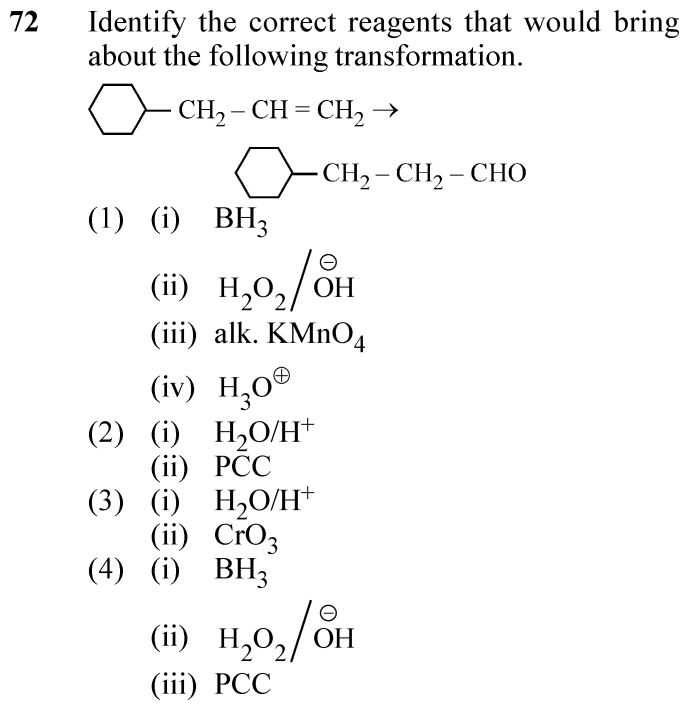
Identify the correct reagents that would bring about the following transformation. C₆H₁₁−CH₂−CH=CH₂ → C₆H₁₁−CH₂−CH₂−CHO (C₆H₁₁ = cyclohexyl)

✓
Verified Against NTA Final Answer Key
Option (4) : (i) BH3, (ii) H2O2 / OH⁻, (iii) PCC
📚 Aldehydes, Ketones and Carboxylic Acids Medium
📋 Given Parameters & Problem Setup
Starting material 3-cyclohexylprop-1-ene (Cyclohexyl-CH2-CH=CH2)
Target product 3-cyclohexylpropanal (Cyclohexyl-CH2-CH2-CHO)
⚡

The 30-Second Exam Hall Shortcut: ⚡ Anti-Markovnikov Hydration + Mild Oxidation Route

⏱️ Save ~45 seconds

Terminal Alkene -> Primary Alcohol via Hydroboration-Oxidation (BH3, then H2O2/OH⁻), followed by PCC to halt oxidation at the ALDEHYDE stage!

1 The transformation converts a terminal alkene (-CH=CH2) into an aldehyde (-CH2-CHO).
2 Step 1 must install an -OH group at the TERMINAL carbon (anti-Markovnikov addition of water).
3 Acid-catalyzed hydration (H2O / H⁺) would give a secondary alcohol via Markovnikov rule (ruling out Options 2 and 3).
4 Hydroboration-oxidation: (i) BH3 followed by (ii) alkaline H2O2 produces the primary alcohol 3-cyclohexylpropan-1-ol.
5 Step 2 requires selective oxidation of the 1° alcohol to an aldehyde. Alkaline KMnO4 in Option (1) over-oxidizes it to a carboxylic acid!
6 Pyridinium chlorochromate (PCC) cleanly stops oxidation at the aldehyde.
7 Sequence: (i) BH3, (ii) H2O2/OH⁻, (iii) PCC -> Option (4) in 10 seconds!
🛡️
Why You Can 100% Trust This Shortcut: NCERT Chemistry · Aldehydes, Ketones and Carboxylic Acids (Preparation of aldehydes by oxidation of primary alcohols using PCC and hydroboration-oxidation).
📐

Step-by-Step Rigorous Workflow & Mathematical Proof

Step 1

Regioselective Anti-Markovnikov Hydration

Reaction of 3-cyclohexylprop-1-ene with borane (BH3) proceeds with syn-addition across the double bond, with boron attaching to the less hindered terminal carbon. Subsequent oxidation with alkaline hydrogen peroxide (H2O2 / OH⁻) replaces boron with a hydroxyl group with retention of stereochemistry, yielding the primary alcohol 3-cyclohexylpropan-1-ol:

R−CH2−CH=CH2→(i) BH3,  (ii) H2O2/OH⊖R−CH2−CH2−CH2OHR{-}\text{CH}_2{-}\text{CH}=\text{CH}_2 \xrightarrow{\text{(i) } \text{BH}_3, \; \text{(ii) } \text{H}_2\text{O}_2/\text{OH}^\ominus} R{-}\text{CH}_2{-}\text{CH}_2{-}\text{CH}_2\text{OH}
Step 2

Controlled Oxidation to Aldehyde using PCC

Primary alcohols are easily over-oxidized to carboxylic acids in aqueous acidic or alkaline media. Pyridinium chlorochromate (PCC, C5H5NH⁺ ClCrO3⁻) in anhydrous dichloromethane (CH2Cl2) selectively oxidizes primary alcohols to aldehydes without further oxidation:

R−CH2−CH2−CH2OH→PCCR−CH2−CH2−CHOR{-}\text{CH}_2{-}\text{CH}_2{-}\text{CH}_2\text{OH} \xrightarrow{\text{PCC}} R{-}\text{CH}_2{-}\text{CH}_2{-}\text{CHO}
Step 3

Evaluating Failure of Distractor Reagent Pathways

Option (1) uses alkaline KMnO4 which oxidizes primary alcohols completely to carboxylic acids (-COOH). Options (2) and (3) use H2O/H⁺ which follows Markovnikov addition to yield a secondary alcohol, which upon oxidation produces a ketone rather than an aldehyde.

H2O/H⊕  ⟹  Markovnikov 2° alcohol→PCCKetone (wrong product)\text{H}_2\text{O}/\text{H}^\oplus \implies \text{Markovnikov 2° alcohol} \xrightarrow{\text{PCC}} \text{Ketone (wrong product)}
⭐

360° Option Elimination Engine Key Feature

Diagnose every choice: Know exactly why the right option works and why distractors fail.

4-Option Deep Scan
1 (1)
✗ Incorrect
Verdict & Scientific Reason:

Alkaline KMnO4 vigorously oxidizes primary alcohols to carboxylic acids, not aldehydes.

⚠️
Student Fallacy (Why candidates pick this trap): Overlooking that KMnO4 is too strong to stop at the aldehyde.
2 (2)
✗ Incorrect
Verdict & Scientific Reason:

Acid-catalyzed hydration gives a secondary alcohol, which oxidizes to a ketone.

⚠️
Student Fallacy (Why candidates pick this trap): Forgetting Markovnikov regioselectivity.
3 (3)
✗ Incorrect
Verdict & Scientific Reason:

Produces a ketone due to Markovnikov hydration.

⚠️
Student Fallacy (Why candidates pick this trap): Ignoring carbocation rearrangement and Markovnikov addition.
4 (4)
✓ 100% Correct
Verdict & Scientific Reason:

Anti-Markovnikov hydration yields 1° alcohol; anhydrous PCC mildly oxidizes it to aldehyde.

💡
Why this is airtight: None.
⚠️

NTA Trap Alert: Markovnikov vs Anti-Markovnikov Choice

To obtain an aldehyde from an alkene, the oxygen must attach to the terminal carbon. Only hydroboration-oxidation gives anti-Markovnikov addition of water.

🛡️ How to avoid the -1 mark: Terminal alkene -> Aldehyde requires BH3/H2O2 + PCC. Terminal alkene -> Ketone uses H3O+ + oxidant.
📖

Core NEET Syllabus Standard

Chemistry Core Organic Chemistry · Aldehydes, Ketones and Carboxylic Acids Standard Benchmark
Core Scientific Principle Tested:

"Hydroboration-oxidation converts terminal alkenes into primary alcohols, which are selectively converted into aldehydes using PCC in non-aqueous medium."

Syllabus Focus: Selective Oxidation of Alcohols to Aldehydes (PCC Reagent)
✓ Core NEET UG Syllabus Anchor Syllabus & Academic Standards ↗
Hydroborate to terminal OH, PCC stops oxidation at the CHO!

Ready to attempt under real exam pressure?

Test your speed and accuracy in the authentic 200-minute timed NTA simulator.

Launch NEET 2024 CBT Test →

Spotted a mistake in this solution? Report an error ([email protected])

⚖️ Legal & Fair Dealing Notice: Sourced from publicly released NEET 2024 question papers and NEET answer keys for private study, research, and non-commercial educational practice under Fair Dealing (Section 52(1)(a) of the Indian Copyright Act, 1957). Not affiliated with or endorsed by NTA or NMC.

Solve 4 NEET Questions a Day — One per Subject

Cover all 1,140 official NEET questions in 285 days at your own pace. Progress is saved on your device. No login needed.