NEET 2024 Chemistry Question 73 Solution
Question
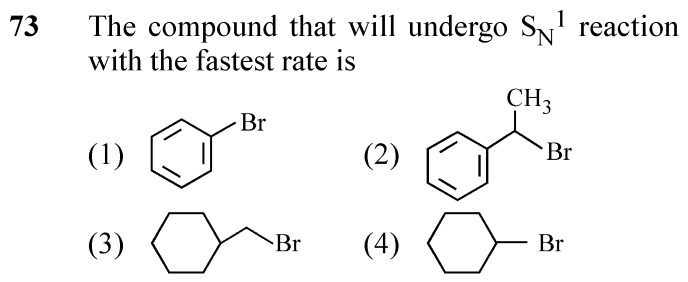
The compound that will undergo Sₙ1 reaction with the fastest rate is
Dynamic 180-question full-length simulator mixed dynamically from all 6 years for 2027 & 2026 aspirants.
The compound that will undergo Sₙ1 reaction with the fastest rate is
SN1 rate ∝ Carbocation Stability! Secondary benzylic carbocation [PhCH⁺CH3] has resonance stabilization from the benzene ring PLUS 3 α-hydrogens -> Fastest SN1!
The unimolecular nucleophilic substitution (SN1) proceeds through a two-step mechanism. The slow, rate-determining step is the heterolytic cleavage of the C-Br bond to form a planar carbocation:
Analyzing the stability of the intermediate generated from each given substrate: 1. Bromobenzene: Phenyl cation C6H5⁺ has the positive charge in an sp² orbital orthogonal to the π-system; it cannot be stabilized by resonance and is energetically prohibitive. 2. (1-Bromoethyl)benzene: The resulting carbocation Ph-C⁺H-CH3 is a secondary benzylic carbocation. The positive charge is extensively delocalized into the benzene ring across four contributing resonance structures, enhanced by hyperconjugation from the methyl group. 3. (Bromomethyl)cyclohexane: Generates an unstable 1° carbocation. 4. Bromocyclohexane: Generates a 2° aliphatic carbocation without any resonance stabilization.
By the Hammond postulate, the transition state leading to the 2° benzylic carbocation has the lowest activation energy (ΔG‡). Consequently, (1-bromoethyl)benzene undergoes solvolysis/SN1 with the fastest rate.
Diagnose every choice: Know exactly why the right option works and why distractors fail.
Does not undergo SN1 due to instability of phenyl cation and partial double bond character of C-Br.
Forms an exceptionally stable 2° benzylic carbocation with aromatic resonance delocalization.
Primary aliphatic halide; reacts predominantly via SN2, extremely slow via SN1.
Secondary aliphatic carbocation lacks resonance stabilization.
Halogen directly on the ring (Bromobenzene) is INERT to SN1. Halogen on the side-chain carbon adjacent to the ring (Benzylic) is HYPER-REACTIVE to SN1!
"Benzylic halides show high reactivity in SN1 reactions because the carbocation formed is stabilized through resonance with the aromatic ring."
Test your speed and accuracy in the authentic 200-minute timed NTA simulator.
Spotted a mistake in this solution? Report an error ([email protected])
Cover all 1,140 official NEET questions in 285 days at your own pace. Progress is saved on your device. No login needed.