MyCompetitiveExams Logo MyCompetitiveExams
Search 1,140+ Questions
Chapters, formulas, speed tricks
→
⚡ Brahmastra NEET 2027
720 MARKS

Dynamic 180-question full-length simulator mixed dynamically from all 6 years for 2027 & 2026 aspirants.

Launch Brahmastra 2027 Test →
Start Practice →
100% Free · No Login Required
🧪 Chemistry ⭐ High Weightage (~2–3 Qs/Year)

NEET Haloalkanes and Haloarenes Previous Year Questions with Solutions

Complete repository of official NTA NEET questions for Haloalkanes and Haloarenes from 2020 to 2026. Every question includes 30-second elimination tricks, step-by-step NCERT solutions, option-by-option traps, and official answer keys.

10 Questions 5 Exam Years (2025, 2024, 2023, 2021, 2020) 7 Easy · 3 Medium · 0 Challenging
NEET 2025 · Q75 Medium
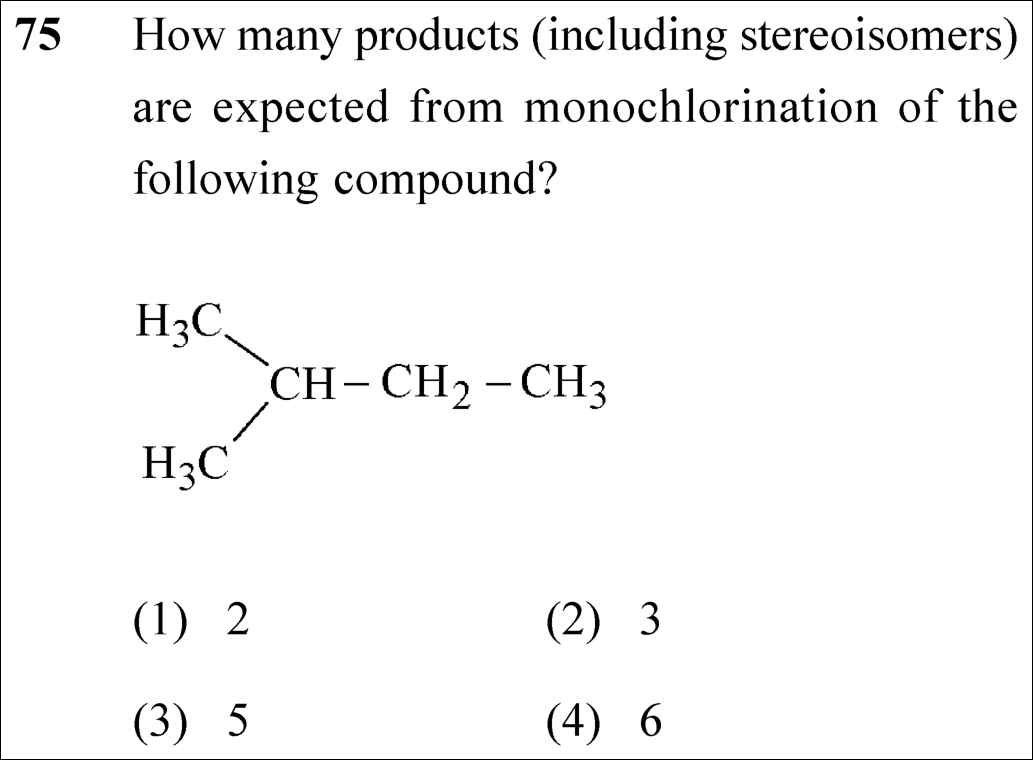
Official NEET 2025 Question 75 - Haloalkanes and Haloarenes
1
2
3
4 ✓ Key
💡 Verified Solution & 30-Second Hack
✓
Verified Against NTA Final Answer Key
Option (4) : 6
📚 Haloalkanes and Haloarenes Medium
📋 Given Parameters & Problem Setup
Substrate 2-Methylbutane (Isopentane, (CH₃)₂CH-CH₂-CH₃)
Reaction Photochemical Monochlorination (Cl₂ / hν)
Inclusion All products INCLUDING stereoisomers (enantiomers and diastereomers)
⚡

The 30-Second Exam Hall Shortcut: ⚡ 4 Regioisomers + 2 Chiral Centers Rule

⏱️ Save ~45 seconds

There are 4 constitutionally distinct carbons: C1 gives 1-chloro-2-methylbutane (C2 is chiral ⟹ 2 enantiomers: d + l). C2 gives 2-chloro-2-methylbutane (achiral ⟹ 1). C3 gives 2-chloro-3-methylbutane (C3 is chiral ⟹ 2 enantiomers: d + l). C4 gives 1-chloro-3-methylbutane (achiral ⟹ 1). Total = 2 + 1 + 2 + 1 = 6!

1 Write the 4 constitutional isomers from monochlorination of 2-methylbutane:
2 Isomer 1 (at C1): ClCH₂-CH(CH₃)-CH₂-CH₃ (1-chloro-2-methylbutane). C2 is bonded to -H, -CH₃, -CH₂Cl, -CH₂CH₃ (4 distinct groups ⟹ CHIRAL!). Produces 2 stereoisomers (d and l pair).
3 Isomer 2 (at C2): CH₃-C(Cl)(CH₃)-CH₂-CH₃ (2-chloro-2-methylbutane). C2 has two identical methyl groups ⟹ Achiral (1 product).
4 Isomer 3 (at C3): CH₃-CH(CH₃)-CH(Cl)-CH₃ (2-chloro-3-methylbutane). C3 is bonded to -H, -Cl, -CH₃, -CH(CH₃)₂ (4 distinct groups ⟹ CHIRAL!). Produces 2 stereoisomers (d and l pair).
5 Isomer 4 (at C4): CH₃-CH(CH₃)-CH₂-CH₂Cl (1-chloro-3-methylbutane). No chiral carbon ⟹ Achiral (1 product).
6 Sum total: 2 + 1 + 2 + 1 = 6 products including stereoisomers.
7 Select Option (4) in under 20 seconds!
🛡️
Why You Can 100% Trust This Shortcut: Free Radical Halogenation and Chiral Stereoisomerism (NCERT Chemistry · Haloalkanes and Haloarenes).
📐

Step-by-Step Rigorous Workflow & Mathematical Proof

Step 1

Identify Constitutionally Distinct Hydrogen Sets in 2-Methylbutane

2-Methylbutane has the structure (CH₃)₂CH-CH₂-CH₃. There are four distinct types of hydrogen atoms available for substitution:

Substitutable sites: C1 (primary),  C2 (tertiary),  C3 (secondary),  C4 (primary)\text{Substitutable sites: } \text{C1 (primary)}, \; \text{C2 (tertiary)}, \; \text{C3 (secondary)}, \; \text{C4 (primary)}
  • • This yields 4 constitutional (structural) isomers.
Step 2

Evaluate Chirality of Monochloro Derivatives at C1 and C2

Examine each constitutional isomer for chiral stereocenters (asymmetric carbons):

(1)  ClCH2−C∗H(CH3)CH2CH3  ⟹  C2 is chiral  ⟹  2 stereoisomers (d,l)(1) \; \text{ClCH}_2-\text{C}^*\text{H(CH}_3)\text{CH}_2\text{CH}_3 \implies \text{C2 is chiral} \implies 2\text{ stereoisomers } (d, l)
  • • (2) CH₃-C(Cl)(CH₃)-CH₂-CH₃: C2 is bonded to two identical methyl groups, hence achiral ⟹ 1 isomer.
Step 3

Evaluate Chirality at C3 and C4 and Calculate Total

Examine the remaining two constitutional isomers:

(3)  (CH3)2CH−C∗H(Cl)−CH3  ⟹  C3 is chiral  ⟹  2 stereoisomers (d,l)(3) \; (\text{CH}_3)_2\text{CH}-\text{C}^*\text{H(Cl)}-\text{CH}_3 \implies \text{C3 is chiral} \implies 2\text{ stereoisomers } (d, l)
  • • (4) (CH₃)₂CH-CH₂-CH₂Cl: Contains no asymmetric carbon atom, hence achiral ⟹ 1 isomer.
  • • Total number of products including stereoisomers:
  • • \text{Total} = 2 + 1 + 2 + 1 = 6.
  • • Matches Option (4) perfectly.
⭐

360° Option Elimination Engine Key Feature

Diagnose every choice: Know exactly why the right option works and why distractors fail.

4-Option Deep Scan
1 A
✗ Incorrect
Verdict & Scientific Reason:

Incorrect. Severe undercount.

⚠️
Student Fallacy (Why candidates pick this trap): Only considering major thermodynamic products.
2 B
✗ Incorrect
Verdict & Scientific Reason:

Incorrect. Omitting primary chlorination and stereoisomers.

⚠️
Student Fallacy (Why candidates pick this trap): Ignoring primary C-H substitution.
3 C
✗ Incorrect
Verdict & Scientific Reason:

Incorrect. Forgetting the chiral center in one of the two chiral isomers.

⚠️
Student Fallacy (Why candidates pick this trap): Counting only one isomer as chiral (4 + 1 = 5).
4 D
✓ 100% Correct
Verdict & Scientific Reason:

100% correct. 4 constitutional isomers, two of which have an asymmetric carbon, giving 2 + 1 + 2 + 1 = 6 stereoisomers.

💡
Why this is airtight: None; rigorous stereochemical analysis.
⚠️

NTA Trap Alert: Counting Structural Isomers Only (4 vs 6)

There are 4 STRUCTURAL (constitutional) isomers. Students who fail to read "(including stereoisomers)" look for 4, and seeing no 4 in the options, guess 5 or 3. Recognizing that C1 and C3 chlorination each creates a pair of enantiomers yields 2 + 1 + 2 + 1 = 6!

🛡️ How to avoid the -1 mark: Always scan for asymmetric carbons (4 different groups) in each constitutional isomer!
📖

Core NEET Syllabus Standard

NEET Chemistry Core Syllabus · Haloalkanes and Haloarenes Standard Benchmark
Core Scientific Principle Tested:

"Monochlorination of 2-methylbutane produces 4 constitutional isomers yielding 6 total stereoisomers."
Syllabus Focus: Free Radical Halogenation & Stereochemistry
✓ Core NEET UG Syllabus Anchor Syllabus & Academic Standards ↗
4 positions, 2 are chiral (d+l): 2 + 1 + 2 + 1 = 6 products (Option 4)!
NEET 2025 · Q84 Easy
Official NEET 2025 Question 84 - Haloalkanes and Haloarenes
1 ✓ Key
2
3
4
💡 Verified Solution & 30-Second Hack
✓
Verified Against NTA Final Answer Key
Option (1) : Both A and R are true and R is the correct explanation of A
📚 Haloalkanes and Haloarenes Easy
📋 Given Parameters & Problem Setup
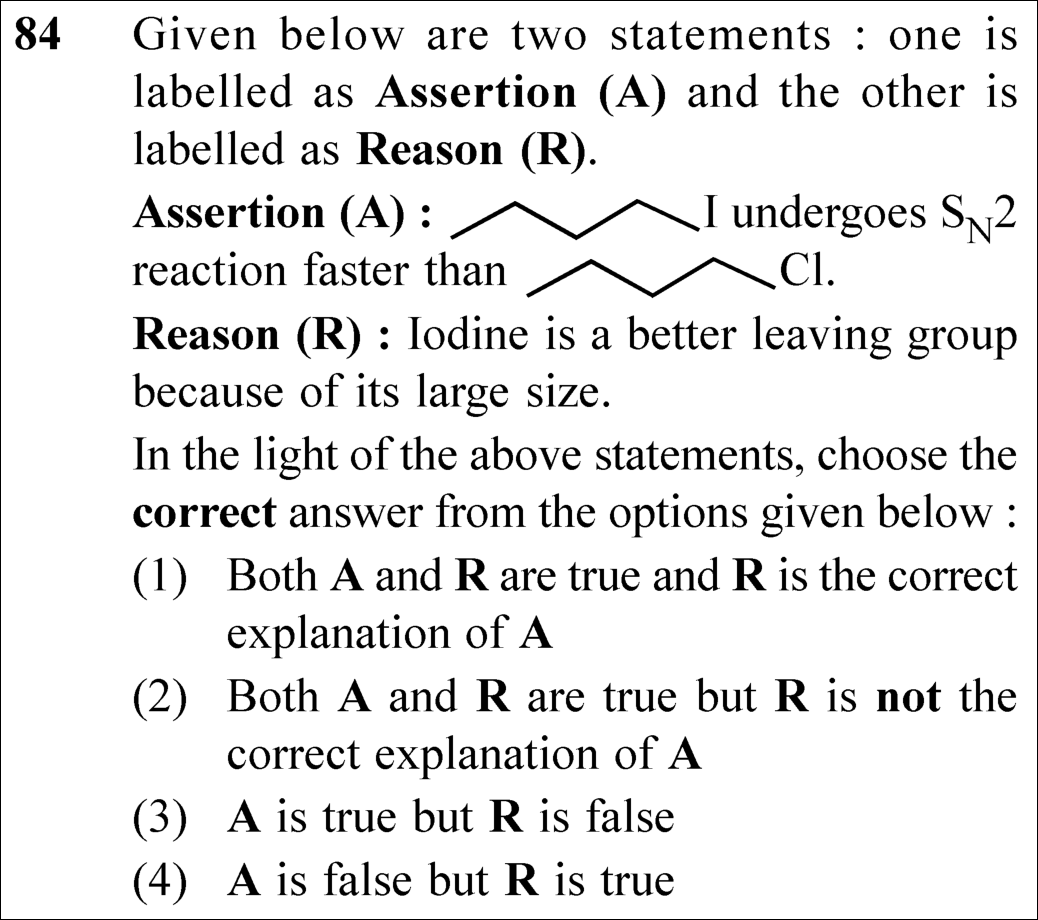
Assertion (A) 1-Iodobutane undergoes S_N2 reaction faster than 1-chlorobutane.
Reason (R) Iodine is a better leaving group because of its large size.
⚡

The 30-Second Exam Hall Shortcut: ⚡ Leaving Group Size & S_N2 Rate Rule

⏱️ Save ~25 seconds

Assertion is TRUE: Rate of S_N2 follows R-I > R-Br > R-Cl > R-F! Reason is TRUE: Iodide (I⁻) has a large ionic radius, making C-I bond weak and dispersing negative charge (stable weak base)! And R directly explains A ⟹ Option (1)!

1 Check Assertion (A): In S_N2 reactions, C-X bond cleavage occurs concurrently with nucleophile attack in the transition state. Since the C-I bond is weaker and I⁻ is a superior leaving group, 1-iodobutane reacts dramatically faster than 1-chlorobutane. Assertion (A) is TRUE.
2 Check Reason (R): Due to its large atomic radius, iodine forms a longer, weaker bond with carbon. Furthermore, the large size of the iodide ion (I⁻) accommodates and disperses negative charge over a larger volume, rendering it a very weak base (conjugate base of strong acid HI, pK_a ≈ -10). Weak bases are excellent leaving groups. Reason (R) is TRUE.
3 Check Explanation: The superior leaving ability of iodine directly accounts for the faster S_N2 reaction rate of 1-iodobutane. Thus, R is the correct explanation of A.
4 Select Option (1) in under 10 seconds!
🛡️
Why You Can 100% Trust This Shortcut: Steric Hindrance & Transition State Energetics in S_N2 Mechanism (NCERT Chemistry · Haloalkanes and Haloarenes).
📐

Step-by-Step Rigorous Workflow & Mathematical Proof

Step 1

Evaluate Assertion (A): S_N2 Kinetics and Leaving Group Influence

In a bimolecular nucleophilic substitution (S_N2), the rate equation is Rate = k [Substrate][Nu⁻]. The rate constant k depends directly on the leaving group ability of the departing halide ion:

Rate of SN2:R−I>R−Br>R−Cl>R−F\text{Rate of } S_N2: \quad R-\text{I} > R-\text{Br} > R-\text{Cl} > R-\text{F}
  • • Because 1-iodobutane and 1-chlorobutane are both primary (1°) alkyl halides with identical steric profiles, the difference in rate is determined purely by the leaving group.
  • • 1-Iodobutane reacts substantially faster than 1-chlorobutane.
  • • Assertion (A) is completely TRUE.
Step 2

Evaluate Reason (R): Physical Basis of Leaving Group Ability

A good leaving group is one that can stably accommodate the electron pair acquired upon cleavage:

Ionic Radius: I−(216 pm)≫Cl−(181 pm)  ⟹  C-I bond enthalpy (234 kJ/mol)≪C-Cl (338 kJ/mol)\text{Ionic Radius: } \text{I}^- (216\text{ pm}) \gg \text{Cl}^- (181\text{ pm}) \implies \text{C-I bond enthalpy } (234\text{ kJ/mol}) \ll \text{C-Cl } (338\text{ kJ/mol})
  • • The large diffuse electron cloud of iodide stabilizes the negative charge effectively, making I⁻ a very weak conjugate base and hence an exceptional leaving group.
  • • Reason (R) is completely TRUE.
Step 3

Determine if Reason (R) Explains Assertion (A)

Connect cause and effect:

Better leaving group due to large size (R)  ⟹  Accelerates SN2 rate (A)\text{Better leaving group due to large size (R)} \implies \text{Accelerates } S_N2 \text{ rate (A)}
  • • The large size and weak C-I bond are the precise mechanistic reason why 1-iodobutane reacts faster.
  • • Therefore, Both A and R are true and R is the correct explanation of A, matching Option (1).
⭐

360° Option Elimination Engine Key Feature

Diagnose every choice: Know exactly why the right option works and why distractors fail.

4-Option Deep Scan
1 A
✓ 100% Correct
Verdict & Scientific Reason:

100% correct. I⁻ is a better leaving group than Cl⁻ due to size/bond strength, directly explaining the faster S_N2 rate.

💡
Why this is airtight: None; flawless reaction kinetics understanding.
2 B
✗ Incorrect
Verdict & Scientific Reason:

Incorrect. R is the direct, primary physical explanation of A.

⚠️
Student Fallacy (Why candidates pick this trap): Failing to see the causal link between leaving group ability and S_N2 rate.
3 C
✗ Incorrect
Verdict & Scientific Reason:

Incorrect. R is true.

⚠️
Student Fallacy (Why candidates pick this trap): Doubting whether large size aids leaving group capacity.
4 D
✗ Incorrect
Verdict & Scientific Reason:

Incorrect. A is true.

⚠️
Student Fallacy (Why candidates pick this trap): Thinking chloride is faster due to higher electronegativity.
⚠️

NTA Trap Alert: Confusing Electronegativity with Leaving Group Ability

Students sometimes think chlorine should leave faster because it is more electronegative. In substitution reactions, leaving group ability is governed by WEAK BASICITY and BOND WEAKNESS, where Iodine wins overwhelmingly: I⁻ > Br⁻ > Cl⁻ > F⁻!

🛡️ How to avoid the -1 mark: Remember: In nucleophilic substitution, IODINE is always the fastest leaving group!
📖

Core NEET Syllabus Standard

NEET Chemistry Core Syllabus · Haloalkanes and Haloarenes Standard Benchmark
Core Scientific Principle Tested:

"S_N2 reaction rates follow R-I > R-Br > R-Cl > R-F due to leaving group ability and C-X bond strength."

Syllabus Focus: Nucleophilic Substitution Reactions: S_N2 Mechanism
✓ Core NEET UG Syllabus Anchor Syllabus & Academic Standards ↗
Bigger ion = Weaker base = Better leaving group = Faster S_N2 (Option 1)!
NEET 2024 · Q73 Easy
Official NEET 2024 Question 73 - Haloalkanes and Haloarenes
1
2 ✓ Key
3
4
💡 Verified Solution & 30-Second Hack
✓
Verified Against NTA Final Answer Key
Option (2) : (1-bromoethyl)benzene (PhCH(Br)CH3)
📚 Haloalkanes and Haloarenes Easy
📋 Given Parameters & Problem Setup
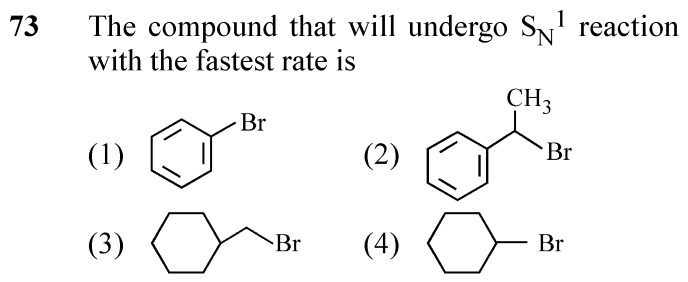
Substrate 1 Bromobenzene (PhBr)
Substrate 2 (1-bromoethyl)benzene (PhCH(CH3)Br)
Substrate 3 (Bromomethyl)cyclohexane (Cyclohexyl-CH2Br)
Substrate 4 Bromocyclohexane (Cyclohexyl-Br)
⚡

The 30-Second Exam Hall Shortcut: ⚡ Carbocation Stability SN1 Speed Rule

⏱️ Save ~35 seconds

SN1 rate ∝ Carbocation Stability! Secondary benzylic carbocation [PhCH⁺CH3] has resonance stabilization from the benzene ring PLUS 3 α-hydrogens -> Fastest SN1!

1 Rate-determining step of an SN1 reaction is the ionization to form a carbocation intermediate.
2 Inspect carbocations formed by each substrate:
3 - Substrate 1: Phenyl cation (sp² hybridized, extremely unstable; zero SN1 rate).
4 - Substrate 2: Secondary benzylic carbocation Ph-C⁺H-CH3 (resonance delocalized across all 3 ortho/para positions of the aromatic ring + 3 hyperconjugative α-hydrogens). Exceptionally stable!
5 - Substrate 3: Primary aliphatic carbocation Cyclohexyl-CH2⁺ (very unstable).
6 - Substrate 4: Secondary aliphatic carbocation Cyclohexyl⁺ (moderately stable, but lacks resonance).
7 Benzylic carbocation stability dominates all aliphatic cations.
8 Option (2) undergoes SN1 with the fastest rate in 5 seconds!
🛡️
Why You Can 100% Trust This Shortcut: NCERT Chemistry · Haloalkanes and Haloarenes (Reactivity order of alkyl halides in SN1 reactions: allylic and benzylic halides show high reactivity due to resonance stabilization).
📐

Step-by-Step Rigorous Workflow & Mathematical Proof

Step 1

Kinetics and Rate Law of the SN1 Mechanism

The unimolecular nucleophilic substitution (SN1) proceeds through a two-step mechanism. The slow, rate-determining step is the heterolytic cleavage of the C-Br bond to form a planar carbocation:

R−Br→slow, rdsR⊕+Br⊖,Rate=k[R−Br]R{-}\text{Br} \xrightarrow{\text{slow, rds}} R^\oplus + \text{Br}^\ominus, \quad \text{Rate} = k[R{-}\text{Br}]
Step 2

Evaluation of Carbocation Intermediates

Analyzing the stability of the intermediate generated from each given substrate: 1. Bromobenzene: Phenyl cation C6H5⁺ has the positive charge in an sp² orbital orthogonal to the π-system; it cannot be stabilized by resonance and is energetically prohibitive. 2. (1-Bromoethyl)benzene: The resulting carbocation Ph-C⁺H-CH3 is a secondary benzylic carbocation. The positive charge is extensively delocalized into the benzene ring across four contributing resonance structures, enhanced by hyperconjugation from the methyl group. 3. (Bromomethyl)cyclohexane: Generates an unstable 1° carbocation. 4. Bromocyclohexane: Generates a 2° aliphatic carbocation without any resonance stabilization.

Stability: PhCH⊕CH3  (2° benzylic)≫Cyclohexyl⊕  (2° aliphatic)>Cyclohexyl-CH2⊕  (1°)≫C6H5⊕\text{Stability: } \text{PhCH}^\oplus\text{CH}_3 \;(\text{2° benzylic}) \gg \text{Cyclohexyl}^\oplus \;(\text{2° aliphatic}) > \text{Cyclohexyl-CH}_2^\oplus \;(\text{1°}) \gg \text{C}_6\text{H}_5^\oplus
Step 3

Conclusion on Relative Reaction Rates

By the Hammond postulate, the transition state leading to the 2° benzylic carbocation has the lowest activation energy (ΔG‡). Consequently, (1-bromoethyl)benzene undergoes solvolysis/SN1 with the fastest rate.

kSN1∝exp⁡(−ΔG‡RT)  ⟹  Fastest for Substrate (2)k_{SN1} \propto \exp\left(-\frac{\Delta G^\ddagger}{RT}\right) \implies \text{Fastest for Substrate (2)}
⭐

360° Option Elimination Engine Key Feature

Diagnose every choice: Know exactly why the right option works and why distractors fail.

4-Option Deep Scan
1 (1)
✗ Incorrect
Verdict & Scientific Reason:

Does not undergo SN1 due to instability of phenyl cation and partial double bond character of C-Br.

⚠️
Student Fallacy (Why candidates pick this trap): Assuming presence of benzene ring always accelerates SN1.
2 (2)
✓ 100% Correct
Verdict & Scientific Reason:

Forms an exceptionally stable 2° benzylic carbocation with aromatic resonance delocalization.

💡
Why this is airtight: None.
3 (3)
✗ Incorrect
Verdict & Scientific Reason:

Primary aliphatic halide; reacts predominantly via SN2, extremely slow via SN1.

⚠️
Student Fallacy (Why candidates pick this trap): Confusing 1° aliphatic with benzylic.
4 (4)
✗ Incorrect
Verdict & Scientific Reason:

Secondary aliphatic carbocation lacks resonance stabilization.

⚠️
Student Fallacy (Why candidates pick this trap): Believing secondary aliphatic is comparable to secondary benzylic.
⚠️

NTA Trap Alert: Confusing Phenyl Halides with Benzylic Halides

Halogen directly on the ring (Bromobenzene) is INERT to SN1. Halogen on the side-chain carbon adjacent to the ring (Benzylic) is HYPER-REACTIVE to SN1!

🛡️ How to avoid the -1 mark: Check the carbon bearing bromine: on the ring = inert; one carbon away from the ring = benzylic (super fast).
📖

Core NEET Syllabus Standard

Chemistry Core Organic Chemistry · Haloalkanes and Haloarenes Standard Benchmark
Core Scientific Principle Tested:

"Benzylic halides show high reactivity in SN1 reactions because the carbocation formed is stabilized through resonance with the aromatic ring."

Syllabus Focus: Nucleophilic Substitution Reactions: SN1 Reactivity Factors
✓ Core NEET UG Syllabus Anchor Syllabus & Academic Standards ↗
Benzylic carbon shares the charge: ring resonance makes its speed huge and large!
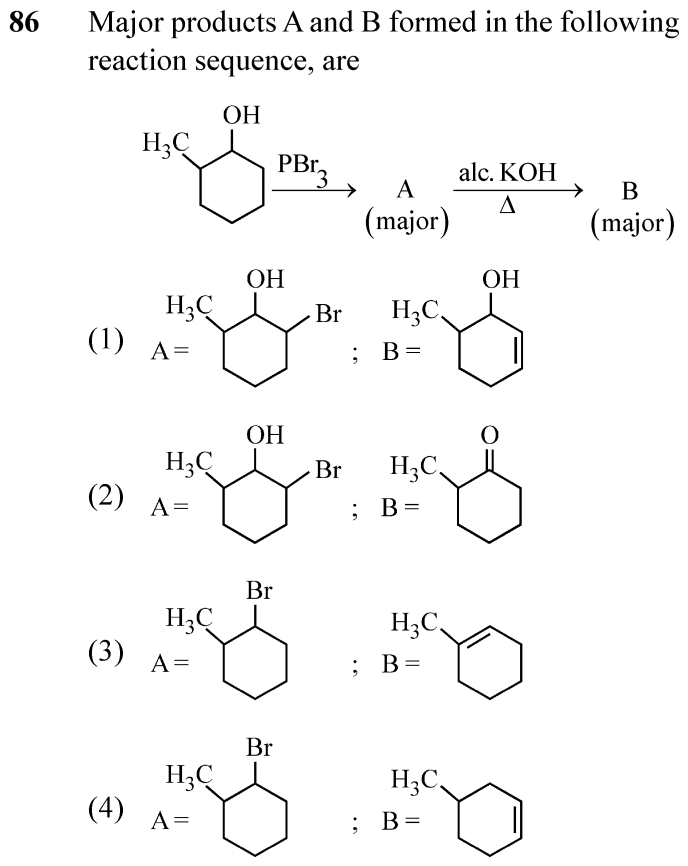
NEET 2024 · Q86 Medium
Official NEET 2024 Question 86 - Haloalkanes and Haloarenes
1
2
3 ✓ Key
4
💡 Verified Solution & 30-Second Hack
✓
Verified Against NTA Final Answer Key
Option (3) : A = 1-bromo-2-methylcyclohexane ; B = 1-methylcyclohexene
📚 Haloalkanes and Haloarenes Medium
📋 Given Parameters & Problem Setup
Starting reactant 2-methylcyclohexan-1-ol
Reagent 1 PBr3 (Phosphorus tribromide)
Reagent 2 Alcoholic KOH / Δ (Dehydrohalogenation)
⚡

The 30-Second Exam Hall Shortcut: ⚡ Saytzeff Major Alkene Elimination Hack

⏱️ Save ~45 seconds

PBr3 substitutes -OH with -Br to give 1-bromo-2-methylcyclohexane (A). alc. KOH/Δ eliminates HBr following Saytzeff’s rule to form the MORE SUBSTITUTED alkene: 1-methylcyclohexene (B)!

1 Reaction with PBr3: 2-methylcyclohexan-1-ol is converted into 1-bromo-2-methylcyclohexane via nucleophilic substitution of -OH by Br (Product A).
2 Reaction with alcoholic KOH and heat: Base abstracts a β-hydrogen with departure of bromide in an E2 elimination.
3 There are two potential β-carbons: C-2 (tertiary with 1 H) and C-6 (secondary with 2 H).
4 Zaitsev’s (Saytzeff’s) rule dictates elimination of hydrogen from the β-carbon with fewer hydrogens to yield the most stable, most highly substituted alkene.
5 Elimination from C-2 yields a trisubstituted alkene (1-methylcyclohexene), which is more stable than the disubstituted 3-methylcyclohexene from C-6.
6 Match: Product A = 1-bromo-2-methylcyclohexane, Product B = 1-methylcyclohexene -> Option (3) in 10 seconds!
🛡️
Why You Can 100% Trust This Shortcut: NCERT Chemistry · Haloalkanes and Haloarenes (Elimination reactions: β-elimination and Zaitsev’s rule for alkyl halides).
📐

Step-by-Step Rigorous Workflow & Mathematical Proof

Step 1

Substitution of Hydroxyl Group by Phosphorus Tribromide (Formation of A)

Reaction of secondary alcohols with phosphorus tribromide (PBr3) cleanly converts the -OH into a bromide leaving group without carbocation rearrangement, yielding 1-bromo-2-methylcyclohexane:

3  R-OH+PBr3⟶3  R-Br+H3PO3  ⟹  Product A=1-bromo-2-methylcyclohexane3\;\text{R-OH} + \text{PBr}_3 \longrightarrow 3\;\text{R-Br} + \text{H}_3\text{PO}_3 \implies \text{Product A} = \text{1-bromo-2-methylcyclohexane}
Step 2

Base-Induced E2 Elimination (Formation of B)

Alcoholic potassium hydroxide (alc. KOH) is a strong dehydrohalogenating reagent. Upon heating, the ethoxide/hydroxide base abstracts a proton from a β-carbon concurrent with the expulsion of the bromide ion in a concerted anti-coplanar E2 pathway:

R-CH2CH(Br)R→alc. KOH, ΔAlkene+KBr+H2O\text{R-CH}_2\text{CH(Br)R} \xrightarrow{\text{alc. KOH, } \Delta} \text{Alkene} + \text{KBr} + \text{H}_2\text{O}
Step 3

Regioselectivity via Saytzeff’s Rule

The base can abstract a proton from either: - The tertiary β-carbon (C-2): Abstraction of the single tertiary hydrogen yields 1-methylcyclohex-1-ene (a trisubstituted alkene with endocyclic double bond). - The secondary β-carbon (C-6): Abstraction yields 3-methylcyclohex-1-ene (a disubstituted alkene). By Zaitsev’s rule, the more substituted alkene possesses more hyperconjugative α-hydrogens and is thermodynamically more stable, predominating as the major product B:

Major Product B=1-methylcyclohexene (trisubstituted alkene)\text{Major Product B} = \text{1-methylcyclohexene (trisubstituted alkene)}
⭐

360° Option Elimination Engine Key Feature

Diagnose every choice: Know exactly why the right option works and why distractors fail.

4-Option Deep Scan
1 (1)
✗ Incorrect
Verdict & Scientific Reason:

PBr3 replaces -OH, it does not add to the ring while retaining -OH.

⚠️
Student Fallacy (Why candidates pick this trap): Believing PBr3 acts as an addition reagent.
2 (2)
✗ Incorrect
Verdict & Scientific Reason:

alc. KOH does not oxidize alcohols to ketones.

⚠️
Student Fallacy (Why candidates pick this trap): Confusing basic elimination with oxidation.
3 (3)
✓ 100% Correct
Verdict & Scientific Reason:

Accurate substitution by PBr3 followed by Saytzeff E2 elimination to the more substituted alkene.

💡
Why this is airtight: None.
4 (4)
✗ Incorrect
Verdict & Scientific Reason:

Forms the minor Hofmann-type disubstituted alkene instead of the major Saytzeff product.

⚠️
Student Fallacy (Why candidates pick this trap): Choosing the less substituted alkene.
⚠️

NTA Trap Alert: Hofmann vs Saytzeff Regiochemistry

With unhindered bases like alcoholic KOH, elimination strictly obeys Saytzeff’s rule yielding the more substituted alkene (Option 3). Option (4) gives the less substituted alkene (Hofmann product), which only forms with bulky bases like t-BuOK.

🛡️ How to avoid the -1 mark: alc. KOH = Saytzeff (more substituted double bond).
📖

Core NEET Syllabus Standard

Chemistry Core Organic Chemistry · Haloalkanes and Haloarenes Standard Benchmark
Core Scientific Principle Tested:

"In dehydrohalogenation of secondary alkyl halides with alcoholic KOH, the preferred product is that alkene which has the greater number of alkyl groups attached to the doubly bonded carbon atoms."

Syllabus Focus: Elimination Reactions: Zaitsev’s Rule and Alkene Stability
✓ Core NEET UG Syllabus Anchor Syllabus & Academic Standards ↗
PBr3 trades OH for Br; Saytzeff puts the double bond right where the methyls are!
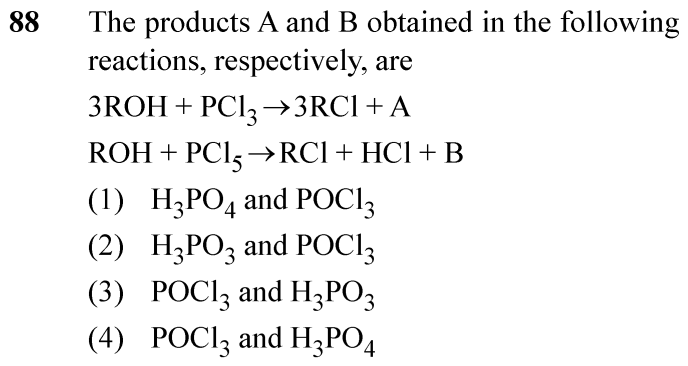
NEET 2024 · Q88 Easy
Official NEET 2024 Question 88 - Haloalkanes and Haloarenes
1
2 ✓ Key
3
4
💡 Verified Solution & 30-Second Hack
✓
Verified Against NTA Final Answer Key
Option (2) : H3PO3 and POCl3
📚 Haloalkanes and Haloarenes Easy
📋 Given Parameters & Problem Setup
Reaction 1 3 ROH + PCl3 -> 3 RCl + A
Reaction 2 ROH + PCl5 -> RCl + HCl + B
⚡

The 30-Second Exam Hall Shortcut: ⚡ PCl3 vs PCl5 Phosphorus By-Product Rule

⏱️ Save ~30 seconds

PCl3 gives phosphorous acid (H3PO3)! PCl5 gives phosphorus oxychloride (POCl3)! Look for (H3PO3 and POCl3) -> Option (2)!

1 Phosphorus trichloride (PCl3) has phosphorus in +3 oxidation state. Hydrolysis/reaction with 3 moles of alcohol yields phosphorous acid: H3PO3 (A).
2 Phosphorus pentachloride (PCl5) has phosphorus in +5 oxidation state. Reaction with 1 mole of alcohol forms phosphorus oxychloride: POCl3 (B) alongside HCl gas.
3 Inspect the given equations:
4 - Equation 1: 3 ROH + PCl3 -> 3 RCl + H3PO3 (A = H3PO3).
5 - Equation 2: ROH + PCl5 -> RCl + HCl + POCl3 (B = POCl3).
6 Option (2) matches A = H3PO3 and B = POCl3 in 3 seconds!
🛡️
Why You Can 100% Trust This Shortcut: NCERT Chemistry · Haloalkanes and Haloarenes (Methods of preparation of alkyl halides from alcohols using phosphorus halides).
📐

Step-by-Step Rigorous Workflow & Mathematical Proof

Step 1

Reaction Mechanism and Stoichiometry with PCl3

Phosphorus trichloride possesses phosphorus in the +3 oxidation state. Nucleophilic attack by three molecules of alcohol displaces all three chloride atoms in sequence, producing three moles of alkyl chloride and one mole of orthophosphorous acid (H3PO3):

3  ROH+PCl3⟶3  RCl+H3PO3(Product A)3\;\text{ROH} + \text{PCl}_3 \longrightarrow 3\;\text{RCl} + \text{H}_3\text{PO}_3 \quad (\text{Product A})
Step 2

Reaction Mechanism and Stoichiometry with PCl5

Phosphorus pentachloride possesses phosphorus in the +5 oxidation state. The alcohol oxygen coordinates to phosphorus, releasing HCl and collapsing through a four-membered transition state to form one mole of alkyl chloride and one mole of phosphoryl chloride / phosphorus oxychloride (POCl3):

ROH+PCl5⟶RCl+HCl↑+POCl3(Product B)\text{ROH} + \text{PCl}_5 \longrightarrow \text{RCl} + \text{HCl}\uparrow + \text{POCl}_3 \quad (\text{Product B})
Step 3

Comparison and Conclusion

Product A is H3PO3 (phosphorous acid), and Product B is POCl3 (phosphoryl chloride). This pairing uniquely matches Option (2).

A=H3PO3,B=POCl3\text{A} = \text{H}_3\text{PO}_3, \quad \text{B} = \text{POCl}_3
⭐

360° Option Elimination Engine Key Feature

Diagnose every choice: Know exactly why the right option works and why distractors fail.

4-Option Deep Scan
1 (1)
✗ Incorrect
Verdict & Scientific Reason:

Product A is H3PO3, not H3PO4 (phosphoric acid requires +5 phosphorus).

⚠️
Student Fallacy (Why candidates pick this trap): Confusing phosphorous acid (+3) with phosphoric acid (+5).
2 (2)
✓ 100% Correct
Verdict & Scientific Reason:

Exact stoichiometric by-products for PCl3 and PCl5 reactions with alcohols.

💡
Why this is airtight: None.
3 (3)
✗ Incorrect
Verdict & Scientific Reason:

Inverts the identity of A and B.

⚠️
Student Fallacy (Why candidates pick this trap): Swapping reactions 1 and 2.
4 (4)
✗ Incorrect
Verdict & Scientific Reason:

Both products incorrectly identified.

⚠️
Student Fallacy (Why candidates pick this trap): Complete confusion of phosphorus oxyacids.
⚠️

NTA Trap Alert: Confusing H3PO3 with H3PO4

PCl3 has P(+3), so it forms H3PO3 (phosphorous acid with P in +3). It CANNOT form H3PO4 (phosphoric acid with P in +5) without an oxidizing agent!

🛡️ How to avoid the -1 mark: Track oxidation states: P(+3) in PCl3 -> P(+3) in H3PO3.
📖

Core NEET Syllabus Standard

Chemistry Core Organic Chemistry · Haloalkanes and Haloarenes Standard Benchmark
Core Scientific Principle Tested:

"Alcohols react with PCl3 to give RCl and H3PO3; alcohols react with PCl5 to give RCl, HCl, and POCl3."

Syllabus Focus: Preparation of Alkyl Halides: Reaction of Alcohols with PCl3 and PCl5
✓ Core NEET UG Syllabus Anchor Syllabus & Academic Standards ↗
PCl3 has three: gives H3PO3! PCl5 breaks free: gives POCl3!
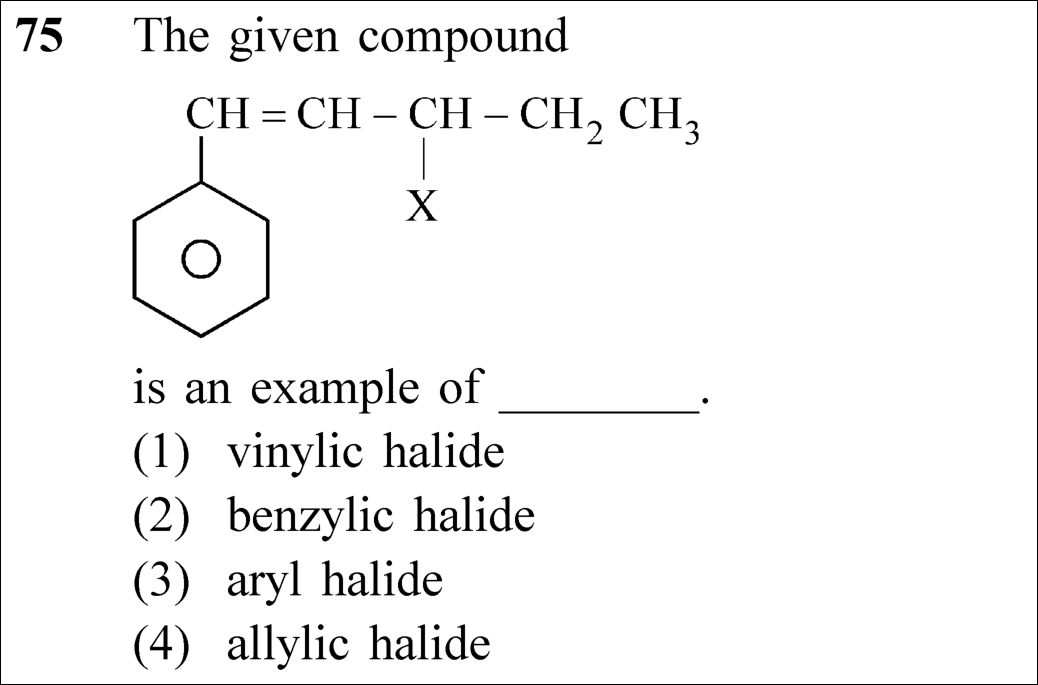
NEET 2023 · Q75 Easy
Official NEET 2023 Question 75 - Haloalkanes and Haloarenes
1
2
3
4 ✓ Key
💡 Verified Solution & 30-Second Hack
✓
Verified Against NTA Final Answer Key
Option (4) : allylic halide
📚 Haloalkanes and Haloarenes Easy
📋 Given Parameters & Problem Setup
Given structure C₆H₅–CH = CH–CH(X)–CH₂CH₃
Position of halogen X Attached to sp³ carbon adjacent to aliphatic C=C double bond
⚡

The 30-Second Exam Hall Shortcut: ⚡ Carbon Neighborhood Check: Attached to C=C, NOT Benzene Ring!

⏱️ Save ~30 seconds

Halogen X is attached to an sp³ carbon that is DIRECTLY adjacent to an aliphatic C=C double bond (–CH=CH–CH(X)–) ⟹ Allylic Halide! (It is NOT benzylic because it is separated from the benzene ring by two carbons). Option (4) in 5 seconds!

1 Inspect the exact carbon holding halogen X: –CH=CH–CH(X)–CH₂CH₃.
2 The carbon bearing X is sp³-hybridized.
3 It is directly bonded to an sp²-hybridized carbon of an aliphatic double bond (–CH=CH–).
4 By definition, a halide attached to an sp³ carbon adjacent to a carbon-carbon double bond is an ALLYLIC HALIDE.
5 Why is it not benzylic? Because a benzylic halide requires X to be attached to an sp³ carbon directly bonded to an aromatic benzene ring (Ar–CH(X)–). Here, the halogen is two carbons away from the benzene ring!
6 Lock Option (4) allylic halide immediately!
🛡️
Why You Can 100% Trust This Shortcut: Organic Nomenclature · Classification of Halogen Compounds (Allylic halides are compounds in which the halogen atom is bonded to an sp³-hybridized carbon atom next to a carbon-carbon double bond).
📐

Step-by-Step Rigorous Workflow & Mathematical Proof

Step 1

IUPAC Definitions of Halide Classes

Halogen derivatives of hydrocarbons are classified into distinct structural categories based on the hybridization and environment of the carbon atom bearing the halogen:

Vinylic halide:Halogen bonded directly to an sp2 carbon of a C=C double bondAryl halide:Halogen bonded directly to an sp2 carbon of an aromatic ringBenzylic halide:Halogen bonded to an sp3 carbon attached directly to an aromatic ringAllylic halide:Halogen bonded to an sp3 carbon attached directly to a C=C double bond\begin{aligned} \text{Vinylic halide} &: \text{Halogen bonded directly to an } sp^2\text{ carbon of a } C=C \text{ double bond} \\[4pt] \text{Aryl halide} &: \text{Halogen bonded directly to an } sp^2\text{ carbon of an aromatic ring} \\[4pt] \text{Benzylic halide} &: \text{Halogen bonded to an } sp^3\text{ carbon attached directly to an aromatic ring} \\[4pt] \text{Allylic halide} &: \text{Halogen bonded to an } sp^3\text{ carbon attached directly to a } C=C \text{ double bond} \end{aligned}
Step 2

Structural Analysis of the Given Molecule

In the provided structure C₆H₅–CH=CH–CH(X)–CH₂CH₃, locate the halogen X:

Ar−CHα=CHβ−CγH(X)−CH2CH3\text{Ar}-\overset{\alpha}{\text{CH}}=\overset{\beta}{\text{CH}}-\overset{\gamma}{\text{C}}\text{H}(\text{X})-\text{CH}_2\text{CH}_3
Step 3

Evaluation of the Carbon-Halogen Environment

The halogen X is bonded to carbon C-γ, which is an sp³-hybridized carbon atom. C-γ is bonded directly to carbon C-β, which is an sp²-hybridized carbon participating in an aliphatic carbon-carbon double bond (C=C). This matches the exact definition of an allylic halide.

−CH=CH−CH(X)−  ⟹  Allylic Halide-\text{CH}=\text{CH}-\text{CH}(\text{X})- \implies \text{Allylic Halide}
Step 4

Refutation of Benzylic Character

The benzene ring (Ar) is attached to C-α, not to C-γ. Because C-γ is not directly attached to the aromatic ring, the compound CANNOT be classified as a benzylic halide.

Distance to benzene ring =2 intervening carbon atoms   ⟹  NOT benzylic\text{Distance to benzene ring } = 2\text{ intervening carbon atoms } \implies \text{NOT benzylic}
⭐

360° Option Elimination Engine Key Feature

Diagnose every choice: Know exactly why the right option works and why distractors fail.

4-Option Deep Scan
1 (1)
✗ Incorrect
Verdict & Scientific Reason:

In a vinylic halide, X must be bonded directly to an sp² double-bonded carbon (–CH=C(X)–). Here X is on an sp³ carbon.

⚠️
Student Fallacy (Why candidates pick this trap): Candidate thought any halide near a double bond is vinylic.
2 (2)
✗ Incorrect
Verdict & Scientific Reason:

In a benzylic halide, X must be on the carbon directly attached to the benzene ring (C₆H₅–CH(X)–). Here X is two carbons away.

⚠️
Student Fallacy (Why candidates pick this trap): Candidate saw the benzene ring in the drawing and reflexively chose benzylic.
3 (3)
✗ Incorrect
Verdict & Scientific Reason:

In an aryl halide, X must be directly on the benzene ring (e.g., chlorobenzene).

⚠️
Student Fallacy (Why candidates pick this trap): Candidate confused presence of an aromatic ring with direct aromatic substitution.
4 (4)
✓ 100% Correct
Verdict & Scientific Reason:

Accurate: X is attached to an sp³ carbon adjacent to an aliphatic C=C double bond.

💡
Why this is airtight: None. Candidate correctly recognized the allylic carbon position.
⚠️

NTA Trap Alert: Seeing the Benzene Ring and Blindly Choosing "Benzylic Halide" (Option 2)

The presence of the benzene ring is an intentional distractor. Students see the phenyl ring and hastily pick "benzylic halide" without checking whether the halogen-bearing carbon is actually attached to the ring. In this molecule, the halogen is attached next to the double bond, making it an ALLYLIC halide!

🛡️ How to avoid the -1 mark: Trace the direct bond: Look at the carbon attached to X. Is it attached directly to the benzene ring? NO. Is it attached to a C=C double bond? YES ⟹ Allylic!
📖

Core NEET Syllabus Standard

National Eligibility cum Entrance Test (NEET UG) · Haloalkanes and Haloarenes Standard Benchmark
Core Scientific Principle Tested:

"Allylic halides are compounds in which the halogen atom is bonded to an sp³-hybridized carbon atom adjacent to a carbon-carbon double bond (C=C)."

Syllabus Focus: Classification of Halogen Compounds
Preserved in Rationalized Curriculum Syllabus & Academic Standards ↗
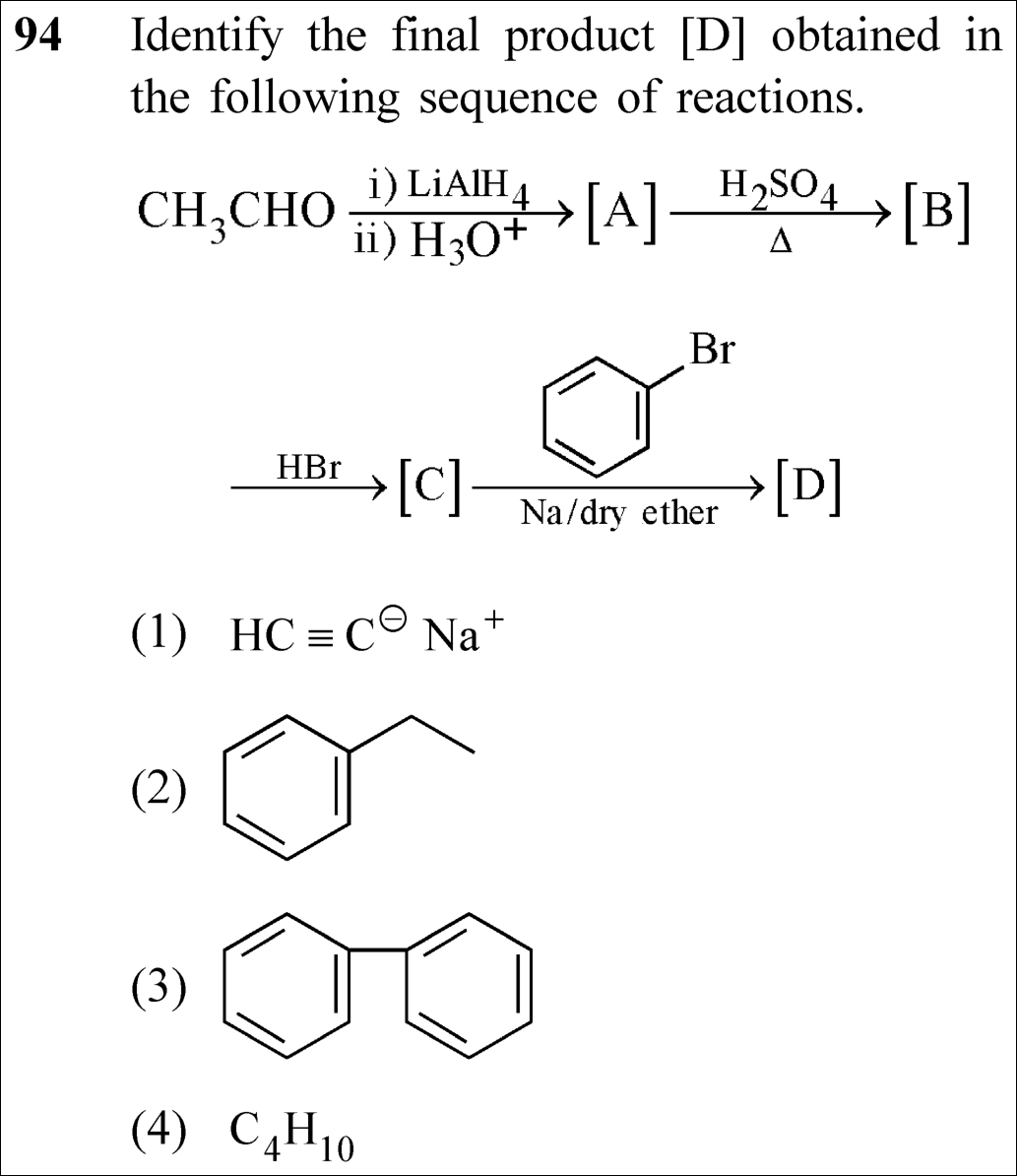
NEET 2023 · Q94 Medium
Official NEET 2023 Question 94 - Haloalkanes and Haloarenes
1
2 ✓ Key
3
4
💡 Verified Solution & 30-Second Hack
✓
Verified Against NTA Final Answer Key
Option (2) : Ethylbenzene (C₆H₅–CH₂–CH₃)
📚 Haloalkanes and Haloarenes Medium
📋 Given Parameters & Problem Setup
Starting material CH₃CHO (acetaldehyde)
Step 1 (i) LiAlH₄, (ii) H₃O⁺ ⟶ [A]
Step 2 Conc. H₂SO₄, Δ ⟶ [B]
Step 3 HBr ⟶ [C]
Step 4 Bromobenzene + Na / dry ether ⟶ [D]
⚡

The 30-Second Exam Hall Shortcut: ⚡ Reaction Sequence Decoder: Reduction ⟶ Dehydration ⟶ Addition ⟶ Wurtz-Fittig

⏱️ Save ~40 seconds

Acetaldehyde reduces to ethanol [A]. Acidic dehydration of ethanol gives ethene [B]. Addition of HBr gives ethyl bromide [C]. Wurtz-Fittig reaction of ethyl bromide with bromobenzene and sodium in dry ether couples the ethyl group to the benzene ring, yielding ethylbenzene [D]! Option (2) in 15 seconds!

1 Step 1: CH₃CHO + LiAlH₄ ⟶ CH₃CH₂OH [A, Ethanol].
2 Step 2: CH₃CH₂OH + conc. H₂SO₄, heat ⟶ CH₂=CH₂ [B, Ethene].
3 Step 3: CH₂=CH₂ + HBr ⟶ CH₃CH₂Br [C, Bromoethane].
4 Step 4: C₆H₅Br + 2 Na + BrCH₂CH₃ in dry ether ⟶ C₆H₅–CH₂CH₃ [D, Ethylbenzene] + 2 NaBr.
5 Select Option (2) Ethylbenzene immediately.
🛡️
Why You Can 100% Trust This Shortcut: Classical reaction chain coupling standard NCERT organic reactions.
📐

Step-by-Step Rigorous Workflow & Mathematical Proof

Step 1

Step 1: Reduction of Acetaldehyde to Ethanol [A]

Lithium aluminium hydride reduces acetaldehyde to primary alcohol ethanol:

CH3CHO→(i) LiAlH4,  (ii) H3O+CH3CH2OH[A]\text{CH}_3\text{CHO} \xrightarrow{(i)\text{ LiAlH}_4,\; (ii)\text{ H}_3\text{O}^+} \text{CH}_3\text{CH}_2\text{OH} \quad [\text{A}]
Step 2

Step 2: Acid-Catalysed Dehydration to Ethene [B]

Heating ethanol with concentrated sulphuric acid at 443 K undergoes intramolecular dehydration to form ethene:

CH3CH2OH→H2SO4,  ΔCH2=CH2[B]\text{CH}_3\text{CH}_2\text{OH} \xrightarrow{\text{H}_2\text{SO}_4,\; \Delta} \text{CH}_2=\text{CH}_2 \quad [\text{B}]
Step 3

Step 3: Electrophilic Addition of HBr to form Bromoethane [C]

Addition of hydrogen bromide across the symmetrical alkene double bond produces bromoethane:

CH2=CH2+HBr⟶CH3CH2Br[C]\text{CH}_2=\text{CH}_2 + \text{HBr} \longrightarrow \text{CH}_3\text{CH}_2\text{Br} \quad [\text{C}]
Step 4

Step 4: Wurtz-Fittig Coupling to Form Ethylbenzene [D]

Reaction of bromoethane and bromobenzene with sodium metal in dry ether produces alkylarene (ethylbenzene) via the Wurtz-Fittig reaction:

C6H5Br+2Na+BrCH2CH3→dry etherC6H5−CH2CH3+2NaBr[D]\text{C}_6\text{H}_5\text{Br} + 2\text{Na} + \text{BrCH}_2\text{CH}_3 \xrightarrow{\text{dry ether}} \text{C}_6\text{H}_5-\text{CH}_2\text{CH}_3 + 2\text{NaBr} \quad [\text{D}]
⭐

360° Option Elimination Engine Key Feature

Diagnose every choice: Know exactly why the right option works and why distractors fail.

4-Option Deep Scan
1 (1)
✗ Incorrect
Verdict & Scientific Reason:

Terminal sodium acetylide is not formed in this reaction pathway.

⚠️
Student Fallacy (Why candidates pick this trap): Candidate misidentified intermediate [B] as ethyne instead of ethene.
2 (2)
✓ 100% Correct
Verdict & Scientific Reason:

Accurate: Cross-coupling of bromobenzene and bromoethane yields ethylbenzene.

💡
Why this is airtight: None. Candidate accurately traced each sequential transformation.
3 (3)
✗ Incorrect
Verdict & Scientific Reason:

Biphenyl is the Fittig self-coupling byproduct of bromobenzene, not the primary cross-coupled product.

⚠️
Student Fallacy (Why candidates pick this trap): Candidate forgot that bromoethane participates in the cross-coupling.
4 (4)
✗ Incorrect
Verdict & Scientific Reason:

Butane is the Wurtz self-coupling byproduct of bromoethane.

⚠️
Student Fallacy (Why candidates pick this trap): Candidate ignored the presence of bromobenzene in the reaction mixture.
⚠️

NTA Trap Alert: Confusing Symmetrical Side Products with Cross-Coupled Product

In the Wurtz-Fittig reaction of bromobenzene and bromoethane, biphenyl and butane form as side products. The intended cross-coupled product of aryl halide + alkyl halide is ethylbenzene.

🛡️ How to avoid the -1 mark: Identify the mixed reaction: Aryl halide + Alkyl halide + 2 Na ⟶ Alkylarene (Wurtz-Fittig product).
📖

Core NEET Syllabus Standard

National Eligibility cum Entrance Test (NEET UG) · Haloalkanes and Haloarenes Standard Benchmark
Core Scientific Principle Tested:

"A mixture of an alkyl halide and aryl halide gives an alkylarene when treated with sodium in dry ether."

Syllabus Focus: Reactions of Haloarenes – Wurtz-Fittig Reaction
Preserved in Rationalized Curriculum Syllabus & Academic Standards ↗
NEET 2021 · Q68 Easy
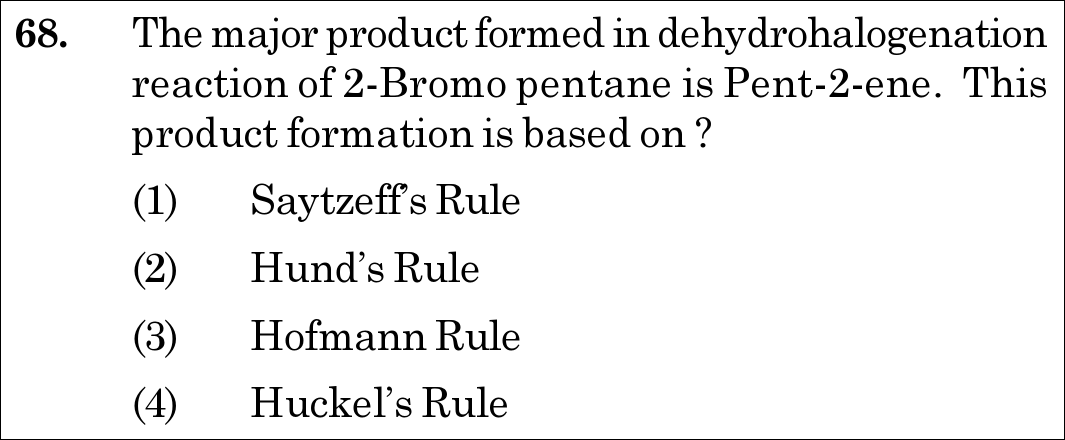
Official NEET 2021 Question 68 - Haloalkanes and Haloarenes
1 Saytzeff's Rule ✓ Key
2 Hund's Rule
3 Hofmann Rule
4 Huckel's Rule
💡 Verified Solution & 30-Second Hack
✓
Verified Against NTA Final Answer Key
Option (1) : Saytzeff's Rule
📚 Haloalkanes and Haloarenes Easy
📋 Given Parameters & Problem Setup
Reactant 2-Bromopentane (CH3-CH2-CH2-CH(Br)-CH3)
Reaction Type Dehydrohalogenation (β-elimination)
Major Product Pent-2-ene (CH3-CH2-CH=CH-CH3)
⚡

The 30-Second Exam Hall Shortcut: ⚡ More Substituted Alkene Major = Saytzeff's Rule

⏱️ Save ~15 seconds

Dehydrohalogenation of 2-bromopentane can yield pent-1-ene (monosubstituted, minor) or pent-2-ene (disubstituted, major). Formation of the more alkylated, thermodynamically stable alkene as major product is the core tenet of Saytzeff's (Zaitsev's) Rule! Match Option (1)!

1 Identify the reaction: β\beta-elimination of an alkyl halide using alcoholic base.
2 Two β\beta-hydrogens are available: at C1C_1 and C3C_3.
3 Elimination involving C3C_3 gives pent-2-ene (disubstituted alkene, 81%).
4 Elimination involving C1C_1 gives pent-1-ene (monosubstituted alkene, 19%).
5 Saytzeff's rule dictates that the more substituted alkene is the predominant product.
6 Match Option (1).
🛡️
Why You Can 100% Trust This Shortcut: Canonical Saytzeff's elimination rule in NCERT Haloalkanes and Haloarenes.
📐

Step-by-Step Rigorous Workflow & Mathematical Proof

Step 1

Formulating the Dehydrohalogenation of 2-Bromopentane

When 2-bromopentane is heated with alcoholic potassium hydroxide (alc.  KOHalc.\; KOH), base-induced β\beta-elimination of HBrHBr occurs across the Cα−CβC_\alpha-C_\beta bond:

CH3−CH2−Cβ2H2−CαH(Br)−Cβ1H3→alc. KOHAlkenes+KBr+H2OCH_3-CH_2-\overset{\beta_2}{C}H_2-\overset{\alpha}{C}H(Br)-\overset{\beta_1}{C}H_3 \xrightarrow{\text{alc. } KOH} \text{Alkenes} + KBr + H_2O
Step 2

Comparing the Competing Elimination Pathways

- Pathway A (Loss of β1\beta_1-H): Yields pent-1-ene (CH3CH2CH2CH=CH2CH_3CH_2CH_2CH=CH_2), which has only 1 alkyl substituent and 2 hyperconjugative α\alpha-hydrogens (19% yield, minor). - Pathway B (Loss of β2\beta_2-H): Yields pent-2-ene (CH3CH2CH=CHCH3CH_3CH_2CH=CHCH_3), which has 2 alkyl substituents and 5 hyperconjugative α\alpha-hydrogens (81% yield, major).

Step 3

Applicable Governing Rule

Alexander Zaitsev (Saytzeff) formulated in 1875 that: *"In dehydrohalogenation reactions, the preferred product is that alkene which has the greater number of alkyl groups attached to the doubly bonded carbon atoms."* This is Saytzeff's Rule, corresponding to Option (1).

⭐

360° Option Elimination Engine Key Feature

Diagnose every choice: Know exactly why the right option works and why distractors fail.

4-Option Deep Scan
1 1
✓ 100% Correct
Verdict & Scientific Reason:

Exact rule governing the preferential formation of the more substituted pent-2-ene.

💡
Why this is airtight: None; textbook organic elimination rule.
2 2
✗ Incorrect
Verdict & Scientific Reason:

Hund's rule of maximum multiplicity governs electron pairing in degenerate atomic orbitals.

⚠️
Student Fallacy (Why candidates pick this trap): Confusing atomic structure rules with organic reaction rules.
3 3
✗ Incorrect
Verdict & Scientific Reason:

Hofmann elimination gives the LEAST substituted alkene (pent-1-ene) as major product, observed with sterically bulky bases or quaternary ammonium hydroxides.

⚠️
Student Fallacy (Why candidates pick this trap): Confusing Hofmann elimination with Saytzeff elimination.
4 4
✗ Incorrect
Verdict & Scientific Reason:

Hückel's rule ((4n+2)π(4n+2)\pi electrons) defines criteria for aromaticity, not elimination.

⚠️
Student Fallacy (Why candidates pick this trap): Confusing aromaticity with alkene regiochemistry.
⚠️

NTA Trap Alert: Hofmann vs. Saytzeff Rule Confusion

Students who confuse Hofmann with Saytzeff often think Hofmann applies to all eliminations. Hofmann's rule produces the LESS substituted alkene (pent-1-ene), whereas Saytzeff's rule produces the MORE substituted alkene (pent-2-ene).

🛡️ How to avoid the -1 mark: Pent-2-ene has MORE alkyl groups   ⟹  \implies Saytzeff rule. Pent-1-ene has FEWER alkyl groups   ⟹  \implies Hofmann rule.
📖

Core NEET Syllabus Standard

NCERT Chemistry · Haloalkanes and Haloarenes Standard Benchmark
Core Scientific Principle Tested:

"In dehydrohalogenation reactions, the alkene with greater number of alkyl groups attached to the double bond is formed as the major product (Saytzeff's rule)."

Syllabus Focus: Elimination Reactions (Saytzeff's Rule)
✓ Core NEET UG Syllabus Anchor Syllabus & Academic Standards ↗
NEET 2021 · Q77 Easy
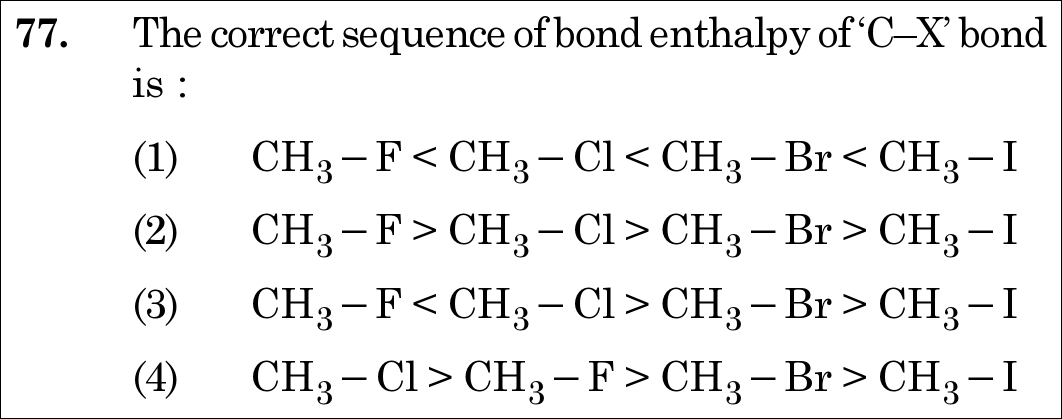
Official NEET 2021 Question 77 - Haloalkanes and Haloarenes
1
2 ✓ Key
3
4
💡 Verified Solution & 30-Second Hack
✓
Verified Against NTA Final Answer Key
Option (2) : CH3 - F > CH3 - Cl > CH3 - Br > CH3 - I
📚 Haloalkanes and Haloarenes Easy
📋 Given Parameters & Problem Setup
Homologous Series Methyl halides (CH3-X with X = F, Cl, Br, I)
Target Property Sequence of bond enthalpy of C-X bond
⚡

The 30-Second Exam Hall Shortcut: ⚡ Shorter Bond = Stronger Bond (F > Cl > Br > I)

⏱️ Save ~15 seconds

Down Group 17, halogen atomic radius increases (F<Cl<Br<IF < Cl < Br < I), so C−XC-X bond length increases (CH3F:139 pm→CH3I:214 pmCH_3F: 139\text{ pm} \to CH_3I: 214\text{ pm}). Shorter bonds exhibit greater orbital overlap and higher bond dissociation enthalpy: CH3−F(452)>CH3−Cl(351)>CH3−Br(293)>CH3−I(234 kJ/mol)CH_3-F (452) > CH_3-Cl (351) > CH_3-Br (293) > CH_3-I (234\text{ kJ/mol})! Match Option (2)!

1 Down the halogen group, atomic size of X increases: F<Cl<Br<IF < Cl < Br < I.
2 C−XC-X bond length increases: CH3−F<CH3−Cl<CH3−Br<CH3−ICH_3-F < CH_3-Cl < CH_3-Br < CH_3-I.
3 Bond enthalpy is inversely related to bond length.
4 Therefore, bond enthalpy order is: CH3−F>CH3−Cl>CH3−Br>CH3−ICH_3-F > CH_3-Cl > CH_3-Br > CH_3-I.
5 Match Option (2).
🛡️
Why You Can 100% Trust This Shortcut: Canonical NCERT Haloalkanes fundamental carbon-halogen bond length and orbital overlap trends.
📐

Step-by-Step Rigorous Workflow & Mathematical Proof

Step 1

Periodic Trend in Halogen Atomic Radii

Halogen atoms in Group 17 increase in size as new quantum electron shells are added down the column: F<Cl<Br<IF < Cl < Br < I. Carbon uses its 2sp32sp^3 hybrid orbital to bond with valence pp orbitals of increasing principal quantum number (2p2p in F, 3p3p in Cl, 4p4p in Br, 5p5p in I).

Step 2

Effect on Orbital Overlap and Bond Length

As orbital size increases, orbital overlap becomes more diffuse and less effective. Experimental bond lengths from NCERT Table 10.2: - C−FC-F: 139 pm139\text{ pm} - C−ClC-Cl: 178 pm178\text{ pm} - C−BrC-Br: 193 pm193\text{ pm} - C−IC-I: 214 pm214\text{ pm}

Step 3

Bond Dissociation Enthalpy Comparison

Because shorter bonds possess stronger electrostatic attraction between nuclei and shared electrons, bond dissociation enthalpy decreases monotonically down the group:

ΔbondH  (kJ/mol):CH3-F (452)>CH3-Cl (351)>CH3-Br (293)>CH3-I (234)\Delta_{\text{bond}}H\;(\text{kJ/mol}): \quad \text{CH}_3\text{-F}\,(452) > \text{CH}_3\text{-Cl}\,(351) > \text{CH}_3\text{-Br}\,(293) > \text{CH}_3\text{-I}\,(234)
⭐

360° Option Elimination Engine Key Feature

Diagnose every choice: Know exactly why the right option works and why distractors fail.

4-Option Deep Scan
1 1
✗ Incorrect
Verdict & Scientific Reason:

This is the order of BOND LENGTH, which is the inverse of bond enthalpy.

⚠️
Student Fallacy (Why candidates pick this trap): Confusing bond length with bond enthalpy.
2 2
✓ 100% Correct
Verdict & Scientific Reason:

Exact sequence: smaller halogen yields shorter, stronger C−XC-X bond with highest dissociation energy.

💡
Why this is airtight: None; textbook bond energy trend.
3 3
✗ Incorrect
Verdict & Scientific Reason:

This is the order of DIPOLE MOMENT (CH3Cl>CH3F>CH3Br>CH3ICH_3Cl > CH_3F > CH_3Br > CH_3I), NOT bond enthalpy.

⚠️
Student Fallacy (Why candidates pick this trap): Confusing bond enthalpy with dipole moment anomaly.
4 4
✗ Incorrect
Verdict & Scientific Reason:

Places CH3ClCH_3Cl ahead of CH3FCH_3F based on dipole moment, which does not apply to bond enthalpy.

⚠️
Student Fallacy (Why candidates pick this trap): Applying dipole moment exception to bond enthalpy.
⚠️

NTA Trap Alert: Bond Enthalpy vs. Dipole Moment Anomaly Trap

In methyl halides, the DIPOLE MOMENT has an anomaly where CH3Cl>CH3FCH_3Cl > CH_3F because the larger bond length of C−ClC-Cl outweighs the electronegativity of fluorine (mu=qimesdmu = q imes d). But BOND ENTHALPY has NO anomaly—it strictly decreases monotonically: CH3F>CH3Cl>CH3Br>CH3ICH_3F > CH_3Cl > CH_3Br > CH_3I.

🛡️ How to avoid the -1 mark: Dipole moment: CH3Cl>CH3FCH_3Cl > CH_3F. Bond enthalpy: CH3F>CH3Cl>CH3Br>CH3ICH_3F > CH_3Cl > CH_3Br > CH_3I (no exceptions!).
📖

Core NEET Syllabus Standard

NCERT Chemistry · Haloalkanes and Haloarenes Standard Benchmark
Core Scientific Principle Tested:

"The C-X bond enthalpy decreases down the group as the size of halogen increases and C-X bond length increases."

Syllabus Focus: Nature of C-X Bond (Bond Enthalpies)
✓ Core NEET UG Syllabus Anchor Syllabus & Academic Standards ↗
NEET 2020 · Q114 Easy
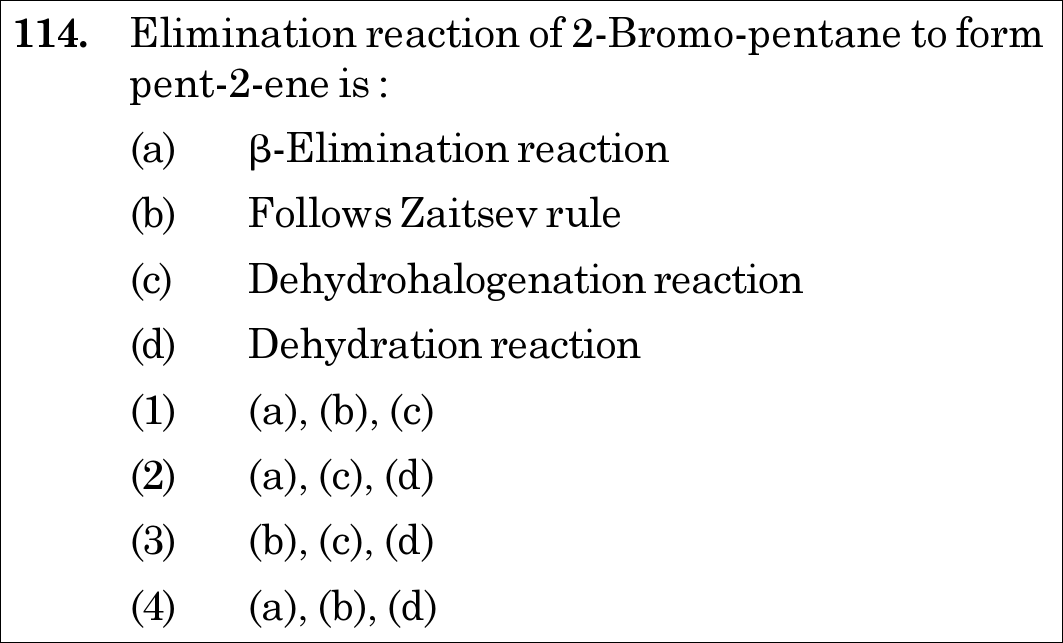
Official NEET 2020 Question 114 - Haloalkanes and Haloarenes
1 ✓ Key
2
3
4
💡 Verified Solution & 30-Second Hack
✓
Verified Against NTA Final Answer Key
Option (1) : (a), (b), (c)
📚 Haloalkanes and Haloarenes Easy
📋 Given Parameters & Problem Setup
Substrate 2-Bromopentane [CH3-CH(Br)-CH2-CH2-CH3]
Major Product Pent-2-ene [CH3-CH=CH-CH2-CH3]
Statements (a) β-Elimination, (b) Follows Zaitsev rule, (c) Dehydrohalogenation, (d) Dehydration
Question Objective Identify which descriptions correctly apply to the reaction
⚡

The 30-Second Exam Hall Shortcut: ⚡ "Loss of HBr from 2-Bromopentane: β-Elimination (a) + Zaitsev Rule (b) + Dehydrohalogenation (c)!"

⏱️ 25 seconds

The reaction eliminates hydrogen from the β-carbon and halogen (Br) from the α-carbon, so it is a β-elimination reaction (a) and a dehydrohalogenation reaction (c). The more substituted, more stable alkene (pent-2-ene, 81%) is favored over pent-1-ene (19%), which follows Zaitsev's rule (b). Dehydration (d) means loss of WATER (from alcohols), not HBr! Thus, (a), (b), (c) only! Mark Option (1) in 5 seconds.

1 Check (a): Proton is removed from β-carbon -> It is a β-elimination reaction (TRUE).
2 Check (b): The more substituted alkene (pent-2-ene) is the major product -> Follows Zaitsev rule (TRUE).
3 Check (c): Overall reaction loses H and Br (HBr) -> Dehydrohalogenation reaction (TRUE).
4 Check (d): Dehydration means loss of H2O (from alcohol) -> It is NOT dehydration (FALSE).
5 Correct combination: (a), (b), (c) -> Option (1).
🛡️
Why You Can 100% Trust This Shortcut: NCERT Chemistry · Haloalkanes and Haloarenes (Reactions of Haloalkanes: Elimination Reactions / Saytzeff Rule)
📐

Step-by-Step Rigorous Workflow & Mathematical Proof

Step 1

Understand the Elimination Mechanism

When 2-bromopentane is heated with alcoholic potassium hydroxide (alc. KOH\text{alc. KOH}), the base abstracts a proton from a β\beta-carbon while the bromide leaving group departs from the α\alpha-carbon: CH3−CH(Br)−CH2−CH2−CH3→alc. KOH, ΔCH3−CH=CH−CH2−CH3+KBr+H2O\text{CH}_3-\text{CH(Br)}-\text{CH}_2-\text{CH}_2-\text{CH}_3 \xrightarrow{\text{alc. KOH, } \Delta} \text{CH}_3-\text{CH}=\text{CH}-\text{CH}_2-\text{CH}_3 + \text{KBr} + \text{H}_2\text{O} Because hydrogen is abstracted from the β\beta-position, this is universally termed a β\beta-elimination reaction (Statement a).

Step 2

Evaluate Zaitsev (Saytzeff) Regioselectivity

2-Bromopentane has two different β\beta-carbons: β1\beta_1 (C1\text{C}_1, methyl group) and β2\beta_2 (C3\text{C}_3, methylene group). According to Zaitsev's rule, in dehydrohalogenation reactions, the preferred product is that alkene which has the greater number of alkyl groups attached to the doubly bonded carbon atoms. Hence, pent-2-ene (disubstituted alkene, 81%) is formed as the major product over pent-1-ene (monosubstituted alkene, 19%). Thus, it follows Zaitsev's rule (Statement b).

Step 3

Distinguish Dehydrohalogenation vs Dehydration

- Dehydrohalogenation: Elimination of a hydrogen halide (HX\text{HX}, here HBr\text{HBr}) from an alkyl halide. Statement (c) is TRUE. - Dehydration: Elimination of a water molecule (H2O\text{H}_2\text{O}) from an alcohol to form an alkene. Here, HBr\text{HBr} is lost, not H2O\text{H}_2\text{O}. Thus, Statement (d) is FALSE.

Step 4

Conclude Option 1

Statements (a), (b), and (c) are all correct descriptions, corresponding to Option 1.

⭐

360° Option Elimination Engine Key Feature

Diagnose every choice: Know exactly why the right option works and why distractors fail.

4-Option Deep Scan
1 A
✓ 100% Correct
Verdict & Scientific Reason:

Factually and mechanistically exact; β-elimination, Zaitsev rule adherence, and dehydrohalogenation all accurately describe this reaction.

💡
Why this is airtight: None; rigorous application of organic reaction terminology.
2 B
✗ Incorrect
Verdict & Scientific Reason:

Incorrect; erroneously includes (d) dehydration, which applies to alcohols losing water, not alkyl halides.

⚠️
Student Fallacy (Why candidates pick this trap): Confusing dehydrohalogenation with dehydration.
3 C
✗ Incorrect
Verdict & Scientific Reason:

Incorrect; erroneously includes (d) and omits (a).

⚠️
Student Fallacy (Why candidates pick this trap): Missing that this is a β-elimination.
4 D
✗ Incorrect
Verdict & Scientific Reason:

Incorrect; erroneously includes (d) dehydration and omits (c) dehydrohalogenation.

⚠️
Student Fallacy (Why candidates pick this trap): Careless terminology confusion between -HX and -H2O elimination.
⚠️

NTA Trap Alert: Dehydration vs Dehydrohalogenation

- Dehydration = Removal of WATER (−H2O-\text{H}_2\text{O}), as in Acid-catalyzed dehydration of alcohols. - Dehydrohalogenation = Removal of HYDROGEN HALIDE (−HX-\text{HX}, e.g. −HBr-\text{HBr}), as in base-catalyzed elimination of alkyl halides.

🛡️ How to avoid the -1 mark: Reactant has Bromine -> Loss of HBr -> DEHYDROHALOGENATION, NEVER dehydration!
📖

Core NEET Syllabus Standard

Chemistry · Haloalkanes and Haloarenes Standard Benchmark
Core Scientific Principle Tested:

""

Syllabus Focus: Dehydrohalogenation of 2-Bromopentane: β-Elimination Following Zaitsev Rule
✓ Core NEET UG Syllabus Anchor Syllabus & Academic Standards ↗

Solve 4 NEET Questions a Day — One per Subject

Cover all 1,140 official NEET questions in 285 days at your own pace. Progress is saved on your device. No login needed.