NEET 2021 Chemistry Question 68 Solution
Question
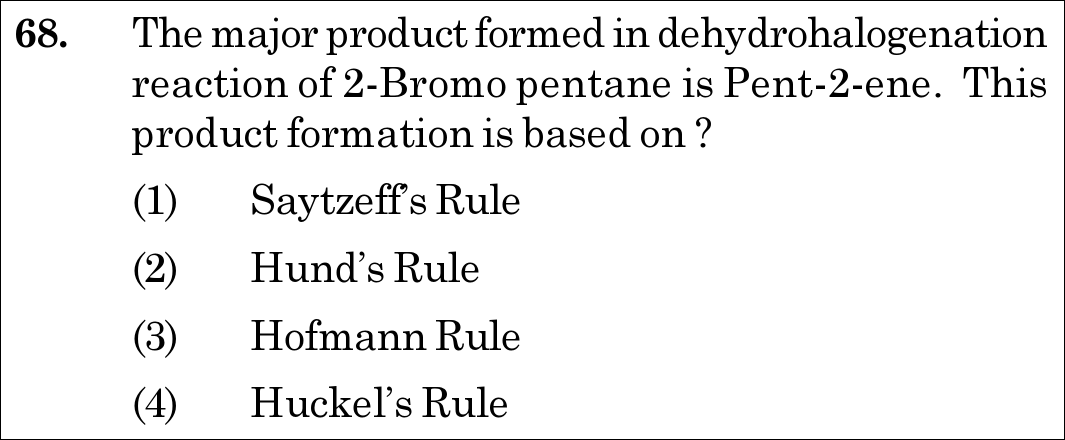
The major product formed in dehydrohalogenation reaction of 2-Bromo pentane is Pent-2-ene. This product formation is based on?
- (1)Saytzeff's Rule
- (2)Hund's Rule
- (3)Hofmann Rule
- (4)Huckel's Rule
Dynamic 180-question full-length simulator mixed dynamically from all 6 years for 2027 & 2026 aspirants.
The major product formed in dehydrohalogenation reaction of 2-Bromo pentane is Pent-2-ene. This product formation is based on?
Dehydrohalogenation of 2-bromopentane can yield pent-1-ene (monosubstituted, minor) or pent-2-ene (disubstituted, major). Formation of the more alkylated, thermodynamically stable alkene as major product is the core tenet of Saytzeff's (Zaitsev's) Rule! Match Option (1)!
When 2-bromopentane is heated with alcoholic potassium hydroxide (), base-induced -elimination of occurs across the bond:
- Pathway A (Loss of -H): Yields pent-1-ene (), which has only 1 alkyl substituent and 2 hyperconjugative -hydrogens (19% yield, minor). - Pathway B (Loss of -H): Yields pent-2-ene (), which has 2 alkyl substituents and 5 hyperconjugative -hydrogens (81% yield, major).
Alexander Zaitsev (Saytzeff) formulated in 1875 that: *"In dehydrohalogenation reactions, the preferred product is that alkene which has the greater number of alkyl groups attached to the doubly bonded carbon atoms."* This is Saytzeff's Rule, corresponding to Option (1).
Diagnose every choice: Know exactly why the right option works and why distractors fail.
Exact rule governing the preferential formation of the more substituted pent-2-ene.
Hund's rule of maximum multiplicity governs electron pairing in degenerate atomic orbitals.
Hofmann elimination gives the LEAST substituted alkene (pent-1-ene) as major product, observed with sterically bulky bases or quaternary ammonium hydroxides.
Hückel's rule ( electrons) defines criteria for aromaticity, not elimination.
Students who confuse Hofmann with Saytzeff often think Hofmann applies to all eliminations. Hofmann's rule produces the LESS substituted alkene (pent-1-ene), whereas Saytzeff's rule produces the MORE substituted alkene (pent-2-ene).
"In dehydrohalogenation reactions, the alkene with greater number of alkyl groups attached to the double bond is formed as the major product (Saytzeff's rule)."
Test your speed and accuracy in the authentic 200-minute timed NTA simulator.
Spotted a mistake in this solution? Report an error ([email protected])
Cover all 1,140 official NEET questions in 285 days at your own pace. Progress is saved on your device. No login needed.