MyCompetitiveExams Logo MyCompetitiveExams
Search 1,140+ Questions
Chapters, formulas, speed tricks
→
⚡ Brahmastra NEET 2027
720 MARKS

Dynamic 180-question full-length simulator mixed dynamically from all 6 years for 2027 & 2026 aspirants.

Launch Brahmastra 2027 Test →
Start Practice →
100% Free · No Login Required
Q.94 Chemistry ⭐ 360° Option Elimination Active
Vault ↗

NEET 2023 Chemistry Question 94 Solution

Topic: Haloalkanes and Haloarenes · Official NTA Booklet Code G5
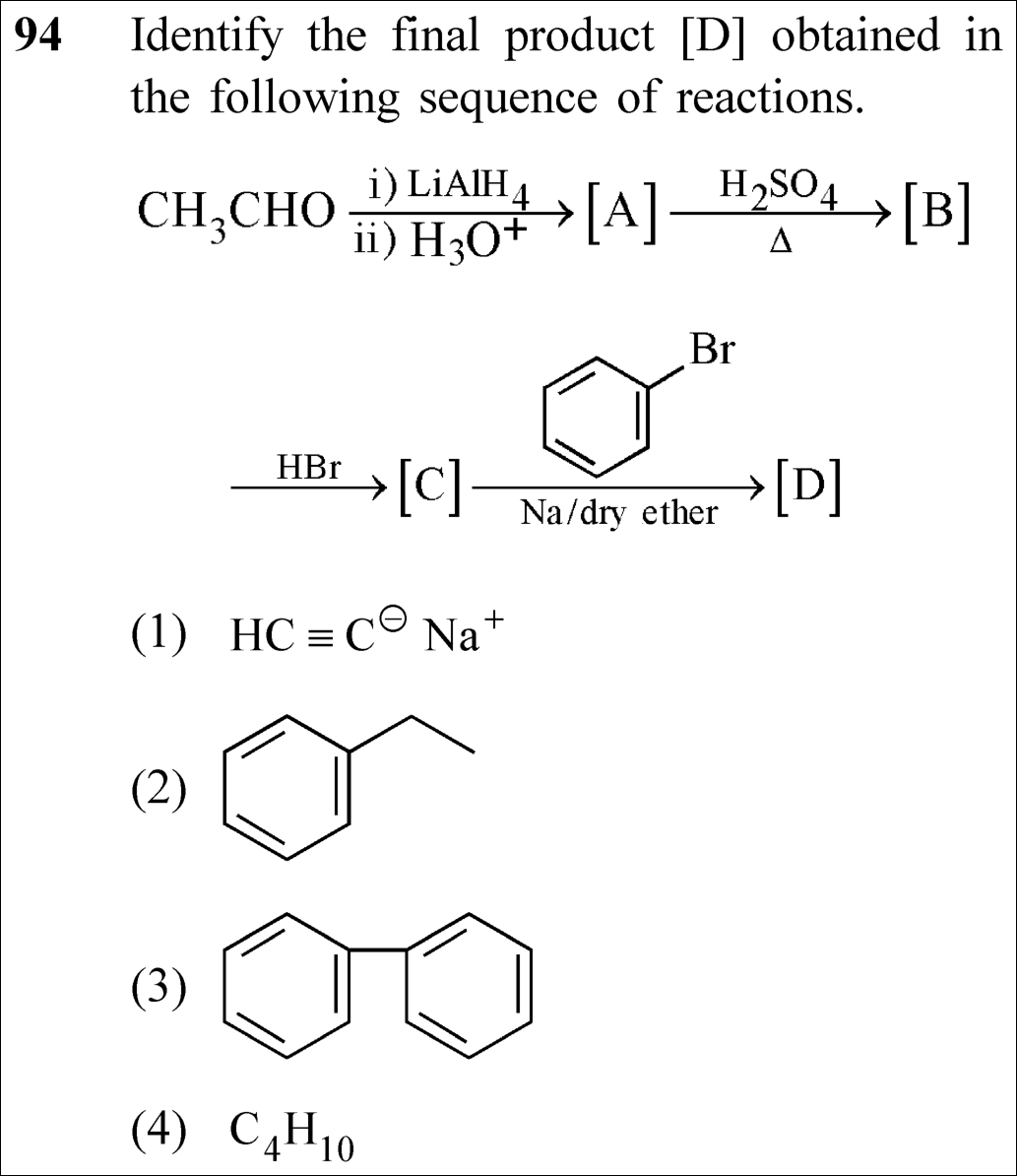
NEET 2023 Chemistry Question 94: Multistep Reaction Sequence: Synthesis of Ethylbenzene via Wurtz-Fittig Reaction

Question

Identify the final product [D] obtained in the following sequence of reactions. CH₃CHO → (i) LiAlH₄ (ii) H₃O⁺ → [A] → (H₂SO₄, Δ) [B] → (HBr) [C] → (bromobenzene, Na/dry ether) [D]

✓
Verified Against NTA Final Answer Key
Option (2) : Ethylbenzene (C₆H₅–CH₂–CH₃)
📚 Haloalkanes and Haloarenes Medium
📋 Given Parameters & Problem Setup
Starting material CH₃CHO (acetaldehyde)
Step 1 (i) LiAlH₄, (ii) H₃O⁺ ⟶ [A]
Step 2 Conc. H₂SO₄, Δ ⟶ [B]
Step 3 HBr ⟶ [C]
Step 4 Bromobenzene + Na / dry ether ⟶ [D]
⚡

The 30-Second Exam Hall Shortcut: ⚡ Reaction Sequence Decoder: Reduction ⟶ Dehydration ⟶ Addition ⟶ Wurtz-Fittig

⏱️ Save ~40 seconds

Acetaldehyde reduces to ethanol [A]. Acidic dehydration of ethanol gives ethene [B]. Addition of HBr gives ethyl bromide [C]. Wurtz-Fittig reaction of ethyl bromide with bromobenzene and sodium in dry ether couples the ethyl group to the benzene ring, yielding ethylbenzene [D]! Option (2) in 15 seconds!

1 Step 1: CH₃CHO + LiAlH₄ ⟶ CH₃CH₂OH [A, Ethanol].
2 Step 2: CH₃CH₂OH + conc. H₂SO₄, heat ⟶ CH₂=CH₂ [B, Ethene].
3 Step 3: CH₂=CH₂ + HBr ⟶ CH₃CH₂Br [C, Bromoethane].
4 Step 4: C₆H₅Br + 2 Na + BrCH₂CH₃ in dry ether ⟶ C₆H₅–CH₂CH₃ [D, Ethylbenzene] + 2 NaBr.
5 Select Option (2) Ethylbenzene immediately.
🛡️
Why You Can 100% Trust This Shortcut: Classical reaction chain coupling standard NCERT organic reactions.
📐

Step-by-Step Rigorous Workflow & Mathematical Proof

Step 1

Step 1: Reduction of Acetaldehyde to Ethanol [A]

Lithium aluminium hydride reduces acetaldehyde to primary alcohol ethanol:

CH3CHO→(i) LiAlH4,  (ii) H3O+CH3CH2OH[A]\text{CH}_3\text{CHO} \xrightarrow{(i)\text{ LiAlH}_4,\; (ii)\text{ H}_3\text{O}^+} \text{CH}_3\text{CH}_2\text{OH} \quad [\text{A}]
Step 2

Step 2: Acid-Catalysed Dehydration to Ethene [B]

Heating ethanol with concentrated sulphuric acid at 443 K undergoes intramolecular dehydration to form ethene:

CH3CH2OH→H2SO4,  ΔCH2=CH2[B]\text{CH}_3\text{CH}_2\text{OH} \xrightarrow{\text{H}_2\text{SO}_4,\; \Delta} \text{CH}_2=\text{CH}_2 \quad [\text{B}]
Step 3

Step 3: Electrophilic Addition of HBr to form Bromoethane [C]

Addition of hydrogen bromide across the symmetrical alkene double bond produces bromoethane:

CH2=CH2+HBr⟶CH3CH2Br[C]\text{CH}_2=\text{CH}_2 + \text{HBr} \longrightarrow \text{CH}_3\text{CH}_2\text{Br} \quad [\text{C}]
Step 4

Step 4: Wurtz-Fittig Coupling to Form Ethylbenzene [D]

Reaction of bromoethane and bromobenzene with sodium metal in dry ether produces alkylarene (ethylbenzene) via the Wurtz-Fittig reaction:

C6H5Br+2Na+BrCH2CH3→dry etherC6H5−CH2CH3+2NaBr[D]\text{C}_6\text{H}_5\text{Br} + 2\text{Na} + \text{BrCH}_2\text{CH}_3 \xrightarrow{\text{dry ether}} \text{C}_6\text{H}_5-\text{CH}_2\text{CH}_3 + 2\text{NaBr} \quad [\text{D}]
⭐

360° Option Elimination Engine Key Feature

Diagnose every choice: Know exactly why the right option works and why distractors fail.

4-Option Deep Scan
1 (1)
✗ Incorrect
Verdict & Scientific Reason:

Terminal sodium acetylide is not formed in this reaction pathway.

⚠️
Student Fallacy (Why candidates pick this trap): Candidate misidentified intermediate [B] as ethyne instead of ethene.
2 (2)
✓ 100% Correct
Verdict & Scientific Reason:

Accurate: Cross-coupling of bromobenzene and bromoethane yields ethylbenzene.

💡
Why this is airtight: None. Candidate accurately traced each sequential transformation.
3 (3)
✗ Incorrect
Verdict & Scientific Reason:

Biphenyl is the Fittig self-coupling byproduct of bromobenzene, not the primary cross-coupled product.

⚠️
Student Fallacy (Why candidates pick this trap): Candidate forgot that bromoethane participates in the cross-coupling.
4 (4)
✗ Incorrect
Verdict & Scientific Reason:

Butane is the Wurtz self-coupling byproduct of bromoethane.

⚠️
Student Fallacy (Why candidates pick this trap): Candidate ignored the presence of bromobenzene in the reaction mixture.
⚠️

NTA Trap Alert: Confusing Symmetrical Side Products with Cross-Coupled Product

In the Wurtz-Fittig reaction of bromobenzene and bromoethane, biphenyl and butane form as side products. The intended cross-coupled product of aryl halide + alkyl halide is ethylbenzene.

🛡️ How to avoid the -1 mark: Identify the mixed reaction: Aryl halide + Alkyl halide + 2 Na ⟶ Alkylarene (Wurtz-Fittig product).
📖

Core NEET Syllabus Standard

National Eligibility cum Entrance Test (NEET UG) · Haloalkanes and Haloarenes Standard Benchmark
Core Scientific Principle Tested:

"A mixture of an alkyl halide and aryl halide gives an alkylarene when treated with sodium in dry ether."

Syllabus Focus: Reactions of Haloarenes – Wurtz-Fittig Reaction
Preserved in Rationalized Curriculum Syllabus & Academic Standards ↗

Ready to attempt under real exam pressure?

Test your speed and accuracy in the authentic 200-minute timed NTA simulator.

Launch NEET 2023 CBT Test →

Spotted a mistake in this solution? Report an error ([email protected])

⚖️ Legal & Fair Dealing Notice: Sourced from publicly released NEET 2023 question papers and NEET answer keys for private study, research, and non-commercial educational practice under Fair Dealing (Section 52(1)(a) of the Indian Copyright Act, 1957). Not affiliated with or endorsed by NTA or NMC.

Solve 4 NEET Questions a Day — One per Subject

Cover all 1,140 official NEET questions in 285 days at your own pace. Progress is saved on your device. No login needed.