MyCompetitiveExams Logo MyCompetitiveExams
Search 1,140+ Questions
Chapters, formulas, speed tricks
→
⚡ Brahmastra NEET 2027
720 MARKS

Dynamic 180-question full-length simulator mixed dynamically from all 6 years for 2027 & 2026 aspirants.

Launch Brahmastra 2027 Test →
Start Practice →
100% Free · No Login Required
Q.93 Chemistry ⭐ 360° Option Elimination Active
Vault ↗

NEET 2023 Chemistry Question 93 Solution

Topic: The Solid State · Official NTA Booklet Code G5
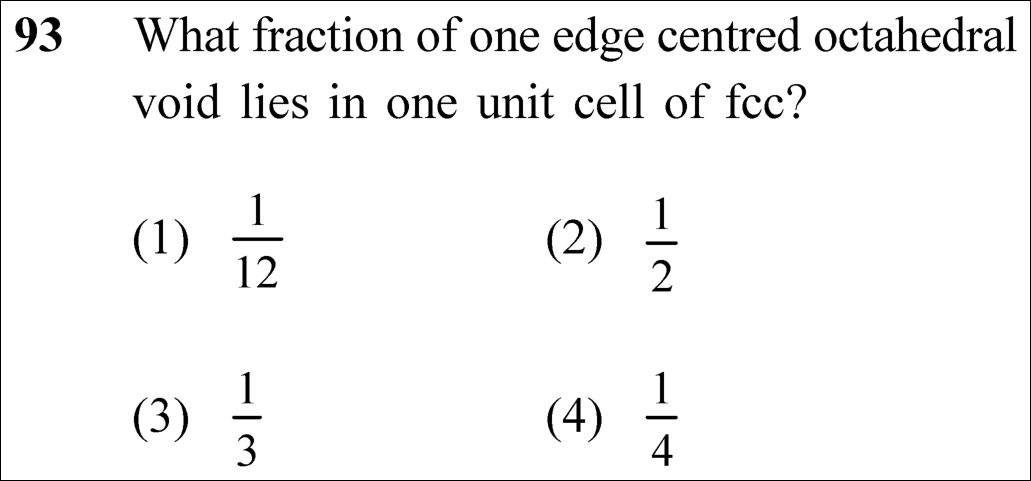
NEET 2023 Chemistry Question 93: Octahedral Voids in Face-Centred Cubic (fcc) Unit Cell

Question

What fraction of one edge centred octahedral void lies in one unit cell of fcc?

✓
Verified Against NTA Final Answer Key
Option (4) : 1/4
📚 The Solid State Easy
📋 Given Parameters & Problem Setup
Lattice type Face-centred cubic (fcc)
Location of void Edge centre
Target fraction Fraction of one edge-centred octahedral void belonging to one unit cell
⚡

The 30-Second Exam Hall Shortcut: ⚡ Lattice Sharing Geometry: 1 Cube Edge is Shared by Exactly 4 Unit Cells

⏱️ Save ~25 seconds

In any cubic lattice, every edge is shared equally by 4 adjacent unit cells. Therefore, any atom or void located at an edge centre contributes exactly 1/4 of its volume to a single unit cell. Instant 5-second answer: 1/4 (Option 4)!

1 Visualize a cubic unit cell edge: four cubes meet along any single edge.
2 Contribution of any particle or interstitial void on an edge = 1/4.
3 Total edge-centred octahedral voids in fcc = 12 × (1/4) = 3.
4 Question specifically asks for the fraction of ONE edge-centred void: 1/4.
5 Select Option (4) directly.
🛡️
Why You Can 100% Trust This Shortcut: Fundamental 3D crystallographic geometry of cubic unit cells in NCERT.
📐

Step-by-Step Rigorous Workflow & Mathematical Proof

Step 1

Analyze Unit Cell Edge Sharing in Cubic Systems

In a three-dimensional cubic lattice, four unit cells share a common edge (two in the same horizontal layer and two in the layer directly above or below):

Number of unit cells sharing one edge=4\text{Number of unit cells sharing one edge} = 4
Step 2

Determine the Fraction of One Edge-Centred Void

Because an edge is divided equally among four unit cells, only 1/4 of any point, sphere, or void positioned at an edge centre belongs to any single unit cell:

Fraction of one edge-centred void per unit cell=14\text{Fraction of one edge-centred void per unit cell} = \frac{1}{4}
Step 3

Differentiate Fraction from Total Count

A cube has 12 edges. The total contribution of all edge-centred octahedral voids to the unit cell is 12 × (1/4) = 3. Combined with 1 body-centred void (1 × 1 = 1), an fcc unit cell has 4 total octahedral voids, but the fraction of ONE edge void is strictly 1/4:

Fraction of ONE void=14(Total edge voids contribution=12×14=3)\text{Fraction of ONE void} = \frac{1}{4} \quad (\text{Total edge voids contribution} = 12 \times \frac{1}{4} = 3)
⭐

360° Option Elimination Engine Key Feature

Diagnose every choice: Know exactly why the right option works and why distractors fail.

4-Option Deep Scan
1 (1)
✗ Incorrect
Verdict & Scientific Reason:

Confuses the total number of edges (12) with the geometric sharing fraction.

⚠️
Student Fallacy (Why candidates pick this trap): Candidate inverted the count of edges in a cube.
2 (2)
✗ Incorrect
Verdict & Scientific Reason:

Fraction for a face-centred position (shared by 2 unit cells), not an edge-centred position.

⚠️
Student Fallacy (Why candidates pick this trap): Candidate confused edge-centred sharing with face-centred sharing.
3 (3)
✗ Incorrect
Verdict & Scientific Reason:

Unphysical sharing factor in a cubic crystal system.

⚠️
Student Fallacy (Why candidates pick this trap): Candidate guessed an arbitrary fraction.
4 (4)
✓ 100% Correct
Verdict & Scientific Reason:

Accurate: Each edge is shared among 4 unit cells, so contribution is exactly 1/4.

💡
Why this is airtight: None. Candidate correctly applied crystallographic sharing geometry.
⚠️

NTA Trap Alert: Confusing Total Contribution with Fraction of a Single Void

Some students compute the total contribution of all edge-centred voids: 12 × 1/4 = 3, and then look for 3. The question asks: "What fraction of ONE edge centred void lies in one unit cell?" The fraction of one void is simply 1/4.

🛡️ How to avoid the -1 mark: Read carefully: "fraction of one void" = 1/4, whereas "total number of edge voids per unit cell" = 3.
📖

Core NEET Syllabus Standard

National Eligibility cum Entrance Test (NEET UG) · The Solid State Standard Benchmark
Core Scientific Principle Tested:

"In a cubic unit cell, a position on an edge is shared equally by 4 unit cells, giving a contribution fraction of 1/4."

Syllabus Focus: Imperfections in Solids & Voids in fcc Lattice
Preserved in Rationalized Curriculum Syllabus & Academic Standards ↗

Ready to attempt under real exam pressure?

Test your speed and accuracy in the authentic 200-minute timed NTA simulator.

Launch NEET 2023 CBT Test →

Spotted a mistake in this solution? Report an error ([email protected])

⚖️ Legal & Fair Dealing Notice: Sourced from publicly released NEET 2023 question papers and NEET answer keys for private study, research, and non-commercial educational practice under Fair Dealing (Section 52(1)(a) of the Indian Copyright Act, 1957). Not affiliated with or endorsed by NTA or NMC.

Solve 4 NEET Questions a Day — One per Subject

Cover all 1,140 official NEET questions in 285 days at your own pace. Progress is saved on your device. No login needed.