MyCompetitiveExams Logo MyCompetitiveExams
Search 1,140+ Questions
Chapters, formulas, speed tricks
→
⚡ Brahmastra NEET 2027
720 MARKS

Dynamic 180-question full-length simulator mixed dynamically from all 6 years for 2027 & 2026 aspirants.

Launch Brahmastra 2027 Test →
Start Practice →
100% Free · No Login Required
🧪 Chemistry 📌 Standard Frequency (~1–2 Qs/Year)

NEET The Solid State Previous Year Questions with Solutions

Complete repository of official NTA NEET questions for The Solid State from 2020 to 2026. Every question includes 30-second elimination tricks, step-by-step NCERT solutions, option-by-option traps, and official answer keys.

5 Questions 3 Exam Years (2023, 2021, 2020) 5 Easy · 0 Medium · 0 Challenging
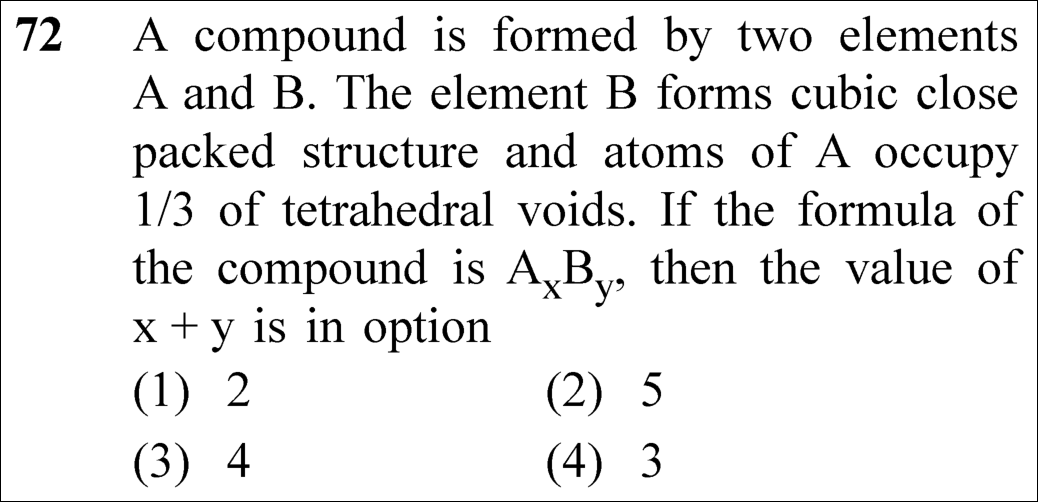
NEET 2023 · Q72 Easy
Official NEET 2023 Question 72 - The Solid State
1
2 ✓ Key
3
4
💡 Verified Solution & 30-Second Hack
✓
Verified Against NTA Final Answer Key
Option (2) : 5
📚 Solid State Easy
📋 Given Parameters & Problem Setup
Element B lattice Cubic close packed (ccp / fcc)
Element A occupancy 1/3 of tetrahedral voids
Formula of compound A_x B_y
Target quantity x + y
⚡

The 30-Second Exam Hall Shortcut: ⚡ Void Ratio Rule: N atoms in ccp ⟹ 2N Tetrahedral Voids

⏱️ Save ~30 seconds

Let B = 1. Tetrahedral voids = 2. A occupies 1/3 of them ⟹ A = 2 × (1/3) = 2/3. Formula = A_(2/3) B_1 = A₂B₃ ⟹ x = 2, y = 3 ⟹ x + y = 2 + 3 = 5 in 10 seconds!

1 In any close-packed lattice (ccp or hcp), if there are N lattice atoms, the number of tetrahedral voids is exactly 2N.
2 Element B forms the ccp lattice ⟹ Number of B atoms = N.
3 Total number of tetrahedral voids = 2N.
4 Atoms of element A occupy 1/3 of these tetrahedral voids:
5 Number of A atoms = (1/3) × 2N = (2/3) N.
6 Ratio of atoms A : B = (2/3) N : N = 2/3 : 1 = 2 : 3.
7 Formula of compound is A₂B₃ (so x = 2 and y = 3).
8 Question asks for x + y: x + y = 2 + 3 = 5.
9 Lock Option (2) 5 immediately!
🛡️
Why You Can 100% Trust This Shortcut: Solid State · Close-Packed Structures (For N close-packed spheres, there are N octahedral voids and 2N tetrahedral voids).
📐

Step-by-Step Rigorous Workflow & Mathematical Proof

Step 1

Number of Voids in a Cubic Close-Packed (ccp) Array

In a cubic close packed (ccp / face-centered cubic) lattice of spheres, let the number of close-packed constituent atoms forming the lattice be N. Geometrical packing dictates that the number of octahedral voids is N, and the number of tetrahedral voids is 2N:

Number of B atoms=N,Total tetrahedral voids=2N\text{Number of B atoms} = N, \qquad \text{Total tetrahedral voids} = 2N
Step 2

Calculation of Constituent Atoms of Element A

Atoms of element A occupy one-third (1/3) of the available tetrahedral voids. Therefore, the total number of atoms of A per N atoms of B is:

Number of A atoms=13×2N=23N\text{Number of A atoms} = \frac{1}{3} \times 2N = \frac{2}{3} N
Step 3

Determination of the Simplest Empirical Formula

Find the simplest whole-number stoichiometric ratio between elements A and B:

A:B=23N:N=23:1=2:3  ⟹  Formula=A2B3A : B = \frac{2}{3} N : N = \frac{2}{3} : 1 = 2 : 3 \implies \text{Formula} = A_2 B_3
Step 4

Evaluation of the Requested Sum (x + y)

Comparing the empirical formula A₂B₃ with A_x B_y identifies x = 2 and y = 3. Computing their sum:

x=2,y=3  ⟹  x+y=2+3=5x = 2, \quad y = 3 \implies x + y = 2 + 3 = 5
⭐

360° Option Elimination Engine Key Feature

Diagnose every choice: Know exactly why the right option works and why distractors fail.

4-Option Deep Scan
1 (1)
✗ Incorrect
Verdict & Scientific Reason:

Represents only subscript x, not the sum x + y.

⚠️
Student Fallacy (Why candidates pick this trap): Candidate gave only the value of x.
2 (2)
✓ 100% Correct
Verdict & Scientific Reason:

Accurate sum of subscripts: In A₂B₃, x = 2 and y = 3 ⟹ x + y = 5.

💡
Why this is airtight: None. Candidate correctly determined formula and calculated the sum.
3 (3)
✗ Incorrect
Verdict & Scientific Reason:

Result of assuming tetrahedral voids equal N instead of 2N (A_(1/3) B_1 = AB₃ ⟹ 1 + 3 = 4).

⚠️
Student Fallacy (Why candidates pick this trap): Candidate forgot the factor of 2 for tetrahedral voids (confused with octahedral voids).
4 (4)
✗ Incorrect
Verdict & Scientific Reason:

Represents only subscript y, not the sum x + y.

⚠️
Student Fallacy (Why candidates pick this trap): Candidate gave only the value of y.
⚠️

NTA Trap Alert: Confusing Tetrahedral Voids (2N) with Octahedral Voids (N)

If a student mistakenly assumes there are N tetrahedral voids per N lattice atoms, they calculate A = (1/3)N ⟹ AB₃ ⟹ x + y = 1 + 3 = 4 (Option 3). In close-packed lattices, tetrahedral voids are ALWAYS TWICE the number of lattice spheres (2N)!

🛡️ How to avoid the -1 mark: Void Rule: Tetrahedral = 2N, Octahedral = N.
📖

Core NEET Syllabus Standard

National Eligibility cum Entrance Test (NEET UG) · Solid State Standard Benchmark
Core Scientific Principle Tested:

"Number of tetrahedral voids generated is double the number of close-packed particles. A occupies 1/3 of 2N ⟹ A₂B₃ ⟹ x + y = 5."
Syllabus Focus: Formula of a Compound and Number of Voids Filled
Preserved in Rationalized Curriculum Syllabus & Academic Standards ↗
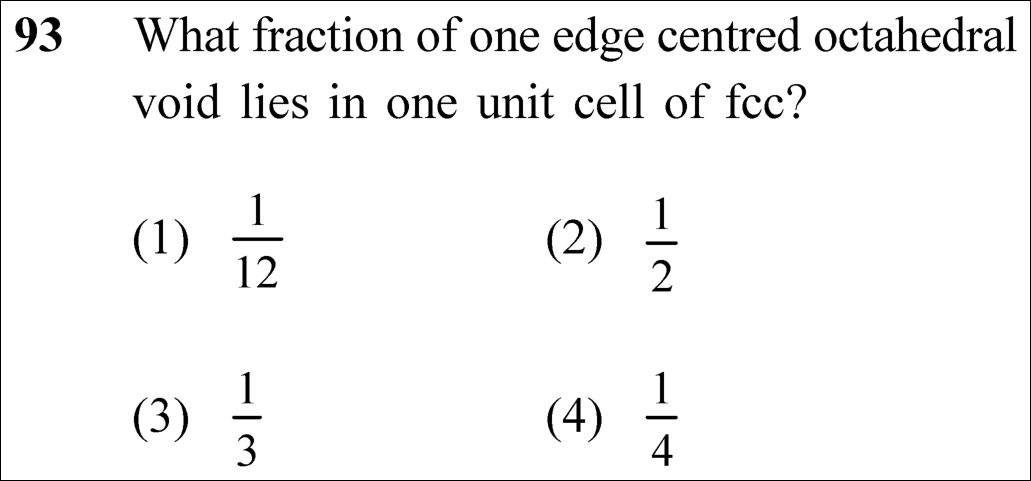
NEET 2023 · Q93 Easy
Official NEET 2023 Question 93 - The Solid State
1
2
3
4 ✓ Key
💡 Verified Solution & 30-Second Hack
✓
Verified Against NTA Final Answer Key
Option (4) : 1/4
📚 The Solid State Easy
📋 Given Parameters & Problem Setup
Lattice type Face-centred cubic (fcc)
Location of void Edge centre
Target fraction Fraction of one edge-centred octahedral void belonging to one unit cell
⚡

The 30-Second Exam Hall Shortcut: ⚡ Lattice Sharing Geometry: 1 Cube Edge is Shared by Exactly 4 Unit Cells

⏱️ Save ~25 seconds

In any cubic lattice, every edge is shared equally by 4 adjacent unit cells. Therefore, any atom or void located at an edge centre contributes exactly 1/4 of its volume to a single unit cell. Instant 5-second answer: 1/4 (Option 4)!

1 Visualize a cubic unit cell edge: four cubes meet along any single edge.
2 Contribution of any particle or interstitial void on an edge = 1/4.
3 Total edge-centred octahedral voids in fcc = 12 × (1/4) = 3.
4 Question specifically asks for the fraction of ONE edge-centred void: 1/4.
5 Select Option (4) directly.
🛡️
Why You Can 100% Trust This Shortcut: Fundamental 3D crystallographic geometry of cubic unit cells in NCERT.
📐

Step-by-Step Rigorous Workflow & Mathematical Proof

Step 1

Analyze Unit Cell Edge Sharing in Cubic Systems

In a three-dimensional cubic lattice, four unit cells share a common edge (two in the same horizontal layer and two in the layer directly above or below):

Number of unit cells sharing one edge=4\text{Number of unit cells sharing one edge} = 4
Step 2

Determine the Fraction of One Edge-Centred Void

Because an edge is divided equally among four unit cells, only 1/4 of any point, sphere, or void positioned at an edge centre belongs to any single unit cell:

Fraction of one edge-centred void per unit cell=14\text{Fraction of one edge-centred void per unit cell} = \frac{1}{4}
Step 3

Differentiate Fraction from Total Count

A cube has 12 edges. The total contribution of all edge-centred octahedral voids to the unit cell is 12 × (1/4) = 3. Combined with 1 body-centred void (1 × 1 = 1), an fcc unit cell has 4 total octahedral voids, but the fraction of ONE edge void is strictly 1/4:

Fraction of ONE void=14(Total edge voids contribution=12×14=3)\text{Fraction of ONE void} = \frac{1}{4} \quad (\text{Total edge voids contribution} = 12 \times \frac{1}{4} = 3)
⭐

360° Option Elimination Engine Key Feature

Diagnose every choice: Know exactly why the right option works and why distractors fail.

4-Option Deep Scan
1 (1)
✗ Incorrect
Verdict & Scientific Reason:

Confuses the total number of edges (12) with the geometric sharing fraction.

⚠️
Student Fallacy (Why candidates pick this trap): Candidate inverted the count of edges in a cube.
2 (2)
✗ Incorrect
Verdict & Scientific Reason:

Fraction for a face-centred position (shared by 2 unit cells), not an edge-centred position.

⚠️
Student Fallacy (Why candidates pick this trap): Candidate confused edge-centred sharing with face-centred sharing.
3 (3)
✗ Incorrect
Verdict & Scientific Reason:

Unphysical sharing factor in a cubic crystal system.

⚠️
Student Fallacy (Why candidates pick this trap): Candidate guessed an arbitrary fraction.
4 (4)
✓ 100% Correct
Verdict & Scientific Reason:

Accurate: Each edge is shared among 4 unit cells, so contribution is exactly 1/4.

💡
Why this is airtight: None. Candidate correctly applied crystallographic sharing geometry.
⚠️

NTA Trap Alert: Confusing Total Contribution with Fraction of a Single Void

Some students compute the total contribution of all edge-centred voids: 12 × 1/4 = 3, and then look for 3. The question asks: "What fraction of ONE edge centred void lies in one unit cell?" The fraction of one void is simply 1/4.

🛡️ How to avoid the -1 mark: Read carefully: "fraction of one void" = 1/4, whereas "total number of edge voids per unit cell" = 3.
📖

Core NEET Syllabus Standard

National Eligibility cum Entrance Test (NEET UG) · The Solid State Standard Benchmark
Core Scientific Principle Tested:

"In a cubic unit cell, a position on an edge is shared equally by 4 unit cells, giving a contribution fraction of 1/4."

Syllabus Focus: Imperfections in Solids & Voids in fcc Lattice
Preserved in Rationalized Curriculum Syllabus & Academic Standards ↗
NEET 2021 · Q56 Easy
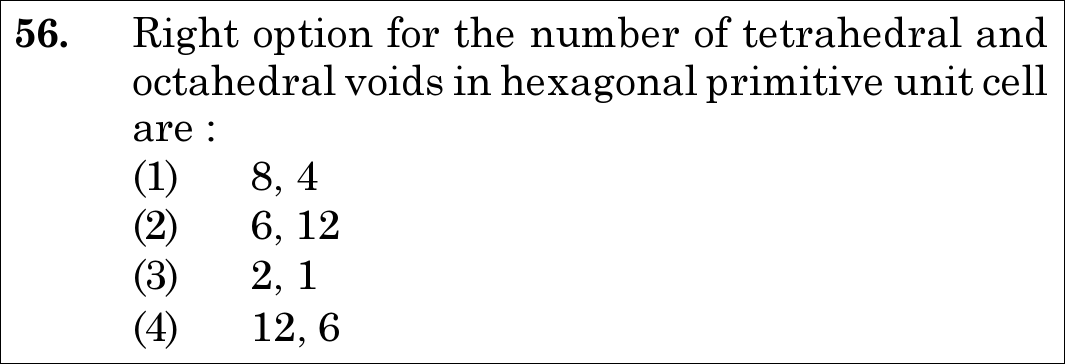
Official NEET 2021 Question 56 - The Solid State
1 8, 4
2 6, 12
3 2, 1
4 12, 6 ✓ Key
💡 Verified Solution & 30-Second Hack
✓
Verified Against NTA Final Answer Key
Option (4) : 12, 6
📚 Solid State Easy
📋 Given Parameters & Problem Setup
Lattice Type Hexagonal primitive unit cell (hcp)
Target Number of tetrahedral and octahedral voids respectively
⚡

The 30-Second Exam Hall Shortcut: ⚡ For N Atoms: Tetrahedral = 2N, Octahedral = N

⏱️ Save ~20 seconds

In any close-packed lattice containing NN constituent particles, the number of octahedral voids is NN, and tetrahedral voids is 2N2N. For a hexagonal primitive unit cell (hcp), N=6N = 6. Therefore, Tetrahedral voids =2×6=12= 2 \times 6 = 12 and Octahedral voids =6= 6. The answer is 12, 6! Match Option (4)!

1 Effective number of atoms per hcp unit cell: Z=N=6Z = N = 6 (12×16+2×12+3=612 \times \frac{1}{6} + 2 \times \frac{1}{2} + 3 = 6).
2 Number of octahedral voids =N=6= N = 6.
3 Number of tetrahedral voids =2N=2×6=12= 2N = 2 \times 6 = 12.
4 Question asks for "tetrahedral and octahedral voids" in order: 12, 6.
5 Match Option (4).
🛡️
Why You Can 100% Trust This Shortcut: Canonical close-packed sphere geometry (Vtet=2N,Voct=NV_{\text{tet}} = 2N, V_{\text{oct}} = N).
📐

Step-by-Step Rigorous Workflow & Mathematical Proof

Step 1

Calculating Effective Atoms per Hexagonal Unit Cell (Z)

A hexagonal primitive (hcp) unit cell contains: - 12 corner atoms, each shared among 6 unit cells: 12×16=212 \times \frac{1}{6} = 2 - 2 face-centered atoms, each shared between 2 unit cells: 2×12=12 \times \frac{1}{2} = 1 - 3 completely enclosed internal atoms: 3×1=33 \times 1 = 3 Total effective constituent particles per unit cell:

Z=N=2+1+3=6Z = N = 2 + 1 + 3 = 6
Step 2

Formula for Interstitial Voids in Close-Packing

For any close-packed arrangement of NN spheres: - Number of Octahedral Voids (OVO_V) =N= N - Number of Tetrahedral Voids (TVT_V) =2N= 2N

Step 3

Evaluating Void Counts for hcp

Substituting N=6N = 6:

TV=2×6=12,OV=6T_V = 2 \times 6 = 12, \quad O_V = 6
⭐

360° Option Elimination Engine Key Feature

Diagnose every choice: Know exactly why the right option works and why distractors fail.

4-Option Deep Scan
1 1
✗ Incorrect
Verdict & Scientific Reason:

These are the void counts for a cubic close-packed (fcc/ccp) unit cell (N=4  ⟹  TV=8,OV=4N = 4 \implies T_V = 8, O_V = 4), not hcp.

⚠️
Student Fallacy (Why candidates pick this trap): Using fcc parameters instead of hexagonal unit cell.
2 2
✗ Incorrect
Verdict & Scientific Reason:

Inverts the requested order (gives octahedral first, then tetrahedral).

⚠️
Student Fallacy (Why candidates pick this trap): Swapping tetrahedral and octahedral void counts.
3 3
✗ Incorrect
Verdict & Scientific Reason:

Per-atom ratio (2:12:1), not the total count per unit cell.

⚠️
Student Fallacy (Why candidates pick this trap): Reporting the ratio per atom rather than per unit cell.
4 4
✓ 100% Correct
Verdict & Scientific Reason:

Exact void counts for hcp unit cell: 12 tetrahedral and 6 octahedral voids.

💡
Why this is airtight: None; rigorous crystallography analysis.
⚠️

NTA Trap Alert: Order of Voids and FCC vs. HCP Trap

NTA traps candidates in two ways: 1. Option (1) gives 8,48, 4, which is for FCC (Z=4Z=4). HCP has Z=6Z=6. 2. Option (2) inverts the order to 6,126, 12. The question explicitly asks for "tetrahedral and octahedral" (12, 6).

🛡️ How to avoid the -1 mark: HCP has N=6N=6. Tetrahedral first (2N=122N = 12), then octahedral (N=6N = 6).
📖

Core NEET Syllabus Standard

NCERT Chemistry · Solid State Standard Benchmark
Core Scientific Principle Tested:

"In a close-packed arrangement of NN spheres, octahedral voids =N= N and tetrahedral voids =2N= 2N. In an hcp unit cell, N=6N = 6."

Syllabus Focus: Number of Voids Filled in Close-Packed Structures
✓ Core NEET UG Syllabus Anchor Syllabus & Academic Standards ↗
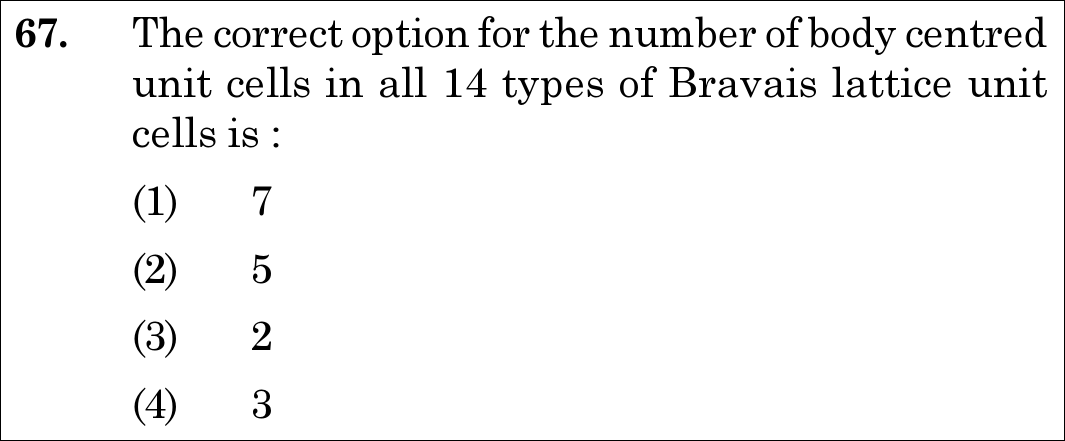
NEET 2021 · Q67 Easy
Official NEET 2021 Question 67 - The Solid State
1
2
3
4 ✓ Key
💡 Verified Solution & 30-Second Hack
✓
Verified Against NTA Final Answer Key
Option (4) : 3
📚 Solid State Easy
📋 Given Parameters & Problem Setup
Total Crystal Systems 7 crystal systems
Total Bravais Lattices 14 Bravais lattices
Target Unit Cell Type Body-centred unit cells (BCC)
⚡

The 30-Second Exam Hall Shortcut: ⚡ BCC Systems: Cubic, Tetragonal, Orthorhombic (Count = 3)

⏱️ Save ~20 seconds

Across all 7 crystal systems, body-centred lattices occur in exactly 3 systems: Cubic (11), Tetragonal (11), and Orthorhombic (11). No other system possesses a body-centred lattice! Total body-centred Bravais lattices =1+1+1=3= 1 + 1 + 1 = 3! Match Option (4)!

1 Total Bravais lattices = 14 across 7 crystal systems.
2 Recall distribution of Bravais types: - Primitive (P): in all 7 systems (7) - Body-centred (I): in Cubic, Tetragonal, Orthorhombic (3) - Face-centred (F): in Cubic, Orthorhombic (2) - End-centred (C): in Orthorhombic, Monoclinic (2) Total = 7 + 3 + 2 + 2 = 14.
3 Count of body-centred unit cells = 3.
4 Match Option (4).
🛡️
Why You Can 100% Trust This Shortcut: Canonical NCERT Solid State crystallography principle on 14 Bravais Lattices.
📐

Step-by-Step Rigorous Workflow & Mathematical Proof

Step 1

Reviewing the 14 Bravais Lattices across 7 Crystal Systems

Auguste Bravais demonstrated that only 14 space lattices are mathematically possible in three dimensions across the 7 crystal systems: 1. Cubic (3): Primitive, Body-centred, Face-centred 2. Tetragonal (2): Primitive, Body-centred 3. Orthorhombic (4): Primitive, Body-centred, Face-centred, End-centred 4. Hexagonal (1): Primitive 5. Rhombohedral / Trigonal (1): Primitive 6. Monoclinic (2): Primitive, End-centred 7. Triclinic (1): Primitive

Step 2

Enumerating Body-Centred Unit Cells

Summing the body-centred lattices: - Cubic body-centred: 1 - Tetragonal body-centred: 1 - Orthorhombic body-centred: 1 No other crystal system allows a body-centred Bravais lattice without reducing to a simpler existing lattice.

Total body-centred Bravais lattices=1+1+1=3\text{Total body-centred Bravais lattices} = 1 + 1 + 1 = 3
⭐

360° Option Elimination Engine Key Feature

Diagnose every choice: Know exactly why the right option works and why distractors fail.

4-Option Deep Scan
1 1
✗ Incorrect
Verdict & Scientific Reason:

7 is the number of PRIMITIVE unit cells (one in each crystal system), not body-centred.

⚠️
Student Fallacy (Why candidates pick this trap): Confusing primitive unit cell count with body-centred unit cell count.
2 2
✗ Incorrect
Verdict & Scientific Reason:

Arbitrary number.

⚠️
Student Fallacy (Why candidates pick this trap): Misremembering the Bravais lattice table.
3 3
✗ Incorrect
Verdict & Scientific Reason:

2 is the number of Face-centred (or End-centred) unit cells, not body-centred.

⚠️
Student Fallacy (Why candidates pick this trap): Confusing body-centred with face-centred Bravais lattices.
4 4
✓ 100% Correct
Verdict & Scientific Reason:

Exact count of body-centred unit cells: Cubic, Tetragonal, and Orthorhombic.

💡
Why this is airtight: None; precise Bravais lattice crystallography knowledge.
⚠️

NTA Trap Alert: Primitive vs. Body-Centred vs. Face-Centred Trap

The Bravais breakdown is: - Primitive = 7 - Body-centred = 3 - Face-centred = 2 - End-centred = 2 Total = 14. Students often confuse the counts of primitive (7) or face-centred (2) with body-centred (3).

🛡️ How to avoid the -1 mark: Mnemonic: "CTO has Body"   ⟹  \implies Cubic, Tetragonal, Orthorhombic = 3 systems.
📖

Core NEET Syllabus Standard

NCERT Chemistry · Solid State Standard Benchmark
Core Scientific Principle Tested:

"Only three crystal systems—cubic, tetragonal, and orthorhombic—possess body-centred Bravais lattices."

Syllabus Focus: Crystal Lattices and Unit Cells (14 Bravais Lattices)
✓ Core NEET UG Syllabus Anchor Syllabus & Academic Standards ↗
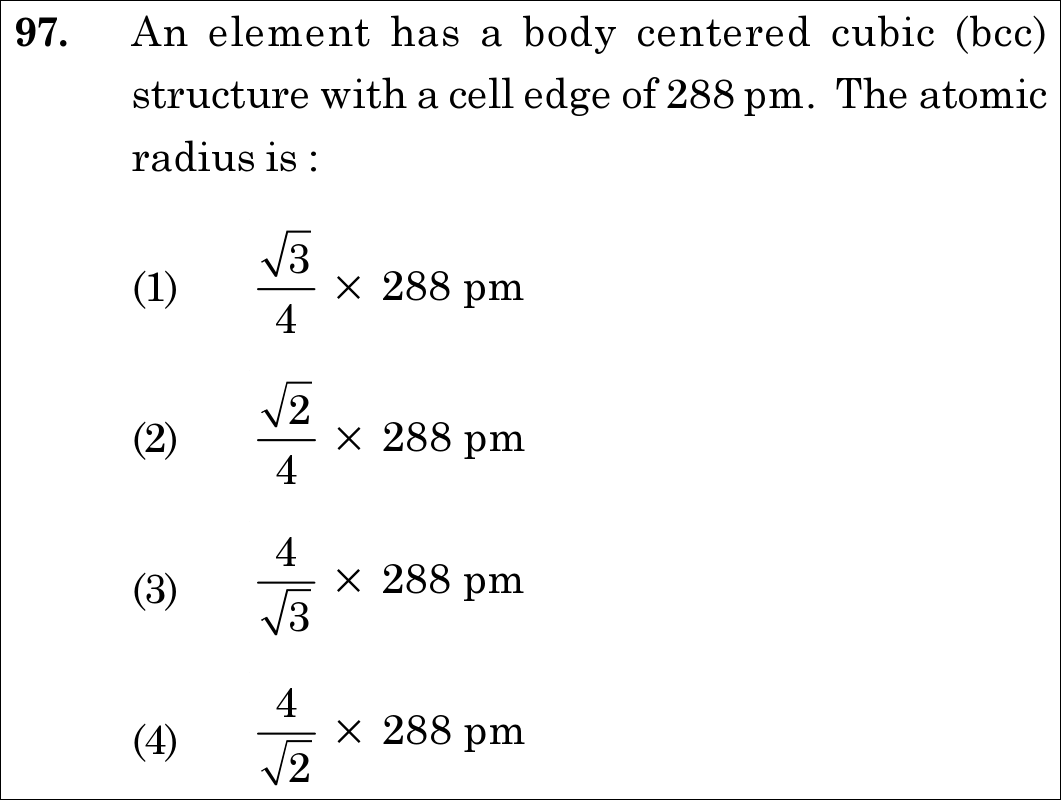
NEET 2020 · Q97 Easy
Official NEET 2020 Question 97 - The Solid State
1 × 288 pm ✓ Key
2 × 288 pm
3 × 288 pm
4 × 288 pm
💡 Verified Solution & 30-Second Hack
✓
Verified Against NTA Final Answer Key
Option (1) : √3 / 4 × 288 pm
📚 Solid State Easy
📋 Given Parameters & Problem Setup
Lattice Type Body Centered Cubic (bcc)
Unit Cell Edge Length (a) 288 pm
Question Objective Express the atomic radius (r) in terms of edge length
⚡

The 30-Second Exam Hall Shortcut: ⚡ "In BCC: 4r = √3 a => r = (√3 / 4) × a = (√3 / 4) × 288 pm!"

⏱️ 20 seconds

In a body-centered cubic unit cell, atoms touch along the body diagonal of length 3a\sqrt{3}a. The body diagonal contains the center atom and two corner radii: 4r=3a4r = \sqrt{3}a. Therefore, r=34a=34×288 pmr = \frac{\sqrt{3}}{4} a = \frac{\sqrt{3}}{4} \times 288\text{ pm}. Mark Option (1) in 5 seconds!

1 Recall geometry of BCC unit cell: Atoms touch along the body diagonal.
2 Body diagonal length = √3 a.
3 Sum of radii along body diagonal = r + 2r + r = 4r.
4 Formula: 4r = √3 a => r = (√3 / 4) × a.
5 Substitute a = 288 pm: r = (√3 / 4) × 288 pm -> Option (1).
🛡️
Why You Can 100% Trust This Shortcut: NCERT Chemistry · Solid State (Packing Efficiency in Body-Centred Cubic Structures)
📐

Step-by-Step Rigorous Workflow & Mathematical Proof

Step 1

Geometric Analysis of BCC Unit Cell

In a body-centered cubic (BCC) crystal lattice, the central atom touches all eight corner atoms. Therefore, sphere contact occurs along the body diagonal of the cube.

Step 2

Calculate Body Diagonal in Terms of Edge Length

Let the edge length of the unit cell be aa. The face diagonal of any face is b=a2+a2=2ab = \sqrt{a^2 + a^2} = \sqrt{2}a. The body diagonal cc running from one corner through the central sphere to the opposite corner is: c=b2+a2=(2a)2+a2=3a2=3ac = \sqrt{b^2 + a^2} = \sqrt{(\sqrt{2}a)^2 + a^2} = \sqrt{3a^2} = \sqrt{3}a

Step 3

Relate Diagonal to Sphere Radii

Along the body diagonal, there is one radius from the starting corner atom, two radii (diameter) of the central atom, and one radius from the ending corner atom: Body Diagonal=r+2r+r=4r\text{Body Diagonal} = r + 2r + r = 4r Equating the two expressions: 4r=3a  ⟹  r=34a4r = \sqrt{3}a \implies r = \frac{\sqrt{3}}{4}a

Step 4

Substitute Numerical Value

With a=288 pma = 288\text{ pm}: r=34×288 pmr = \frac{\sqrt{3}}{4} \times 288\text{ pm} This corresponds precisely to Option (1).

⭐

360° Option Elimination Engine Key Feature

Diagnose every choice: Know exactly why the right option works and why distractors fail.

4-Option Deep Scan
1 A
✓ 100% Correct
Verdict & Scientific Reason:

Factually and mathematically exact; in BCC, r=34ar = \frac{\sqrt{3}}{4} a.

💡
Why this is airtight: None; standard solid state formula.
2 B
✗ Incorrect
Verdict & Scientific Reason:

Incorrect; this is the relationship for a Face Centered Cubic (FCC/CCP) unit cell, where 4r=2a  ⟹  r=24a4r = \sqrt{2}a \implies r = \frac{\sqrt{2}}{4}a.

⚠️
Student Fallacy (Why candidates pick this trap): Confusing FCC face diagonal (2a\sqrt{2}a) with BCC body diagonal (3a\sqrt{3}a).
3 C
✗ Incorrect
Verdict & Scientific Reason:

Incorrect; inverts the ratio, which would give aa in terms of rr (a=43ra = \frac{4}{\sqrt{3}}r), yielding a radius larger than the unit cell.

⚠️
Student Fallacy (Why candidates pick this trap): Solving for edge length aa instead of atomic radius rr.
4 D
✗ Incorrect
Verdict & Scientific Reason:

Incorrect; inverted FCC formula.

⚠️
Student Fallacy (Why candidates pick this trap): Mixing up lattice type and formula inversion.
⚠️

NTA Trap Alert: BCC vs FCC Diagonal Relationship

- Simple cubic: 2r=a  ⟹  r=a/22r = a \implies r = a / 2. - BCC (Body diagonal): 4r=3a  ⟹  r=34a4r = \sqrt{3}a \implies r = \frac{\sqrt{3}}{4}a. - FCC (Face diagonal): 4r=2a  ⟹  r=24a4r = \sqrt{2}a \implies r = \frac{\sqrt{2}}{4}a.

🛡️ How to avoid the -1 mark: BCC = Body = √3! FCC = Face = √2!
📖

Core NEET Syllabus Standard

Chemistry · Solid State Standard Benchmark
Core Scientific Principle Tested:

""

Syllabus Focus: Body Centered Cubic (BCC) Lattice: Relationship Between Edge Length and Atomic Radius
✓ Core NEET UG Syllabus Anchor Syllabus & Academic Standards ↗

Solve 4 NEET Questions a Day — One per Subject

Cover all 1,140 official NEET questions in 285 days at your own pace. Progress is saved on your device. No login needed.