NEET 2023 Chemistry Question 57 Solution
Question
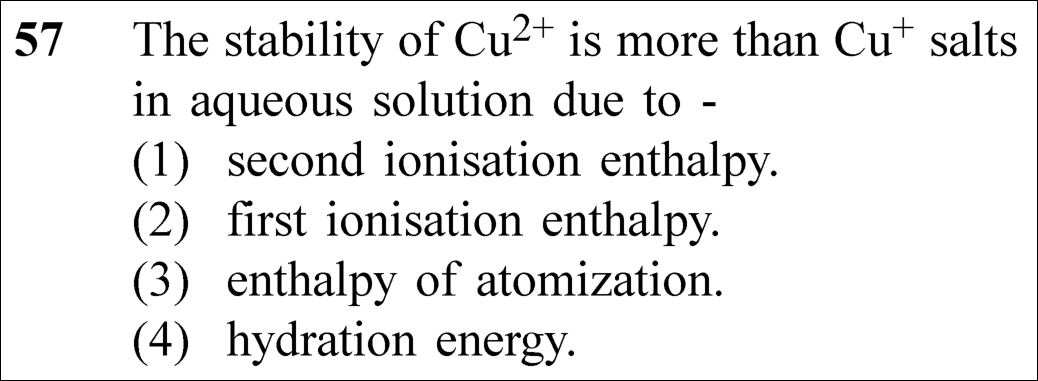
The stability of Cu²⁺ is more than Cu⁺ salts in aqueous solution due to -
Dynamic 180-question full-length simulator mixed dynamically from all 6 years for 2027 & 2026 aspirants.
The stability of Cu²⁺ is more than Cu⁺ salts in aqueous solution due to -
Cu⁺ has d¹⁰ configuration, but Cu²⁺ has double the charge density! High negative hydration enthalpy of Cu²⁺ (-2121 kJ/mol) overcomes its 2nd ionization enthalpy, making Cu²⁺ stable in aqueous solution in 5 seconds!
In the isolated gaseous state, copper exhibits the following configurations:
The stability of an oxidation state in aqueous solution is dictated by the total standard electrode potential (E°), which is governed by the Born-Haber energy cycle involving sublimation enthalpy, ionization enthalpy, and hydration enthalpy:
Although removing a second electron from copper requires a very large amount of energy (high second ionization enthalpy IE₂ = 1958 kJ mol⁻¹ to break the stable 3d¹⁰ shell), the much smaller ionic radius and higher charge of Cu²⁺ gives it a massive negative hydration enthalpy (-2121 kJ mol⁻¹ compared to only -593 kJ mol⁻¹ for Cu⁺):
Because the hydration enthalpy heavily tilts the free energy balance toward Cu²⁺, Cu⁺ ions are unstable in water and undergo rapid disproportionation:
Diagnose every choice: Know exactly why the right option works and why distractors fail.
Second ionization enthalpy is unfavorable (endothermic, opposes Cu²⁺ formation).
First ionization enthalpy is identical for forming Cu⁺.
Sublimation/atomization enthalpy is the same for both oxidation states starting from metallic copper.
Direct canonical textbook reason: huge negative hydration enthalpy of Cu²⁺ compensates for IE₂.
Students frequently remember that Cu⁺ has a fully filled 3d¹⁰ configuration and assume it must be more stable than 3d⁹ Cu²⁺. In aqueous solution, lattice/hydration energetics completely override subshell symmetry!
"The stability of Cu²⁺(aq) rather than Cu⁺(aq) is due to the much more negative hydration enthalpy of Cu²⁺(aq) which more than compensates for second ionization enthalpy."
Test your speed and accuracy in the authentic 200-minute timed NTA simulator.
Spotted a mistake in this solution? Report an error ([email protected])
Cover all 1,140 official NEET questions in 285 days at your own pace. Progress is saved on your device. No login needed.