MyCompetitiveExams Logo MyCompetitiveExams
Search 1,140+ Questions
Chapters, formulas, speed tricks
→
⚡ Brahmastra NEET 2027
720 MARKS

Dynamic 180-question full-length simulator mixed dynamically from all 6 years for 2027 & 2026 aspirants.

Launch Brahmastra 2027 Test →
Start Practice →
100% Free · No Login Required
Q.56 Chemistry ⭐ 360° Option Elimination Active
Vault ↗

NEET 2023 Chemistry Question 56 Solution

Topic: Alcohols, Phenols and Ethers · Official NTA Booklet Code G5
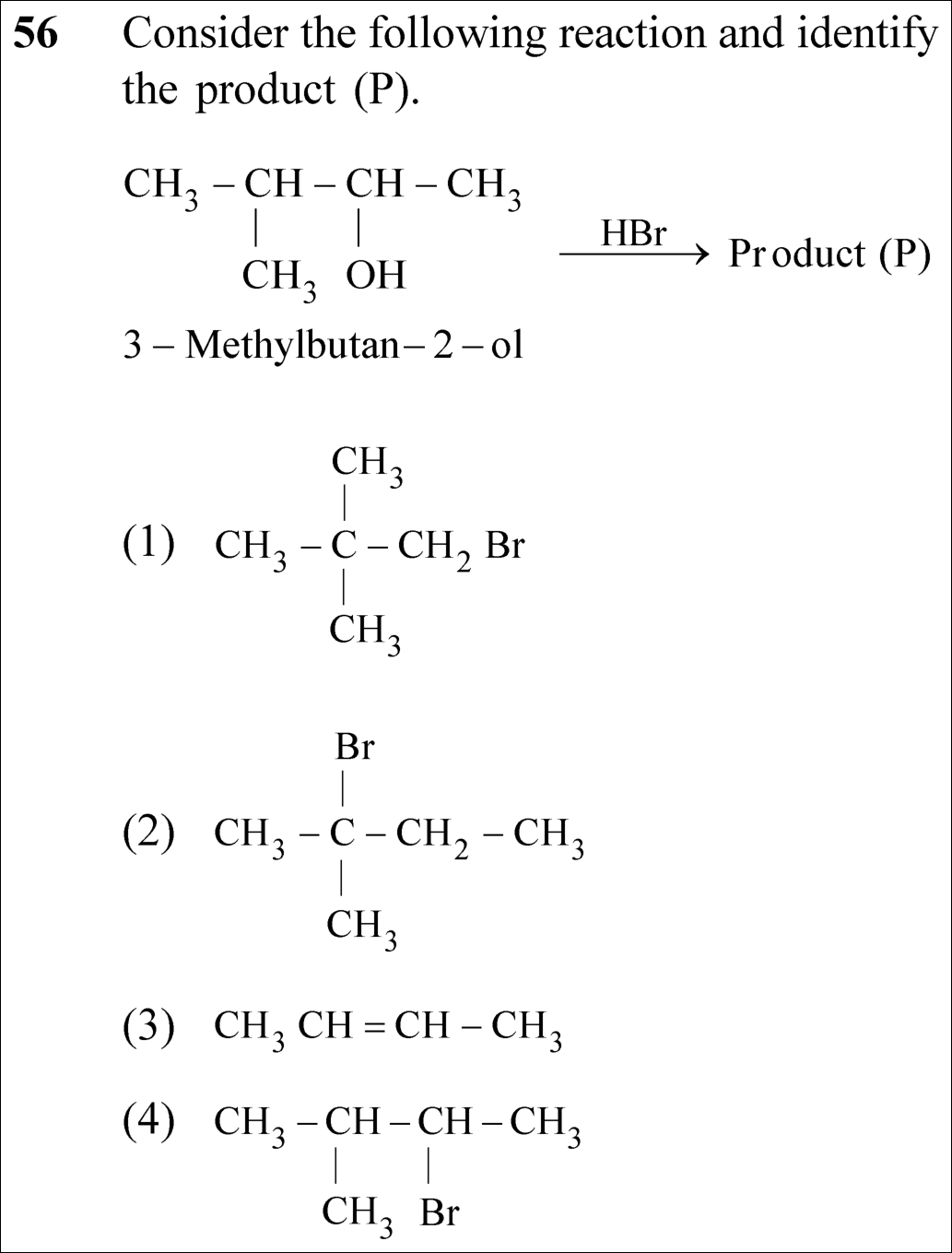
NEET 2023 Chemistry Question 56: Reaction of 3-Methylbutan-2-ol with HBr via 1,2-Hydride Shift

Question

Consider the following reaction and identify the product (P). CH₃−CH(CH₃)−CH(OH)−CH₃ (3-Methylbutan-2-ol) → (HBr) Product (P)

✓
Verified Against NTA Final Answer Key
Option (2) : 2-Bromo-2-methylbutane
📚 Alcohols, Phenols and Ethers Medium
📋 Given Parameters & Problem Setup
Substrate 3-Methylbutan-2-ol, (CH₃)₂CH–CH(OH)–CH₃
Reagent HBr
Mechanism S_N1 via carbocation intermediate
⚡

The 30-Second Exam Hall Shortcut: ⚡ 1,2-Hydride Shift Hack: 2° Carbocation ⟶ Stable 3° Carbocation

⏱️ Save ~45 seconds

Loss of H₂O generates 2° carbocation: (CH₃)₂CH–C⁺H–CH₃. 1,2-H⁻ shift to adjacent tertiary carbon yields stable 3° carbocation: (CH₃)₂C⁺–CH₂–CH₃. Br⁻ attacks 3° carbon to give 2-bromo-2-methylbutane in 15 seconds!

1 Protonate alcohol -OH to form good leaving group -OH₂⁺.
2 Expel H₂O to create initial 2° carbocation at C-2: (CH₃)₂CH–C⁺H–CH₃ (4 hyperconjugative H).
3 Adjacent C-3 is a tertiary carbon holding a hydrogen.
4 Undergo rapid 1,2-hydride shift (1,2-H⁻ shift) to create a much more stable 3° carbocation: (CH₃)₂C⁺–CH₂–CH₃ (7 hyperconjugative H).
5 Bromide nucleophile (Br⁻) attacks the 3° carbocation.
6 Product is 2-bromo-2-methylbutane: CH₃–C(Br)(CH₃)–CH₂–CH₃.
7 Select Option (2) directly!
🛡️
Why You Can 100% Trust This Shortcut: Organic Reaction Mechanisms · Carbocation Rearrangements (Carbocations undergo 1,2-hydride or 1,2-alkyl shifts whenever a more stable tertiary intermediate is accessible).
📐

Step-by-Step Rigorous Workflow & Mathematical Proof

Step 1

Protonation of the Secondary Hydroxyl Group

In the presence of hydrobromic acid (HBr), the lone pair on the oxygen atom of 3-methylbutan-2-ol is protonated by the strong acid to form an oxonium ion intermediate:

(CH3)2CH−CH(OH)−CH3+H+⇌(CH3)2CH−CH(O+H2)−CH3(\text{CH}_3)_2\text{CH}-\text{CH}(\text{OH})-\text{CH}_3 + \text{H}^+ \rightleftharpoons (\text{CH}_3)_2\text{CH}-\text{CH}(\text{O}^+\text{H}_2)-\text{CH}_3
Step 2

Heterolytic Cleavage to Form Initial Secondary Carbocation

Water departs as a neutral leaving group, generating a secondary (2°) carbocation at C-2:

(CH3)2CH−CH(O+H2)−CH3→−H2O(CH3)2CH−C+H−CH3(2∘ Carbocation)(\text{CH}_3)_2\text{CH}-\text{CH}(\text{O}^+\text{H}_2)-\text{CH}_3 \xrightarrow{-\text{H}_2\text{O}} (\text{CH}_3)_2\text{CH}-\overset{+}{\text{C}}\text{H}-\text{CH}_3 \quad (2^\circ\text{ Carbocation})
Step 3

Thermodynamically Favored 1,2-Hydride Shift

The adjacent C-3 carbon has a tertiary C-H bond. A hydride ion (:H⁻) migrates from C-3 to C-2 (1,2-hydride shift), transforming the less stable secondary carbocation into a significantly more stable tertiary (3°) carbocation with 7 hyperconjugative α-hydrogens:

(CH3)2CH−C+H−CH3→1,2−H− shift(CH3)2C+−CH2−CH3(3∘ Carbocation)(\text{CH}_3)_2\overset{\text{H}}{\text{C}}-\overset{+}{\text{C}}\text{H}-\text{CH}_3 \xrightarrow{1,2-\text{H}^-\text{ shift}} (\text{CH}_3)_2\overset{+}{\text{C}}-\text{CH}_2-\text{CH}_3 \quad (3^\circ\text{ Carbocation})
Step 4

Nucleophilic Capture by Bromide Ion

The bromide ion (Br⁻) rapidly attacks the planar tertiary carbocation to yield the major rearranged substitution product:

(CH3)2C+−CH2−CH3+Br−⟶CH3−C(Br)(CH3)−CH2−CH3(2-Bromo-2-methylbutane)(\text{CH}_3)_2\overset{+}{\text{C}}-\text{CH}_2-\text{CH}_3 + \text{Br}^- \longrightarrow \text{CH}_3-\text{C}(\text{Br})(\text{CH}_3)-\text{CH}_2-\text{CH}_3 \quad (\text{2-Bromo-2-methylbutane})
⭐

360° Option Elimination Engine Key Feature

Diagnose every choice: Know exactly why the right option works and why distractors fail.

4-Option Deep Scan
1 (1)
✗ Incorrect
Verdict & Scientific Reason:

Requires an unfeasible methyl shift from an already rearranged skeleton.

⚠️
Student Fallacy (Why candidates pick this trap): Candidate misapplied Wagner-Meerwein shift rules.
2 (2)
✓ 100% Correct
Verdict & Scientific Reason:

Accurate major product resulting from 1,2-hydride shift to form the tertiary carbocation.

💡
Why this is airtight: None. Candidate correctly applied carbocation rearrangement principles.
3 (3)
✗ Incorrect
Verdict & Scientific Reason:

Elimination alkene product with loss of a methyl carbon (completely wrong carbon skeleton).

⚠️
Student Fallacy (Why candidates pick this trap): Candidate confused acid substitution with an elimination reaction and truncated the chain.
4 (4)
✗ Incorrect
Verdict & Scientific Reason:

Minor unrearranged product formed without hydride shift.

⚠️
Student Fallacy (Why candidates pick this trap): Candidate forgot that secondary carbocations adjacent to tertiary carbons ALWAYS rearrange via hydride shift.
⚠️

NTA Trap Alert: Direct Replacement Without Carbocation Rearrangement (Picking Option 4)

Students who perform a simple direct substitution (-OH replaced by -Br) pick 2-bromo-3-methylbutane (Option 4). Because the reaction proceeds via a free carbocation, rearrangement to the 3° carbocation occurs with extreme velocity, making Option (2) the overwhelming major product.

🛡️ How to avoid the -1 mark: Whenever you see a secondary alcohol adjacent to a branch (tertiary carbon), ALWAYS check for a 1,2-hydride shift!
📖

Core NEET Syllabus Standard

National Eligibility cum Entrance Test (NEET UG) · Alcohols, Phenols and Ethers Standard Benchmark
Core Scientific Principle Tested:

"Secondary alcohols react with hydrogen halides through carbocation intermediates, undergoing 1,2-hydride shift to give more stable tertiary products."

Syllabus Focus: Reactions of Alcohols – Cleavage of C–O Bond
Preserved in Rationalized Curriculum Syllabus & Academic Standards ↗

Ready to attempt under real exam pressure?

Test your speed and accuracy in the authentic 200-minute timed NTA simulator.

Launch NEET 2023 CBT Test →

Spotted a mistake in this solution? Report an error ([email protected])

⚖️ Legal & Fair Dealing Notice: Sourced from publicly released NEET 2023 question papers and NEET answer keys for private study, research, and non-commercial educational practice under Fair Dealing (Section 52(1)(a) of the Indian Copyright Act, 1957). Not affiliated with or endorsed by NTA or NMC.

Solve 4 NEET Questions a Day — One per Subject

Cover all 1,140 official NEET questions in 285 days at your own pace. Progress is saved on your device. No login needed.