📋 Given Parameters & Problem Setup
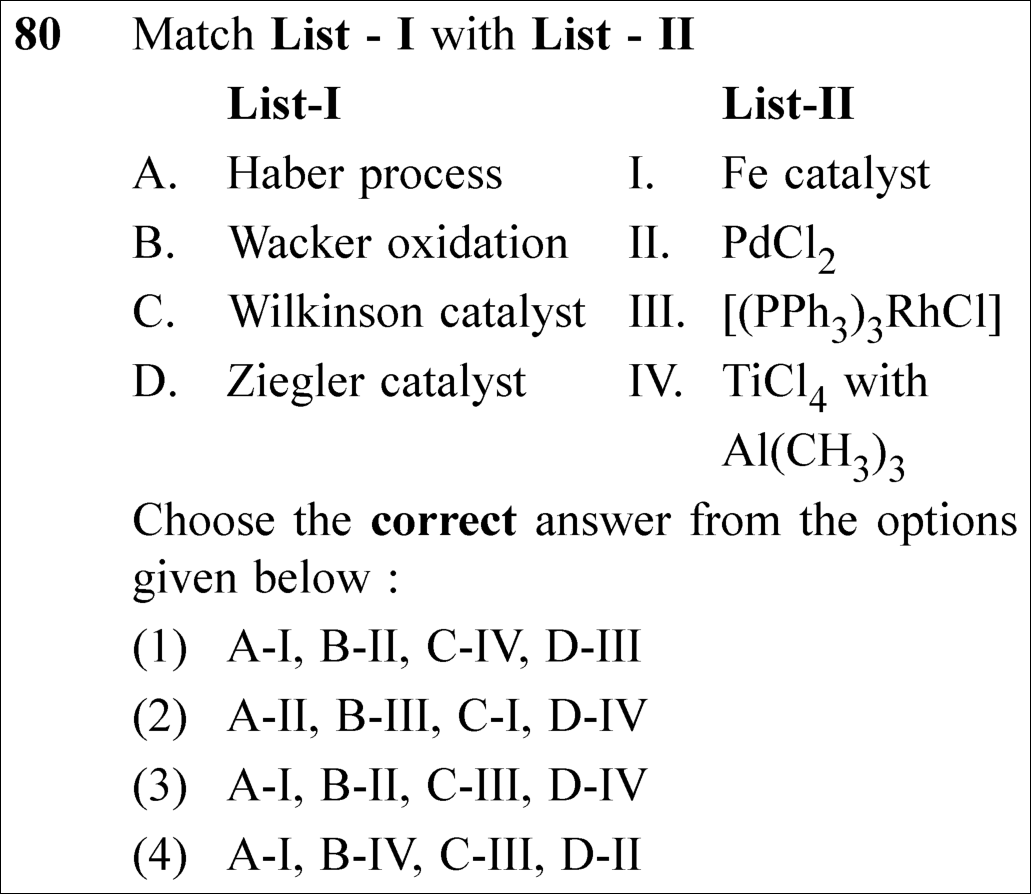
List I (Processes/Catalysts) A. Haber process, B. Wacker oxidation, C. Wilkinson catalyst, D. Ziegler catalyst
List II (Catalyst Formulations) I. Fe catalyst, II. PdCl₂, III. [(PPh₃)₃RhCl], IV. TiCl₄ with Al(CH₃)₃
Haber = Fe (A-I). Wacker oxidation = PdCl₂ (B-II). Wilkinson = Rh complex [(PPh₃)₃RhCl] (C-III). Ziegler-Natta = TiCl₄ + AlR₃ (D-IV)! Perfect sequential match: A-I, B-II, C-III, D-IV!
1 A. Haber process: Industrial synthesis of ammonia (N₂ + 3H₂ ⇌ 2NH₃) uses Iron (Fe) catalyst with K₂O/Al₂O₃ promoter ⟹ A matches I.
2 B. Wacker process: Oxidation of ethene to ethanal (acetaldehyde) uses Palladium chloride (PdCl₂) with CuCl₂ ⟹ B matches II.
3 C. Wilkinson’s catalyst: Homogeneous hydrogenation of alkenes uses chloridotris(triphenylphosphine)rhodium(I), [(PPh₃)₃RhCl] ⟹ C matches III.
4 D. Ziegler-Natta catalyst: Coordination polymerization of alkenes uses Titanium tetrachloride (TiCl₄) with trialkylaluminium (Al(CH₃)₃ or Al(C₂H₅)₃) ⟹ D matches IV.
5 Sequential match: A-I, B-II, C-III, D-IV.
6 Select Option (3) in under 10 seconds!
🛡️ Why You Can 100% Trust This Shortcut: Variable Oxidation States & Catalytic Mechanisms of Transition Elements (NCERT Chemistry · d- and f-Block Elements).
⚠️
Option 1 swaps Wilkinson (Rh) and Ziegler (Ti). Remembering that Wilkinson’s catalyst is the famous Rhodium complex [(PPh₃)₃RhCl] easily prevents this confusion.
🛡️ How to avoid the -1 mark: Remember: Wilkinson = Rhodium (Rh); Ziegler-Natta = Titanium (Ti) + Aluminium (Al)!
📖
NEET Chemistry Core Syllabus · The d- and f-Block Elements Standard Benchmark
Core Scientific Principle Tested:
"Haber = Fe, Wacker = PdCl₂, Wilkinson = [(PPh₃)₃RhCl], Ziegler = TiCl₄ + AlR₃."
Syllabus Focus: Catalytic Properties of Transition Metals and Coordination Complexes
Haber-Fe, Wacker-Pd, Wilkinson-Rh, Ziegler-Ti ⟹ 1, 2, 3, 4 straight down (Option 3)!