MyCompetitiveExams Logo MyCompetitiveExams
Search 1,140+ Questions
Chapters, formulas, speed tricks
→
⚡ Brahmastra NEET 2027
720 MARKS

Dynamic 180-question full-length simulator mixed dynamically from all 6 years for 2027 & 2026 aspirants.

Launch Brahmastra 2027 Test →
Start Practice →
100% Free · No Login Required
Q.75 Chemistry ⭐ 360° Option Elimination Active
Vault ↗

NEET 2026 Chemistry Question 75 Solution

Topic: Chemical Bonding and Molecular Structure & Coordination Compounds · Official NTA Booklet Code 50
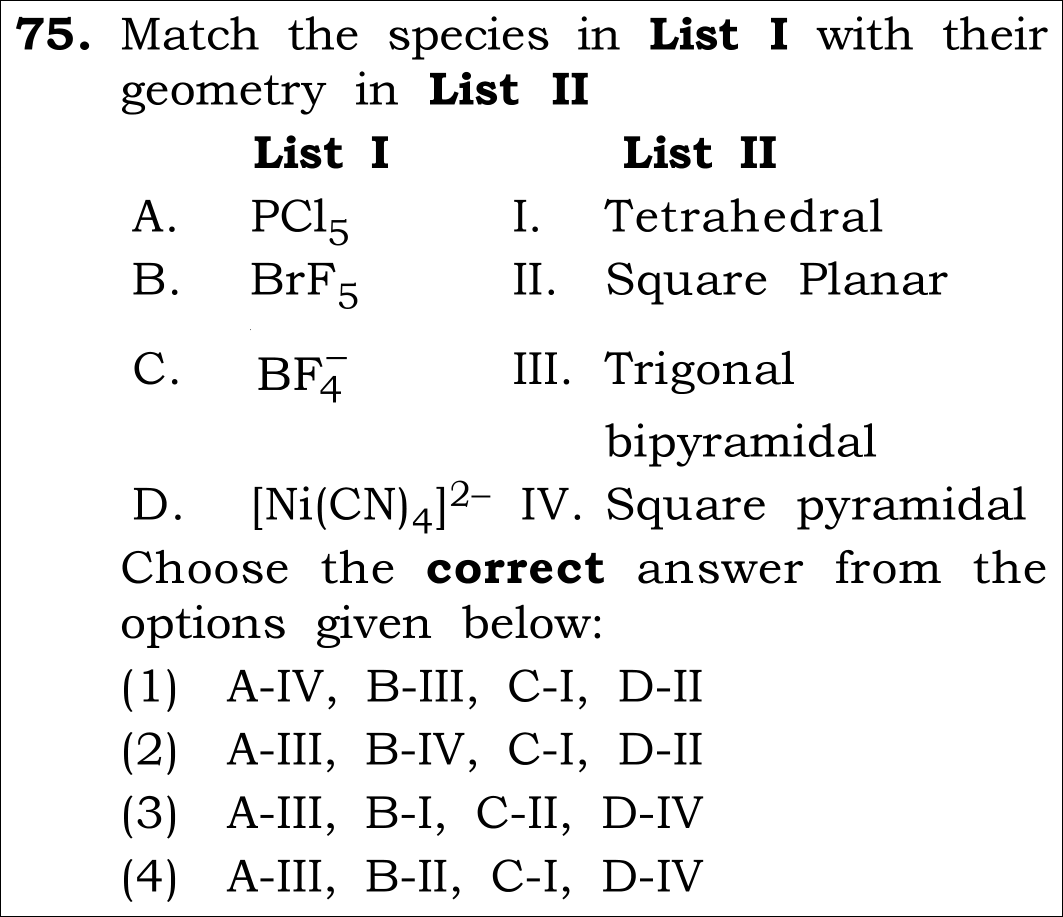
NEET 2026 Chemistry Question 75: VSEPR Molecular Geometry & Coordination Geometry Matching

Question

Match the species in List I with their geometry in List II. List I: A. PCl₅; B. BrF₅; C. BF₄⁻; D. [Ni(CN)₄]²⁻. List II: I. Tetrahedral; II. Square Planar; III. Trigonal bipyramidal; IV. Square pyramidal. Choose the correct answer from the options given below:

✓
Verified Against NTA Final Answer Key
Option (2) : A-III, B-IV, C-I, D-II
📚 Chemical Bonding and Molecular Structure & Coordination Compounds Easy
📋 Given Parameters & Problem Setup
Species A PCl₅
Species B BrF₅
Species C BF₄⁻
Species D [Ni(CN)₄]²⁻
Geometries I. Tetrahedral, II. Square Planar, III. Trigonal bipyramidal, IV. Square pyramidal
⚡

The 30-Second Exam Hall Shortcut: ⚡ Steric Number & Electron Pair Fingerprint

⏱️ Save ~50 seconds

Match PCl₅ (5 bp = TBP) and [Ni(CN)₄]²⁻ (d⁸ strong field = Square Planar) to finish in 10 seconds!

1 A. PCl₅: 5 bond pairs, 0 lone pairs -> Steric Number 5 -> Trigonal bipyramidal (III) -> A-III.
2 This immediately eliminates Option (1)!
3 D. [Ni(CN)₄]²⁻: Ni²⁺ (3d⁸) with strong field CN⁻ forces pairing -> dsp² hybridization -> Square Planar (II) -> D-II.
4 This eliminates Option (3) and Option (4)!
5 Confirm B and C: BrF₅ (5 bp + 1 lp = Square pyramidal, IV); BF₄⁻ (4 bp + 0 lp = Tetrahedral, I).
6 Option (2) is rock-solid: A-III, B-IV, C-I, D-II!
🛡️
Why You Can 100% Trust This Shortcut: Direct application of VSEPR theory for main group species and Crystal Field / Valence Bond Theory for coordination complexes.
📐

Step-by-Step Rigorous Workflow & Mathematical Proof

Step 1

Determine Geometry of PCl₅ (Species A)

Phosphorus has 5 valence electrons, all forming single σ bonds with five chlorine atoms. Steric number = 5 (5 bond pairs + 0 lone pairs). Hybridization = sp³d.

Steric Number=5+0=5  ⟹  Trigonal bipyramidal (III)\text{Steric Number} = 5 + 0 = 5 \implies \text{Trigonal bipyramidal (III)}
  • • Match: A -> III.
Step 2

Determine Geometry of BrF₅ (Species B)

Bromine has 7 valence electrons: 5 form single bonds with fluorine, leaving 1 lone pair. Steric number = 5 bond pairs + 1 lone pair = 6. Hybridization = sp³d² with octahedral electron geometry and square pyramidal molecular shape.

Steric Number=5+1=6  ⟹  Square pyramidal (IV)\text{Steric Number} = 5 + 1 = 6 \implies \text{Square pyramidal (IV)}
  • • Match: B -> IV.
Step 3

Determine Geometry of BF₄⁻ (Species C)

Boron has 3 valence electrons + 1 negative charge = 4 electrons, forming four σ bonds with four fluorine atoms. Steric number = 4 bond pairs + 0 lone pairs = 4. Hybridization = sp³.

Steric Number=4+0=4  ⟹  Tetrahedral (I)\text{Steric Number} = 4 + 0 = 4 \implies \text{Tetrahedral (I)}
  • • Match: C -> I.
Step 4

Determine Geometry of [Ni(CN)₄]²⁻ (Species D)

Nickel is in the +2 oxidation state (3d⁸). Cyanide (CN⁻) is a strong field ligand that forces the 3d electrons to pair up, leaving one vacant 3d orbital. Hybridization is dsp² with a square planar geometry.

Ni2+(3d8)+4CN−→pairingdsp2  ⟹  Square Planar (II)\text{Ni}^{2+} (3d^8) + 4\text{CN}^- \xrightarrow{\text{pairing}} dsp^2 \implies \text{Square Planar (II)}
  • • Match: D -> II.
  • • Full Match: A-III, B-IV, C-I, D-II (Option 2).
⭐

360° Option Elimination Engine Key Feature

Diagnose every choice: Know exactly why the right option works and why distractors fail.

4-Option Deep Scan
1 A
✗ Incorrect
Verdict & Scientific Reason:

Incorrect. Swaps geometries of PCl₅ and BrF₅.

⚠️
Student Fallacy (Why candidates pick this trap): Confusing 5 bond pairs with 5 bond pairs + 1 lone pair.
2 B
✓ 100% Correct
Verdict & Scientific Reason:

Exact match: PCl₅ is TBP (III), BrF₅ is square pyramidal (IV), BF₄⁻ is tetrahedral (I), and [Ni(CN)₄]²⁻ is square planar (II).

💡
Why this is airtight: None; flawless VSEPR and CFT alignment.
3 C
✗ Incorrect
Verdict & Scientific Reason:

Incorrect. Assigns tetrahedral to BrF₅ and square pyramidal to [Ni(CN)₄]²⁻.

⚠️
Student Fallacy (Why candidates pick this trap): Miscounting electron pairs.
4 D
✗ Incorrect
Verdict & Scientific Reason:

Incorrect. Assigns square planar to BrF₅.

⚠️
Student Fallacy (Why candidates pick this trap): Confusing square planar (AX₄E₂) with square pyramidal (AX₅E).
⚠️

NTA Trap Alert: Confusing BrF₅ (Square Pyramidal) with PCl₅ (TBP)

Both PCl₅ and BrF₅ have five peripheral halogen atoms, but PCl₅ has NO lone pairs (Trigonal bipyramidal), while BrF₅ has ONE lone pair on bromine (Square pyramidal).

🛡️ How to avoid the -1 mark: Count total valence electrons: PCl₅ has 5 pairs (TBP); BrF₅ has 6 pairs (Square pyramidal).
📖

Core NEET Syllabus Standard

NEET Chemistry Core Syllabus · Chemical Bonding and Coordination Compounds Standard Benchmark
Core Scientific Principle Tested:

"Shape is dictated by steric number and lone pairs: 5+0 = TBP, 5+1 = square pyramidal, 4+0 = tetrahedral, dsp² = square planar."

Syllabus Focus: VSEPR Theory shapes and dsp² square planar coordination geometries
✓ Core NEET UG Syllabus Anchor Syllabus & Academic Standards ↗
PCl₅ = TBP; BrF₅ = Square Pyramid; BF₄⁻ = Tetrahedral; [Ni(CN)₄]²⁻ = Square Planar!

Ready to attempt under real exam pressure?

Test your speed and accuracy in the authentic 180-minute timed NTA simulator.

Launch NEET 2026 CBT Test →

Spotted a mistake in this solution? Report an error ([email protected])

⚖️ Legal & Fair Dealing Notice: Sourced from publicly released NEET 2026 question papers and NEET answer keys for private study, research, and non-commercial educational practice under Fair Dealing (Section 52(1)(a) of the Indian Copyright Act, 1957). Not affiliated with or endorsed by NTA or NMC.

Solve 4 NEET Questions a Day — One per Subject

Cover all 1,140 official NEET questions in 285 days at your own pace. Progress is saved on your device. No login needed.