📋 Given Parameters & Problem Setup
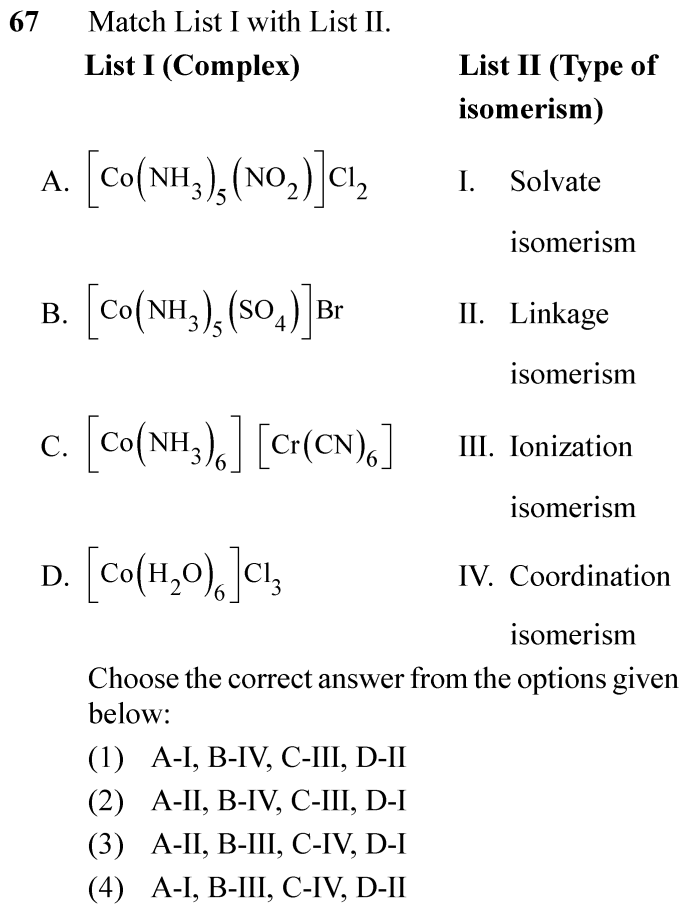
Complex A [Co(NH3)5(NO2)]Cl2
Complex B [Co(NH3)5(SO4)]Br
Complex C [Co(NH3)6][Cr(CN)6]
Complex D [Co(H2O)6]Cl3
NO2⁻ is ambidentate -> Linkage (II); SO4²⁻/Br⁻ exchange outside sphere -> Ionization (III); Two complex ions swapping ligands -> Coordination (IV); H2O ligand/hydrate -> Solvate (I)!
1 Complex A contains NO2⁻ (nitro / nitrito), an ambidentate ligand that can coordinate through N or O -> Linkage isomerism (A-II).
2 Complex B has SO4²⁻ inside and Br⁻ outside, which can interchange to form [Co(NH3)5Br]SO4 -> Ionization isomerism (B-III).
3 Complex C contains both cationic [Co(NH3)6]³⁺ and anionic [Cr(CN)6]³⁻ coordination spheres capable of interchanging ligands -> Coordination isomerism (C-IV).
4 Complex D contains coordinated water molecules that can interchange with counterions (hydrate/solvate) -> Solvate isomerism (D-I).
5 Match: A-II, B-III, C-IV, D-I -> Option (3) in 5 seconds!
🛡️ Why You Can 100% Trust This Shortcut: NCERT Chemistry · Coordination Compounds (Structural isomerism: linkage, coordination, ionization, and solvate isomerism).
⚠️
Ionization involves exchange between inner sphere ligand and outer sphere simple counterion. Coordination isomerism requires TWO complex coordination spheres exchanging ligands.
🛡️ How to avoid the -1 mark: Two brackets [ ][ ] = Coordination isomerism; One bracket with outer ion [ ]X = Ionization isomerism.
📖
Chemistry Core Inorganic Chemistry · Coordination Compounds Standard Benchmark
Core Scientific Principle Tested:
"Ambidentate ligand -> Linkage; Counterion exchange -> Ionization; Dual complex ion interchange -> Coordination; Water participation -> Solvate."
Syllabus Focus: Isomerism in Coordination Compounds: Structural Types
Ambidentate links, ions trade free, two cages coordinate, water solvates thee!