MyCompetitiveExams Logo MyCompetitiveExams
Search 1,140+ Questions
Chapters, formulas, speed tricks
→
⚡ Brahmastra NEET 2027
720 MARKS

Dynamic 180-question full-length simulator mixed dynamically from all 6 years for 2027 & 2026 aspirants.

Launch Brahmastra 2027 Test →
Start Practice →
100% Free · No Login Required
Q.140 Botany ⭐ 360° Option Elimination Active
Vault ↗

NEET 2021 Botany Question 140 Solution

Topic: Biological Classification · Official NTA Booklet Code M1
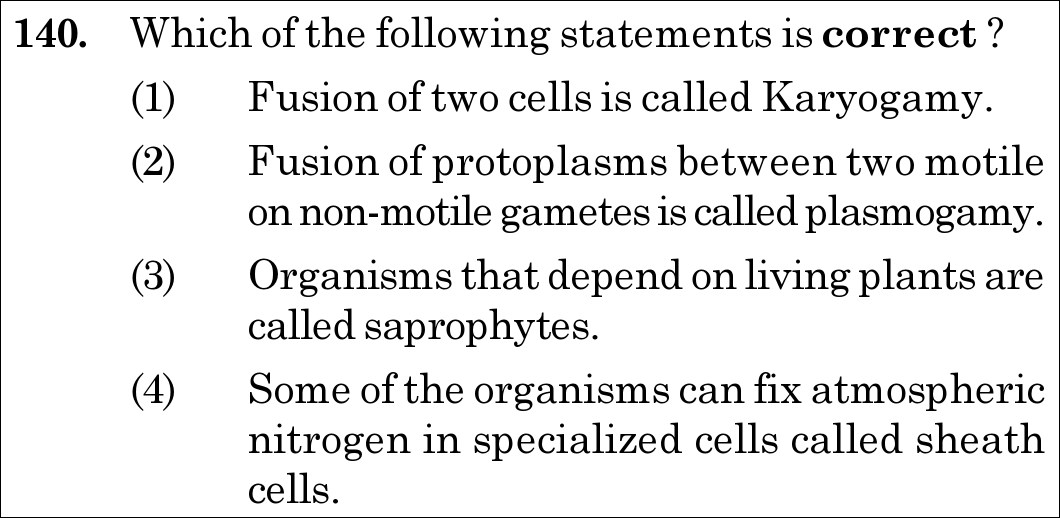
NEET 2021 Botany Question 140: Stages of Sexual Reproduction in Fungi: Plasmogamy vs Karyogamy

Question

Which of the following statements is correct?

  1. (1)Fusion of two cells is called Karyogamy.
  2. (2)Fusion of protoplasms between two motile on non-motile gametes is called plasmogamy.
  3. (3)Organisms that depend on living plants are called saprophytes.
  4. (4)Some of the organisms can fix atmospheric nitrogen in specialized cells called sheath cells.
✓
Verified Against NTA Final Answer Key
Option (2) : Fusion of protoplasms between two motile on non-motile gametes is called plasmogamy.
📚 Biological Classification Easy
📋 Given Parameters & Problem Setup
Phenomenon Sexual reproduction in fungi & microbial definitions
Target Identify the statement that is CORRECT
⚡

The 30-Second Exam Hall Shortcut: ⚡ Plasmogamy = Protoplasm Fusion | Karyogamy = Nuclear Fusion

⏱️ Save ~20 seconds

The sexual cycle in fungi proceeds through three sequential stages: 1. Plasmogamy (fusion of protoplasms between two motile or non-motile gametes), 2. Karyogamy (fusion of two haploid nuclei), and 3. Meiosis in zygote! Statement (2) is verbatim NCERT text. Match Option (2)!

1 Check Statement (1): Fusion of two cells/nuclei is not karyogamy; karyogamy specifically means fusion of two nuclei   ⟹  \implies INCORRECT.
2 Check Statement (2): Fusion of protoplasms between two motile or non-motile gametes is called plasmogamy   ⟹  \implies CORRECT verbatim NCERT.
3 Check Statement (3): Organisms that depend on living plants are parasites, NOT saprophytes (saprophytes absorb nutrients from dead substrates)   ⟹  \implies INCORRECT.
4 Check Statement (4): Organisms fix nitrogen in specialized cells called heterocysts, NOT sheath cells   ⟹  \implies INCORRECT.
5 Match Option (2).
🛡️
Why You Can 100% Trust This Shortcut: Canonical NCERT Biological Classification on Kingdom Fungi Sexual Cycle.
📐

Step-by-Step Rigorous Workflow & Mathematical Proof

Step 1

The Tripartite Sexual Cycle in Fungi

In Kingdom Fungi, sexual reproduction involves three fundamental sequential events:

1. Plasmogamy:Fusion of protoplasms between two motile or non-motile gametes2. Karyogamy:Fusion of the two compatible haploid nuclei (n+n→2n)3. Meiosis:Reduction division in zygote resulting in haploid spores\begin{aligned} \mathbf{1.\text{ Plasmogamy:}} & \quad \mathbf{\text{Fusion of protoplasms between two motile or non-motile gametes}} \\[4pt] \text{\textbf{2. Karyogamy:}} & \quad \text{Fusion of the two compatible haploid nuclei } (n + n \to 2n) \\[4pt] \text{\textbf{3. Meiosis:}} & \quad \text{Reduction division in zygote resulting in haploid spores} \end{aligned}
Step 2

Evaluation and Refutation of Distractors

- Statement (1): Karyogamy refers strictly to the fusion of two nuclei (karyonkaryon = nucleus), not the fusion of entire vegetative cells. - Statement (3): Organisms that depend directly on living host plants are parasites; saprophytes feed strictly on dead, decaying organic matter. - Statement (4): Atmospheric nitrogen-fixing cyanobacteria (e.g., *Nostoc*, *Anabaena*) fix nitrogen in specialized thick-walled cells called heterocysts, not sheath cells (the gelatinous mucilaginous sheath simply protects the colony).

⭐

360° Option Elimination Engine Key Feature

Diagnose every choice: Know exactly why the right option works and why distractors fail.

4-Option Deep Scan
1 1
✗ Incorrect
Verdict & Scientific Reason:

Incorrect. Karyogamy is the fusion of two nuclei, whereas cell/protoplast fusion is plasmogamy.

⚠️
Student Fallacy (Why candidates pick this trap): Confusing nuclear fusion (karyogamy) with protoplast fusion.
2 2
✓ 100% Correct
Verdict & Scientific Reason:

This statement is completely TRUE and represents the verbatim canonical NCERT definition of plasmogamy.

💡
Why this is airtight: None. Verbatim textbook definition.
3 3
✗ Incorrect
Verdict & Scientific Reason:

Incorrect. Organisms depending on living hosts are parasites; saprophytes absorb soluble organic matter from dead substrates.

⚠️
Student Fallacy (Why candidates pick this trap): Confusing parasites with saprophytes.
4 4
✗ Incorrect
Verdict & Scientific Reason:

Incorrect. Nitrogen fixation takes place inside specialized cells called heterocysts.

⚠️
Student Fallacy (Why candidates pick this trap): Confusing protective mucilaginous sheath with nitrogen-fixing heterocysts.
⚠️

NTA Trap Alert: Plasmogamy vs Karyogamy Root Confusion

"Plasma" = cytoplasm/protoplasm; "Karyon" = nucleus. Misreading these prefixes leads to selecting Statement (1).

🛡️ How to avoid the -1 mark: Remember: Plasmogamy = Protoplasm fusion; Karyogamy = Karyon (nuclear) fusion.
📖

Core NEET Syllabus Standard

NEET / NCERT Biology · Biological Classification Standard Benchmark
Core Scientific Principle Tested:

"The sexual cycle involves three steps: (i) Fusion of protoplasms between two motile or non-motile gametes called plasmogamy, (ii) Fusion of two nuclei called karyogamy, and (iii) Meiosis in zygote resulting in haploid spores."

Syllabus Focus: Kingdom Fungi: Reproduction
✓ Core NEET UG Syllabus Anchor Syllabus & Academic Standards ↗

Ready to attempt under real exam pressure?

Test your speed and accuracy in the authentic 200-minute timed NTA simulator.

Launch NEET 2021 CBT Test →

Spotted a mistake in this solution? Report an error ([email protected])

⚖️ Legal & Fair Dealing Notice: Sourced from publicly released NEET 2021 question papers and NEET answer keys for private study, research, and non-commercial educational practice under Fair Dealing (Section 52(1)(a) of the Indian Copyright Act, 1957). Not affiliated with or endorsed by NTA or NMC.

Solve 4 NEET Questions a Day — One per Subject

Cover all 1,140 official NEET questions in 285 days at your own pace. Progress is saved on your device. No login needed.