MyCompetitiveExams Logo MyCompetitiveExams
Search 1,140+ Questions
Chapters, formulas, speed tricks
→
⚡ Brahmastra NEET 2027
720 MARKS

Dynamic 180-question full-length simulator mixed dynamically from all 6 years for 2027 & 2026 aspirants.

Launch Brahmastra 2027 Test →
Start Practice →
100% Free · No Login Required
Q.176 Zoology ⭐ 360° Option Elimination Active
Vault ↗

NEET 2021 Zoology Question 176 Solution

Topic: Animal Kingdom · Official NTA Booklet Code M1
NEET 2021 Zoology Question 176: Comparative Analysis of Invertebrate Phyla (Cnidaria, Ctenophora, Aschelminthes, Echinodermata)

Question

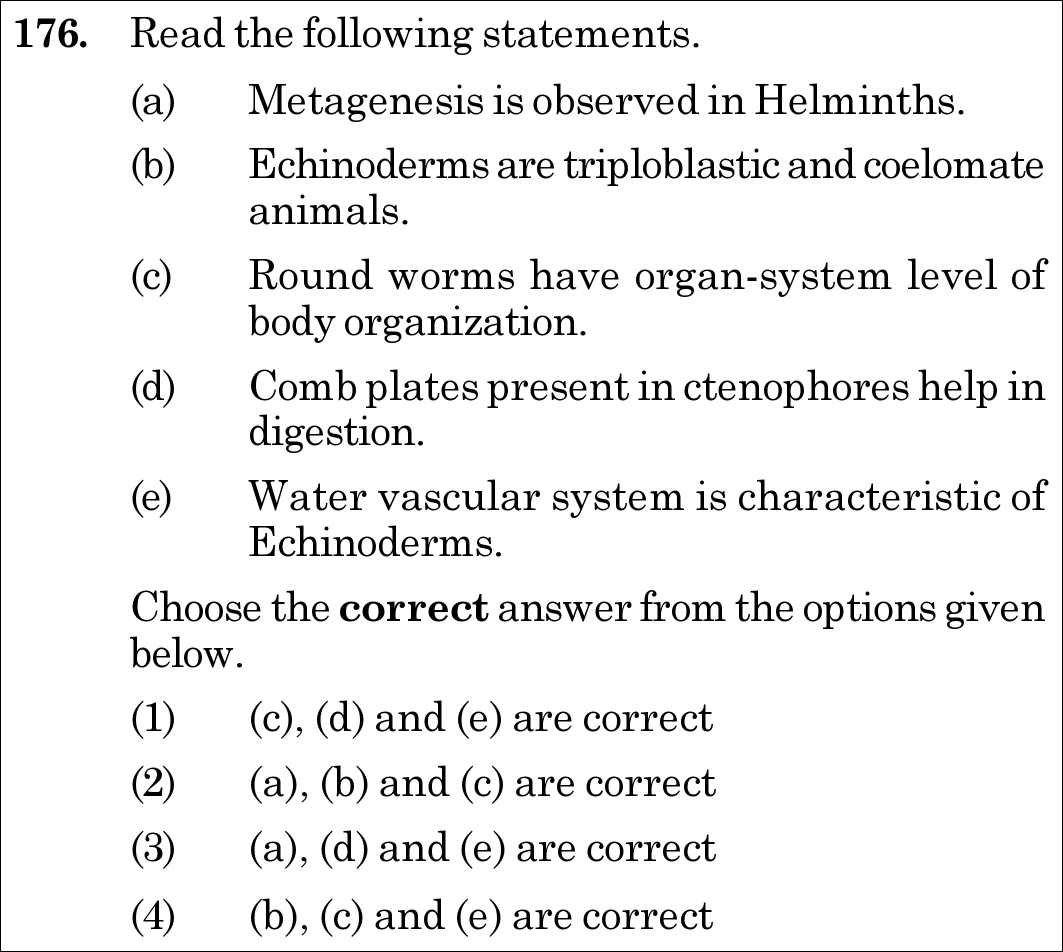
Read the following statements. (a) Metagenesis is observed in Helminths. (b) Echinoderms are triploblastic and coelomate animals. (c) Round worms have organ-system level of body organization. (d) Comb plates present in ctenophores help in digestion. (e) Water vascular system is characteristic of Echinoderms. Choose the correct answer from the options given below.

  1. (1)(c), (d) and (e) are correct
  2. (2)(a), (b) and (c) are correct
  3. (3)(a), (d) and (e) are correct
  4. (4)(b), (c) and (e) are correct
✓
Verified Against NTA Final Answer Key
Option (4) : (b), (c) and (e) are correct
📚 Animal Kingdom Medium
📋 Given Parameters & Problem Setup
Statement (a) Metagenesis is observed in Helminths
Statement (b) Echinoderms are triploblastic and coelomate animals
Statement (c) Round worms have organ-system level of body organization
Statement (d) Comb plates present in ctenophores help in digestion
Statement (e) Water vascular system is characteristic of Echinoderms
⚡

The 30-Second Exam Hall Shortcut: ⚡ "Eliminate False (a) & (d): Metagenesis is Cnidaria, Comb Plates are for Swimming!"

⏱️ Save ~35 seconds

Metagenesis (polyp-medusa alternation) occurs in Cnidarians (e.g. Obelia), NOT Helminths (eliminates (a)). Comb plates of ctenophores function strictly in locomotion, NOT digestion (eliminates (d)). Discard any option containing (a) or (d) -> Options 1, 2, 3 vanish immediately!

1 Check statement (a): Metagenesis is alternation of generations in Cnidaria (Coelenterates like Obelia), false for Helminths. Eliminate Options (2) and (3).
2 Check statement (d): Ctenophore ciliated comb plates (8 rows) drive locomotion, not digestion. Eliminate Option (1).
3 Confirm surviving statements: (b) Echinoderms are triploblastic coelomates (True), (c) Aschelminthes have organ-system organization (True), (e) Water vascular system is diagnostic of Echinoderms (True).
4 Option (4) is the sole surviving, 100% correct choice.
🛡️
Why You Can 100% Trust This Shortcut: NCERT Biology · Animal Kingdom (Salient features of Cnidaria, Ctenophora, Aschelminthes, and Echinodermata: Metagenesis is in Cnidaria; comb plates are for locomotion; echinoderms have water vascular system).
📐

Step-by-Step Rigorous Workflow & Mathematical Proof

Step 1

Rigorous Verification of Diagnostic Statements

- (a) Metagenesis in Helminths (FALSE): Metagenesis is the alternation of asexual polyp generation with sexual medusa generation, characteristic of Cnidarians (*Obelia*). Helminths exhibit complex parasitic life cycles with multiple larval stages, but never metagenesis. - (b) Echinoderm Germ Layers and Coelom (TRUE): Adult echinoderms possess triploblastic germ layer organization (ectoderm, mesoderm, endoderm) and a true enterocoelic coelom lined by mesoderm. - (c) Body Organization of Roundworms (TRUE): Aschelminthes (roundworms) represent the first phylum in evolutionary phylogeny to attain the organ-system level of body organization along with a pseudocoelom and a complete alimentary canal with muscular pharynx. - (d) Function of Ctenophore Comb Plates (FALSE): Ctenophores (comb jellies or sea walnuts) possess eight external rows of ciliated comb plates which function exclusively in locomotion, not digestion. Digestion in ctenophores is both extracellular and intracellular. - (e) Water Vascular System in Echinodermata (TRUE): The water vascular (ambulacral) system is the unique diagnostic anatomical hallmark of phylum Echinodermata, driving locomotion, capture/transport of food, and respiration via tube feet (podia).

Statements Assessment  ⟹  {(a) Metagenesis→False (Cnidaria)(b) Triploblastic, Coelomate→True (Echinodermata)(c) Organ-system level→True (Aschelminthes)(d) Comb plates→False (Locomotion)(e) Water vascular system→True (Echinodermata)\text{Statements Assessment} \implies \begin{cases} \text{(a) Metagenesis} & \to \textbf{False } (\text{Cnidaria}) \\ \text{(b) Triploblastic, Coelomate} & \to \textbf{True } (\text{Echinodermata}) \\ \text{(c) Organ-system level} & \to \textbf{True } (\text{Aschelminthes}) \\ \text{(d) Comb plates} & \to \textbf{False } (\text{Locomotion}) \\ \text{(e) Water vascular system} & \to \textbf{True } (\text{Echinodermata}) \end{cases}
Step 2

Option Elimination and Synthesis

Only statements (b), (c), and (e) are correct. Combining them leads unequivocally to Option (4).

⭐

360° Option Elimination Engine Key Feature

Diagnose every choice: Know exactly why the right option works and why distractors fail.

4-Option Deep Scan
1 1
✗ Incorrect
Verdict & Scientific Reason:

Incorrect because statement (d) is false; comb plates serve locomotion, not digestion.

⚠️
Student Fallacy (Why candidates pick this trap): Believing that ciliary beating sweeps food into the mouth, misattributing a digestive role to comb plates.
2 2
✗ Incorrect
Verdict & Scientific Reason:

Incorrect because statement (a) is false; metagenesis is a coelenterate trait, not helminthic.

⚠️
Student Fallacy (Why candidates pick this trap): Confusing metagenesis with the alternation of hosts in digenetic trematodes (flukes).
3 3
✗ Incorrect
Verdict & Scientific Reason:

Incorrect because both (a) and (d) are false.

⚠️
Student Fallacy (Why candidates pick this trap): Multiple misconceptions regarding cnidarian and ctenophoran diagnostic features.
4 4
✓ 100% Correct
Verdict & Scientific Reason:

Correct. Accurately selects all three true statements ((b), (c), and (e)) while excluding false statements (a) and (d).

💡
Why this is airtight: None. Candidate exhibits flawless command of invertebrate zoology.
⚠️

NTA Trap Alert: Water Vascular vs Water Canal System Confusion Trap

Students frequently confuse the "water vascular system" of Echinoderms with the "water canal system" (spongeocoel-osculum) of Porifera. Furthermore, they confuse metagenesis (Cnidaria) with metamorphosis (insects/amphibians).

🛡️ How to avoid the -1 mark: Remember: Water CANAL = Porifera (sponges); Water VASCULAR = Echinodermata (starfish). Comb plates = Locomotive rows.
📖

Core NEET Syllabus Standard

NEET / NCERT Biology · Animal Kingdom Standard Benchmark
Core Scientific Principle Tested:

"Metagenesis is seen in Cnidaria; comb plates drive locomotion in Ctenophora; Echinoderms possess a water vascular system."

Syllabus Focus: Non-Chordata Diagnostic Phyla
✓ Core NEET UG Syllabus Anchor Syllabus & Academic Standards ↗

Ready to attempt under real exam pressure?

Test your speed and accuracy in the authentic 200-minute timed NTA simulator.

Launch NEET 2021 CBT Test →

Spotted a mistake in this solution? Report an error ([email protected])

⚖️ Legal & Fair Dealing Notice: Sourced from publicly released NEET 2021 question papers and NEET answer keys for private study, research, and non-commercial educational practice under Fair Dealing (Section 52(1)(a) of the Indian Copyright Act, 1957). Not affiliated with or endorsed by NTA or NMC.

Solve 4 NEET Questions a Day — One per Subject

Cover all 1,140 official NEET questions in 285 days at your own pace. Progress is saved on your device. No login needed.