MyCompetitiveExams Logo MyCompetitiveExams
Search 1,140+ Questions
Chapters, formulas, speed tricks
→
⚡ Brahmastra NEET 2027
720 MARKS

Dynamic 180-question full-length simulator mixed dynamically from all 6 years for 2027 & 2026 aspirants.

Launch Brahmastra 2027 Test →
Start Practice →
100% Free · No Login Required
Q.107 Botany ⭐ 360° Option Elimination Active
Vault ↗

NEET 2026 Botany Question 107 Solution

Topic: Animal Kingdom · Official NTA Booklet Code 50
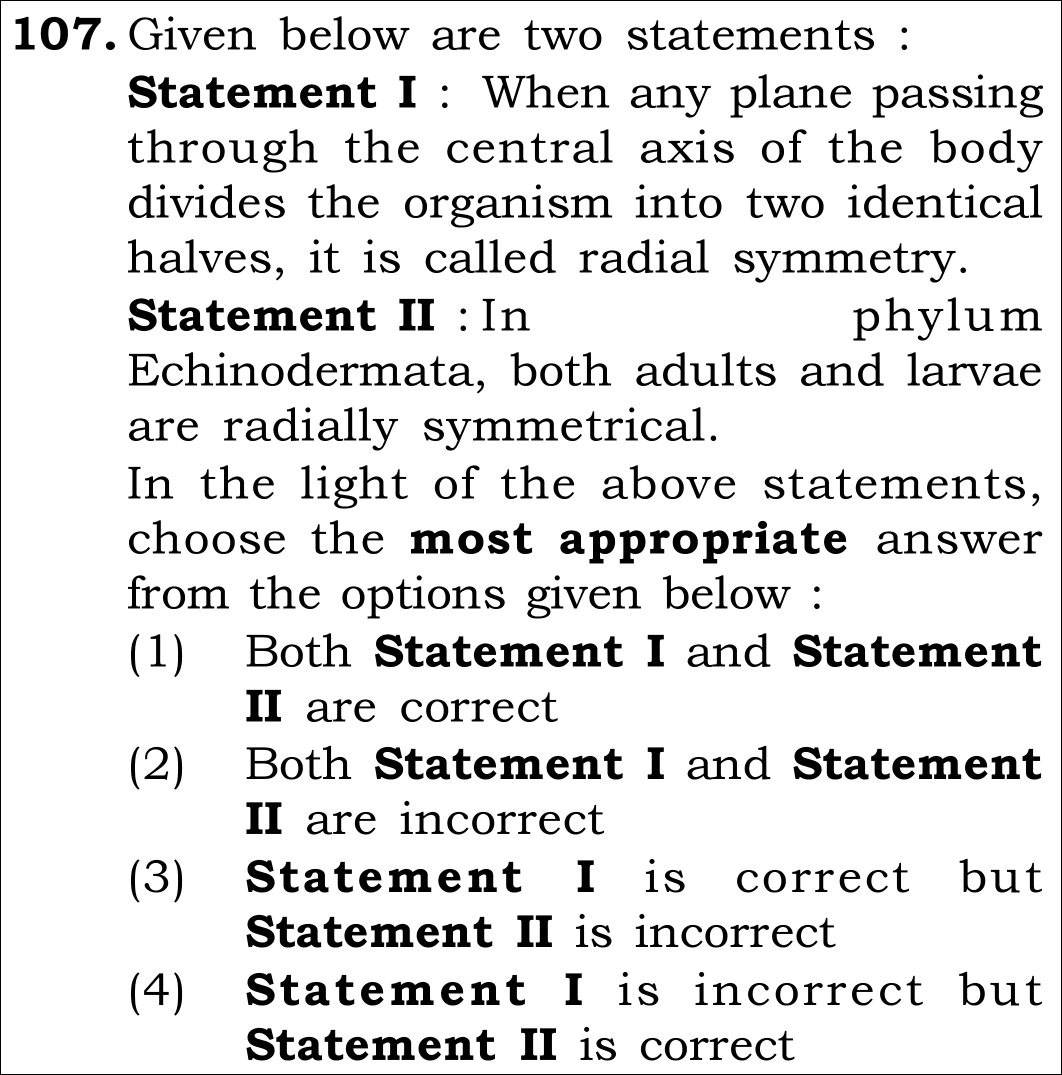
NEET 2026 Botany Question 107: Basis of Classification - Body Symmetry in Echinodermata

Question

Given below are two statements: Statement I: When any plane passing through the central axis of the body divides the organism into two identical halves, it is called radial symmetry. Statement II:In phylum Echinodermata, both adults and larvae are radially symmetrical. In the light of the above statements, choose the most appropriate answer from the options given below:

  1. (1)Both Statement I and Statement II are correct
  2. (2)Both Statement I and Statement II are incorrect
  3. (3)Statement I is correct but Statement II is incorrect
  4. (4)Statement I is incorrect but Statement II is correct
✓
Verified Against NTA Final Answer Key
Option (3) : Statement I is correct but Statement II is incorrect
📚 Animal Kingdom Medium
📋 Given Parameters & Problem Setup
Statement I When any plane passing through the central axis of the body divides the organism into two identical halves, it is called radial symmetry.
Statement II In phylum Echinodermata, both adults and larvae are radially symmetrical.
⚡

The 30-Second Exam Hall Shortcut: ⚡ Echinoderm Symmetry Paradox

⏱️ Save ~40 seconds

Adult Echinoderms = Radial; Echinoderm Larvae = Bilateral!

1 Read Statement I: Verbatim canonical definition of radial symmetry -> Statement I is TRUE.
2 Read Statement II: Claims BOTH adult and larval echinoderms are radially symmetrical.
3 Recall the classic NEET trap: Adult echinoderms have pentamerous radial symmetry, but larvae are BILATERALLY symmetrical.
4 Therefore, Statement II is FALSE.
5 Pick Option (3) immediately!
🛡️
Why You Can 100% Trust This Shortcut: NCERT Animal Kingdom Phylum Echinodermata: Adult echinoderms are radially symmetrical but larvae are bilaterally symmetrical.
📐

Step-by-Step Rigorous Workflow & Mathematical Proof

Step 1

Evaluate Statement I (Definition of Radial Symmetry)

In animal morphology, when any longitudinal plane passing through the central body axis divides an organism into two identical mirrored halves, the body plan exhibits radial symmetry. Examples include coelenterates, ctenophores, and adult echinoderms.

Central axis plane→Two identical halves  ⟹  Radial Symmetry (TRUE)\text{Central axis plane} \rightarrow \text{Two identical halves} \implies \text{Radial Symmetry (TRUE)}
  • • Statement I is verbatim text from NCERT Animal Kingdom (Section 4.1.2 Symmetry).
Step 2

Evaluate Statement II (Symmetry in Phylum Echinodermata)

Echinoderms display a unique developmental transition in symmetry: they develop from free-swimming ciliated larvae that are bilaterally symmetrical (reflecting their deuterostome ancestry with chordates), which then metamorphose into adults exhibiting pentamerous radial symmetry.

{Adult Echinoderm:Radial symmetryLarval Echinoderm:Bilateral symmetry (not radial!)\begin{cases} \text{Adult Echinoderm} &: \text{Radial symmetry} \\ \text{Larval Echinoderm} &: \mathbf{Bilateral\text{ symmetry (not radial!)}} \end{cases}
  • • Because larvae are bilateral, stating that "both adults and larvae are radially symmetrical" is definitively false.
Step 3

Determine the Correct Option

Since Statement I is correct and Statement II is incorrect, Option (3) is the solely valid choice.

Statement I is correct but Statement II is incorrect  ⟹  Option (3)\text{Statement I is correct but Statement II is incorrect} \implies \text{Option (3)}
  • • Matches official NTA final answer key Option C / (3).
⭐

360° Option Elimination Engine Key Feature

Diagnose every choice: Know exactly why the right option works and why distractors fail.

4-Option Deep Scan
1 A
✗ Incorrect
Verdict & Scientific Reason:

Incorrect. Fails because echinoderm larvae possess bilateral, not radial, symmetry.

⚠️
Student Fallacy (Why candidates pick this trap): Overlooking the distinct larval stage symmetry in echinoderms.
2 B
✗ Incorrect
Verdict & Scientific Reason:

Incorrect. Statement I is an unquestioned NCERT textbook definition.

⚠️
Student Fallacy (Why candidates pick this trap): Doubting basic definition of radial symmetry.
3 C
✓ 100% Correct
Verdict & Scientific Reason:

Accurate. Radial symmetry definition is correct, while Statement II erroneously assumes larvae are radial.

💡
Why this is airtight: None; mastered the developmental biology exception.
4 D
✗ Incorrect
Verdict & Scientific Reason:

Completely contrary to canonical facts.

⚠️
Student Fallacy (Why candidates pick this trap): Confusing both statements.
⚠️

NTA Trap Alert: The Echinoderm Larva Trap

Echinoderms are the only non-chordate phylum tested where the larval stage possesses bilateral symmetry while the adult exhibits secondary radial symmetry. NEET tests this specific contrast repeatedly.

🛡️ How to avoid the -1 mark: Remember: Baby Echinoderm swims with Bilateral wings; Adult Echinoderm crawls in Radial rings!
📖

Core NEET Syllabus Standard

NEET Biology Core Syllabus · Animal Kingdom Standard Benchmark
Core Scientific Principle Tested:

"Radial symmetry permits dividing into equal halves along any central plane. Echinoderms uniquely transition from bilateral larvae to secondary radial adults."

Syllabus Focus: Levels of Organisation & Phylum Echinodermata
✓ Core NEET UG Syllabus Anchor Syllabus & Academic Standards ↗
Adult Starfish has Radial arms, but its Larva swims with Bilateral charms!

Ready to attempt under real exam pressure?

Test your speed and accuracy in the authentic 180-minute timed NTA simulator.

Launch NEET 2026 CBT Test →

Spotted a mistake in this solution? Report an error ([email protected])

⚖️ Legal & Fair Dealing Notice: Sourced from publicly released NEET 2026 question papers and NEET answer keys for private study, research, and non-commercial educational practice under Fair Dealing (Section 52(1)(a) of the Indian Copyright Act, 1957). Not affiliated with or endorsed by NTA or NMC.

Solve 4 NEET Questions a Day — One per Subject

Cover all 1,140 official NEET questions in 285 days at your own pace. Progress is saved on your device. No login needed.