MyCompetitiveExams Logo MyCompetitiveExams
Search 1,140+ Questions
Chapters, formulas, speed tricks
→
⚡ Brahmastra NEET 2027
720 MARKS

Dynamic 180-question full-length simulator mixed dynamically from all 6 years for 2027 & 2026 aspirants.

Launch Brahmastra 2027 Test →
Start Practice →
100% Free · No Login Required
Q.197 Zoology ⭐ 360° Option Elimination Active
Vault ↗

NEET 2021 Zoology Question 197 Solution

Topic: Organisms and Populations · Official NTA Booklet Code M1
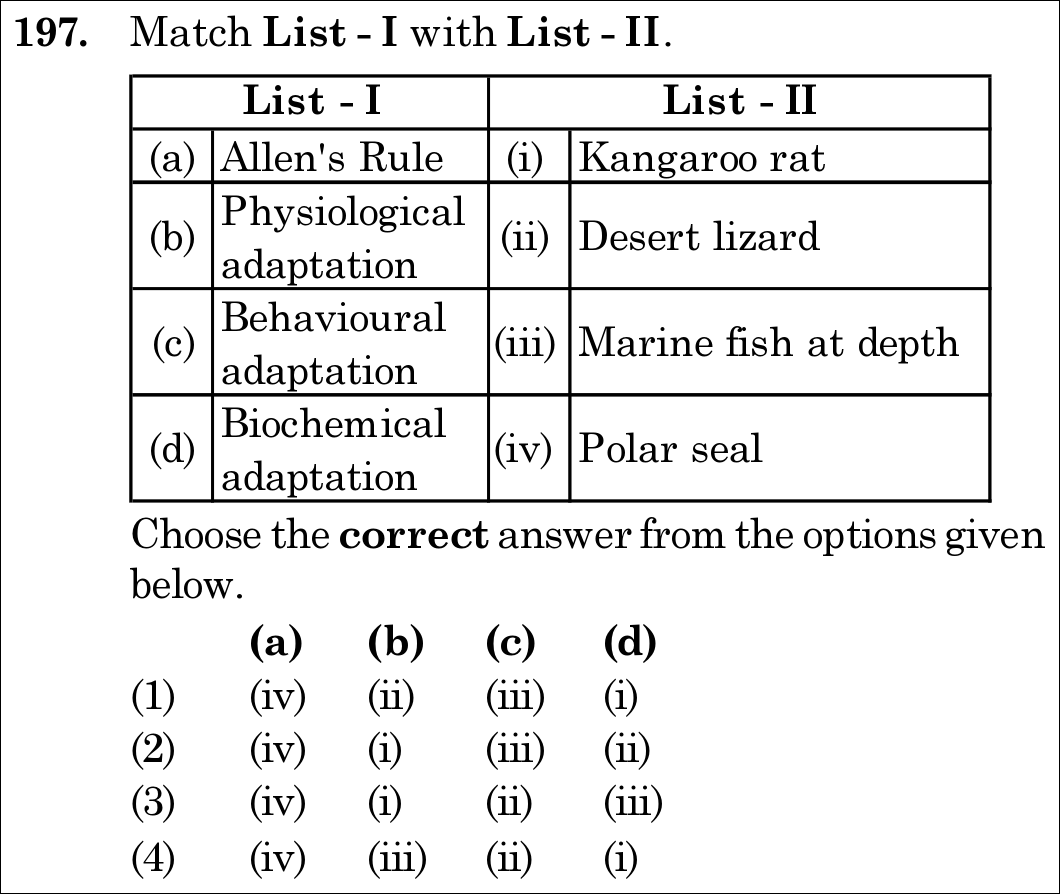
NEET 2021 Zoology Question 197: Ecological Adaptations: Allen Rule, Physiological, Behavioural, and Biochemical

Question

Match List - I with List - II. (a) Allen's Rule (i) Kangaroo rat (b) Physiological adaptation (ii) Desert lizard (c) Behavioural adaptation (iii) Marine fish at depth (d) Biochemical adaptation (iv) Polar seal List - I List - II Choose the correct answer from the options given below. (a) (b) (c) (d)

  1. (1)(iv) (ii) (iii) (i)
  2. (2)(iv) (i) (iii) (ii)
  3. (3)(iv) (i) (ii) (iii)
  4. (4)(iv) (iii) (ii) (i)
✓
Verified Against NTA Final Answer Key
Option (3) : (a)-(iv), (b)-(i), (c)-(ii), (d)-(iii)
📚 Organisms and Populations Medium
📋 Given Parameters & Problem Setup
List I (Adaptation Rules / Classes) (a) Allen's Rule, (b) Physiological adaptation, (c) Behavioural adaptation, (d) Biochemical adaptation
List II (Organisms) (i) Kangaroo rat, (ii) Desert lizard, (iii) Marine fish at depth, (iv) Polar seal
⚡

The 30-Second Exam Hall Shortcut: ⚡ "Allen's Rule = Polar Seal, Behavioural = Desert Lizard, Physiological = Kangaroo Rat"

⏱️ Save ~30 seconds

Allen's rule states cold-climate mammals have shorter extremities, exemplified by polar seals with short flippers & blubber ((a)-(iv)). Desert lizards regulate body temperature purely through behaviour by basking in sun and moving to shade ((c)-(ii)). Kangaroo rat concentrates urine and oxidizes fat physiologically ((b)-(i)). Marine fish survive crushing deep pressure biochemically ((d)-(iii)). Match is (iv), (i), (ii), (iii) -> Option (3)!

1 Match (a) Allen's Rule -> (iv) Polar seal (blubber and reduced extremities to prevent heat loss).
2 Match (b) Physiological adaptation -> (i) Kangaroo rat (internal fat oxidation for metabolic water and hyper-concentrated urine).
3 Match (c) Behavioural adaptation -> (ii) Desert lizard (basks in sun when cold, retreats to shade/burrows when hot).
4 Match (d) Biochemical adaptation -> (iii) Marine fish at depth (specialized enzymes and pressure-resistant biochemical machinery).
5 Match pattern (iv), (i), (ii), (iii) -> Option (3).
🛡️
Why You Can 100% Trust This Shortcut: NCERT Biology · Organisms and Populations (Adaptations: Mammals from colder climates generally have shorter ears and limbs to minimise heat loss (Allen’s Rule) - seal in polar seas; Kangaroo rat in North American deserts can meet all water requirements through internal fat oxidation; Desert lizards lack physiological regulation and manage body temperature behaviourally; Marine invertebrates and fish thrive at great ocean depths through biochemical adaptations).
📐

Step-by-Step Rigorous Workflow & Mathematical Proof

Step 1

Analysis of Each Adaptation Class and Classic NCERT Type Specimen

- (a) Allen’s Rule: Formulated by Joel Asaph Allen: Mammals from colder climates generally possess shorter ears, limbs, and extremities to minimize surface area-to-volume ratio and reduce conductive heat loss. In polar seas, aquatic mammals like the polar seal exhibit shortened flippers and an insulating subcutaneous fat layer (blubber). - (b) Physiological Adaptation: The Kangaroo rat (*Dipodomys*) of North American deserts is capable of living without drinking liquid water: it fulfills 90% of its water requirements via the endogenous physiological oxidation of internal storage fat (producing metabolic water) and possesses elongated loops of Henle that concentrate its urine to hyperosmolar levels. - (c) Behavioural Adaptation: Desert lizards lack the internal physiological capacity for autonomic thermoregulation (homeothermy). Instead, they manage body temperature behaviourally: they bask in the morning sun to absorb solar radiation when body temperature drops below comfort zone, and scurry into subterranean burrows or shaded crevices when ambient temperatures climb. - (d) Biochemical Adaptation: Organisms living in extreme marine abyssal depths (where hydrostatic pressure exceeds 100 atmospheres) possess biochemical adaptations, including piezolyte pressure-protecting osmolytes (TMAO) and specialized membrane unsaturations that keep membranes fluid and enzymes functional under immense hydrostatic crush forces.

Allen’s Rule  ⟺  Polar seal[(a)→(iv)]Physiological adaptation  ⟺  Kangaroo rat[(b)→(i)]Behavioural adaptation  ⟺  Desert lizard[(c)→(ii)]Biochemical adaptation  ⟺  Marine fish at depth[(d)→(iii)]\begin{aligned} \text{Allen's Rule} &\iff \text{Polar seal} \quad [\text{(a)} \to \text{(iv)}] \\ \text{Physiological adaptation} &\iff \text{Kangaroo rat} \quad [\text{(b)} \to \text{(i)}] \\ \text{Behavioural adaptation} &\iff \text{Desert lizard} \quad [\text{(c)} \to \text{(ii)}] \\ \text{Biochemical adaptation} &\iff \text{Marine fish at depth} \quad [\text{(d)} \to \text{(iii)}] \end{aligned}
Step 2

Option Alignment and Conclusion

Sequence of matches: (a)-(iv), (b)-(i), (c)-(ii), (d)-(iii). This corresponds uniquely to Option (3).

⭐

360° Option Elimination Engine Key Feature

Diagnose every choice: Know exactly why the right option works and why distractors fail.

4-Option Deep Scan
1 1
✗ Incorrect
Verdict & Scientific Reason:

Incorrect. Assigns physiological adaptation to desert lizard and biochemical adaptation to kangaroo rat.

⚠️
Student Fallacy (Why candidates pick this trap): Swapping behavioural adaptation with physiological/biochemical categories.
2 2
✗ Incorrect
Verdict & Scientific Reason:

Incorrect. Misidentifies marine fish as behavioural and desert lizard as biochemical.

⚠️
Student Fallacy (Why candidates pick this trap): Failing to remember that desert lizards regulate body temperature behaviourally.
3 3
✓ 100% Correct
Verdict & Scientific Reason:

Correct. Flawlessly aligns all 4 adaptation classes with their canonical NCERT textbook examples.

💡
Why this is airtight: None. Candidate accurately connects each adaptation mechanism.
4 4
✗ Incorrect
Verdict & Scientific Reason:

Incorrect. Assigns marine fish to physiological and kangaroo rat to biochemical adaptation.

⚠️
Student Fallacy (Why candidates pick this trap): Confusing internal physiological water retention with deep ocean pressure biochemistry.
⚠️

NTA Trap Alert: Physiological vs Behavioural Desert Adaptation Trap

Both the kangaroo rat and the desert lizard live in hot, arid deserts. The critical distinction is that the kangaroo rat adapts *physiologically* (fat oxidation and renal urine concentration), whereas the desert lizard adapts *behaviourally* (basking in sun vs moving to shade).

🛡️ How to avoid the -1 mark: Remember: Lizard = Basking Behaviour; Kangaroo rat = Internal Metabolic Physiology.
📖

Core NEET Syllabus Standard

NEET / NCERT Biology · Organisms and Populations Standard Benchmark
Core Scientific Principle Tested:

"Polar seal illustrates Allen’s rule; kangaroo rat exhibits physiological adaptation; desert lizard exhibits behavioural adaptation; deep marine fish exhibit biochemical adaptation."

Syllabus Focus: Adaptations
✓ Core NEET UG Syllabus Anchor Syllabus & Academic Standards ↗

Ready to attempt under real exam pressure?

Test your speed and accuracy in the authentic 200-minute timed NTA simulator.

Launch NEET 2021 CBT Test →

Spotted a mistake in this solution? Report an error ([email protected])

⚖️ Legal & Fair Dealing Notice: Sourced from publicly released NEET 2021 question papers and NEET answer keys for private study, research, and non-commercial educational practice under Fair Dealing (Section 52(1)(a) of the Indian Copyright Act, 1957). Not affiliated with or endorsed by NTA or NMC.

Solve 4 NEET Questions a Day — One per Subject

Cover all 1,140 official NEET questions in 285 days at your own pace. Progress is saved on your device. No login needed.