MyCompetitiveExams Logo MyCompetitiveExams
Search 1,140+ Questions
Chapters, formulas, speed tricks
→
⚡ Brahmastra NEET 2027
720 MARKS

Dynamic 180-question full-length simulator mixed dynamically from all 6 years for 2027 & 2026 aspirants.

Launch Brahmastra 2027 Test →
Start Practice →
100% Free · No Login Required
🌿 Botany 🔥 High-Yield Core Topic (~3–4 Qs/Year)

NEET Organisms and Populations Previous Year Questions with Solutions

Complete repository of official NTA NEET questions for Organisms and Populations from 2020 to 2026. Every question includes 30-second elimination tricks, step-by-step NCERT solutions, option-by-option traps, and official answer keys.

21 Questions 6 Exam Years (2026, 2025, 2024, 2023, 2021, 2020) 16 Easy · 5 Medium · 0 Challenging
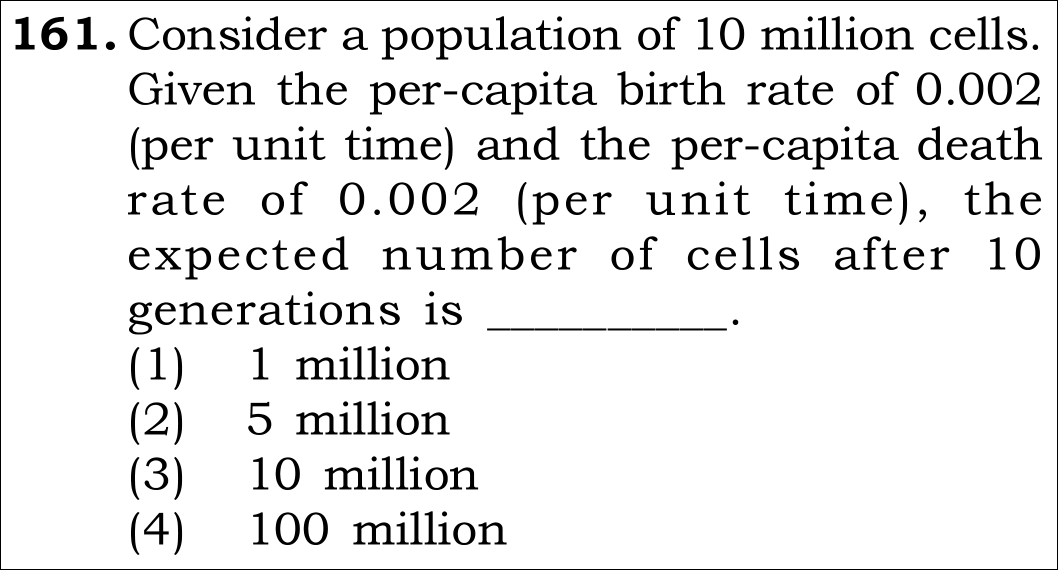
NEET 2026 · Q161 Easy
Official NEET 2026 Question 161 - Organisms and Populations
1
2
3 ✓ Key
4
💡 Verified Solution & 30-Second Hack
✓
Verified Against NTA Final Answer Key
Option (3) : 10 million
📚 Organisms and Populations Easy
📋 Given Parameters & Problem Setup
Initial Population (N₀) 10 million
Per Capita Birth Rate (b) 0.002
Per Capita Death Rate (d) 0.002
Time Span 10 generations (no migration)
⚡

The 30-Second Exam Hall Shortcut: ⚡ Zero Population Growth (ZPG) Rule

⏱️ Save ~40 seconds

b = d ⟹ r = 0 ⟹ Population Size NEVER CHANGES!

1 Calculate intrinsic rate of natural increase: r = b - d = 0.002 - 0.002 = 0.
2 Population growth equation: dN/dt = rN = 0 × N = 0.
3 Since rate of change is zero, population size at any generation t is: N(t) = N₀ = 10 million.
4 No exponential explosion, no extinction.
5 Pick Option (3) = 10 million in 5 seconds flat!
🛡️
Why You Can 100% Trust This Shortcut: NCERT Biology · Organisms and Populations (Population Growth Models: Logistic growth equation dN/dt = rN(K-N)/K).
📐

Step-by-Step Rigorous Workflow & Mathematical Proof

Step 1

Calculate Intrinsic Rate of Natural Increase (r)

In population ecology, the intrinsic rate of natural increase (r) is determined by subtracting the per capita death rate (d) from the per capita birth rate (b).

r=b−d=0.002−0.002=0r = b - d = 0.002 - 0.002 = 0
  • • r is the vital statistic measuring inherent capacity of a population to grow.
Step 2

Apply Exponential Growth Equation

The population size after t time periods is given by the integral form of exponential growth. When r = 0, e^(rt) = e^0 = 1, meaning the population remains completely stationary.

Nt=N0ert=10 million×e0×10=10 million×1=10 millionN_t = N_0 e^{rt} = 10 \text{ million} \times e^{0 \times 10} = 10 \text{ million} \times 1 = 10 \text{ million}
  • • Stationary population exhibiting Zero Population Growth (ZPG).
⭐

360° Option Elimination Engine Key Feature

Diagnose every choice: Know exactly why the right option works and why distractors fail.

4-Option Deep Scan
1 A
✗ Incorrect
Verdict & Scientific Reason:

Incorrect. Population would only double if r > 0.

⚠️
Student Fallacy (Why candidates pick this trap): Arbitrarily doubling the population over 10 generations.
2 B
✗ Incorrect
Verdict & Scientific Reason:

Incorrect. Reduction would require death rate to exceed birth rate (d > b).

⚠️
Student Fallacy (Why candidates pick this trap): Assuming natural decline despite equal birth and death rates.
3 C
✓ 100% Correct
Verdict & Scientific Reason:

100% mathematically and ecologically exact. Since b = d, r = 0, and population remains constant at 10 million.

💡
Why this is airtight: None; straightforward application of r = b - d.
4 D
✗ Incorrect
Verdict & Scientific Reason:

Incorrect. The population is not going extinct.

⚠️
Student Fallacy (Why candidates pick this trap): Equating r = 0 with population = 0.
⚠️

NTA Trap Alert: Growth Rate Zero vs. Population Zero Confusion

Careless students sometimes confuse the rate of growth (dN/dt = 0) with the population size (N = 0). A growth rate of zero means size remains CONSTANT.

🛡️ How to avoid the -1 mark: Remember: dN/dt = 0 means ΔN = 0, so N_final = N_initial.
📖

Core NEET Syllabus Standard

NEET Biology Core Syllabus · Organisms and Populations Standard Benchmark
Core Scientific Principle Tested:

"dN/dt = (b - d) × N; when b = d, dN/dt = 0 and population size remains constant."
Syllabus Focus: Population Growth Models
✓ Core NEET UG Syllabus Anchor Syllabus & Academic Standards ↗
Births Balance Deaths = Baseline Stays (10M -> 10M)!
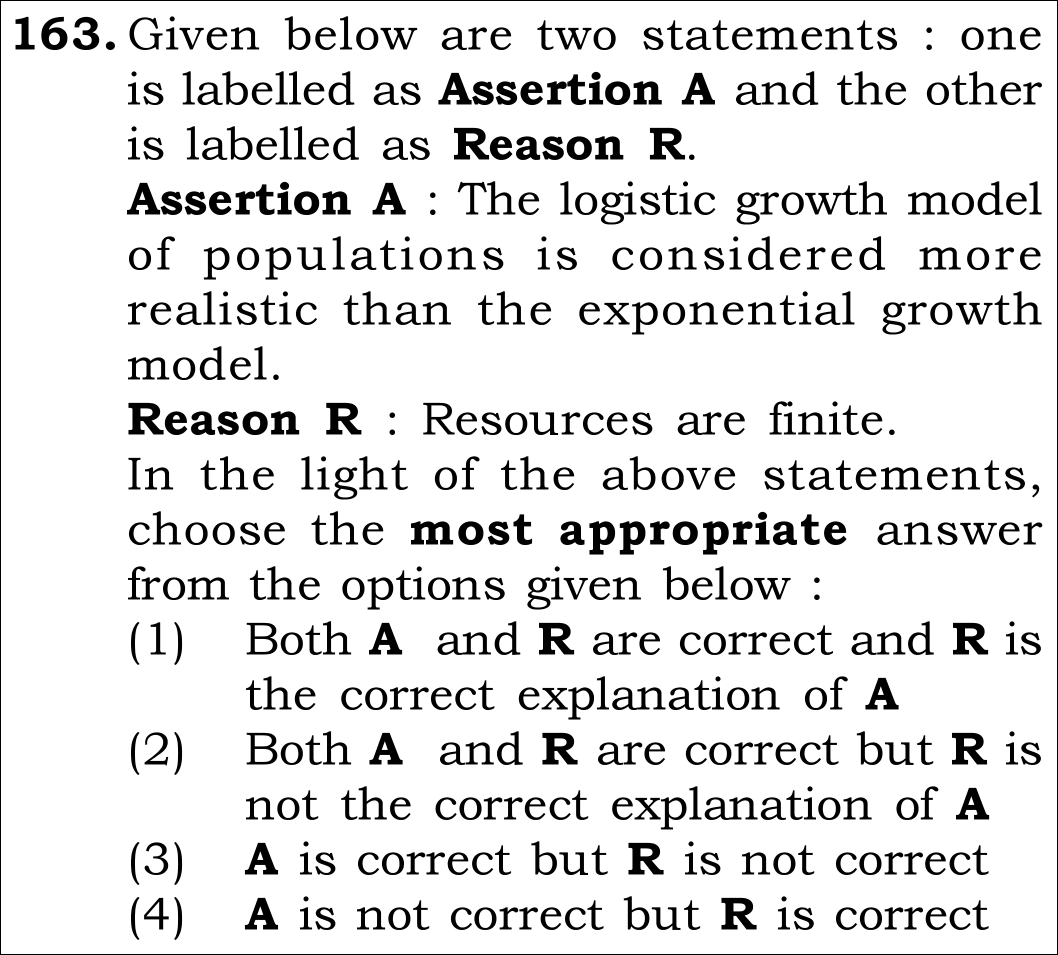
NEET 2026 · Q163 Medium
Official NEET 2026 Question 163 - Organisms and Populations
1 Both A and R are correct and R is the correct explanation of A ✓ Key
2 Both A and R are correct but R is not the correct explanation of A
3 A is correct but R is not correct
4 A is not correct but R is correct
💡 Verified Solution & 30-Second Hack
✓
Verified Against NTA Final Answer Key
Option (1) : Both (A) and (R) are true and (R) is the correct explanation of (A)
📚 Organisms and Populations Medium
📋 Given Parameters & Problem Setup
Assertion (A) Logistic growth model is considered more realistic than exponential growth model.
Reason (R) In nature, resources are finite and become limiting, leading to competition among individuals.
⚡

The 30-Second Exam Hall Shortcut: ⚡ "Because" Bridge Test

⏱️ Save ~40 seconds

Logistic is realistic BECAUSE natural resources are finite and limiting!

1 Read Assertion (A): Logistic growth is considered more realistic than exponential growth -> TRUE (NCERT verbatim).
2 Read Reason (R): Resources are finite and become limiting, leading to competition -> TRUE (NCERT verbatim).
3 Connect with "BECAUSE": Logistic growth is more realistic BECAUSE no population in nature has unlimited resources; resources are finite and limiting, leading to competition for carrying capacity (K).
4 Reason (R) gives the exact biological cause for Assertion (A).
5 Pick Option (1) with absolute certainty.
🛡️
Why You Can 100% Trust This Shortcut: NCERT Biology · Organisms and Populations (Age Pyramids: Expanding triangular pyramid with large pre-reproductive base).
📐

Step-by-Step Rigorous Workflow & Mathematical Proof

Step 1

Evaluate Assertion (A)

Resource availability is obviously essential for the unimpeded growth of a population. In nature, a given habitat has enough resources to support a maximum possible number, beyond which no further growth is possible (carrying capacity K). Thus, the logistic model is considered more realistic than exponential growth.

dNdt=rN(K−NK)(Verhulst-Pearl Logistic Growth)\frac{dN}{dt} = rN \left(\frac{K - N}{K}\right) \quad (\text{Verhulst-Pearl Logistic Growth})
  • • Assertion (A) is completely true.
Step 2

Evaluate Reason (R) and Explanatory Link

In the real world, food and space are never unlimited. Competition for these limited resources inevitably occurs among individuals, eventually resulting in the survival and reproduction of the fittest, establishing an upper asymptote at carrying capacity K. Thus, Reason (R) is true and is the precise scientific rationale for (A).

Finite Resources→Intraspecific Competition→Growth Decelerates to K  ⟹  (R) explains (A)\text{Finite Resources} \rightarrow \text{Intraspecific Competition} \rightarrow \text{Growth Decelerates to } K \implies (R) \text{ explains } (A)
  • • Both are true, and (R) correctly explains (A).
⭐

360° Option Elimination Engine Key Feature

Diagnose every choice: Know exactly why the right option works and why distractors fail.

4-Option Deep Scan
1 A
✓ 100% Correct
Verdict & Scientific Reason:

100% correct. Logistic growth is realistic precisely because resources in the real world are finite and limiting.

💡
Why this is airtight: None; classic textbook assertion-reason relationship.
2 B
✗ Incorrect
Verdict & Scientific Reason:

Incorrect. (R) directly explains why logistic growth represents reality over idealized exponential growth.

⚠️
Student Fallacy (Why candidates pick this trap): Failing to see that finite resources are the foundational basis of logistic growth.
3 C
✗ Incorrect
Verdict & Scientific Reason:

Incorrect. Reason (R) is a universally accepted biological fact.

⚠️
Student Fallacy (Why candidates pick this trap): Assuming natural resources are unlimited.
4 D
✗ Incorrect
Verdict & Scientific Reason:

Incorrect. Assertion (A) is a canonical statement in NCERT.

⚠️
Student Fallacy (Why candidates pick this trap): Believing exponential growth is realistic.
⚠️

NTA Trap Alert: Disconnecting Carrying Capacity from Finite Resources

Students sometimes think carrying capacity is an arbitrary mathematical construct rather than a direct consequence of finite food, water, and shelter.

🛡️ How to avoid the -1 mark: Remember: Real world = Limited resources = S-shaped Logistic curve = Realistic.
📖

Core NEET Syllabus Standard

NEET Biology Core Syllabus · Organisms and Populations Standard Benchmark
Core Scientific Principle Tested:

"Logistic growth model is considered more realistic since resources in nature are finite and limiting."

Syllabus Focus: Logistic Growth & Carrying Capacity
✓ Core NEET UG Syllabus Anchor Syllabus & Academic Standards ↗
Limited resources Limit growth = Logistic is Logical!
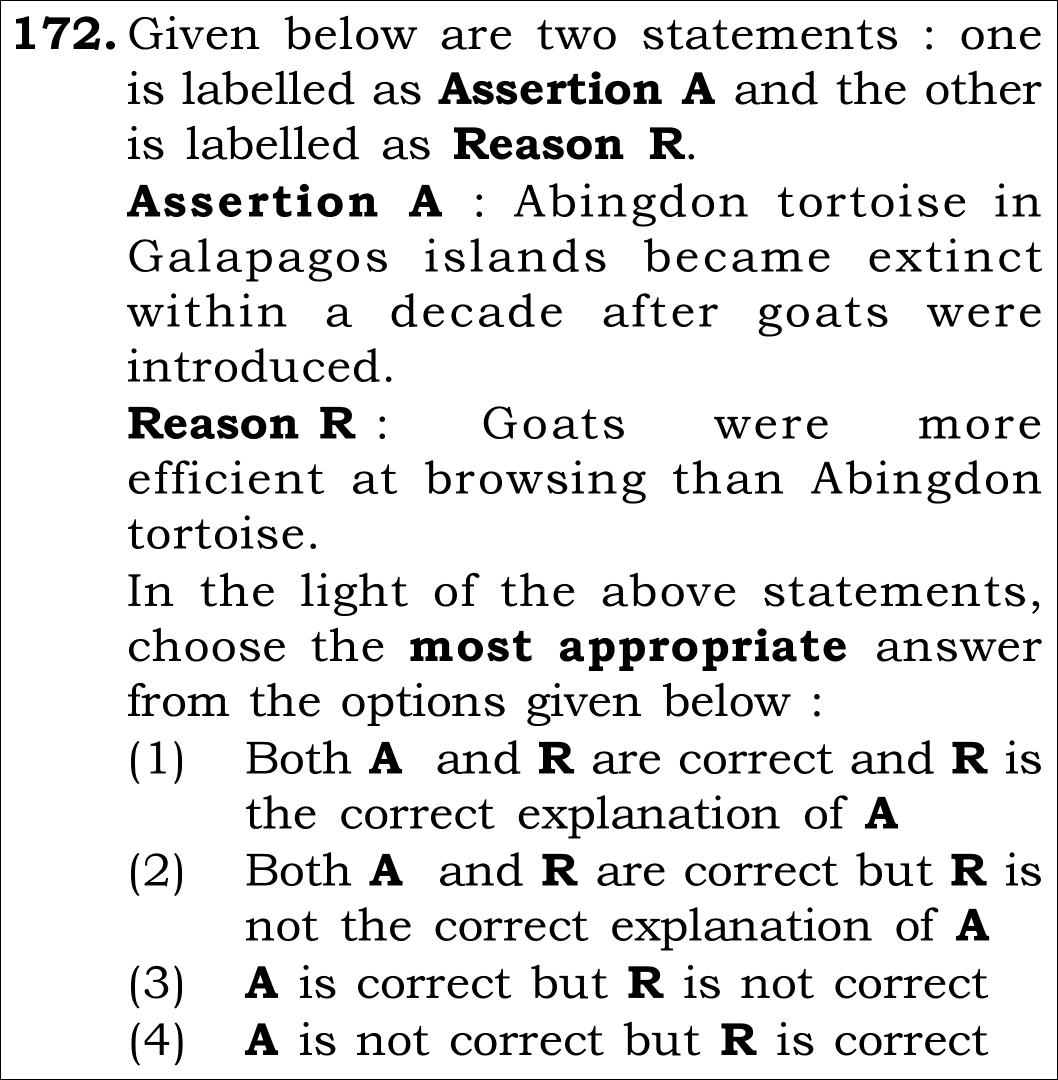
NEET 2026 · Q172 Easy
Official NEET 2026 Question 172 - Organisms and Populations
1 Both A and R are correct and R is the correct explanation of A ✓ Key
2 Both A and R are correct but R is not the correct explanation of A
3 A is correct but R is not correct
4 A is not correct but R is correct
💡 Verified Solution & 30-Second Hack
✓
Verified Against NTA Final Answer Key
Option (1) : Both (A) and (R) are true and (R) is the correct explanation of (A)
📚 Organisms and Populations Easy
📋 Given Parameters & Problem Setup
Assertion (A) The Abingdon tortoise in Galapagos Islands became extinct within a decade after goats were introduced on the island.
Reason (R) Goats had greater browsing efficiency than the tortoises for the available resources.
⚡

The 30-Second Exam Hall Shortcut: ⚡ Competitive Exclusion "Because" Link

⏱️ Save ~35 seconds

Tortoises went extinct BECAUSE goats were faster and more efficient browsers!

1 Read Assertion (A): Abingdon tortoise in Galapagos became extinct within a decade after goats were introduced -> TRUE (NCERT verbatim).
2 Read Reason (R): Goats had greater browsing efficiency than tortoises -> TRUE (NCERT verbatim).
3 Apply the "BECAUSE" connector: The Abingdon tortoise went extinct within a decade BECAUSE introduced goats had vastly greater browsing efficiency, rapidly consuming the available vegetation and competitively starving the slow-moving tortoises.
4 Reason (R) gives the precise biological cause for Assertion (A).
5 Select Option (1) with absolute confidence.
🛡️
Why You Can 100% Trust This Shortcut: NCERT Biology · Organisms and Populations (Predation & Camouflage: Monarch butterfly unpalatable to predatory birds).
📐

Step-by-Step Rigorous Workflow & Mathematical Proof

Step 1

Evaluate Assertion (A)

Competition is best defined as a process in which the fitness of one species is significantly lower in the presence of another species. A classic ecological example documented in NCERT is the Abingdon tortoise in Galapagos Islands, which became extinct within a decade after goats were introduced on the island.

Introduction of Goats→Interspecific CompetitionExtinction of Abingdon Tortoise (Within 10 Years)\text{Introduction of Goats} \xrightarrow{\text{Interspecific Competition}} \text{Extinction of Abingdon Tortoise (Within 10 Years)}
  • • Assertion (A) is completely true.
Step 2

Evaluate Reason (R) and Explanatory Link

Goats are agile, fast-eating herbivores with greater browsing efficiency than the slow-moving, ectothermic Abingdon tortoises. Goats outcompeted the tortoises for scarce island vegetation, driving them to extinction. Thus, Reason (R) is true and perfectly explains Assertion (A).

Browsing Efficiency: Goats≫Tortoises  ⟹  Competitive Exclusion  ⟹  (R) explains (A)\text{Browsing Efficiency: Goats} \gg \text{Tortoises} \implies \text{Competitive Exclusion} \implies (R) \text{ explains } (A)
  • • Illustrates Gause’s Principle of Competitive Exclusion in nature.
⭐

360° Option Elimination Engine Key Feature

Diagnose every choice: Know exactly why the right option works and why distractors fail.

4-Option Deep Scan
1 A
✓ 100% Correct
Verdict & Scientific Reason:

100% correct. The greater browsing efficiency of goats is the direct reason the tortoises were competitively eliminated.

💡
Why this is airtight: None; verbatim NCERT explanation.
2 B
✗ Incorrect
Verdict & Scientific Reason:

Incorrect. Reason (R) directly explains the cause of extinction in Assertion (A).

⚠️
Student Fallacy (Why candidates pick this trap): Failing to link resource competition to extinction.
3 C
✗ Incorrect
Verdict & Scientific Reason:

Incorrect. Reason (R) is a documented empirical fact.

⚠️
Student Fallacy (Why candidates pick this trap): Assuming tortoises were better browsers.
4 D
✗ Incorrect
Verdict & Scientific Reason:

Incorrect. Assertion (A) is a historic ecological extinction event.

⚠️
Student Fallacy (Why candidates pick this trap): Thinking Abingdon tortoises are still thriving.
⚠️

NTA Trap Alert: Predation vs. Competition Confusion

Students sometimes mistakenly think goats "preyed upon" or attacked the tortoises. Goats are herbivores; the interaction was purely interspecific COMPETITION for food.

🛡️ How to avoid the -1 mark: Remember: Goats ate the grass, NOT the tortoises (Exploitative Competition).
📖

Core NEET Syllabus Standard

NEET Biology Core Syllabus · Organisms and Populations Standard Benchmark
Core Scientific Principle Tested:

"The Abingdon tortoise in Galapagos became extinct after goats were introduced due to the greater browsing efficiency of the goats."

Syllabus Focus: Interspecific Competition
✓ Core NEET UG Syllabus Anchor Syllabus & Academic Standards ↗
Goats Gulp Grass Faster = Tortoises Terminated!
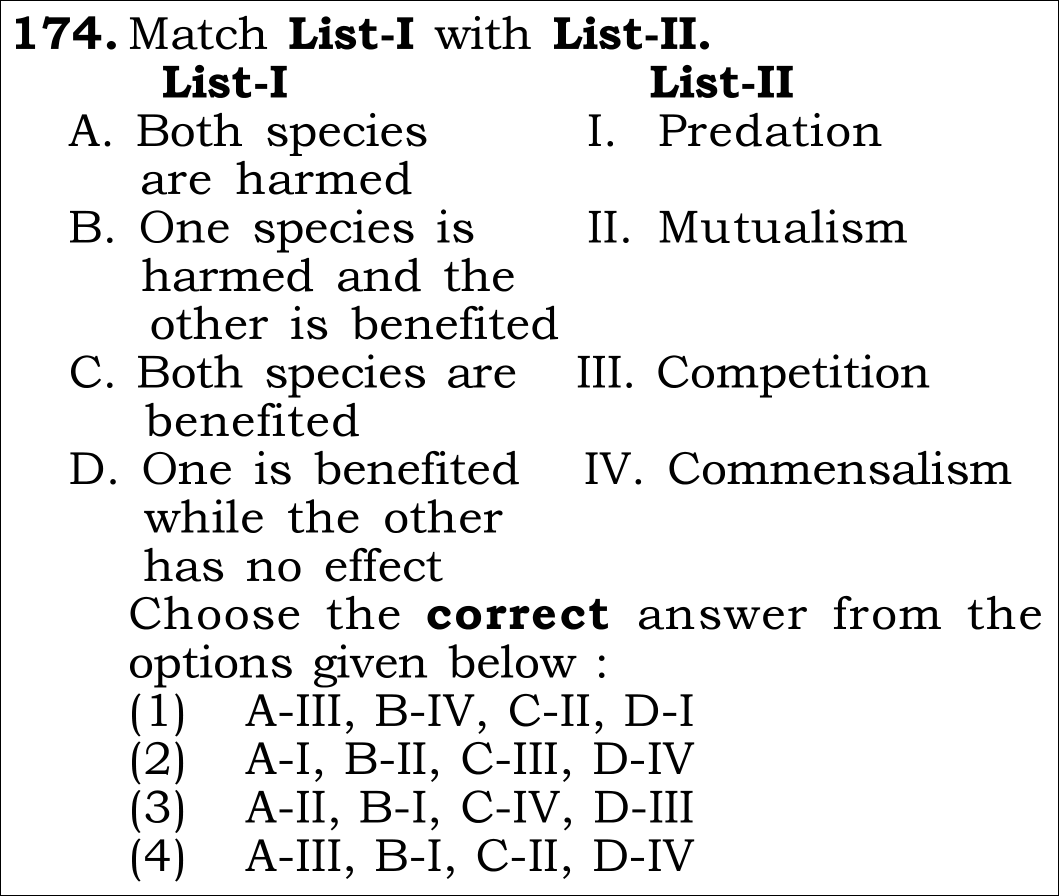
NEET 2026 · Q174 Easy
Official NEET 2026 Question 174 - Organisms and Populations
1
2
3
4 ✓ Key
💡 Verified Solution & 30-Second Hack
✓
Verified Against NTA Final Answer Key
Option (4) : A-III, B-I, C-II, D-IV
📚 Organisms and Populations Easy
📋 Given Parameters & Problem Setup
List I (Interactions) A. Competition, B. Predation, C. Mutualism, D. Commensalism
List II (Effects) I. (+, -), II. (+, +), III. (-, -), IV. (+, 0)
⚡

The 30-Second Exam Hall Shortcut: ⚡ Sign of Interaction Quad-Match

⏱️ Save ~45 seconds

Competition = (-/-), Predation = (+/-), Mutualism = (+/+), Commensalism = (+/0)!

1 Mutualism: Both species benefit -> (+, +) -> C matches II.
2 Competition: Both species suffer -> (-, -) -> A matches III.
3 Predation: One benefits, one is harmed -> (+, -) -> B matches I.
4 Commensalism: One benefits, other unaffected -> (+, 0) -> D matches IV.
5 Compiled match: A-III, B-I, C-II, D-IV.
6 Scan options: Matches Option (4) uniquely. Solved in 5 seconds!
🛡️
Why You Can 100% Trust This Shortcut: NCERT Biology · Organisms and Populations (Interspecific Interactions: Commensalism (+, 0), Amensalism (-, 0), Parasitism (+, -)).
📐

Step-by-Step Rigorous Workflow & Mathematical Proof

Step 1

NCERT Table 13.1 Population Interactions

Biological interactions between two species are formally designated using positive (+), negative (-), and neutral (0) signs based on fitness outcomes.

A. Competition  ⟹  (−,−)(List II - III)B. Predation  ⟹  (+,−)(List II - I)C. Mutualism  ⟹  (+,+)(List II - II)D. Commensalism  ⟹  (+,0)(List II - IV)\begin{aligned} \text{A. Competition} &\implies (-,-) \quad (\text{List II - III}) \\ \text{B. Predation} &\implies (+,-) \quad (\text{List II - I}) \\ \text{C. Mutualism} &\implies (+,+) \quad (\text{List II - II}) \\ \text{D. Commensalism} &\implies (+,0) \quad (\text{List II - IV}) \end{aligned}
  • • Amensalism is (-, 0); Parasitism is (+, -).
Step 2

Combine Matches

A matches III, B matches I, C matches II, D matches IV. This corresponds uniquely to Option (4).

A-III, B-I, C-II, D-IV  ⟹  Option (4)\text{A-III, B-I, C-II, D-IV} \implies \text{Option (4)}
  • • No other option correctly pairs all four interactions.
⭐

360° Option Elimination Engine Key Feature

Diagnose every choice: Know exactly why the right option works and why distractors fail.

4-Option Deep Scan
1 A
✗ Incorrect
Verdict & Scientific Reason:

Incorrect. Wrongly maps Competition to (+,-) and Mutualism to (-,-).

⚠️
Student Fallacy (Why candidates pick this trap): Scrambling interaction signs.
2 B
✗ Incorrect
Verdict & Scientific Reason:

Incorrect. Wrongly maps Competition to (+,+).

⚠️
Student Fallacy (Why candidates pick this trap): Assigning mutual benefit to competition.
3 C
✗ Incorrect
Verdict & Scientific Reason:

Incorrect. Swaps Predation (+,-) and Mutualism (+,+).

⚠️
Student Fallacy (Why candidates pick this trap): Swapping B and C.
4 D
✓ 100% Correct
Verdict & Scientific Reason:

100% correct. Competition is (-,-) [III], Predation is (+,-) [I], Mutualism is (+,+) [II], and Commensalism is (+,0) [IV].

💡
Why this is airtight: None; perfect table mapping.
⚠️

NTA Trap Alert: Competition Sign Trap

Students sometimes think the "winner" of competition gets a (+) sign. Both species suffer from reduced growth, survival, or reproduction compared to living alone; thus competition is ALWAYS (-,-).

🛡️ How to avoid the -1 mark: Remember: In competition, both sides pay a cost -> (-,-).
📖

Core NEET Syllabus Standard

NEET Biology Core Syllabus · Organisms and Populations Standard Benchmark
Core Scientific Principle Tested:

"In mutualism both species benefit (+,+); in competition both lose (-,-); in predation one benefits and one is harmed (+,-); in commensalism one benefits and the other is unaffected (+,0)."

Syllabus Focus: Population Interactions
✓ Core NEET UG Syllabus Anchor Syllabus & Academic Standards ↗
Mutual = Win-Win (+,+); Compete = Lose-Lose (-,-); Predator = Win-Lose (+,-); Commensal = Win-Shrug (+,0)!
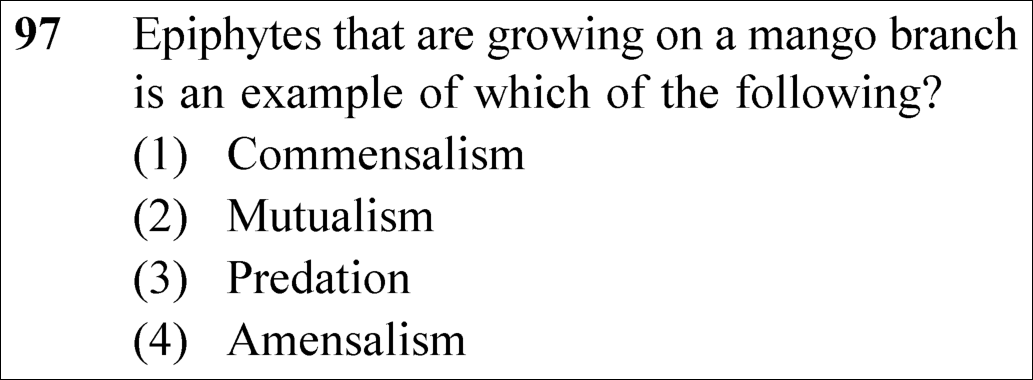
NEET 2025 · Q97 Easy
Official NEET 2025 Question 97 - Organisms and Populations
1 ✓ Key
2
3
4
💡 Verified Solution & 30-Second Hack
✓
Verified Against NTA Final Answer Key
Option (1) : Commensalism
📚 Organisms and Populations Easy
📋 Given Parameters & Problem Setup
Interacting Species Epiphytes (e.g. orchid) and Mango tree
Nature of Association Epiphyte grows on mango branch for physical support and sunlight without absorbing nutrients from the host
⚡

The 30-Second Exam Hall Shortcut: ⚡ (+, 0) Interaction Shortcut

⏱️ Save ~20 seconds

Orchid epiphyte benefits from support and sunlight (+). Mango tree is neither harmed nor benefited (0). An interaction of type (+, 0) is COMMENSALISM! ⟹ Commensalism!

1 Analyze the interaction between the epiphyte (e.g. orchid) and the mango tree:
2 Benefit to epiphyte: Gaining elevated physical perch for sunlight and moisture from humid air (+).
3 Effect on mango tree: The epiphyte does not tap into the vascular tissue of mango or steal nutrients/water; the tree is unharmed and receives no benefit (0).
4 Interaction type (+, 0) defines COMMENSALISM.
5 Contrast with alternatives:
6 - Mutualism: (+, +)
7 - Predation: (+, -)
8 - Amensalism: (-, 0)
9 - Parasitism: (+, -)
10 Select Option (1) Commensalism in under 5 seconds!
🛡️
Why You Can 100% Trust This Shortcut: Interspecific Population Interactions & Mutualism (NCERT Biology · Organisms and Populations).
📐

Step-by-Step Rigorous Workflow & Mathematical Proof

Step 1

Definition of Commensalism in Population Ecology

Commensalism is a positive interspecific interaction in which one population is benefited while the other remains unaffected:

Commensalism: (+,  0) Interaction\text{Commensalism: } (+, \; 0) \text{ Interaction}
  • • The benefiting partner is the commensal; the neutral partner is the host.
Step 2

Examine the Epiphyte-Mango Tree Relationship

Evaluate the ecological exchange between epiphyte and mango branch:

Epiphyte (Orchid)⟶(+) [Access to light and space],Mango tree⟶(0) [Neither harmed nor helped]\text{Epiphyte (Orchid)} \longrightarrow (+) \text{ [Access to light and space]}, \quad \text{Mango tree} \longrightarrow (0) \text{ [Neither harmed nor helped]}
  • • Epiphytes are non-parasitic space-dwellers; they synthesize their own food via photosynthesis and absorb atmospheric moisture via hygroscopic velamen roots.
  • • They do not produce haustoria or draw sap from the mango tree.
Step 3

Confirm with NCERT Canonical Examples

NCERT explicitly cites two benchmark examples of commensalism:

(1) Orchid on mango branch,(2) Barnacles on the back of a whale(1) \text{ Orchid on mango branch}, \quad (2) \text{ Barnacles on the back of a whale}
  • • Thus the interaction is unequivocally Commensalism, matching Option (1).
⭐

360° Option Elimination Engine Key Feature

Diagnose every choice: Know exactly why the right option works and why distractors fail.

4-Option Deep Scan
1 A
✓ 100% Correct
Verdict & Scientific Reason:

100% correct. (+, 0) interaction where orchid benefits and mango is unaffected.

💡
Why this is airtight: None; textbook ecological classification.
2 B
✗ Incorrect
Verdict & Scientific Reason:

Incorrect. Mutualism requires both species to benefit (+, +); the mango tree receives no benefit.

⚠️
Student Fallacy (Why candidates pick this trap): Thinking both species benefit.
3 C
✗ Incorrect
Verdict & Scientific Reason:

Incorrect. Predation is a (+, -) interaction involving killing of prey.

⚠️
Student Fallacy (Why candidates pick this trap): Confusing epiphyte with predator.
4 D
✗ Incorrect
Verdict & Scientific Reason:

Incorrect. Amensalism is a (-, 0) interaction where one species is harmed while the other is unaffected.

⚠️
Student Fallacy (Why candidates pick this trap): Inverting signs of interaction.
⚠️

NTA Trap Alert: Confusing Epiphytes with Parasitic Plants (Cuscuta)

Students sometimes confuse epiphytes with parasites like Cuscuta (dodder) or Loranthus. Parasites develop haustoria to rob food and water (+, - interaction: parasitism). Epiphytes only use the branch for MECHANICAL SUPPORT (+, 0 interaction: commensalism)!

🛡️ How to avoid the -1 mark: Epiphytes = Physical support only (Commensalism); Parasites = Nutrient theft (Parasitism)!
📖

Core NEET Syllabus Standard

NEET Biology Core Syllabus · Organisms and Populations Standard Benchmark
Core Scientific Principle Tested:

"An orchid growing as an epiphyte on a mango branch is a classic (+, 0) commensalism."

Syllabus Focus: Population Interactions: Commensalism
✓ Core NEET UG Syllabus Anchor Syllabus & Academic Standards ↗
Orchid gets light (+), Mango doesn’t care (0) ⟹ Commensalism (Option 1)!
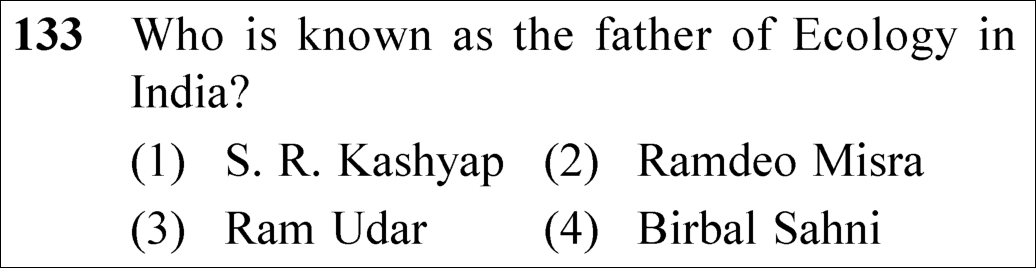
NEET 2025 · Q133 Easy
Official NEET 2025 Question 133 - Organisms and Populations
1 S.R. Kashyap
2 Ramdeo Misra ✓ Key
3 Ram Udar
4 Birbal Sahni
💡 Verified Solution & 30-Second Hack
✓
Verified Against NTA Final Answer Key
Option (2) : Ramdeo Misra
📚 Organisms and Populations Easy
📋 Given Parameters & Problem Setup
Target Honorific Father of Ecology in India
Field Ecology and Environmental Biology
⚡

The 30-Second Exam Hall Shortcut: ⚡ Indian Ecology Pioneer Fingerprint

⏱️ Save ~20 seconds

Professor Ramdeo Misra (BHU Varanasi) is revered as the Father of Ecology in India! Direct NCERT Unit X scientist profile!

1 Recall the scientist profile preceding Unit X (Ecology) in NCERT Biology:
2 - "Ramdeo Misra is revered as the Father of Ecology in India."
3 - Born 26 August 1908, obtained Ph.D. in Ecology (1937) from Leeds University under W.H. Pearsall.
4 - Established teaching and research in ecology at the Department of Botany, Banaras Hindu University (BHU), Varanasi.
5 - Initiated the National Committee on Environmental Planning and Coordination (1972) paving way for MoEF.
6 Father of Ecology in India = Ramdeo Misra!
7 Select Option (2) Ramdeo Misra!
🛡️
Why You Can 100% Trust This Shortcut: NCERT Biology Unit X (Ecology, Scientist Profile) verbatim.
📐

Step-by-Step Rigorous Workflow & Mathematical Proof

Step 1

Historical Background of Prof. Ramdeo Misra

The opening biographical profile of Unit X (Ecology) in the NCERT textbook honors Professor Ramdeo Misra:

  • • Revered as the Father of Ecology in India.
  • • Established ecology as a foundational biological discipline in India at Banaras Hindu University (BHU).
  • • Conducted pioneering ecological research on tropical communities, primary productivity, and nutrient cycling.
Step 2

Profiles of Other Prominent Indian Botanists

Distinguishing the historical figures in Indian botany:

  • • S. R. Kashyap (Shiv Ram Kashyap): Revered as the "Father of Indian Bryology".
  • • Ram Udar: Renowned Indian bryologist, student of S.R. Kashyap.
  • • Birbal Sahni: Revered as the "Father of Indian Palaeobotany" (established the Birbal Sahni Institute of Palaeosciences in Lucknow).
Step 3

Conclusion

Professor Ramdeo Misra is unequivocally recognized as the Father of Ecology in India.

Father of Ecology in India=Prof. Ramdeo Misra\text{Father of Ecology in India} = \text{Prof. Ramdeo Misra}
⭐

360° Option Elimination Engine Key Feature

Diagnose every choice: Know exactly why the right option works and why distractors fail.

4-Option Deep Scan
1 A
✗ Incorrect
Verdict & Scientific Reason:

Incorrect. Prof. S. R. Kashyap is the Father of Indian Bryology.

⚠️
Student Fallacy (Why candidates pick this trap): Confusing Indian bryology with Indian ecology.
2 B
✓ 100% Correct
Verdict & Scientific Reason:

100% correct. Explicitly designated as the Father of Ecology in India in the opening scientist profile of NCERT Unit X.

💡
Why this is airtight: None; textbook mastery of scientist profiles.
3 C
✗ Incorrect
Verdict & Scientific Reason:

Incorrect. Prof. Ram Udar was a prominent bryologist at Lucknow University.

⚠️
Student Fallacy (Why candidates pick this trap): Confusing bryologists with ecologists.
4 D
✗ Incorrect
Verdict & Scientific Reason:

Incorrect. Prof. Birbal Sahni is the Father of Indian Palaeobotany (discovered Pentoxylon).

⚠️
Student Fallacy (Why candidates pick this trap): Confusing palaeobotany with ecology.
⚠️

NTA Trap Alert: Overlooking Unit Opening Scientist Profiles in NCERT

NEET frequently draws direct factual questions from the introductory scientist biography pages preceding each unit (e.g. Ramdeo Misra in Ecology, Katherine Esau in Anatomy, Ernst Mayr in Diversity). Always study these profiles!

🛡️ How to avoid the -1 mark: Ramdeo Misra = Ecology; Birbal Sahni = Fossils/Palaeobotany; S.R. Kashyap = Bryology.
📖

Core NEET Syllabus Standard

NEET Biology Core Syllabus · Organisms and Populations Standard Benchmark
Core Scientific Principle Tested:

"Professor Ramdeo Misra is revered as the Father of Ecology in India."

Syllabus Focus: Scientist Profile · Unit X Ecology
✓ Core NEET UG Syllabus Anchor Syllabus & Academic Standards ↗
RAMDEO MISRA = Royal Master of Indian Ecology!
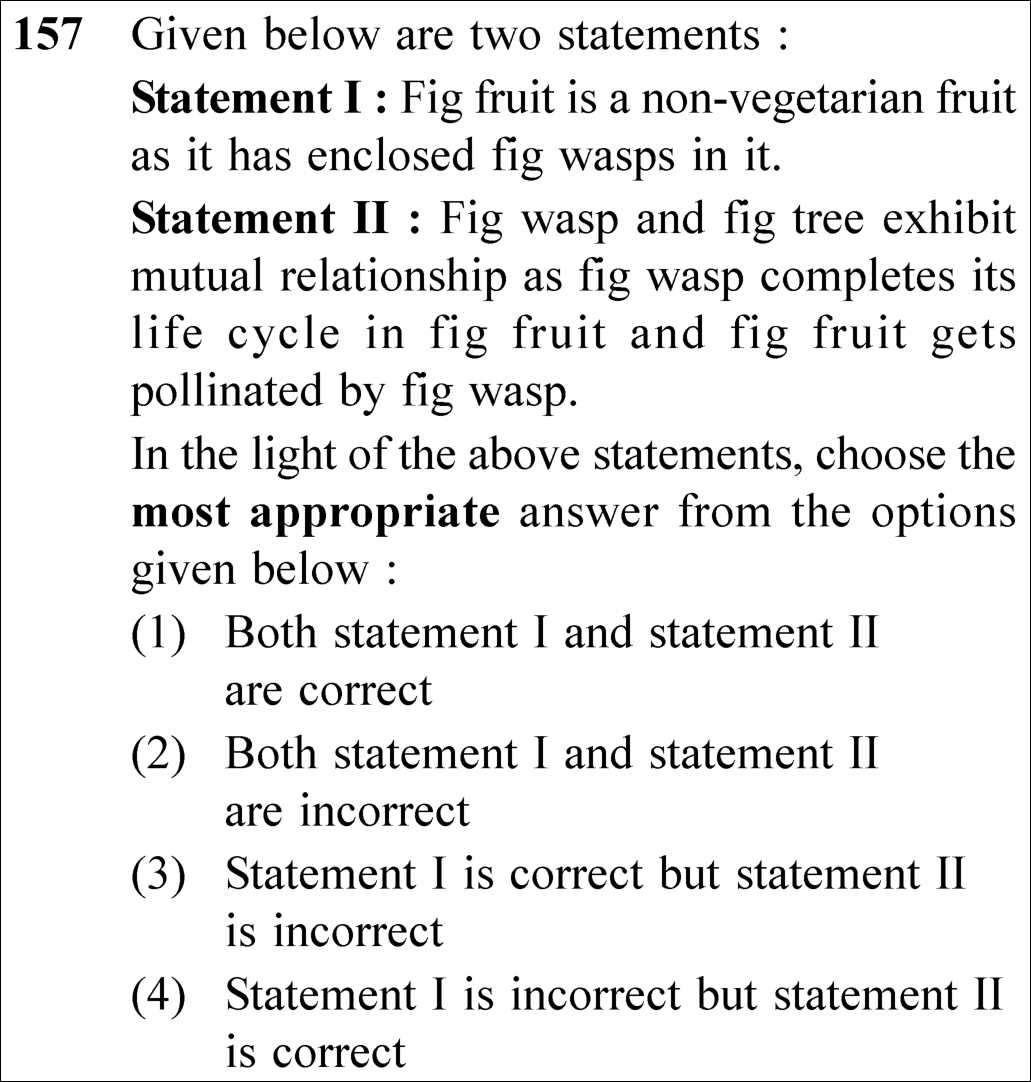
NEET 2025 · Q157 Medium
Official NEET 2025 Question 157 - Organisms and Populations
1 Both statement I and statement II are correct
2 Both statement I and statement II are incorrect ✓ Key
3 Statement I is correct but statement II is incorrect
4 Statement I is incorrect but statement II is correct
💡 Verified Solution & 30-Second Hack
✓
Verified Against NTA Final Answer Key
Option (2) : Both statement I and statement II are incorrect
📚 Organisms and Populations Medium
📋 Given Parameters & Problem Setup
Statement I Fig fruit is a non-vegetarian fruit as it has enclosed fig wasps in it.
Statement II Fig wasp and fig tree exhibit mutual relationship as fig wasp completes its life cycle in fig fruit and fig fruit gets pollinated by fig wasp.
⚡

The 30-Second Exam Hall Shortcut: ⚡ Fig-Wasp Precision Terminology Fingerprint

⏱️ Save ~35 seconds

Statement I is unscientific/false ("non-vegetarian fruit" is scientifically invalid; the fruit is 100% plant tissue)! Statement II is botanically false because FRUITS do not get pollinated — FLOWERS/INFLORESCENCES (hypanthodium) get pollinated! Both statements are INCORRECT!

1 Analyze Statement I scientifically:
2 - Calling fig a "non-vegetarian fruit" is unscientific and botanically false. The fig is an aggregate/composite fruit (syconus) derived from a plant ovary/inflorescence. Any female wasp that enters is fully broken down by the plant's proteolytic enzyme (ficin); it does not classify the fruit as non-vegetarian. Statement I is INCORRECT.
3 Analyze Statement II botanically:
4 - "fig fruit gets pollinated by fig wasp" -> In botany, pollination is the transfer of pollen grains to the STIGMA OF A FLOWER, NEVER to a fruit! Pollination occurs inside the unopened inflorescence (hypanthodium) on female flowers long before fruit maturation.
5 - Furthermore, the wasp oviposits into the ovules of flowers, not "in fig fruit".
6 - Therefore, Statement II is botanically and scientifically INCORRECT.
7 Conclusion: Both statement I and statement II are incorrect (Option 2)!
8 Select Option (2)!
🛡️
Why You Can 100% Trust This Shortcut: Gause’s Competitive Exclusion Principle (NCERT Biology · Organisms and Populations) & NTA Final Key.
📐

Step-by-Step Rigorous Workflow & Mathematical Proof

Step 1

Scientific Analysis of Statement I

Addressing the popular myth vs biological reality of fig fruits:

  • • Botanically, a fruit is a mature, ripened ovary (or inflorescence axis, syconus in *Ficus*) produced exclusively by angiosperm plants.
  • • There is no scientific or botanical taxonomic category called a "non-vegetarian fruit".
  • • While a female agaonid pollinator wasp may enter the ostiole of the inflorescence and die after oviposition/pollination, the plant secretes a proteolytic enzyme called ficin that completely digests the insect into amino acids and elemental nutrients absorbed by the developing fruit tissue.
  • • Asserting that "Fig fruit is a non-vegetarian fruit" is biologically erroneous. Hence, Statement I is INCORRECT.
Step 2

Botanical Analysis of Statement II

Scrutinizing the precise morphological stage of pollination and life cycle completion:

  • • Pollination is strictly defined as the transfer of pollen grains from the anther to the receptive stigma of a flower.
  • • In the genus *Ficus*, the pollinator wasp enters the specialized urn-shaped inflorescence (hypanthodium), which houses hundreds of tiny male and female flowers along its inner cavity wall.
  • • The wasp pollinates the female flowers while searching for suitable egg-laying sites in the ovaries of gall flowers.
  • • A fruit (*syconus*) is the post-fertilization developmental product. A fruit does not possess stigmas or ovules and CANNOT "get pollinated".
  • • Therefore, claiming that the "fig fruit gets pollinated by fig wasp" is a glaring botanical contradiction. Hence, Statement II is INCORRECT.
Step 3

Conclusion

Because both Statement I and Statement II contain fundamental factual and botanical errors, the correct verdict is that both statements are incorrect, matching Option (2).

Statement I: Incorrect,Statement II: Incorrect  ⟹  Option (2)\text{Statement I: Incorrect}, \quad \text{Statement II: Incorrect} \implies \text{Option (2)}
⭐

360° Option Elimination Engine Key Feature

Diagnose every choice: Know exactly why the right option works and why distractors fail.

4-Option Deep Scan
1 A
✗ Incorrect
Verdict & Scientific Reason:

Incorrect. Neither statement is biologically accurate (non-vegetarian fruit is scientifically invalid, and fruits cannot be pollinated).

⚠️
Student Fallacy (Why candidates pick this trap): Accepting casual colloquial phrasing without botanical scrutiny.
2 B
✓ 100% Correct
Verdict & Scientific Reason:

100% correct. Accurately recognizes that Statement I is an unscientific cultural claim and Statement II contains a critical botanical error (fruits do not get pollinated). Matches NTA Final Answer Key.

💡
Why this is airtight: None; rigorous scientific and botanical precision.
3 C
✗ Incorrect
Verdict & Scientific Reason:

Incorrect. Statement I is false because fruits are strictly botanical plant products.

⚠️
Student Fallacy (Why candidates pick this trap): Believing the dietary myth that figs are non-vegetarian.
4 D
✗ Incorrect
Verdict & Scientific Reason:

Incorrect. Overlooks that Statement II claims the "fruit gets pollinated", which is botanically impossible.

⚠️
Student Fallacy (Why candidates pick this trap): Failing to catch the substitution of "flower/inflorescence" with "fruit" in pollination.
⚠️

NTA Trap Alert: Pollination Occurs in Flowers/Inflorescence, NEVER Fruit!

Students frequently read past the word "fruit" in Statement II ("fig fruit gets pollinated"). Remember: Pollination precedes fertilization; fertilization forms fruit. A fruit CANNOT be pollinated! Only flowers/inflorescences get pollinated.

🛡️ How to avoid the -1 mark: Check the anatomical subject: Flowers are pollinated -> Fruits are produced!
📖

Core NEET Syllabus Standard

NEET Biology Core Syllabus · Organisms and Populations Standard Benchmark
Core Scientific Principle Tested:

"Mutualism occurs between fig flowers (inflorescence) and wasps; fruits do not undergo pollination, and figs are botanical plant organs."

Syllabus Focus: Population Interactions · Mutualism (Fig-Wasp Co-evolution)
✓ Core NEET UG Syllabus Anchor Syllabus & Academic Standards ↗
Both FALSE: Fig is NO meat (I false), and Fruits CANNOT be pollinated (II false)!
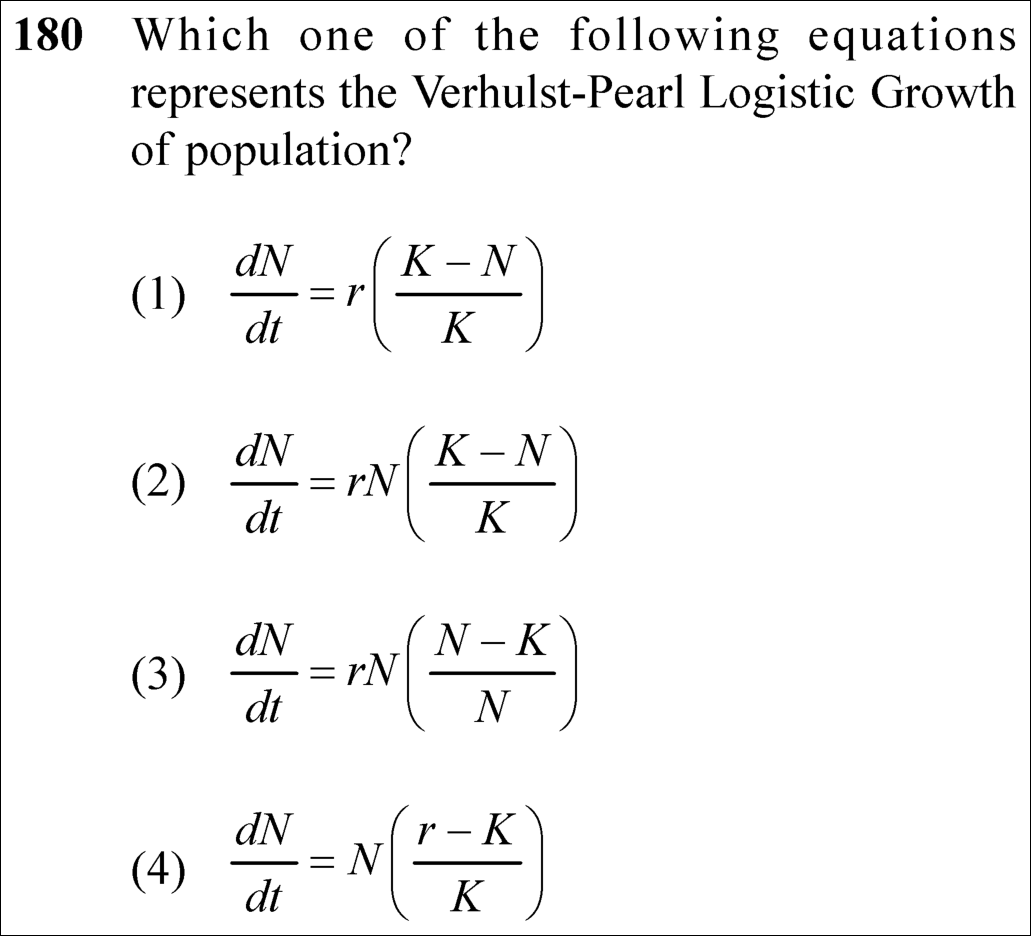
NEET 2025 · Q180 Easy
Official NEET 2025 Question 180 - Organisms and Populations
1
2 ✓ Key
3
4
💡 Verified Solution & 30-Second Hack
✓
Verified Against NTA Final Answer Key
Option (2) : dN/dt = rN((K - N)/K)
📚 Organisms and Populations Easy
📋 Given Parameters & Problem Setup
Growth Model Verhulst-Pearl Logistic Growth (sigmoid S-shaped curve)
Target Formula Mathematical differential equation of growth rate
⚡

The 30-Second Exam Hall Shortcut: ⚡ Logistic Growth Formula Fingerprint

⏱️ Save ~15 seconds

Verhulst-Pearl Logistic growth equation is: dN/dt = rN((K - N)/K), where (K - N)/K is the environmental resistance factor! Option (2)!

1 Recall NCERT Section 13.1.3 (Population Growth Models) verbatim:
2 - Exponential growth equation: dN/dt = rN (J-shaped curve, unlimited resources).
3 - Logistic growth equation: dN/dt = rN((K - N)/K) (Sigmoid S-shaped curve, limited resources).
4 * N = Population density at time t.
5 * r = Intrinsic rate of natural increase.
6 * K = Carrying capacity.
7 * (K - N)/K = Environmental resistance fraction.
8 - Look at Option (2): dN/dt = rN((K - N)/K).
9 Select Option (2)!
🛡️
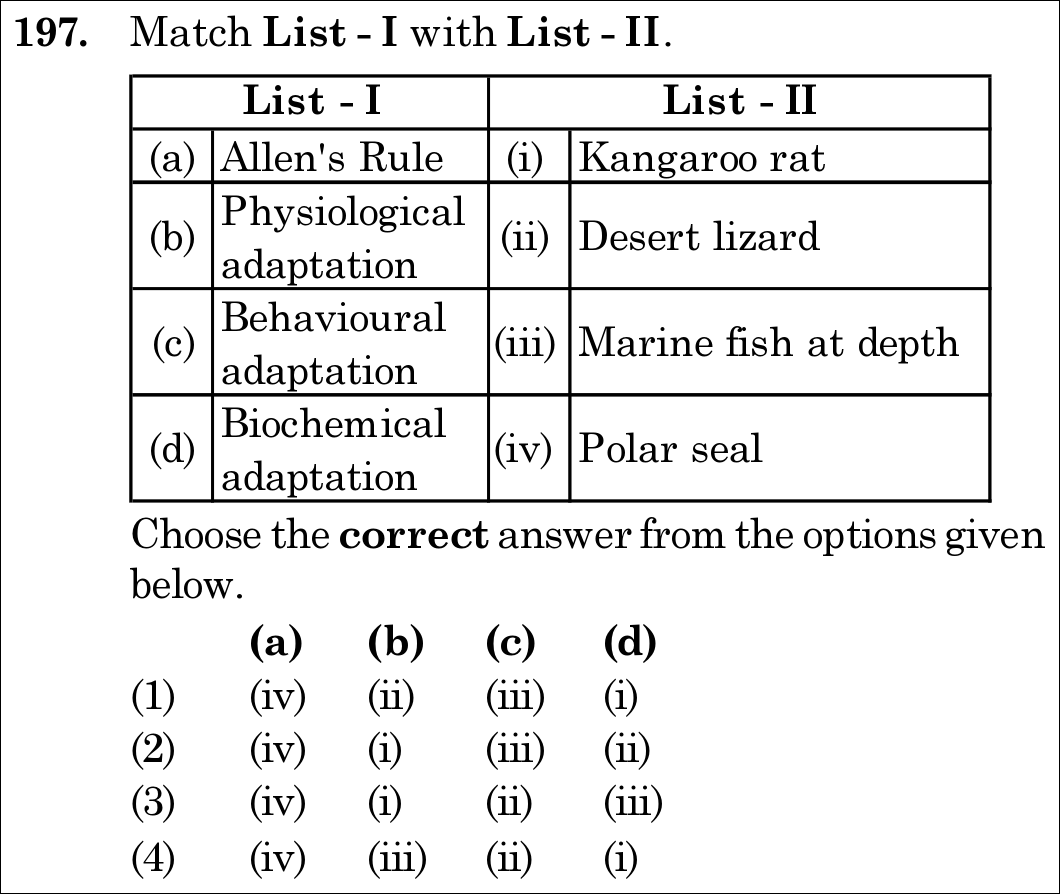
Why You Can 100% Trust This Shortcut: Allen’s Rule & Physiological Adaptations to Temperature (NCERT Biology · Organisms and Populations: Shorter extremities in cold climates).
📐

Step-by-Step Rigorous Workflow & Mathematical Proof

Step 1

Ecological Rationale of Logistic Growth

In nature, resource availability is finite and limited. No population can sustain geometric/exponential growth indefinitely:

  • • A habitat has finite resources to support a maximum possible number of individuals, beyond which no further growth is possible. This limit is termed the carrying capacity (KK).
  • • A population growing in a habitat with limited resources shows an initial lag phase, followed by phases of acceleration and deceleration, and finally reaches an asymptote as N→KN \rightarrow K.
  • • A plot of population density (NN) in relation to time (tt) yields a sigmoid (SS-shaped) logistic curve, designated as Verhulst-Pearl Logistic Growth.
Step 2

Mathematical Formulation of the Equation

Deriving the differential equation from first principles:

  • • Unconstrained intrinsic growth rate: dNdt=rN\frac{dN}{dt} = rN.
  • • Correction for carrying capacity (environmental resistance): As NN approaches KK, the fraction of unutilized carrying capacity is K−NK\frac{K - N}{K}.
  • • When N≪KN \ll K, K−NK≈1\frac{K - N}{K} \approx 1, and growth is exponential (rNrN).
  • • When N=KN = K, K−NK=0\frac{K - N}{K} = 0, and growth stops (dNdt=0\frac{dN}{dt} = 0, reaching the asymptote).
  • • Combining these yields: dNdt=rN(K−NK)\frac{dN}{dt} = rN \left( \frac{K - N}{K} \right).
Step 3

Conclusion

The canonical equation for Verhulst-Pearl Logistic Growth is dNdt=rN(K−NK)\frac{dN}{dt} = rN \left( \frac{K - N}{K} \right), matching Option (2).

dNdt=rN(K−NK)\frac{dN}{dt} = rN \left( \frac{K - N}{K} \right)
⭐

360° Option Elimination Engine Key Feature

Diagnose every choice: Know exactly why the right option works and why distractors fail.

4-Option Deep Scan
1 A
✗ Incorrect
Verdict & Scientific Reason:

Incorrect. Missing the population density variable N in the numerator (growth rate must depend on current population size N).

⚠️
Student Fallacy (Why candidates pick this trap): Omitting N from rN.
2 B
✓ 100% Correct
Verdict & Scientific Reason:

100% correct. Direct verbatim NCERT equation for Verhulst-Pearl logistic growth.

💡
Why this is airtight: None; pristine mathematical ecology recall.
3 C
✗ Incorrect
Verdict & Scientific Reason:

Incorrect. Inverts the environmental resistance fraction to (N - K)/N, which would yield negative growth below carrying capacity.

⚠️
Student Fallacy (Why candidates pick this trap): Inverting K and N.
4 D
✗ Incorrect
Verdict & Scientific Reason:

Incorrect. Scrambles intrinsic growth rate r and carrying capacity K.

⚠️
Student Fallacy (Why candidates pick this trap): Mismatched variables.
⚠️

NTA Trap Alert: (K - N)/K vs (N - K)/K

Always remember: Carrying capacity K is the ceiling. As long as population N is less than K, (K - N) is positive, allowing positive growth. Writing (N - K) would make the growth rate negative!

🛡️ How to avoid the -1 mark: Ceiling minus Population over Ceiling: (K - N) / K.
📖

Core NEET Syllabus Standard

NEET Biology Core Syllabus · Organisms and Populations Standard Benchmark
Core Scientific Principle Tested:

"Verhulst-Pearl logistic growth describes resource-limited population growth via the differential equation dN/dt = rN((K - N)/K)."

Syllabus Focus: Population Growth · Logistic Growth
✓ Core NEET UG Syllabus Anchor Syllabus & Academic Standards ↗
dN/dt = rN × [(K - N) / K] : Reality (rN) tempered by Capacity (K - N)/K!
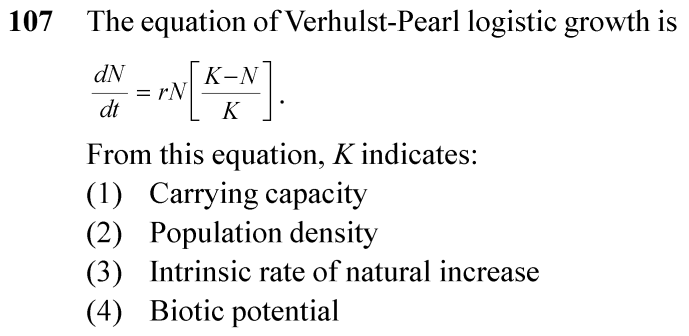
NEET 2024 · Q107 Easy
Official NEET 2024 Question 107 - Organisms and Populations
1 ✓ Key
2
3
4
💡 Verified Solution & 30-Second Hack
✓
Verified Against NTA Final Answer Key
Option (1) : Carrying capacity
📚 Organisms and Populations Easy
📋 Given Parameters & Problem Setup
Equation dN/dt = rN((K - N)/K)
Variable of Interest K
⚡

The 30-Second Exam Hall Shortcut: ⚡ Logistic Equation Variable Identity

⏱️ Save ~15 seconds

In dN/dt = rN(1 - N/K), N is population density, r is intrinsic rate of natural increase, and K is the carrying capacity of the environment.

1 Recall the logistic growth equation parameters:
2 - N = Population density at time t
3 - r = Intrinsic rate of natural increase
4 - K = Carrying capacity (maximum individuals an environment can sustain)
5 Direct identification: K indicates Carrying capacity -> Option (1) / A.
🛡️
Why You Can 100% Trust This Shortcut: NCERT Biology · Organisms and Populations (Verhulst-Pearl Logistic Growth)
📐

Step-by-Step Rigorous Workflow & Mathematical Proof

Step 1

Understand Logistic Growth Foundations

No population of any organism in nature has at its disposal unlimited resources to permit exponential growth. This leads to competition between individuals for limited resources. Eventually, the fittest individual survives and reproduces.

Step 2

Analyze the Mathematical Model

Verhulst-Pearl Logistic Growth is described by: dNdt=rN(K−NK)\frac{dN}{dt} = rN\left(\frac{K - N}{K}\right) where NN is population density at time tt, rr is the intrinsic rate of natural increase, and KK represents carrying capacity—the upper ecological limit of population size supported by the habitat without degradation.

⭐

360° Option Elimination Engine Key Feature

Diagnose every choice: Know exactly why the right option works and why distractors fail.

4-Option Deep Scan
1 (1)
✓ 100% Correct
Verdict & Scientific Reason:

K represents the carrying capacity: the maximum population size that a given environment can sustain indefinitely.

💡
Why this is airtight: None.
2 (2)
✗ Incorrect
Verdict & Scientific Reason:

Environmental resistance is conceptually represented by the term (K - N)/K, not by the constant K alone.

⚠️
Student Fallacy (Why candidates pick this trap): Environmental resistance is conceptually represented by the term (K - N)/K, not by the constant K alone.
3 (3)
✗ Incorrect
Verdict & Scientific Reason:

The intrinsic rate of natural increase is denoted by r.

⚠️
Student Fallacy (Why candidates pick this trap): The intrinsic rate of natural increase is denoted by r.
4 (4)
✗ Incorrect
Verdict & Scientific Reason:

Biotic potential relates to r under non-limiting conditions.

⚠️
Student Fallacy (Why candidates pick this trap): Biotic potential relates to r under non-limiting conditions.
⚠️

NTA Trap Alert: K vs (K-N)/K Confusion

Confusing the capacity constant K with the term (K - N)/K which represents environmental resistance.

🛡️ How to avoid the -1 mark: K alone = Carrying capacity; (K - N)/K = Fraction of carrying capacity still available (environmental resistance factor).
📖

Core NEET Syllabus Standard

Biology Core Botany · Organisms and Populations Standard Benchmark
Core Scientific Principle Tested:

"A population growing in a habitat with limited resources shows initially a lag phase, followed by phases of acceleration and deceleration and finally an asymptote, when the population density reaches the carrying capacity (K)."

Syllabus Focus: Verhulst-Pearl Logistic Growth Model and Carrying Capacity
✓ Core NEET UG Syllabus Anchor Syllabus & Academic Standards ↗
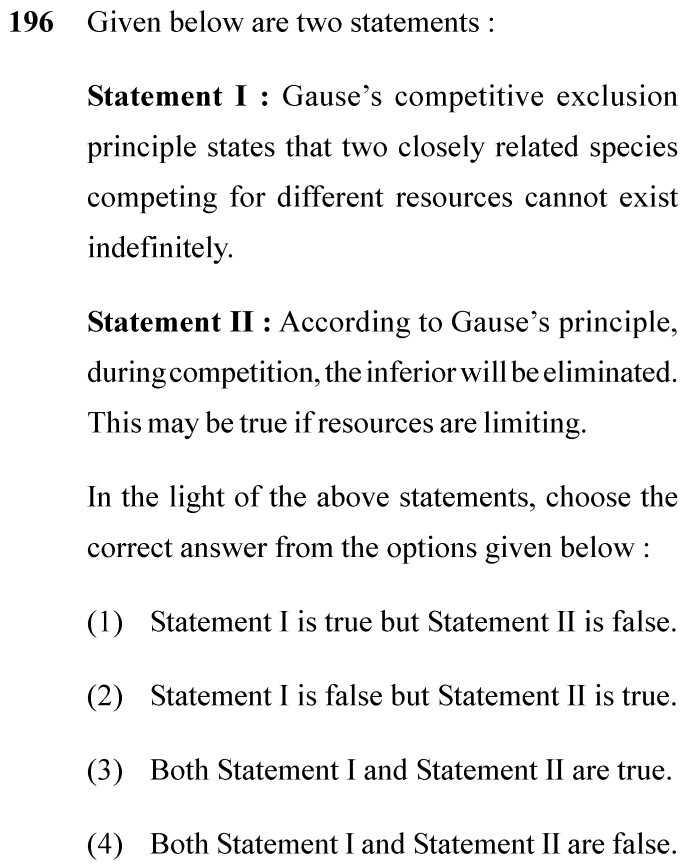
NEET 2024 · Q196 Medium
Official NEET 2024 Question 196 - Organisms and Populations
1 Statement I is true but Statement II is false.
2 Statement I is false but Statement II is true. ✓ Key
3 Both Statement I and Statement II are true.
4 Both Statement I and Statement II are false.
💡 Verified Solution & 30-Second Hack
✓
Verified Against NTA Final Answer Key
Option (2) : Statement I is false but Statement II is true.
📚 Organisms and Populations Medium
📋 Given Parameters & Problem Setup
Statement I Gause’s competitive exclusion principle states that two closely related species competing for different resources cannot exist indefinitely.
Statement II According to Gause’s principle, during competition, the inferior will be eliminated. This may be true if resources are limiting.
⚡

The 30-Second Exam Hall Shortcut: ⚡ Gause’s Principle Exact Wording Trap

⏱️ Save ~25 seconds

Gause’s principle applies to species competing for the SAME limiting resources (Statement I says "different resources" -> FALSE)! Statement II correctly notes the inferior species will be eliminated -> TRUE!

1 Check Statement I: "two closely related species competing for different resources cannot exist indefinitely" -> FALSE! Gause’s principle applies strictly to species competing for the SAME limiting resources.
2 Check Statement II: "during competition, the inferior will be eliminated. This may be true if resources are limiting" -> TRUE! Competitive exclusion holds true when resources are limiting.
3 Conclusion: Statement I is false but Statement II is true -> Option (2) / B.
🛡️
Why You Can 100% Trust This Shortcut: NCERT Biology · Organisms and Populations (Gause’s Competitive Exclusion Principle)
📐

Step-by-Step Rigorous Workflow & Mathematical Proof

Step 1

Review Gause’s Competitive Exclusion Principle

NCERT defines Gause’s 'Competitive Exclusion Principle' as follows: "two closely related species competing for the SAME resources cannot co-exist indefinitely and the competitively inferior one will be eliminated eventually." Statement I says "competing for different resources", which completely subverts the definition. Thus, Statement I is false.

Step 2

Evaluate Limiting Resource Criterion (Statement II)

This competitive exclusion may be true if resources are limiting, but not otherwise. More recent studies do not support such gross generalisation about competition; they point out that species facing competition might evolve mechanisms that promote co-existence rather than exclusion (e.g., resource partitioning). However, as stated under Gause's core principle, under limiting resources the inferior is eliminated. Thus, Statement II is true.

Step 3

Formulate Option Selection

Statement I is false but Statement II is true, matching Option (2).

⭐

360° Option Elimination Engine Key Feature

Diagnose every choice: Know exactly why the right option works and why distractors fail.

4-Option Deep Scan
1 (1)
✗ Incorrect
Verdict & Scientific Reason:

Statement I is false and Statement II is true.

⚠️
Student Fallacy (Why candidates pick this trap): Statement I is false and Statement II is true.
2 (2)
✓ 100% Correct
Verdict & Scientific Reason:

Accurately recognizes that Gause’s principle strictly requires competition for the SAME resources, not different ones.

💡
Why this is airtight: None.
3 (3)
✗ Incorrect
Verdict & Scientific Reason:

Statement I is false.

⚠️
Student Fallacy (Why candidates pick this trap): Statement I is false.
4 (4)
✗ Incorrect
Verdict & Scientific Reason:

Statement II is factually true.

⚠️
Student Fallacy (Why candidates pick this trap): Statement II is factually true.
⚠️

NTA Trap Alert: Glancing Over "Different" vs "Same"

Reading "competing for different resources" as "competing for resources" without catching the word "different".

🛡️ How to avoid the -1 mark: If species use DIFFERENT resources, they do not compete and can easily coexist indefinitely.
📖

Core NEET Syllabus Standard

Biology Core Zoology · Organisms and Populations Standard Benchmark
Core Scientific Principle Tested:

"Gause’s ‘Competitive Exclusion Principle’ states that two closely related species competing for the same resources cannot co-exist indefinitely and the competitively inferior one will be eliminated eventually. This may be true if resources are limiting, but not otherwise."

Syllabus Focus: Gause’s Competitive Exclusion Principle: Assumptions and Invariant Rules
✓ Core NEET UG Syllabus Anchor Syllabus & Academic Standards ↗
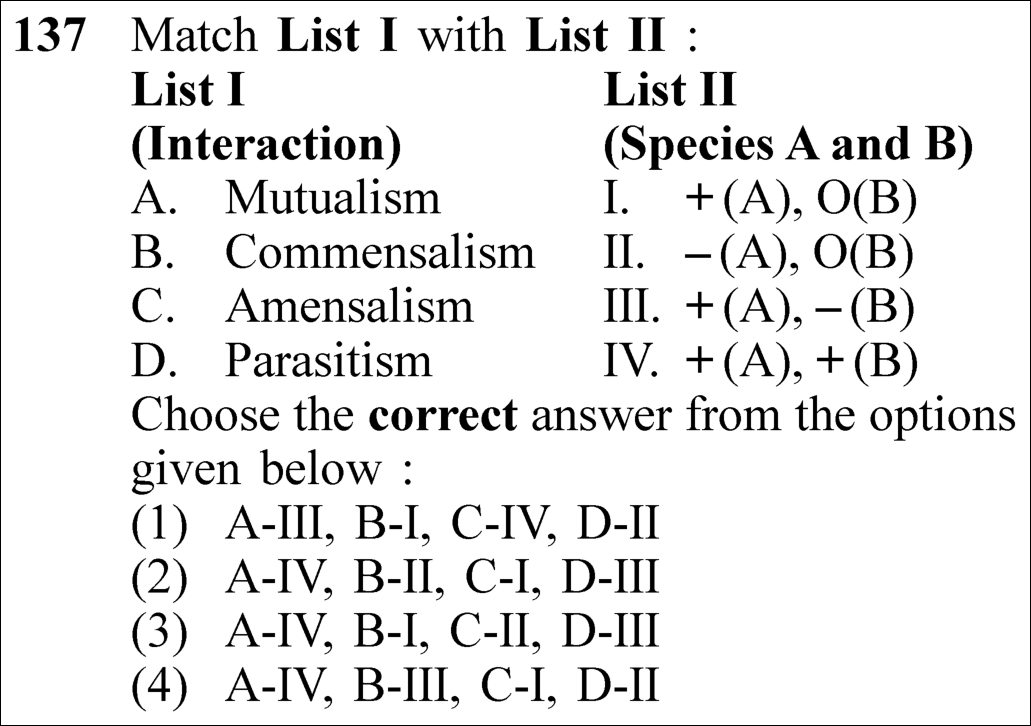
NEET 2023 · Q137 Easy
Official NEET 2023 Question 137 - Organisms and Populations
1
2
3 ✓ Key
4
💡 Verified Solution & 30-Second Hack
✓
Verified Against NTA Final Answer Key
Option (3) : A-IV, B-I, C-II, D-III
📚 Organisms and Populations Easy
📋 Given Parameters & Problem Setup
Interaction Matrix Signs (+ = benefit, - = harm, 0 = neutral)
⚡

The 30-Second Exam Hall Shortcut: ⚡ Ecological Interaction Sign Matrix

⏱️ Save ~25 seconds

Match standard signs: Mutualism (+, +); Commensalism (+, 0); Amensalism (-, 0); Parasitism (+, -). Look for A-IV and B-I to eliminate all incorrect options instantly!

1 Mutualism: Both species benefit -> +(A), +(B) -> IV.
2 Commensalism: One benefits, other neutral -> +(A), 0(B) -> I.
3 Amensalism: One harmed, other neutral -> -(A), 0(B) -> II.
4 Parasitism: Parasite benefits, host harmed -> +(A), -(B) -> III.
5 Match combination: A-IV, B-I, C-II, D-III -> Option (3).
🛡️
Why You Can 100% Trust This Shortcut: Canonical NCERT Organisms and Populations interspecific interaction sign matrix.
📐

Step-by-Step Rigorous Workflow & Mathematical Proof

Step 1

NCERT Population Interaction Table Analysis

Biotic interactions between two interacting species (A and B) are formalized via positive (+), negative (-), and neutral (0) fitness effects:

A. Mutualism:+(A), +(B)  ⟹  IVB. Commensalism:+(A), 0(B)  ⟹  IC. Amensalism:−(A), 0(B)  ⟹  IID. Parasitism:+(A), −(B)  ⟹  III\begin{aligned} \text{\textbf{A. Mutualism:}} & \quad +(A),\, +(B) \implies \mathbf{\text{IV}} \\[3pt] \text{\textbf{B. Commensalism:}} & \quad +(A),\, 0(B) \implies \mathbf{\text{I}} \\[3pt] \text{\textbf{C. Amensalism:}} & \quad -(A),\, 0(B) \implies \mathbf{\text{II}} \\[3pt] \text{\textbf{D. Parasitism:}} & \quad +(A),\, -(B) \implies \mathbf{\text{III}} \end{aligned}
Step 2

Corroboration with Ecological Examples

Examples include: Lichens/Mycorrhizae (Mutualism); Orchid on mango tree / Barnacles on whale (Commensalism); Penicillium inhibiting bacteria / Grazing cattle trampling grass (Amensalism); Cuscuta on host hedge (Parasitism).

Step 3

Option Elimination

A maps to IV (eliminates Option 1). B maps to I (eliminates Options 2 and 4). This uniquely leaves Option (3) as the only correct match.

⭐

360° Option Elimination Engine Key Feature

Diagnose every choice: Know exactly why the right option works and why distractors fail.

4-Option Deep Scan
1 1
✗ Incorrect
Verdict & Scientific Reason:

Mismatches Mutualism with +(A), -(B).

⚠️
Student Fallacy (Why candidates pick this trap): Confusing mutualism with parasitism/predation.
2 2
✗ Incorrect
Verdict & Scientific Reason:

Inverts Commensalism with Amensalism signs.

⚠️
Student Fallacy (Why candidates pick this trap): Confusing beneficial neutral (+, 0) with detrimental neutral (-, 0).
3 3
✓ 100% Correct
Verdict & Scientific Reason:

Perfect 1-to-1 match with the canonical NCERT population interaction matrix.

💡
Why this is airtight: None; textbook matrix recall.
4 4
✗ Incorrect
Verdict & Scientific Reason:

Incorrect pairings for B, C, and D.

⚠️
Student Fallacy (Why candidates pick this trap): Scrambling interaction signs.
⚠️

NTA Trap Alert: Commensalism (+, 0) vs. Amensalism (-, 0) Sign Trap

Both interactions feature a zero (0) for one species. Students often misremember which one receives the plus (+) and which receives the minus (-).

🛡️ How to avoid the -1 mark: Commensalism = positive (+, 0). Amensalism = negative/adversity (-, 0).
📖

Core NEET Syllabus Standard

NCERT Biology · Organisms and Populations Standard Benchmark
Core Scientific Principle Tested:

"In mutualism both species benefit; in commensalism one benefits and other is unaffected; in amensalism one is harmed and other unaffected; in parasitism one benefits and other is harmed."

Syllabus Focus: Population Interactions
✓ Core NEET UG Syllabus Anchor Syllabus & Academic Standards ↗
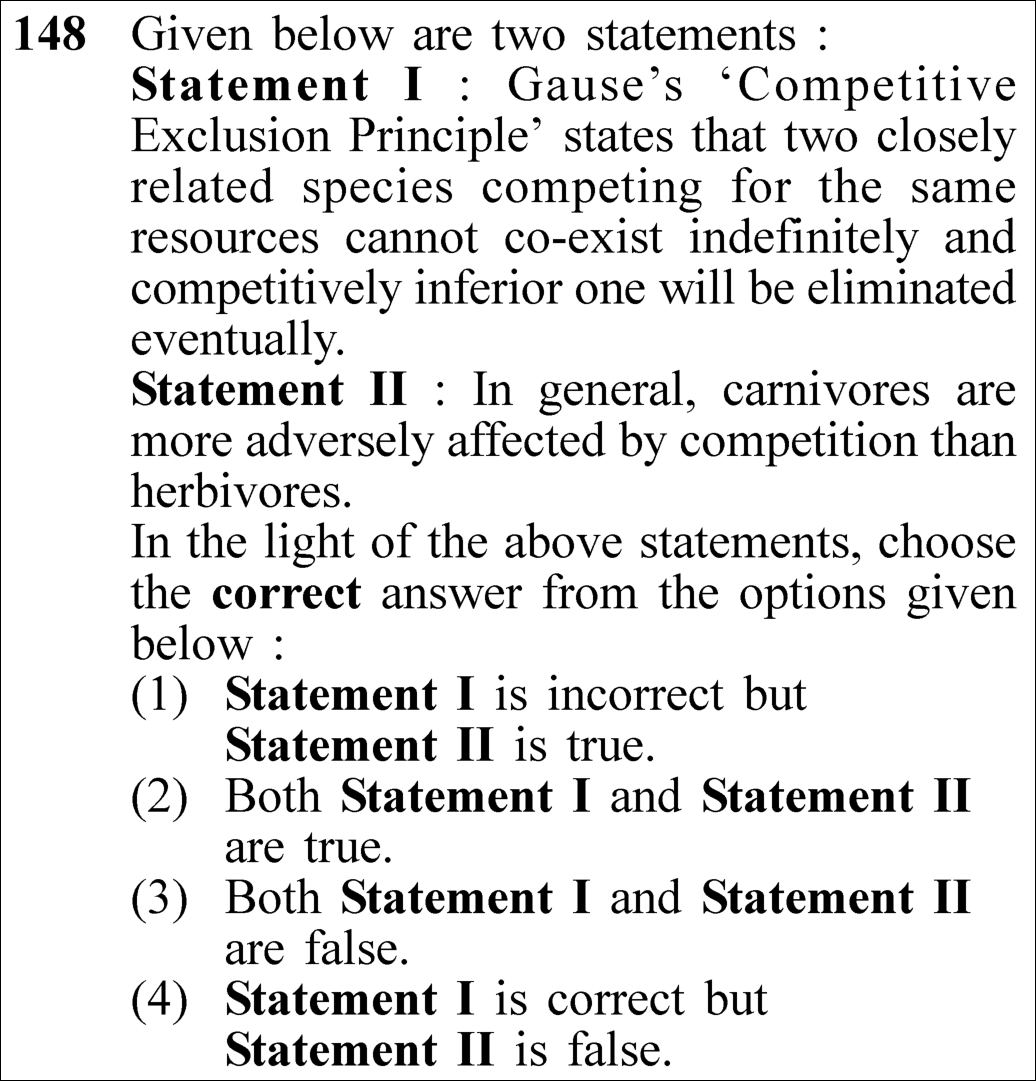
NEET 2023 · Q148 Medium
Official NEET 2023 Question 148 - Organisms and Populations
1 Statement I is incorrect but Statement II is true.
2 Both Statement I and Statement II are true.
3 Both Statement I and Statement II are false.
4 Statement I is correct but Statement II is false. ✓ Key
💡 Verified Solution & 30-Second Hack
✓
Verified Against NTA Final Answer Key
Option (4) : Statement I is correct but Statement II is false.
📚 Organisms and Populations Medium
📋 Given Parameters & Problem Setup
Statement I Gause's Principle: Two closely related species competing for same resources cannot co-exist indefinitely and inferior one is eliminated.
Statement II In general, carnivores are more adversely affected by competition than herbivores.
⚡

The 30-Second Exam Hall Shortcut: ⚡ Herbivores Are MORE Affected by Competition, NOT Carnivores!

⏱️ Save ~25 seconds

Statement I is verbatim Gause's Competitive Exclusion Principle -> Correct! But Statement II claims carnivores are more affected. NCERT explicitly states: "In general, herbivores and plants appear to be more adversely affected by competition than carnivores!" Statement II is False! Select Option (4)!

1 Check Statement I: Gause's Principle states competing species for limited resources cannot coexist indefinitely, inferior eliminated -> Verbatim NCERT, Correct.
2 Check Statement II: Claims carnivores are more adversely affected than herbivores -> NCERT says HERBIVORES and plants are more adversely affected -> False.
3 Statement I is correct but Statement II is false.
4 Match Option (4).
🛡️
Why You Can 100% Trust This Shortcut: Canonical NCERT Organisms and Populations competition ecological principles.
📐

Step-by-Step Rigorous Workflow & Mathematical Proof

Step 1

Evaluation of Statement I (Gause's Competitive Exclusion Principle)

Gause's principle describes resource competition under limiting conditions:

Gause’s Principle  ⟺  Two competing species with identical niches cannot coexist indefinitely  ⟹  Statement I is Correct\text{Gause's Principle} \iff \text{Two competing species with identical niches cannot coexist indefinitely} \implies \text{Statement I is } \mathbf{\text{Correct}}
Step 2

Evaluation of Statement II (Trophic Susceptibility to Competition)

Plants and herbivores compete intensely for limited forage, sunlight, and soil nutrients. Field ecological studies summarized in NCERT demonstrate that herbivores experience greater competitive displacement than carnivores:

Adverse Impact of Competition: Herbivores & Plants>Carnivores  ⟹  Statement II is False\text{Adverse Impact of Competition: } \mathbf{\text{Herbivores \& Plants}} > \text{Carnivores} \implies \text{Statement II is } \mathbf{\text{False}}
Step 3

Verbatim NCERT Reference

NCERT states verbatim: - Statement I: "Gause's 'Competitive Exclusion Principle' states that two closely related species competing for the same resources cannot co-exist indefinitely and the competitively inferior one will be eliminated eventually." - Statement II: "In general, herbivores and plants appear to be more adversely affected by competition than carnivores."

⭐

360° Option Elimination Engine Key Feature

Diagnose every choice: Know exactly why the right option works and why distractors fail.

4-Option Deep Scan
1 1
✗ Incorrect
Verdict & Scientific Reason:

Inverts both statements: Statement I is true, while Statement II is false.

⚠️
Student Fallacy (Why candidates pick this trap): Doubting Gause's principle or accepting the inverted trophic claim.
2 2
✗ Incorrect
Verdict & Scientific Reason:

Statement II is factually contradicted by NCERT ecology.

⚠️
Student Fallacy (Why candidates pick this trap): Assuming predators compete more fiercely for scarce prey than herbivores for abundant plants.
3 3
✗ Incorrect
Verdict & Scientific Reason:

Statement I is a foundational law of community ecology and fully correct.

⚠️
Student Fallacy (Why candidates pick this trap): Rejecting Gause's principle based on resource partitioning exceptions.
4 4
✓ 100% Correct
Verdict & Scientific Reason:

Statement I is verbatim NCERT, while Statement II directly inverts the relative susceptibility of herbivores and carnivores.

💡
Why this is airtight: None; rigorous ecological literacy.
⚠️

NTA Trap Alert: Trophic Level Competition Intuition Trap

Intuitively, students think apex carnivores (lions, tigers) fight violently and are more affected by competition. Ecologically, herbivores face severe food biomass and quality limitations that exert stronger population regulation.

🛡️ How to avoid the -1 mark: Remember NCERT rule: Herbivores and plants are MORE adversely affected by competition than carnivores.
📖

Core NEET Syllabus Standard

NCERT Biology · Organisms and Populations Standard Benchmark
Core Scientific Principle Tested:

"Gause's principle states two closely related species competing for same resources cannot coexist indefinitely. In general, herbivores and plants appear to be more adversely affected by competition than carnivores."

Syllabus Focus: Competition
✓ Core NEET UG Syllabus Anchor Syllabus & Academic Standards ↗
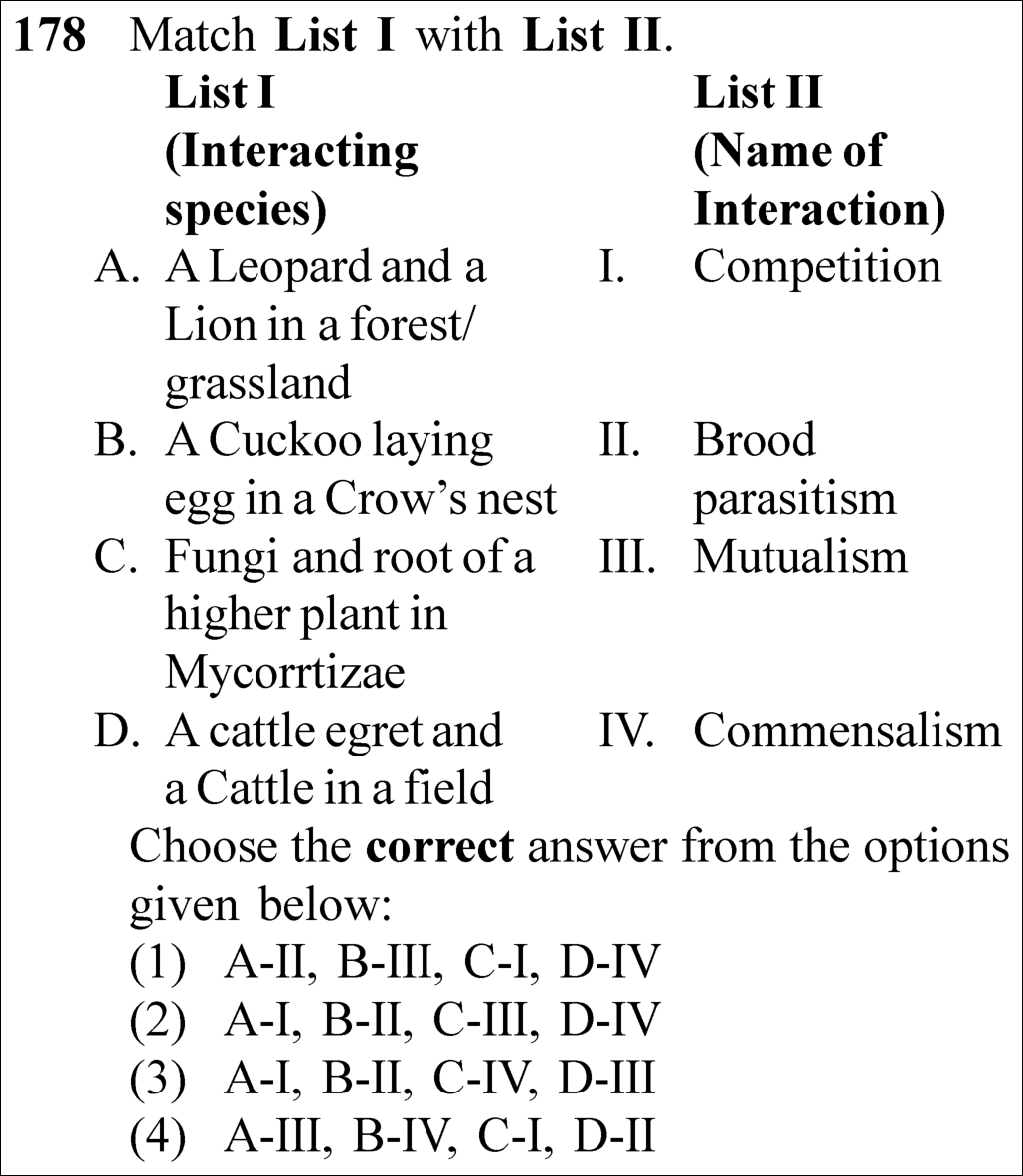
NEET 2023 · Q178 Easy
Official NEET 2023 Question 178 - Organisms and Populations
1
2 ✓ Key
3
4
💡 Verified Solution & 30-Second Hack
✓
Verified Against NTA Final Answer Key
Option (2) : A-I, B-II, C-III, D-IV
📚 Organisms and Populations Easy
📋 Given Parameters & Problem Setup
Interacting Species Pairs Leopard & Lion, Cuckoo & Crow, Fungi & Roots (Mycorrhizae), Cattle Egret & Cattle
Interaction Types Competition, Brood parasitism, Mutualism, Commensalism
⚡

The 30-Second Exam Hall Shortcut: ⚡ Classic Ecological Interaction Pairings

⏱️ Save ~25 seconds

Match classic ecological case studies: Leopard & Lion = Interspecific Competition (I). Cuckoo egg in Crow's nest = Brood parasitism (II). Mycorrhizae = Mutualism (III). Cattle egret foraging near grazing cattle = Commensalism (IV)! Match Option (2)!

1 Leopard and Lion competing for prey in shared habitat -> Interspecific Competition -> A-I.
2 Cuckoo laying eggs in Crow nest for foster rearing -> Brood parasitism -> B-II.
3 Mycorrhizae (Glomus fungi + higher plant roots) -> Mutualism -> C-III.
4 Cattle egret foraging on stirred-up insects near cattle -> Commensalism (+, 0) -> D-IV.
5 Match combination: A-I, B-II, C-III, D-IV -> Option (2).
🛡️
Why You Can 100% Trust This Shortcut: Canonical NCERT Organisms and Populations population interactions case studies.
📐

Step-by-Step Rigorous Workflow & Mathematical Proof

Step 1

Ecological Mechanisms of Listed Interactions

Analyzing the ecological dynamics of each species pair:

A. Leopard & Lion:Top carnivores competing for overlapping ungulate prey  ⟹  Competition (I)B. Cuckoo & Crow:Parasitic bird lays eggs in host nest mimicking host egg  ⟹  Brood Parasitism (II)C. Mycorrhizae:Fungi absorb minerals/phosphorus; plant supplies carbohydrates  ⟹  Mutualism (III)D. Cattle Egret & Cattle:Egret benefits from flushed insects (+); cattle unaffected (0)  ⟹  Commensalism (IV)\begin{aligned} \text{\textbf{A. Leopard \& Lion:}} & \quad \text{Top carnivores competing for overlapping ungulate prey} \implies \mathbf{\text{Competition (I)}} \\[4pt] \text{\textbf{B. Cuckoo \& Crow:}} & \quad \text{Parasitic bird lays eggs in host nest mimicking host egg} \implies \mathbf{\text{Brood Parasitism (II)}} \\[4pt] \text{\textbf{C. Mycorrhizae:}} & \quad \text{Fungi absorb minerals/phosphorus; plant supplies carbohydrates} \implies \mathbf{\text{Mutualism (III)}} \\[4pt] \text{\textbf{D. Cattle Egret \& Cattle:}} & \quad \text{Egret benefits from flushed insects (+); cattle unaffected (0)} \implies \mathbf{\text{Commensalism (IV)}} \end{aligned}
Step 2

Verbatim NCERT References

NCERT states under Population Interactions: - "Competition: In South American lakes, visiting flamingos and resident fishes compete for their common food... Leopard and lion compete for same prey." - "Brood parasitism in birds is a fascinating example... cuckoo (koel) and the crow." - "Mycorrhizae are associations between fungi and the roots of higher plants (Mutualism)." - "The cattle egret and grazing cattle in close association... a classic example of commensalism."

Step 3

Option Cross-Verification

A-I, B-II, C-III, D-IV corresponds directly to Option (2).

⭐

360° Option Elimination Engine Key Feature

Diagnose every choice: Know exactly why the right option works and why distractors fail.

4-Option Deep Scan
1 1
✗ Incorrect
Verdict & Scientific Reason:

Mismatches Leopard/Lion with brood parasitism.

⚠️
Student Fallacy (Why candidates pick this trap): Grossly misattributing avian reproductive parasitism to big cats.
2 2
✓ 100% Correct
Verdict & Scientific Reason:

Exact 1-to-1 match with all four canonical NCERT ecological interactions.

💡
Why this is airtight: None; textbook verbatim match.
3 3
✗ Incorrect
Verdict & Scientific Reason:

Inverts Mycorrhizae with commensalism and Egret/Cattle with mutualism.

⚠️
Student Fallacy (Why candidates pick this trap): Confusing obligate mutualism with facultative commensalism.
4 4
✗ Incorrect
Verdict & Scientific Reason:

Mismatches Leopard/Lion with mutualism.

⚠️
Student Fallacy (Why candidates pick this trap): Calling predator-predator conflict mutualism.
⚠️

NTA Trap Alert: Mutualism vs. Commensalism in Cattle Egret Trap

Students often wonder if the cattle benefit from the egret eating insects off their backs. NCERT explicitly states that the cattle are unaffected (00), while the egret benefits (++) by catching insects flushed out by moving vegetation, making it Commensalism.

🛡️ How to avoid the -1 mark: Cattle Egret & Grazing Cattle = Commensalism (+, 0). Mycorrhizae = Mutualism (+, +).
📖

Core NEET Syllabus Standard

NCERT Biology · Organisms and Populations Standard Benchmark
Core Scientific Principle Tested:

"Leopard and lion exhibit competition; Cuckoo and crow exhibit brood parasitism; Mycorrhizae is mutualism; Cattle egret and cattle is commensalism."

Syllabus Focus: Population Interactions
✓ Core NEET UG Syllabus Anchor Syllabus & Academic Standards ↗
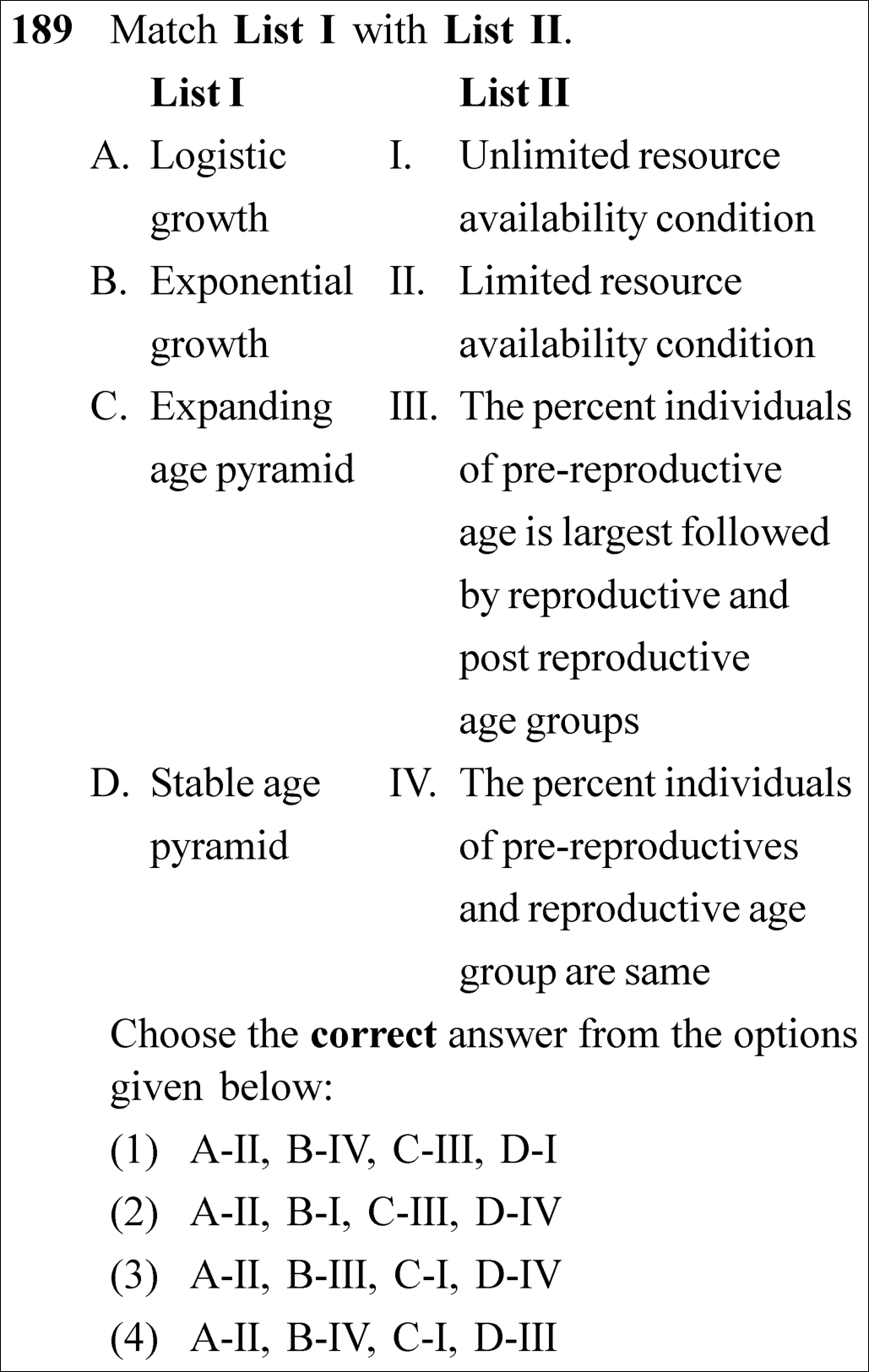
NEET 2023 · Q189 Easy
Official NEET 2023 Question 189 - Organisms and Populations
1
2 ✓ Key
3
4
💡 Verified Solution & 30-Second Hack
✓
Verified Against NTA Final Answer Key
Option (2) : A-II, B-I, C-III, D-IV
📚 Organisms and Populations Easy
📋 Given Parameters & Problem Setup
List I (Growth / Pyramid Types) Logistic growth, Exponential growth, Expanding age pyramid, Stable age pyramid
List II (Conditions / Structures) Unlimited resources, Limited resources, Pre-reproductive largest, Pre-reproductive equals reproductive
⚡

The 30-Second Exam Hall Shortcut: ⚡ Population Growth & Pyramid Matcher

⏱️ Save ~25 seconds

Match standard ecological definitions: Logistic growth = Limited resources / carrying capacity (II). Exponential growth = Unlimited resources (I). Expanding pyramid = Pre-reproductive population largest (III). Stable pyramid = Pre-reproductive equals reproductive (IV)! Match Option (2)!

1 Logistic growth: Resources are limited, growth reaches carrying capacity K -> A-II.
2 Exponential growth: Unlimited resource availability condition (J-shaped curve) -> B-I.
3 Expanding age pyramid: Triangular, percent individuals of pre-reproductive age is largest -> C-III.
4 Stable age pyramid: Bell-shaped, pre-reproductive and reproductive percent are nearly equal -> D-IV.
5 Match combination: A-II, B-I, C-III, D-IV -> Option (2).
🛡️
Why You Can 100% Trust This Shortcut: Canonical NCERT Organisms and Populations population dynamics and demography.
📐

Step-by-Step Rigorous Workflow & Mathematical Proof

Step 1

Population Growth Models and Resource Availability

Analyzing the population growth curves described in NCERT:

A. Logistic growth:dNdt=rN(K−NK)  ⟹  Limited resources (II)B. Exponential growth:dNdt=rN  ⟹  Unlimited resources (I)\begin{aligned} \text{\textbf{A. Logistic growth:}} & \quad \frac{dN}{dt} = rN\left(\frac{K-N}{K}\right) \implies \mathbf{\text{Limited resources (II)}} \\[4pt] \text{\textbf{B. Exponential growth:}} & \quad \frac{dN}{dt} = rN \implies \mathbf{\text{Unlimited resources (I)}} \end{aligned}
Step 2

Demographic Structure of Age Pyramids

Analyzing the age distribution profiles of human populations:

C. Expanding pyramid:Triangular: Pre-reproductive > Reproductive > Post-reproductive  ⟹  IIID. Stable pyramid:Bell-shaped: Pre-reproductive ≈ Reproductive  ⟹  IV\begin{aligned} \text{\textbf{C. Expanding pyramid:}} & \quad \text{Triangular: Pre-reproductive } > \text{ Reproductive } > \text{ Post-reproductive} \implies \mathbf{\text{III}} \\[4pt] \text{\textbf{D. Stable pyramid:}} & \quad \text{Bell-shaped: Pre-reproductive } \approx \text{ Reproductive} \implies \mathbf{\text{IV}} \end{aligned}
Step 3

Option Verification

Matching A-II, B-I, C-III, D-IV perfectly corresponds to Option (2).

⭐

360° Option Elimination Engine Key Feature

Diagnose every choice: Know exactly why the right option works and why distractors fail.

4-Option Deep Scan
1 1
✗ Incorrect
Verdict & Scientific Reason:

Mismatches Exponential growth with stable pyramid description.

⚠️
Student Fallacy (Why candidates pick this trap): Confusing growth curves with age structures.
2 2
✓ 100% Correct
Verdict & Scientific Reason:

Flawless 1-to-1 match with the canonical NCERT population growth and demography definitions.

💡
Why this is airtight: None; textbook verbatim match.
3 3
✗ Incorrect
Verdict & Scientific Reason:

Mismatches Exponential growth with expanding pyramid.

⚠️
Student Fallacy (Why candidates pick this trap): Swapping growth models and pyramid types.
4 4
✗ Incorrect
Verdict & Scientific Reason:

Scrambles all associations.

⚠️
Student Fallacy (Why candidates pick this trap): Random guessing.
⚠️

NTA Trap Alert: Expanding vs. Declining Age Pyramid Trap

Expanding = Pre-reproductive is largest (broad base). Stable = Pre-reproductive and reproductive are equal. Declining = Pre-reproductive is smaller than reproductive (narrow base).

🛡️ How to avoid the -1 mark: Broad base (largest pre-reproductive) = Expanding. Equal base and middle = Stable.
📖

Core NEET Syllabus Standard

NCERT Biology · Organisms and Populations Standard Benchmark
Core Scientific Principle Tested:

"Logistic growth occurs with limited resources; Exponential growth occurs with unlimited resources; Expanding pyramid has largest pre-reproductive age; Stable pyramid has equal pre-reproductive and reproductive groups."

Syllabus Focus: Population Growth & Age Pyramids
✓ Core NEET UG Syllabus Anchor Syllabus & Academic Standards ↗
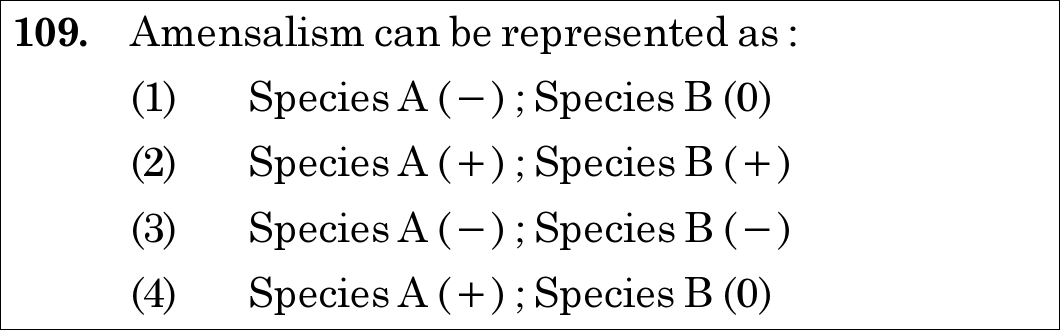
NEET 2021 · Q109 Easy
Official NEET 2021 Question 109 - Organisms and Populations
1 ✓ Key
2
3
4
💡 Verified Solution & 30-Second Hack
✓
Verified Against NTA Final Answer Key
Option (1) : Species A ( - ) ; Species B ( 0 )
📚 Organisms and Populations Easy
📋 Given Parameters & Problem Setup
Interaction Type Amensalism
Symbolism (+) Beneficial, (-) Detrimental, (0) Neutral
⚡

The 30-Second Exam Hall Shortcut: ⚡ Amensalism = "Harm and Neutral" = (- , 0)

⏱️ Save ~15 seconds

In amensalism, one species is harmed (-) while the other species is neither harmed nor benefited (0). For example, Penicillium secretes penicillin inhibiting bacteria without gaining or losing. Match Option (1)!

1 Mutualism: (+, +).
2 Competition: (-, -).
3 Predation & Parasitism: (+, -).
4 Commensalism: (+, 0).
5 Amensalism: (-, 0).
6 Match Option (1).
🛡️
Why You Can 100% Trust This Shortcut: Canonical NCERT Ecology taxonomy on Population Interactions.
📐

Step-by-Step Rigorous Workflow & Mathematical Proof

Step 1

Definition of Amensalism

Amensalism is an interspecific ecological interaction wherein one species suffers negative effects (inhibition, injury, or death) while the second species remains completely unaffected:

Amensalism  ⟺  {Species A:(−)[Harmed]Species B:(0)[Unaffected / Neutral]\text{Amensalism} \iff \begin{cases} \text{Species A:} & (-) \quad [\text{Harmed}] \\[4pt] \text{Species B:} & (0) \quad [\text{Unaffected / Neutral}] \end{cases}
Step 2

Biological Examples

Classic textbook manifestations include: - Antibiosis: *Penicillium notatum* secretes the antibiotic penicillin, destroying surrounding bacterial colonies while *Penicillium* itself experiences no nutritional or reproductive change (− ,0-\,, 0). - Allelopathy: Roots of Black Walnut (*Juglans nigra*) release juglone, inhibiting germination of nearby herbaceous seedlings without direct benefit to the tree.

⭐

360° Option Elimination Engine Key Feature

Diagnose every choice: Know exactly why the right option works and why distractors fail.

4-Option Deep Scan
1 1
✓ 100% Correct
Verdict & Scientific Reason:

Accurate representation of amensalism: one partner is inhibited/harmed (-) while the other remains neutral (0).

💡
Why this is airtight: None. Direct textbook match.
2 2
✗ Incorrect
Verdict & Scientific Reason:

Represents mutualism, where both interacting species derive positive fitness benefits.

⚠️
Student Fallacy (Why candidates pick this trap): Confusing amensalism with mutualism.
3 3
✗ Incorrect
Verdict & Scientific Reason:

Represents interspecific competition, where both interacting species suffer negative fitness impacts.

⚠️
Student Fallacy (Why candidates pick this trap): Confusing amensalism with competition.
4 4
✗ Incorrect
Verdict & Scientific Reason:

Represents commensalism, where one species benefits (+) and the other is unaffected (0).

⚠️
Student Fallacy (Why candidates pick this trap): Swapping the negative (-) sign for harm with the positive (+) sign for benefit, conflating amensalism with commensalism.
⚠️

NTA Trap Alert: Commensalism (+, 0) vs Amensalism (-, 0) Sign Inversion

Both interactions feature one neutral partner (0), making hasty candidates confuse (+, 0) for commensalism with (-, 0) for amensalism.

🛡️ How to avoid the -1 mark: Remember: "Co" = cooperate/benefit (+, 0) for Commensalism; "A" = Adversity/harm (-, 0) for Amensalism.
📖

Core NEET Syllabus Standard

NEET / NCERT Biology · Organisms and Populations Standard Benchmark
Core Scientific Principle Tested:

"In amensalism, one species is harmed whereas the other is unaffected."

Syllabus Focus: Population Interactions
✓ Core NEET UG Syllabus Anchor Syllabus & Academic Standards ↗
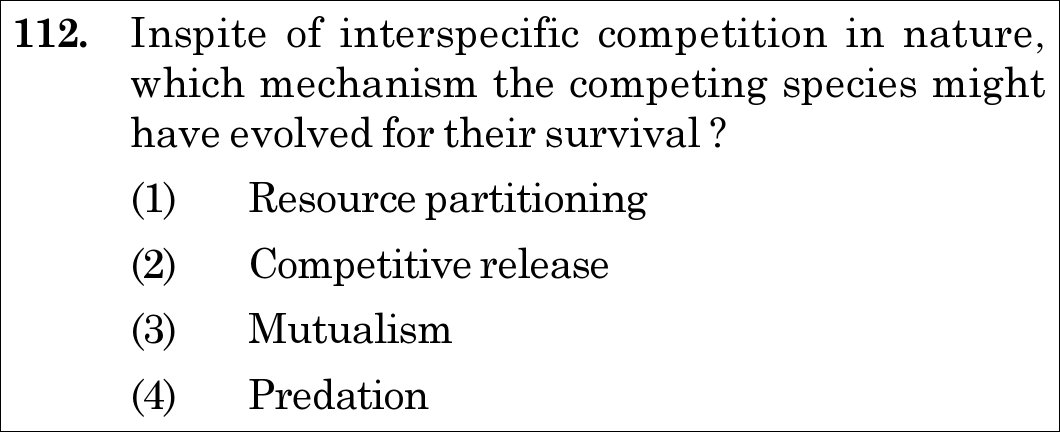
NEET 2021 · Q112 Easy
Official NEET 2021 Question 112 - Organisms and Populations
1 Resource partitioning ✓ Key
2 Competitive release
3 Mutualism
4 Predation
💡 Verified Solution & 30-Second Hack
✓
Verified Against NTA Final Answer Key
Option (1) : Resource partitioning
📚 Organisms and Populations Easy
📋 Given Parameters & Problem Setup
Ecological Force Interspecific competition in nature
Adaptive Outcome Mechanism evolved by competing species for coexistence/survival
⚡

The 30-Second Exam Hall Shortcut: ⚡ Competition Coexistence = Resource Partitioning (Warblers)

⏱️ Save ~15 seconds

Rather than facing competitive exclusion (Gause's Principle), competing species evolve Resource Partitioning—sharing resources by selecting different feeding times, foraging patterns, or microhabitats! Match Option (1)!

1 Gause's competitive exclusion states that two closely related species competing for identical limiting resources cannot coexist indefinitely.
2 However, competing species in nature evolve mechanisms that promote coexistence rather than exclusion.
3 One such primary evolutionary mechanism is Resource partitioning (e.g., MacArthur's five species of warblers).
4 Match Option (1).
🛡️
Why You Can 100% Trust This Shortcut: Canonical NCERT Ecology principles on Population Interactions and Competition.
📐

Step-by-Step Rigorous Workflow & Mathematical Proof

Step 1

Ecological Conflict and Gause's Principle

Gause's Competitive Exclusion Principle dictates that two species competing for the exact same limiting resource cannot coexist at constant population values; the inferior competitor is ultimately eliminated.

Step 2

Evolution of Resource Partitioning for Coexistence

To circumvent competitive exclusion, natural selection favors behavioral and morphological divergence:

Interspecific Competition→Natural SelectionResource Partitioning  ⟹  Coexistence without exclusion\text{Interspecific Competition} \xrightarrow{\text{Natural Selection}} \mathbf{\text{Resource Partitioning}} \implies \text{Coexistence without exclusion}
Step 3

Experimental Evidence (Robert MacArthur)

MacArthur demonstrated that five closely related species of warblers living on the same spruce tree were able to coexist without competitive exclusion by foraging at different heights, exploring different zones of the foliage, and adopting different hunting rhythms.

⭐

360° Option Elimination Engine Key Feature

Diagnose every choice: Know exactly why the right option works and why distractors fail.

4-Option Deep Scan
1 1
✓ 100% Correct
Verdict & Scientific Reason:

Resource partitioning enables competing species to avoid exclusion by choosing different feeding times or foraging patterns, ensuring coexistence.

💡
Why this is airtight: None. Direct textbook concept.
2 2
✗ Incorrect
Verdict & Scientific Reason:

Competitive release describes the dramatic expansion of a species' distributional range when a superior competitor is experimentally removed, not a coexistence adaptation.

⚠️
Student Fallacy (Why candidates pick this trap): Confusing the release phenomenon with the evolutionary adaptation for coexistence.
3 3
✗ Incorrect
Verdict & Scientific Reason:

Mutualism is an obligate (+, +) cooperation between species, not an evolutionary mechanism arising directly to resolve interspecific competition between ecological rivals.

⚠️
Student Fallacy (Why candidates pick this trap): Assuming any mechanism where species avoid conflict must be "mutualism".
4 4
✗ Incorrect
Verdict & Scientific Reason:

Predation is a trophic consumer-resource interaction (+, -), not a mechanism evolved between competing species at the same trophic guild.

⚠️
Student Fallacy (Why candidates pick this trap): Conflating competitive interactions with predatory interactions.
⚠️

NTA Trap Alert: Resource Partitioning vs Competitive Release

Both terms involve competition. Resource partitioning is what species evolve to coexist; Competitive release is what happens when one competitor is artificially taken away.

🛡️ How to avoid the -1 mark: Remember: "Partition = Divide & Share to Survive"   ⟹  \implies Resource Partitioning.
📖

Core NEET Syllabus Standard

NEET / NCERT Biology · Organisms and Populations Standard Benchmark
Core Scientific Principle Tested:

"If two species compete for the same resource, they could avoid competition by choosing different times for feeding or different foraging patterns (resource partitioning)."

Syllabus Focus: Population Interactions: Competition
✓ Core NEET UG Syllabus Anchor Syllabus & Academic Standards ↗
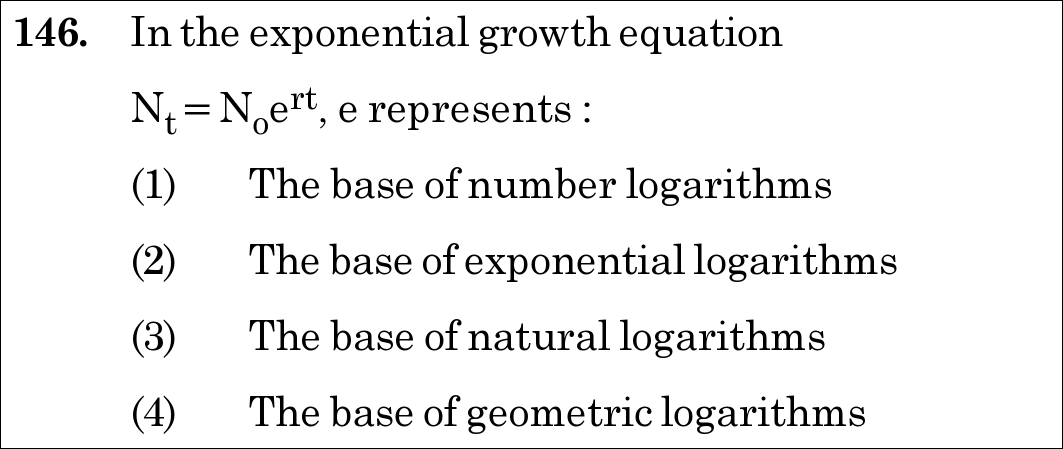
NEET 2021 · Q146 Easy
Official NEET 2021 Question 146 - Organisms and Populations
1 The base of number logarithms
2 The base of exponential logarithms
3 The base of natural logarithms ✓ Key
4 The base of geometric logarithms
💡 Verified Solution & 30-Second Hack
✓
Verified Against NTA Final Answer Key
Option (3) : The base of natural logarithms
📚 Organisms and Populations Easy
📋 Given Parameters & Problem Setup
Equation N_t = N_0 e^{rt}
Target Variable Physical/mathematical meaning of the base "e"
⚡

The 30-Second Exam Hall Shortcut: ⚡ Euler's Number "e" = Base of Natural Logarithms (ln)!

⏱️ Save ~10 seconds

In the integrated exponential growth equation Nt=N0ertN_t = N_0 e^{rt}, ee represents Euler's constant (e≈2.71828e \approx 2.71828), which is the base of natural logarithms (ln⁡\ln)! Match Option (3)!

1 NtN_t = Population density at time tt.
2 N0N_0 = Initial population density at time zero.
3 rr = Intrinsic rate of natural increase.
4 ee = Base of natural logarithms (approximately 2.71828).
5 Match Option (3).
🛡️
Why You Can 100% Trust This Shortcut: Canonical NCERT Organisms and Populations on Exponential Growth Formulations.
📐

Step-by-Step Rigorous Workflow & Mathematical Proof

Step 1

Derivation and Parameters of the Exponential Growth Curve

When resources in the habitat are unlimited, the rate of increase of population density is given by the differential equation:

dNdt=rN\frac{dN}{dt} = rN
Step 2

Integrated Exponential Equation

Integrating between limits N0N_0 and NtN_t over time duration tt yields the exponential form:

∫N0NtdNN=r∫0tdt  ⟹  ln⁡(NtN0)=rt  ⟹  Nt=N0ert\int_{N_0}^{N_t} \frac{dN}{N} = r \int_0^t dt \implies \ln\left(\frac{N_t}{N_0}\right) = rt \implies \mathbf{N_t = N_0 e^{rt}}
Step 3

Parameter Identification from Canonical NCERT Legend

The NCERT textbook explicitly lists the legend for this formula: - NtN_t = Population density after time tt - N0N_0 = Population density at time zero - rr = Intrinsic rate of natural increase - ee = The base of natural logarithms (2.718282.71828)

⭐

360° Option Elimination Engine Key Feature

Diagnose every choice: Know exactly why the right option works and why distractors fail.

4-Option Deep Scan
1 1
✗ Incorrect
Verdict & Scientific Reason:

Fictitious mathematical phrasing; common logarithms use base 10.

⚠️
Student Fallacy (Why candidates pick this trap): Confusing standard common logarithms with base e.
2 2
✗ Incorrect
Verdict & Scientific Reason:

Incorrect non-standard mathematical terminology.

⚠️
Student Fallacy (Why candidates pick this trap): Assuming exponential equation implies "exponential logarithms".
3 3
✓ 100% Correct
Verdict & Scientific Reason:

Exact mathematical and textbook definition of constant e (e=2.71828e = 2.71828, base of Napierian/natural logarithm ln).

💡
Why this is airtight: None. Textbook definition.
4 4
✗ Incorrect
Verdict & Scientific Reason:

Fabricated distractor term.

⚠️
Student Fallacy (Why candidates pick this trap): Conflating geometric growth with a non-existent "geometric logarithm".
⚠️

NTA Trap Alert: Common vs Natural Logarithm Confusion

Students who remember logarithms recall base 10 (common logs) rather than base e (natural logs, ln).

🛡️ How to avoid the -1 mark: Remember: ee is Euler's constant   ⟹  \implies base of NATURAL logarithms.
📖

Core NEET Syllabus Standard

NEET / NCERT Biology · Organisms and Populations Standard Benchmark
Core Scientific Principle Tested:

"The integral form of exponential growth is Nt = N0 e^(rt), where e is the base of natural logarithms (2.71828)."

Syllabus Focus: Populations: Population Growth Models
✓ Core NEET UG Syllabus Anchor Syllabus & Academic Standards ↗
NEET 2021 · Q190 Easy
Official NEET 2021 Question 190 - Organisms and Populations
1 Both (A) and (R) are true and (R) is the correct explanation of (A) ✓ Key
2 Both (A) and (R) are true but (R) is not the correct explanation of (A)
3 (A) is true but (R) is false
4 (A) is false but (R) is true
💡 Verified Solution & 30-Second Hack
✓
Verified Against NTA Final Answer Key
Option (1) : Both (A) and (R) are true and (R) is the correct explanation of (A)
📚 Organisms and Populations Easy
📋 Given Parameters & Problem Setup
Assertion (A) A person goes to high altitude and experiences ‘altitude sickness’ with symptoms like breathing difficulty and heart palpitations.
Reason (R) Due to low atmospheric pressure at high altitude, the body does not get sufficient oxygen.
⚡

The 30-Second Exam Hall Shortcut: ⚡ "Altitude Sickness is DIRECTLY Caused by Hypobaric Hypoxia (Low Patm → Low O₂)"

⏱️ Save ~20 seconds

At high altitudes (>3,500 m), low barometric atmospheric pressure reduces the partial pressure of oxygen (hypobaric hypoxia), so arterial blood cannot be fully saturated. This directly causes hyperventilation, palpitations, and fatigue! Both (A) and (R) are true, and (R) is the exact scientific cause of (A). Mark Option (1)!

1 Check Assertion (A): Altitude sickness symptoms include nausea, fatigue, heart palpitations, and dyspnea (breathing difficulty) at high altitude (>3,500 m) -> TRUE.
2 Check Reason (R): Low atmospheric pressure decreases alveolar pO2pO_2, causing arterial hypoxia -> TRUE.
3 Test causality: Why does the person experience breathing difficulty and palpitations? Because low atmospheric pressure deprives the body of adequate oxygen! (R) correctly explains (A).
4 Select Option (1).
🛡️
Why You Can 100% Trust This Shortcut: NCERT Biology · Organisms and Populations (Adaptations: Many people experience altitude sickness at high altitude (>3,500m Rohtang Pass). This is because in the low atmospheric pressure of high altitudes, the body does not get enough oxygen).
📐

Step-by-Step Rigorous Workflow & Mathematical Proof

Step 1

Physiological Etiology of Acute Altitude Sickness

When an unacclimatized human ascends rapidly to high altitude (such as Rohtang Pass near Manali, altitude >3,500 m), they experience acute mountain sickness: - Pathophysiology: Total barometric atmospheric pressure (PatmP_{\text{atm}}) decreases exponentially with altitude. Although the fractional concentration of oxygen remains ~21%, its partial pressure (pO2=0.21×PatmpO_2 = 0.21 \times P_{\text{atm}}) drops drastically. - Symptom Manifestations: Inadequate alveolar pO2pO_2 causes arterial hypoxia (tissue oxygen deprivation). The respiratory center in the brainstem stimulates rapid hyperventilation (breathing difficulty), while the sympathetic nervous system triggers tachycardia (heart palpitations) to increase cardiac output and compensate for diminished oxygen transport.

↑Altitude  ⟹  ↓Patm  ⟹  ↓pO2  ⟹  Arterial Hypoxia  ⟹  {↑Ventilation (Dyspnea)↑Heart Rate (Palpitations)\uparrow \text{Altitude} \implies \downarrow P_{\text{atm}} \implies \downarrow pO_2 \implies \text{Arterial Hypoxia} \implies \begin{cases} \uparrow \text{Ventilation (Dyspnea)} \\ \uparrow \text{Heart Rate (Palpitations)} \end{cases}
Step 2

Long-Term Acclimatization Responses

Gradually, the body acclimatizes to high altitude by: 1. Increasing red blood cell production (erythropoietin release from kidneys stimulating bone marrow erythropoiesis). 2. Increasing breathing rate. 3. Decreasing the binding affinity of haemoglobin for oxygen (shifting curve to right via elevated 2,3-BPG) to facilitate easier unloading of O2O_2 in systemic tissues.

⭐

360° Option Elimination Engine Key Feature

Diagnose every choice: Know exactly why the right option works and why distractors fail.

4-Option Deep Scan
1 1
✓ 100% Correct
Verdict & Scientific Reason:

Correct. (A) correctly describes the symptoms of altitude sickness, and (R) provides the direct causal biophysical mechanism (hypobaric hypoxia).

💡
Why this is airtight: None. Candidate establishes the direct cause-and-effect link.
2 2
✗ Incorrect
Verdict & Scientific Reason:

Incorrect. (R) is the exact causal explanation for (A).

⚠️
Student Fallacy (Why candidates pick this trap): Failing to see that oxygen deprivation is the direct reason for breathing difficulty and palpitations.
3 3
✗ Incorrect
Verdict & Scientific Reason:

Incorrect because Reason is a well-established physical fact.

⚠️
Student Fallacy (Why candidates pick this trap): Believing atmospheric pressure remains constant at altitude.
4 4
✗ Incorrect
Verdict & Scientific Reason:

Incorrect because Assertion accurately details standard altitude sickness symptoms.

⚠️
Student Fallacy (Why candidates pick this trap): Denying altitude sickness symptomology.
⚠️

NTA Trap Alert: Fractional O₂ vs Partial Pressure Confusion Trap

Some candidates think oxygen percentage decreases at high altitude. The percentage of O₂ in air is always ~21%; it is the *total atmospheric pressure* that drops, reducing the *partial pressure* of O₂. (R) correctly specifies "low atmospheric pressure".

🛡️ How to avoid the -1 mark: Recognize that hypobaric pressure is the physical driver of hypoxia.
📖

Core NEET Syllabus Standard

NEET / NCERT Biology · Organisms and Populations Standard Benchmark
Core Scientific Principle Tested:

"Low atmospheric pressure at high altitudes leads to insufficient oxygen delivery, causing altitude sickness."

Syllabus Focus: Physiological Adaptations
✓ Core NEET UG Syllabus Anchor Syllabus & Academic Standards ↗
NEET 2021 · Q197 Medium
Official NEET 2021 Question 197 - Organisms and Populations
1 (iv) (ii) (iii) (i)
2 (iv) (i) (iii) (ii)
3 (iv) (i) (ii) (iii) ✓ Key
4 (iv) (iii) (ii) (i)
💡 Verified Solution & 30-Second Hack
✓
Verified Against NTA Final Answer Key
Option (3) : (a)-(iv), (b)-(i), (c)-(ii), (d)-(iii)
📚 Organisms and Populations Medium
📋 Given Parameters & Problem Setup
List I (Adaptation Rules / Classes) (a) Allen's Rule, (b) Physiological adaptation, (c) Behavioural adaptation, (d) Biochemical adaptation
List II (Organisms) (i) Kangaroo rat, (ii) Desert lizard, (iii) Marine fish at depth, (iv) Polar seal
⚡

The 30-Second Exam Hall Shortcut: ⚡ "Allen's Rule = Polar Seal, Behavioural = Desert Lizard, Physiological = Kangaroo Rat"

⏱️ Save ~30 seconds

Allen's rule states cold-climate mammals have shorter extremities, exemplified by polar seals with short flippers & blubber ((a)-(iv)). Desert lizards regulate body temperature purely through behaviour by basking in sun and moving to shade ((c)-(ii)). Kangaroo rat concentrates urine and oxidizes fat physiologically ((b)-(i)). Marine fish survive crushing deep pressure biochemically ((d)-(iii)). Match is (iv), (i), (ii), (iii) -> Option (3)!

1 Match (a) Allen's Rule -> (iv) Polar seal (blubber and reduced extremities to prevent heat loss).
2 Match (b) Physiological adaptation -> (i) Kangaroo rat (internal fat oxidation for metabolic water and hyper-concentrated urine).
3 Match (c) Behavioural adaptation -> (ii) Desert lizard (basks in sun when cold, retreats to shade/burrows when hot).
4 Match (d) Biochemical adaptation -> (iii) Marine fish at depth (specialized enzymes and pressure-resistant biochemical machinery).
5 Match pattern (iv), (i), (ii), (iii) -> Option (3).
🛡️
Why You Can 100% Trust This Shortcut: NCERT Biology · Organisms and Populations (Adaptations: Mammals from colder climates generally have shorter ears and limbs to minimise heat loss (Allen’s Rule) - seal in polar seas; Kangaroo rat in North American deserts can meet all water requirements through internal fat oxidation; Desert lizards lack physiological regulation and manage body temperature behaviourally; Marine invertebrates and fish thrive at great ocean depths through biochemical adaptations).
📐

Step-by-Step Rigorous Workflow & Mathematical Proof

Step 1

Analysis of Each Adaptation Class and Classic NCERT Type Specimen

- (a) Allen’s Rule: Formulated by Joel Asaph Allen: Mammals from colder climates generally possess shorter ears, limbs, and extremities to minimize surface area-to-volume ratio and reduce conductive heat loss. In polar seas, aquatic mammals like the polar seal exhibit shortened flippers and an insulating subcutaneous fat layer (blubber). - (b) Physiological Adaptation: The Kangaroo rat (*Dipodomys*) of North American deserts is capable of living without drinking liquid water: it fulfills 90% of its water requirements via the endogenous physiological oxidation of internal storage fat (producing metabolic water) and possesses elongated loops of Henle that concentrate its urine to hyperosmolar levels. - (c) Behavioural Adaptation: Desert lizards lack the internal physiological capacity for autonomic thermoregulation (homeothermy). Instead, they manage body temperature behaviourally: they bask in the morning sun to absorb solar radiation when body temperature drops below comfort zone, and scurry into subterranean burrows or shaded crevices when ambient temperatures climb. - (d) Biochemical Adaptation: Organisms living in extreme marine abyssal depths (where hydrostatic pressure exceeds 100 atmospheres) possess biochemical adaptations, including piezolyte pressure-protecting osmolytes (TMAO) and specialized membrane unsaturations that keep membranes fluid and enzymes functional under immense hydrostatic crush forces.

Allen’s Rule  ⟺  Polar seal[(a)→(iv)]Physiological adaptation  ⟺  Kangaroo rat[(b)→(i)]Behavioural adaptation  ⟺  Desert lizard[(c)→(ii)]Biochemical adaptation  ⟺  Marine fish at depth[(d)→(iii)]\begin{aligned} \text{Allen's Rule} &\iff \text{Polar seal} \quad [\text{(a)} \to \text{(iv)}] \\ \text{Physiological adaptation} &\iff \text{Kangaroo rat} \quad [\text{(b)} \to \text{(i)}] \\ \text{Behavioural adaptation} &\iff \text{Desert lizard} \quad [\text{(c)} \to \text{(ii)}] \\ \text{Biochemical adaptation} &\iff \text{Marine fish at depth} \quad [\text{(d)} \to \text{(iii)}] \end{aligned}
Step 2

Option Alignment and Conclusion

Sequence of matches: (a)-(iv), (b)-(i), (c)-(ii), (d)-(iii). This corresponds uniquely to Option (3).

⭐

360° Option Elimination Engine Key Feature

Diagnose every choice: Know exactly why the right option works and why distractors fail.

4-Option Deep Scan
1 1
✗ Incorrect
Verdict & Scientific Reason:

Incorrect. Assigns physiological adaptation to desert lizard and biochemical adaptation to kangaroo rat.

⚠️
Student Fallacy (Why candidates pick this trap): Swapping behavioural adaptation with physiological/biochemical categories.
2 2
✗ Incorrect
Verdict & Scientific Reason:

Incorrect. Misidentifies marine fish as behavioural and desert lizard as biochemical.

⚠️
Student Fallacy (Why candidates pick this trap): Failing to remember that desert lizards regulate body temperature behaviourally.
3 3
✓ 100% Correct
Verdict & Scientific Reason:

Correct. Flawlessly aligns all 4 adaptation classes with their canonical NCERT textbook examples.

💡
Why this is airtight: None. Candidate accurately connects each adaptation mechanism.
4 4
✗ Incorrect
Verdict & Scientific Reason:

Incorrect. Assigns marine fish to physiological and kangaroo rat to biochemical adaptation.

⚠️
Student Fallacy (Why candidates pick this trap): Confusing internal physiological water retention with deep ocean pressure biochemistry.
⚠️

NTA Trap Alert: Physiological vs Behavioural Desert Adaptation Trap

Both the kangaroo rat and the desert lizard live in hot, arid deserts. The critical distinction is that the kangaroo rat adapts *physiologically* (fat oxidation and renal urine concentration), whereas the desert lizard adapts *behaviourally* (basking in sun vs moving to shade).

🛡️ How to avoid the -1 mark: Remember: Lizard = Basking Behaviour; Kangaroo rat = Internal Metabolic Physiology.
📖

Core NEET Syllabus Standard

NEET / NCERT Biology · Organisms and Populations Standard Benchmark
Core Scientific Principle Tested:

"Polar seal illustrates Allen’s rule; kangaroo rat exhibits physiological adaptation; desert lizard exhibits behavioural adaptation; deep marine fish exhibit biochemical adaptation."

Syllabus Focus: Adaptations
✓ Core NEET UG Syllabus Anchor Syllabus & Academic Standards ↗
NEET 2020 · Q1 Easy
Official NEET 2020 Question 1 - Organisms and Populations
1 Sex ratio
2 Natality
3 Mortality
4 Species interaction ✓ Key
💡 Verified Solution & 30-Second Hack
✓
Verified Against NTA Final Answer Key
Option (4) : Species interaction
📚 Organisms and Populations Easy
📋 Given Parameters & Problem Setup
Ecological Level Population (Single Species Group)
Question Objective Identify which listed feature is NOT an attribute of a population
⚡

The 30-Second Exam Hall Shortcut: ⚡ "Populations Have Vital Statistics: Species Interaction is a Community Trait!"

⏱️ Save ~20 seconds

A biological population possesses demographic group metrics: Birth rate (natality), Death rate (mortality), Sex ratio, and Age pyramids. Interspecific interaction (predation, mutualism, parasitism) requires TWO or more species, making it a Community attribute! Mark Option (4) in 10 seconds.

1 Recall NCERT definition of a population: A group of individuals of the same species living in a given geographical area.
2 Identify true population attributes: Natality (birth rate), Mortality (death rate), Sex ratio, Age distribution.
3 Analyze Option (4): "Species interaction" involves interactions between different populations (Community level ecology).
4 Option (4) is NOT a population attribute.
🛡️
Why You Can 100% Trust This Shortcut: NCERT Biology · Organisms and Populations (Population Attributes: An individual may have births and deaths, but a population has birth rates and death rates. Another attribute characteristic of a population is sex ratio. Species interactions like mutualism and predation occur at the community level).
📐

Step-by-Step Rigorous Workflow & Mathematical Proof

Step 1

Definition and Statistical Metrics of a Population

In ecology, a population is defined as a group of individuals belonging to the same species that inhabit a defined geographic area, share or compete for similar resources, and potentially interbreed. While individual organisms are born, die, and have a male or female sex, a population exhibits aggregate demographic attributes: - Natality (Birth Rate): Number of births per unit of population per unit time. - Mortality (Death Rate): Number of deaths per unit of population per unit time. - Sex Ratio: Ratio of males to females within the population. - Age Distribution / Pyramids: Proportion of individuals in pre-reproductive, reproductive, and post-reproductive age groups.

Population Attributes={Natality, Mortality, Sex Ratio, Age Pyramids, Population Density (N)}\textbf{Population Attributes} = \{ \text{Natality}, \, \text{Mortality}, \, \text{Sex Ratio}, \, \text{Age Pyramids}, \, \text{Population Density } (N) \}
Step 2

Community Ecology: Why Species Interaction is Distinct

Species interactions (such as mutualism, competition, predation, parasitism, commensalism, and amensalism) occur between populations of two or more distinct species coexisting within a habitat. Therefore, species interactions operate at the biotic community level, not as an intrinsic demographic attribute of a single-species population.

⭐

360° Option Elimination Engine Key Feature

Diagnose every choice: Know exactly why the right option works and why distractors fail.

4-Option Deep Scan
1 A
✗ Incorrect
Verdict & Scientific Reason:

Incorrect. Sex ratio is a canonical population attribute (e.g. 60% of the population are females and 40% are males).

⚠️
Student Fallacy (Why candidates pick this trap): Confusing individual sex (male/female) with the population demographic ratio.
2 B
✗ Incorrect
Verdict & Scientific Reason:

Incorrect. Natality (birth rate per capita) is one of the foundational demographic attributes of a population.

⚠️
Student Fallacy (Why candidates pick this trap): Failing to recognize natality as the ecological term for birth rate.
3 C
✗ Incorrect
Verdict & Scientific Reason:

Incorrect. Mortality (death rate per capita) is a core population attribute determining population growth rate.

⚠️
Student Fallacy (Why candidates pick this trap): Confusing individual death with population mortality rate.
4 D
✓ 100% Correct
Verdict & Scientific Reason:

Correct as the non-attribute. Interspecific interaction occurs between different species and is a biological community attribute.

💡
Why this is airtight: None. Candidate correctly distinguishes population ecology from community ecology.
⚠️

NTA Trap Alert: Individual vs Population vs Community Level Trap

An individual has birth, death, and sex. A population has birth rate (natality), death rate (mortality), and sex ratio. A community has species diversity and interspecific interactions. Do not blur hierarchical ecological levels.

🛡️ How to avoid the -1 mark: Remember: One species = Population; Two or more species interacting = Community.
📖

Core NEET Syllabus Standard

NEET / NCERT Biology · Organisms and Populations Standard Benchmark
Core Scientific Principle Tested:

"Sex ratio, natality, and mortality are population attributes; interspecific interactions occur at the community level."

Syllabus Focus: Population Attributes
✓ Core NEET UG Syllabus Anchor Syllabus & Academic Standards ↗
NEET 2020 · Q41 Easy
Official NEET 2020 Question 41 - Organisms and Populations
1 Nutritive value
2 Growth response
3 Defence action ✓ Key
4 Effect on reproduction
💡 Verified Solution & 30-Second Hack
✓
Verified Against NTA Final Answer Key
Option (3) : Defence action
📚 Organisms and Populations Easy
📋 Given Parameters & Problem Setup
Chemical Classes Secondary metabolites: Nicotine, strychnine, caffeine, morphine, quinine
Question Objective Identify why plants produce these compounds in nature
⚡

The 30-Second Exam Hall Shortcut: ⚡ "Secondary Metabolites in Plants = Chemical DEFENCE Against Herbivores!"

⏱️ 25 seconds

Plants cannot run away from grazers and browsers, so they synthesize toxic/distasteful secondary metabolites (nicotine, caffeine, strychnine, cardiac glycosides) strictly as chemical DEFENCE mechanisms! Mark Defence action (Option 3) in 5 seconds.

1 Secondary metabolites do not serve direct nutritional or reproductive functions in plants.
2 They act as repellents, toxins, and anti-feedants against herbivores.
3 Select Option (3) Defence action.
🛡️
Why You Can 100% Trust This Shortcut: NCERT Biology · Organisms and Populations (Predation & Chemical Defenses in Plants)
📐

Step-by-Step Rigorous Workflow & Mathematical Proof

Step 1

Define Plant Secondary Metabolites

Secondary metabolites (alkaloids, tannins, terpenoids, resins, cardiac glycosides) are organic compounds not directly involved in the primary processes of plant growth, development, or reproduction.

Step 2

Evolutionary and Ecological Function

Because sessile plants cannot flee from predators (herbivores and browsers), they have evolved morphological defenses (thorns, spines) and chemical defenses (toxic secondary metabolites) to deter grazing.

Step 3

Specific Examples in NCERT

NCERT explicitly highlights that a wide variety of chemical substances that we extract from plants on a commercial scale (nicotine, caffeine, quinine, strychnine, opium) are produced by them actually as defenses against grazers and browsers.

Step 4

Eliminate Other Options

These toxic alkaloids have zero nutritive value for the plant, do not regulate growth (auxins/gibberellins do), and are not reproductive attractants.

⭐

360° Option Elimination Engine Key Feature

Diagnose every choice: Know exactly why the right option works and why distractors fail.

4-Option Deep Scan
1 A
✗ Incorrect
Verdict & Scientific Reason:

Incorrect; secondary metabolites provide no nutrition to the plant; primary metabolites (sugars, proteins, lipids) provide nutrition.

⚠️
Student Fallacy (Why candidates pick this trap): Thinking of human commercial uses of plant extracts.
2 B
✗ Incorrect
Verdict & Scientific Reason:

Incorrect; plant growth responses are orchestrated by phytohormones (auxins, cytokinins, gibberellins), not toxic alkaloids.

⚠️
Student Fallacy (Why candidates pick this trap): Confusing plant defense chemicals with growth regulators.
3 C
✓ 100% Correct
Verdict & Scientific Reason:

Factually exact; plants produce these bitter and toxic alkaloids specifically to defend against herbivory and predation.

💡
Why this is airtight: None; explicit ecological concept in NCERT.
4 D
✗ Incorrect
Verdict & Scientific Reason:

Incorrect; floral scents and nectar aid reproduction; toxic alkaloids in leaves and stems serve defensive roles.

⚠️
Student Fallacy (Why candidates pick this trap): Confusing pollination rewards with unpalatable vegetative defenses.
⚠️

NTA Trap Alert: Human Utility vs Plant Adaptive Function

Humans utilize nicotine, caffeine, and quinine for medicinal, pharmacological, or stimulant purposes, but the evolutionary reason the plant produces them is strictly PREDATION DEFENSE.

🛡️ How to avoid the -1 mark: Always view botanical chemistry through the lens of natural selection: Sessile plant + toxin = DEFENSE against herbivores!
📖

Core NEET Syllabus Standard

Botany · Organisms and Populations Standard Benchmark
Core Scientific Principle Tested:

""

Syllabus Focus: Ecological Role of Secondary Metabolites: Defense Against Herbivores
✓ Core NEET UG Syllabus Anchor Syllabus & Academic Standards ↗

Solve 4 NEET Questions a Day — One per Subject

Cover all 1,140 official NEET questions in 285 days at your own pace. Progress is saved on your device. No login needed.