MyCompetitiveExams Logo MyCompetitiveExams
Search 1,140+ Questions
Chapters, formulas, speed tricks
→
⚡ Brahmastra NEET 2027
720 MARKS

Dynamic 180-question full-length simulator mixed dynamically from all 6 years for 2027 & 2026 aspirants.

Launch Brahmastra 2027 Test →
Start Practice →
100% Free · No Login Required
Q.1 Botany ⭐ 360° Option Elimination Active
Vault ↗

NEET 2020 Botany Question 1 Solution

Topic: Organisms and Populations · Official NTA Booklet Code E1
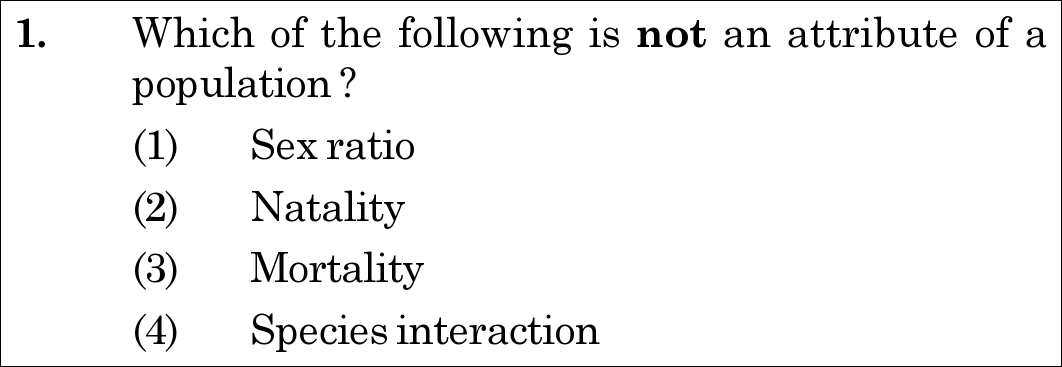
NEET 2020 Botany Question 1: Population Attributes vs Community Ecological Interactions

Question

Which of the following is not an attribute of a population?

  1. (1)Sex ratio
  2. (2)Natality
  3. (3)Mortality
  4. (4)Species interaction
✓
Verified Against NTA Final Answer Key
Option (4) : Species interaction
📚 Organisms and Populations Easy
📋 Given Parameters & Problem Setup
Ecological Level Population (Single Species Group)
Question Objective Identify which listed feature is NOT an attribute of a population
⚡

The 30-Second Exam Hall Shortcut: ⚡ "Populations Have Vital Statistics: Species Interaction is a Community Trait!"

⏱️ Save ~20 seconds

A biological population possesses demographic group metrics: Birth rate (natality), Death rate (mortality), Sex ratio, and Age pyramids. Interspecific interaction (predation, mutualism, parasitism) requires TWO or more species, making it a Community attribute! Mark Option (4) in 10 seconds.

1 Recall NCERT definition of a population: A group of individuals of the same species living in a given geographical area.
2 Identify true population attributes: Natality (birth rate), Mortality (death rate), Sex ratio, Age distribution.
3 Analyze Option (4): "Species interaction" involves interactions between different populations (Community level ecology).
4 Option (4) is NOT a population attribute.
🛡️
Why You Can 100% Trust This Shortcut: NCERT Biology · Organisms and Populations (Population Attributes: An individual may have births and deaths, but a population has birth rates and death rates. Another attribute characteristic of a population is sex ratio. Species interactions like mutualism and predation occur at the community level).
📐

Step-by-Step Rigorous Workflow & Mathematical Proof

Step 1

Definition and Statistical Metrics of a Population

In ecology, a population is defined as a group of individuals belonging to the same species that inhabit a defined geographic area, share or compete for similar resources, and potentially interbreed. While individual organisms are born, die, and have a male or female sex, a population exhibits aggregate demographic attributes: - Natality (Birth Rate): Number of births per unit of population per unit time. - Mortality (Death Rate): Number of deaths per unit of population per unit time. - Sex Ratio: Ratio of males to females within the population. - Age Distribution / Pyramids: Proportion of individuals in pre-reproductive, reproductive, and post-reproductive age groups.

Population Attributes={Natality, Mortality, Sex Ratio, Age Pyramids, Population Density (N)}\textbf{Population Attributes} = \{ \text{Natality}, \, \text{Mortality}, \, \text{Sex Ratio}, \, \text{Age Pyramids}, \, \text{Population Density } (N) \}
Step 2

Community Ecology: Why Species Interaction is Distinct

Species interactions (such as mutualism, competition, predation, parasitism, commensalism, and amensalism) occur between populations of two or more distinct species coexisting within a habitat. Therefore, species interactions operate at the biotic community level, not as an intrinsic demographic attribute of a single-species population.

⭐

360° Option Elimination Engine Key Feature

Diagnose every choice: Know exactly why the right option works and why distractors fail.

4-Option Deep Scan
1 A
✗ Incorrect
Verdict & Scientific Reason:

Incorrect. Sex ratio is a canonical population attribute (e.g. 60% of the population are females and 40% are males).

⚠️
Student Fallacy (Why candidates pick this trap): Confusing individual sex (male/female) with the population demographic ratio.
2 B
✗ Incorrect
Verdict & Scientific Reason:

Incorrect. Natality (birth rate per capita) is one of the foundational demographic attributes of a population.

⚠️
Student Fallacy (Why candidates pick this trap): Failing to recognize natality as the ecological term for birth rate.
3 C
✗ Incorrect
Verdict & Scientific Reason:

Incorrect. Mortality (death rate per capita) is a core population attribute determining population growth rate.

⚠️
Student Fallacy (Why candidates pick this trap): Confusing individual death with population mortality rate.
4 D
✓ 100% Correct
Verdict & Scientific Reason:

Correct as the non-attribute. Interspecific interaction occurs between different species and is a biological community attribute.

💡
Why this is airtight: None. Candidate correctly distinguishes population ecology from community ecology.
⚠️

NTA Trap Alert: Individual vs Population vs Community Level Trap

An individual has birth, death, and sex. A population has birth rate (natality), death rate (mortality), and sex ratio. A community has species diversity and interspecific interactions. Do not blur hierarchical ecological levels.

🛡️ How to avoid the -1 mark: Remember: One species = Population; Two or more species interacting = Community.
📖

Core NEET Syllabus Standard

NEET / NCERT Biology · Organisms and Populations Standard Benchmark
Core Scientific Principle Tested:

"Sex ratio, natality, and mortality are population attributes; interspecific interactions occur at the community level."

Syllabus Focus: Population Attributes
✓ Core NEET UG Syllabus Anchor Syllabus & Academic Standards ↗

Ready to attempt under real exam pressure?

Test your speed and accuracy in the authentic 180-minute timed NTA simulator.

Launch NEET 2020 CBT Test →

Spotted a mistake in this solution? Report an error ([email protected])

⚖️ Legal & Fair Dealing Notice: Sourced from publicly released NEET 2020 question papers and NEET answer keys for private study, research, and non-commercial educational practice under Fair Dealing (Section 52(1)(a) of the Indian Copyright Act, 1957). Not affiliated with or endorsed by NTA or NMC.

Solve 4 NEET Questions a Day — One per Subject

Cover all 1,140 official NEET questions in 285 days at your own pace. Progress is saved on your device. No login needed.