MyCompetitiveExams Logo MyCompetitiveExams
Search 1,140+ Questions
Chapters, formulas, speed tricks
→
⚡ Brahmastra NEET 2027
720 MARKS

Dynamic 180-question full-length simulator mixed dynamically from all 6 years for 2027 & 2026 aspirants.

Launch Brahmastra 2027 Test →
Start Practice →
100% Free · No Login Required
Q.146 Botany ⭐ 360° Option Elimination Active
Vault ↗

NEET 2021 Botany Question 146 Solution

Topic: Organisms and Populations · Official NTA Booklet Code M1
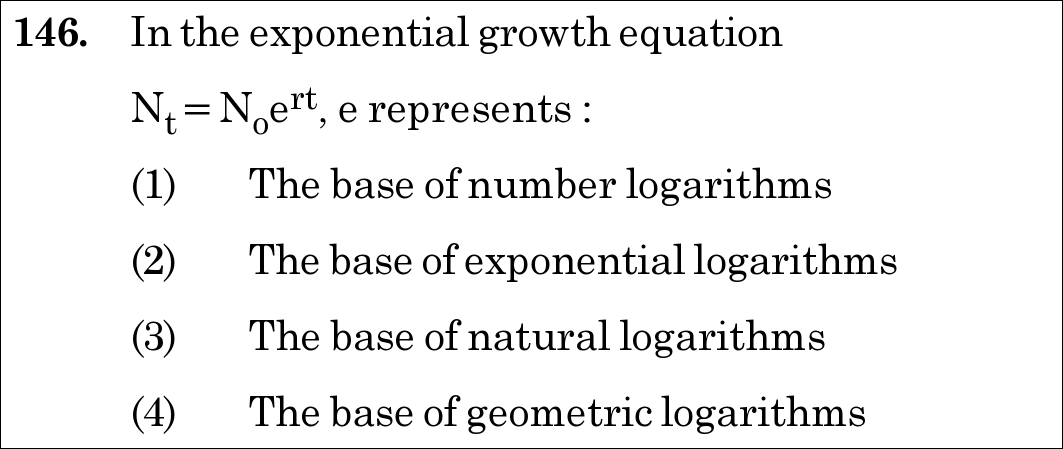
NEET 2021 Botany Question 146: Mathematical Formulation of Exponential Population Growth

Question

In the exponential growth equation Nt=Noert, e represents:

  1. (1)The base of number logarithms
  2. (2)The base of exponential logarithms
  3. (3)The base of natural logarithms
  4. (4)The base of geometric logarithms
✓
Verified Against NTA Final Answer Key
Option (3) : The base of natural logarithms
📚 Organisms and Populations Easy
📋 Given Parameters & Problem Setup
Equation N_t = N_0 e^{rt}
Target Variable Physical/mathematical meaning of the base "e"
⚡

The 30-Second Exam Hall Shortcut: ⚡ Euler's Number "e" = Base of Natural Logarithms (ln)!

⏱️ Save ~10 seconds

In the integrated exponential growth equation Nt=N0ertN_t = N_0 e^{rt}, ee represents Euler's constant (e≈2.71828e \approx 2.71828), which is the base of natural logarithms (ln⁡\ln)! Match Option (3)!

1 NtN_t = Population density at time tt.
2 N0N_0 = Initial population density at time zero.
3 rr = Intrinsic rate of natural increase.
4 ee = Base of natural logarithms (approximately 2.71828).
5 Match Option (3).
🛡️
Why You Can 100% Trust This Shortcut: Canonical NCERT Organisms and Populations on Exponential Growth Formulations.
📐

Step-by-Step Rigorous Workflow & Mathematical Proof

Step 1

Derivation and Parameters of the Exponential Growth Curve

When resources in the habitat are unlimited, the rate of increase of population density is given by the differential equation:

dNdt=rN\frac{dN}{dt} = rN
Step 2

Integrated Exponential Equation

Integrating between limits N0N_0 and NtN_t over time duration tt yields the exponential form:

∫N0NtdNN=r∫0tdt  ⟹  ln⁡(NtN0)=rt  ⟹  Nt=N0ert\int_{N_0}^{N_t} \frac{dN}{N} = r \int_0^t dt \implies \ln\left(\frac{N_t}{N_0}\right) = rt \implies \mathbf{N_t = N_0 e^{rt}}
Step 3

Parameter Identification from Canonical NCERT Legend

The NCERT textbook explicitly lists the legend for this formula: - NtN_t = Population density after time tt - N0N_0 = Population density at time zero - rr = Intrinsic rate of natural increase - ee = The base of natural logarithms (2.718282.71828)

⭐

360° Option Elimination Engine Key Feature

Diagnose every choice: Know exactly why the right option works and why distractors fail.

4-Option Deep Scan
1 1
✗ Incorrect
Verdict & Scientific Reason:

Fictitious mathematical phrasing; common logarithms use base 10.

⚠️
Student Fallacy (Why candidates pick this trap): Confusing standard common logarithms with base e.
2 2
✗ Incorrect
Verdict & Scientific Reason:

Incorrect non-standard mathematical terminology.

⚠️
Student Fallacy (Why candidates pick this trap): Assuming exponential equation implies "exponential logarithms".
3 3
✓ 100% Correct
Verdict & Scientific Reason:

Exact mathematical and textbook definition of constant e (e=2.71828e = 2.71828, base of Napierian/natural logarithm ln).

💡
Why this is airtight: None. Textbook definition.
4 4
✗ Incorrect
Verdict & Scientific Reason:

Fabricated distractor term.

⚠️
Student Fallacy (Why candidates pick this trap): Conflating geometric growth with a non-existent "geometric logarithm".
⚠️

NTA Trap Alert: Common vs Natural Logarithm Confusion

Students who remember logarithms recall base 10 (common logs) rather than base e (natural logs, ln).

🛡️ How to avoid the -1 mark: Remember: ee is Euler's constant   ⟹  \implies base of NATURAL logarithms.
📖

Core NEET Syllabus Standard

NEET / NCERT Biology · Organisms and Populations Standard Benchmark
Core Scientific Principle Tested:

"The integral form of exponential growth is Nt = N0 e^(rt), where e is the base of natural logarithms (2.71828)."

Syllabus Focus: Populations: Population Growth Models
✓ Core NEET UG Syllabus Anchor Syllabus & Academic Standards ↗

Ready to attempt under real exam pressure?

Test your speed and accuracy in the authentic 200-minute timed NTA simulator.

Launch NEET 2021 CBT Test →

Spotted a mistake in this solution? Report an error ([email protected])

⚖️ Legal & Fair Dealing Notice: Sourced from publicly released NEET 2021 question papers and NEET answer keys for private study, research, and non-commercial educational practice under Fair Dealing (Section 52(1)(a) of the Indian Copyright Act, 1957). Not affiliated with or endorsed by NTA or NMC.

Solve 4 NEET Questions a Day — One per Subject

Cover all 1,140 official NEET questions in 285 days at your own pace. Progress is saved on your device. No login needed.