MyCompetitiveExams Logo MyCompetitiveExams
Search 1,140+ Questions
Chapters, formulas, speed tricks
→
⚡ Brahmastra NEET 2027
720 MARKS

Dynamic 180-question full-length simulator mixed dynamically from all 6 years for 2027 & 2026 aspirants.

Launch Brahmastra 2027 Test →
Start Practice →
100% Free · No Login Required
Q.147 Botany ⭐ 360° Option Elimination Active
Vault ↗

NEET 2021 Botany Question 147 Solution

Topic: Biotechnology and its Applications · Official NTA Booklet Code M1
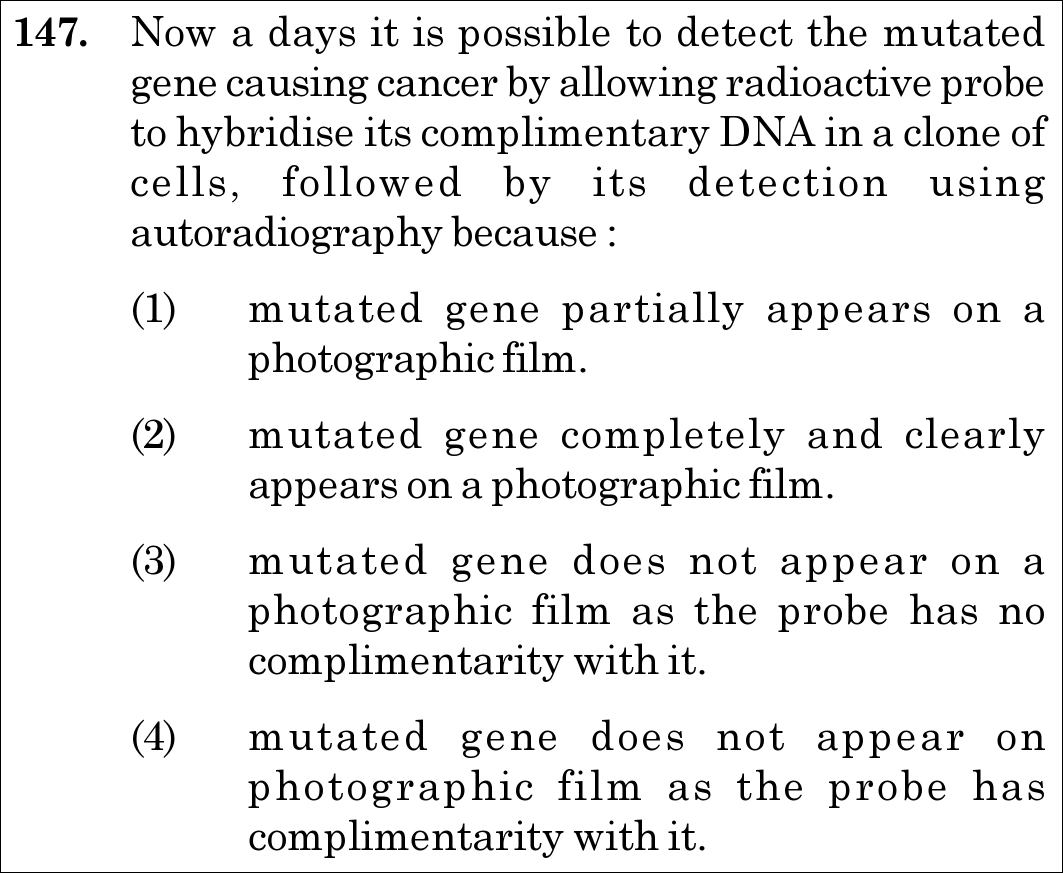
NEET 2021 Botany Question 147: Detection of Mutated Cancer Genes by Radioactive Probe Hybridization

Question

Now a days it is possible to detect the mutated gene causing cancer by allowing radioactive probe to hybridise its complimentary DNA in a clone of cells, followed by its detection using autoradiography because:

  1. (1)mutated gene partially appears on a photographic film.
  2. (2)mutated gene completely and clearly appears on a photographic film.
  3. (3)mutated gene does not appear on a photographic film as the probe has no complimentarity with it.
  4. (4)mutated gene does not appear on photographic film as the probe has complimentarity with it.
✓
Verified Against NTA Final Answer Key
Option (3) : mutated gene does not appear on a photographic film as the probe has no complimentarity with it.
📚 Biotechnology and its Applications Easy
📋 Given Parameters & Problem Setup
Diagnostic Technique Radioactive single-stranded probe hybridization + Autoradiography
Target Why a mutated cancer gene fails to produce a photographic band
⚡

The 30-Second Exam Hall Shortcut: ⚡ No Complementarity   ⟹  \implies No Probe Binding   ⟹  \implies No Band on Film!

⏱️ Save ~20 seconds

A radioactive probe is synthesized to be complementary to the normal (unmutated) wild-type gene! If a cell has a mutated cancer gene, the probe CANNOT hybridize due to base-pair mismatch. Because no radioactive probe binds, it emits zero radiation and does NOT appear on the photographic film! Match Option (3)!

1 Single-stranded radioactive DNA/RNA probe is prepared complementary to the normal gene.
2 In mutated cancer cells, nucleotide sequence changes prevent complementary base-pairing with the probe.
3 Because the probe cannot hybridize, it is washed away.
4 During autoradiography, the mutated gene fails to expose the X-ray photographic film.
5 Match Option (3).
🛡️
Why You Can 100% Trust This Shortcut: Canonical NCERT Biotechnology Applications on Molecular Diagnosis.
📐

Step-by-Step Rigorous Workflow & Mathematical Proof

Step 1

Mechanism of Molecular Hybridization Probing

In molecular cancer diagnosis, single-stranded DNA from patient cell clones is immobilized on a nitrocellulose membrane and allowed to hybridize with a radioactively labelled (32P^{32}\text{P}) probe designed complementary to the normal gene:

Normal Gene+Radioactive Probe→Complementary BindingDark Band on Film (Autoradiography)Mutated Gene+Radioactive Probe→Mismatch / No BindingNo Band on Photographic Film\begin{aligned} \text{Normal Gene} + \text{Radioactive Probe} & \xrightarrow{\text{Complementary Binding}} \mathbf{\text{Dark Band on Film (Autoradiography)}} \\[4pt] \text{Mutated Gene} + \text{Radioactive Probe} & \xrightarrow{\text{Mismatch / No Binding}} \mathbf{\text{No Band on Photographic Film}} \end{aligned}
Step 2

Verbatim NCERT Explanation

As stated verbatim in NCERT: *"A single stranded DNA or RNA, tagged with a radioactive molecule (probe) is allowed to hybridise to its complementary DNA in a clone of cells followed by detection using autoradiography. The clone having the mutated gene will hence not appear on the photographic film, because the probe will not have complimentarity with the mutated gene."*

⭐

360° Option Elimination Engine Key Feature

Diagnose every choice: Know exactly why the right option works and why distractors fail.

4-Option Deep Scan
1 1
✗ Incorrect
Verdict & Scientific Reason:

Under stringent hybridization conditions, mismatch prevents stable duplex formation; it does not partially appear.

⚠️
Student Fallacy (Why candidates pick this trap): Assuming point mutations cause a faint or partial band.
2 2
✗ Incorrect
Verdict & Scientific Reason:

Only the normal gene complementary to the radioactive probe produces a clear band.

⚠️
Student Fallacy (Why candidates pick this trap): Thinking the probe is specifically designed to bind the mutated gene.
3 3
✓ 100% Correct
Verdict & Scientific Reason:

This statement is completely TRUE and represents the verbatim principle from NCERT.

💡
Why this is airtight: None. Exact textbook understanding.
4 4
✗ Incorrect
Verdict & Scientific Reason:

Contradictory statement: if the probe had complementarity, it would bind and appear on the film.

⚠️
Student Fallacy (Why candidates pick this trap): Misreading the word "has" instead of "has no".
⚠️

NTA Trap Alert: Has vs Has No Complementarity Reading Trap

Options (3) and (4) differ by a single word: "has no" vs "has". A student in a hurry might misread (4) as (3).

🛡️ How to avoid the -1 mark: Read carefully: No complementarity   ⟹  \implies No hybridization   ⟹  \implies mutated gene DOES NOT appear.
📖

Core NEET Syllabus Standard

NEET / NCERT Biology · Biotechnology and its Applications Standard Benchmark
Core Scientific Principle Tested:

"The clone having the mutated gene will hence not appear on the photographic film, because the probe will not have complimentarity with the mutated gene."

Syllabus Focus: Biotechnological Applications in Medicine: Molecular Diagnosis
✓ Core NEET UG Syllabus Anchor Syllabus & Academic Standards ↗

Ready to attempt under real exam pressure?

Test your speed and accuracy in the authentic 200-minute timed NTA simulator.

Launch NEET 2021 CBT Test →

Spotted a mistake in this solution? Report an error ([email protected])

⚖️ Legal & Fair Dealing Notice: Sourced from publicly released NEET 2021 question papers and NEET answer keys for private study, research, and non-commercial educational practice under Fair Dealing (Section 52(1)(a) of the Indian Copyright Act, 1957). Not affiliated with or endorsed by NTA or NMC.

Solve 4 NEET Questions a Day — One per Subject

Cover all 1,140 official NEET questions in 285 days at your own pace. Progress is saved on your device. No login needed.