MyCompetitiveExams Logo MyCompetitiveExams
Search 1,140+ Questions
Chapters, formulas, speed tricks
→
⚡ Brahmastra NEET 2027
720 MARKS

Dynamic 180-question full-length simulator mixed dynamically from all 6 years for 2027 & 2026 aspirants.

Launch Brahmastra 2027 Test →
Start Practice →
100% Free · No Login Required
Q.116 Botany ⭐ 360° Option Elimination Active
Vault ↗

NEET 2025 Botany Question 116 Solution

Topic: Biotechnology and its Applications · Official NTA Booklet Code 45
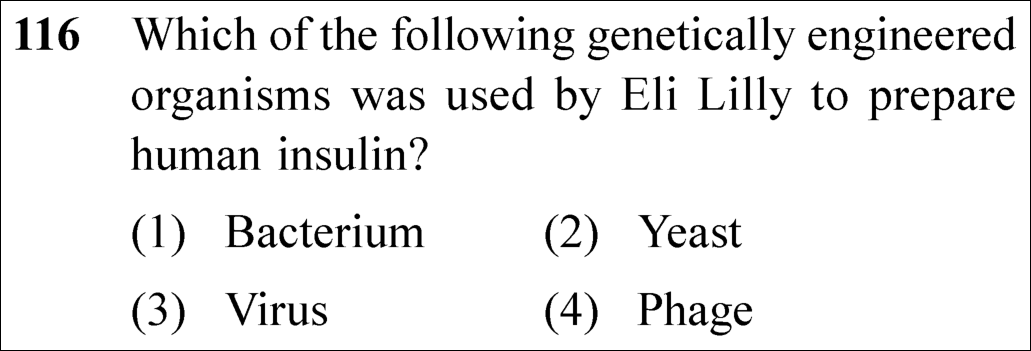
NEET 2025 Botany Question 116: Genetically Engineered Insulin (Humulin) by Eli Lilly

Question

Which of the following genetically engineered organisms was used by Eli Lilly to prepare human insulin?

  1. (1)Bacterium
  2. (2)Yeast
  3. (3)Virus
  4. (4)Phage
✓
Verified Against NTA Final Answer Key
Option (1) : Bacterium
📚 Biotechnology and its Applications Easy
📋 Given Parameters & Problem Setup
Company Eli Lilly (American pharmaceutical company, 1983)
Product Human insulin (Humulin)
Host Organism Class Host used to clone and express insulin A and B chains
⚡

The 30-Second Exam Hall Shortcut: ⚡ Humulin Host Fingerprint

⏱️ Save ~20 seconds

Eli Lilly produced human insulin A and B chains in the bacterium Escherichia coli (E. coli)! E. coli is a BACTERIUM!

1 Recall NCERT Section "Genetically Engineered Insulin":
2 - "In 1983, Eli Lilly an American company prepared two DNA sequences corresponding to A and B, chains of human insulin and introduced them in plasmids of E. coli to produce insulin chains."
3 - Chains A and B were produced separately, extracted and combined by creating disulfide bonds.
4 - What organism is E. coli? A BACTERIUM!
5 Select Option (1) Bacterium!
🛡️
Why You Can 100% Trust This Shortcut: Recombinant Human Insulin Engineering (NCERT Biology · Biotechnology and its Applications: Disulfide bridges between A and B chains).
📐

Step-by-Step Rigorous Workflow & Mathematical Proof

Step 1

Historical Milestone in Recombinant Insulin Production

Insulin for diabetes was traditionally extracted from pancreas of slaughtered cattle and pigs, causing severe allergic reactions in some patients:

  • • Human insulin is synthesized as a pro-hormone containing an extra C-peptide which is removed during maturation.
  • • The major challenge for production of insulin using rDNA techniques was getting insulin assembled into a mature form.
Step 2

Eli Lilly Strategy (1983)

The breakthrough approach devised by Eli Lilly:

  • • Synthesized two separate DNA oligonucleotides encoding human chain A (21 amino acids) and chain B (30 amino acids).
  • • Inserted these sequences into expression plasmids downstream of the β\beta-galactosidase promoter.
  • • Transformed these plasmids into *Escherichia coli* (*E. coli*), which is a bacterium.
  • • Chains A and B were extracted from the bacterial cultures and linked in vitro by forming disulfide bonds to yield active mature human insulin.
Step 3

Conclusion

*E. coli* belongs to Domain Bacteria (Eubacteria). Hence, the organism class used is a Bacterium.

Organism=Escherichia coli (Bacterium)\text{Organism} = \text{Escherichia coli (Bacterium)}
⭐

360° Option Elimination Engine Key Feature

Diagnose every choice: Know exactly why the right option works and why distractors fail.

4-Option Deep Scan
1 A
✓ 100% Correct
Verdict & Scientific Reason:

100% correct. Eli Lilly used plasmids introduced into the bacterium Escherichia coli (E. coli).

💡
Why this is airtight: None; direct textbook recall.
2 B
✗ Incorrect
Verdict & Scientific Reason:

Incorrect. Although yeast (Saccharomyces cerevisiae) is used for recombinant Hepatitis B vaccine, Eli Lilly used E. coli (bacterium) for insulin.

⚠️
Student Fallacy (Why candidates pick this trap): Confusing the hepatitis B vaccine host (yeast) with the insulin host (E. coli).
3 C
✗ Incorrect
Verdict & Scientific Reason:

Incorrect. Viruses are acellular vectors/pathogens, not cellular expression hosts for recombinant protein production.

⚠️
Student Fallacy (Why candidates pick this trap): Confusing vector delivery with expression organism.
4 D
✗ Incorrect
Verdict & Scientific Reason:

Incorrect. Bacteriophages are viral parasites of bacteria, not the cellular production factories.

⚠️
Student Fallacy (Why candidates pick this trap): Equating phage cloning with industrial protein biosynthesis.
⚠️

NTA Trap Alert: Yeast vs Bacterium as rDNA Hosts in NCERT

NCERT highlights two famous recombinant medical products: 1. Insulin (Eli Lilly) -> Bacterium (E. coli). 2. Hepatitis B vaccine -> Yeast. Keep these two distinct!

🛡️ How to avoid the -1 mark: Insulin = E. coli (Bacterium); Hep B = Yeast (Eukaryote).
📖

Core NEET Syllabus Standard

NEET Biology Core Syllabus · Biotechnology and its Applications Standard Benchmark
Core Scientific Principle Tested:

"Eli Lilly used plasmids of the bacterium Escherichia coli to express individual human insulin chains A and B."

Syllabus Focus: Genetically Engineered Insulin
✓ Core NEET UG Syllabus Anchor Syllabus & Academic Standards ↗
Insulin in E. coli: B = Bacterium produces Both chains A and B!

Ready to attempt under real exam pressure?

Test your speed and accuracy in the authentic 180-minute timed NTA simulator.

Launch NEET 2025 CBT Test →

Spotted a mistake in this solution? Report an error ([email protected])

⚖️ Legal & Fair Dealing Notice: Sourced from publicly released NEET 2025 question papers and NEET answer keys for private study, research, and non-commercial educational practice under Fair Dealing (Section 52(1)(a) of the Indian Copyright Act, 1957). Not affiliated with or endorsed by NTA or NMC.

Solve 4 NEET Questions a Day — One per Subject

Cover all 1,140 official NEET questions in 285 days at your own pace. Progress is saved on your device. No login needed.