MyCompetitiveExams Logo MyCompetitiveExams
Search 1,140+ Questions
Chapters, formulas, speed tricks
→
⚡ Brahmastra NEET 2027
720 MARKS

Dynamic 180-question full-length simulator mixed dynamically from all 6 years for 2027 & 2026 aspirants.

Launch Brahmastra 2027 Test →
Start Practice →
100% Free · No Login Required
Q.161 Zoology ⭐ 360° Option Elimination Active
Vault ↗

NEET 2025 Zoology Question 161 Solution

Topic: Biotechnology and its Applications · Official NTA Booklet Code 45
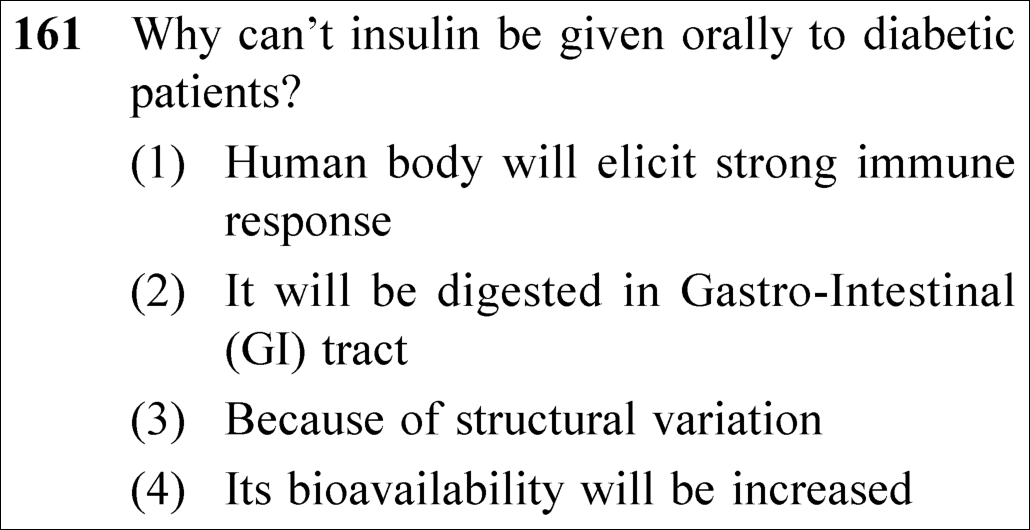
NEET 2025 Zoology Question 161: Why Insulin Cannot be Administered Orally (Proteolytic GI Degradation)

Question

Why can't insulin be given orally to diabetic patients?

✓
Verified Against NTA Final Answer Key
Option (2) : It will be digested in Gastro-Intestinal (GI) tract
📚 Biotechnology and its Applications Easy
📋 Given Parameters & Problem Setup
Therapeutic Agent Insulin (polypeptide hormone used for diabetes mellitus)
Route Question Why insulin cannot be given orally
⚡

The 30-Second Exam Hall Shortcut: ⚡ Peptide Hormone Route Fingerprint

⏱️ Save ~15 seconds

Insulin is a PROTEIN! If swallowed orally, digestive proteases (pepsin in stomach, trypsin/chymotrypsin in intestine) will DIGEST it into inactive amino acids before it enters blood! It MUST be injected subcutaneously!

1 Analyze the biochemical nature of insulin:
2 - Insulin is a 51-amino acid polypeptide hormone consisting of chains A and B linked by disulfide bonds.
3 - The human gastro-intestinal (GI) tract is specialized to digest dietary proteins using potent endopeptidases and exopeptidases (pepsin, trypsin, chymotrypsin, carboxypeptidases).
4 - If taken orally, insulin is completely proteolyzed and inactivated in the stomach and duodenum.
5 - Therefore, it must be administered parenterally (subcutaneous injection) to reach circulation intact.
6 Direct answer: It will be digested in Gastro-Intestinal (GI) tract!
7 Select Option (2)!
🛡️
Why You Can 100% Trust This Shortcut: Gene Therapy for Adenosine Deaminase (ADA) Deficiency (NCERT Biology · Biotechnology and its Applications: Retroviral cDNA vector delivery).
📐

Step-by-Step Rigorous Workflow & Mathematical Proof

Step 1

Polypeptide Structure of Insulin

Human insulin is a small globular protein hormone synthesized by beta-cells of the pancreatic islets of Langerhans:

  • • It comprises 51 amino acids distributed into two polypeptide chains: Chain A (21 residues) and Chain B (30 residues), cross-linked by two inter-chain disulfide bridges.
  • • Its biological activity relies on an intact, three-dimensional folded conformation.
Step 2

Fate of Ingested Polypeptides in the Gastrointestinal Tract

The digestive physiology of orally consumed proteins:

  • • In the stomach, gastric juice contains hydrochloric acid (pH ~1.8) and pepsin, which denatures and cleaves protein polypeptide bonds.
  • • In the small intestine, pancreatic proteases (trypsin, chymotrypsin, elastase, carboxypeptidases) and intestinal brush-border peptidases rapidly hydrolyze insulin into dipeptides, tripeptides, and free amino acids.
  • • As a consequence, intact functional insulin cannot survive transit through the GI tract to be absorbed into the portal circulation.
Step 3

Conclusion

Insulin cannot be administered orally because it undergoes enzymatic digestion in the gastrointestinal tract, matching Option (2).

Oral Insulin→GI ProteasesAmino Acids (Inactive)  ⟹  Must inject parenterally\text{Oral Insulin} \xrightarrow{\text{GI Proteases}} \text{Amino Acids (Inactive)} \implies \text{Must inject parenterally}
⭐

360° Option Elimination Engine Key Feature

Diagnose every choice: Know exactly why the right option works and why distractors fail.

4-Option Deep Scan
1 A
✗ Incorrect
Verdict & Scientific Reason:

Incorrect. Human recombinant insulin (Humulin) does not trigger immune attacks; the barrier is enzymatic digestion, not immunogenicity.

⚠️
Student Fallacy (Why candidates pick this trap): Confusing non-human antigenicity with oral degradation.
2 B
✓ 100% Correct
Verdict & Scientific Reason:

100% correct. Protein hormones are degraded by gastric and pancreatic proteases upon oral ingestion.

💡
Why this is airtight: None; sound physiological and pharmacological reasoning.
3 C
✗ Incorrect
Verdict & Scientific Reason:

Incorrect. Structural variation between individuals does not prevent oral ingestion; proteolytic cleavage does.

⚠️
Student Fallacy (Why candidates pick this trap): Selecting a vague distraction.
4 D
✗ Incorrect
Verdict & Scientific Reason:

Incorrect. Oral administration destroys insulin, reducing its oral bioavailability to near zero, not increasing it.

⚠️
Student Fallacy (Why candidates pick this trap): Reversing bioavailability terminology.
⚠️

NTA Trap Alert: Steroid vs Peptide Hormone Administration Routes

Steroid hormones (like estrogen, progesterone in birth control pills, or cortisone) can be taken ORALLY because they are lipids that resist gastric proteases. Protein/peptide hormones (insulin, glucagon, growth hormone) CANNOT be taken orally because proteases digest them!

🛡️ How to avoid the -1 mark: Steroid = Oral OK. Protein/Peptide = Digested by gut proteases!
📖

Core NEET Syllabus Standard

NEET Biology Core Syllabus · Biotechnology and its Applications / Chemical Coordination and Integration Standard Benchmark
Core Scientific Principle Tested:

"Insulin is a protein hormone that is enzymatically degraded by gastrointestinal proteases if taken orally."

Syllabus Focus: Genetically Engineered Insulin & Hormone Delivery
✓ Core NEET UG Syllabus Anchor Syllabus & Academic Standards ↗
Insulin is a Protein -> Stomach Treats it like a Meal (Digested in GI tract)!

Ready to attempt under real exam pressure?

Test your speed and accuracy in the authentic 180-minute timed NTA simulator.

Launch NEET 2025 CBT Test →

Spotted a mistake in this solution? Report an error ([email protected])

⚖️ Legal & Fair Dealing Notice: Sourced from publicly released NEET 2025 question papers and NEET answer keys for private study, research, and non-commercial educational practice under Fair Dealing (Section 52(1)(a) of the Indian Copyright Act, 1957). Not affiliated with or endorsed by NTA or NMC.

Solve 4 NEET Questions a Day — One per Subject

Cover all 1,140 official NEET questions in 285 days at your own pace. Progress is saved on your device. No login needed.