MyCompetitiveExams Logo MyCompetitiveExams
Search 1,140+ Questions
Chapters, formulas, speed tricks
→
⚡ Brahmastra NEET 2027
720 MARKS

Dynamic 180-question full-length simulator mixed dynamically from all 6 years for 2027 & 2026 aspirants.

Launch Brahmastra 2027 Test →
Start Practice →
100% Free · No Login Required
Q.160 Zoology ⭐ 360° Option Elimination Active
Vault ↗

NEET 2025 Zoology Question 160 Solution

Topic: Chemical Coordination and Integration · Official NTA Booklet Code 45
NEET 2025 Zoology Question 160: Physiological Actions of Adrenal Medullary Hormones (Catecholamines)

Question

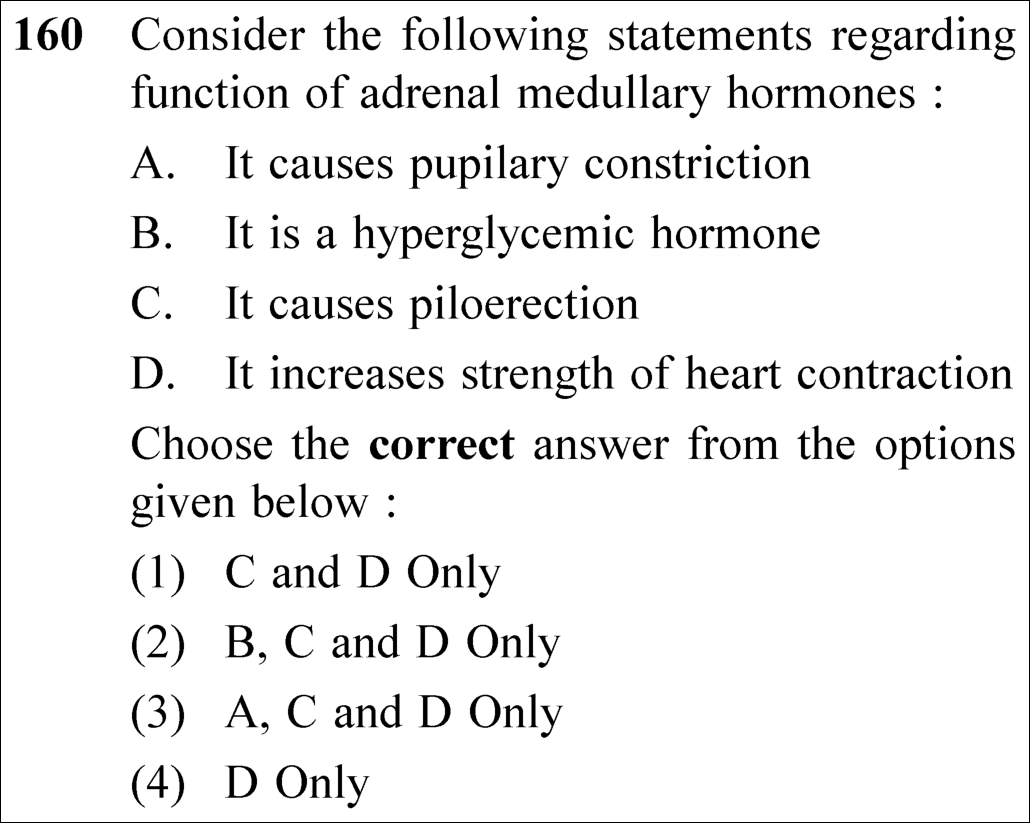
Consider the following statements regarding function of adrenal medullary hormones: A. It causes pupilary constriction B. It is a hyperglycemic hormone C. It causes piloerection D. It increases strength of heart contraction Choose the correct answer from the options given below:

✓
Verified Against NTA Final Answer Key
Option (2) : B, C and D Only
📚 Chemical Coordination and Integration Medium
📋 Given Parameters & Problem Setup
Hormone Class Adrenal medullary hormones (Adrenaline / Epinephrine & Noradrenaline)
Statement A It causes pupilary constriction
Statement B It is a hyperglycemic hormone
Statement C It causes piloerection
Statement D It increases strength of heart contraction
⚡

The 30-Second Exam Hall Shortcut: ⚡ Fight-or-Flight Catecholamine Diagnostic

⏱️ Save ~25 seconds

Adrenaline prepares you for EMERGENCY: Dilates pupils for vision (A is FALSE, not constriction)! Stimulates glycogen breakdown -> Hyperglycemic (B is TRUE)! Causes goosebumps/piloerection (C is TRUE)! Increases heart force (D is TRUE)! B, C and D Only!

1 Check each catecholamine effect against NCERT Section 22.2.6:
2 - Statement A: Causes pupillary constriction? FALSE! It causes pupillary DILATION (mydriasis) to admit more light during emergencies.
3 - Statement B: "Catecholamines also stimulate the breakdown of glycogen resulting in an increased concentration of glucose in blood." -> Hyperglycemic! [TRUE]
4 - Statement C: "These hormones increase alertness, pupillary dilation, piloerection (raising of hairs), sweating etc." -> Piloerection! [TRUE]
5 - Statement D: "Both the hormones increase the heartbeat, the strength of heart contraction and the rate of respiration." -> Inotropic cardiac boost! [TRUE]
6 Correct combination: B, C and D Only (Option 2)!
7 Select Option (2)!
🛡️
Why You Can 100% Trust This Shortcut: Thyroid Hormones & Basal Metabolic Rate Regulation (NCERT Biology · Chemical Coordination and Integration: T3 and T4 synthesis requires iodine).
📐

Step-by-Step Rigorous Workflow & Mathematical Proof

Step 1

Secretion and Nature of Adrenal Medullary Hormones

The adrenal medulla secretes two catecholamines in response to stress or sympathetic stimulation: adrenaline (epinephrine) and noradrenaline (norepinephrine):

  • • Commonly called emergency hormones or hormones of Fight or Flight.
  • • They elicit coordinated physiological shifts to prepare the organism for intense physical exertion or survival emergencies.
Step 2

Ocular and Cutaneous Effects (Statements A & C)

Evaluating sensory and autonomic responses:

  • • Pupillary dynamics (Statement A): Catecholamines stimulate α1\alpha_1-adrenergic receptors on the pupillary dilator muscle, causing pupillary dilation (mydriasis) to maximize visual field and light capture. They do NOT cause pupillary constriction (miosis). Hence, Statement A is INCORRECT.
  • • Cutaneous dynamics (Statement C): Adrenaline causes contraction of arrector pili muscles attached to hair follicles, causing piloerection (raising of hairs or "goosebumps"). Hence, Statement C is CORRECT.
Step 3

Metabolic and Cardiovascular Effects (Statements B & D)

Evaluating energy mobilization and cardiac performance:

  • • Glucose homeostasis (Statement B): Catecholamines stimulate hepatic and muscular glycogenolysis (breakdown of glycogen into glucose) and lipolysis, sharply elevating blood glucose levels. Thus, adrenaline is a potent hyperglycemic hormone. Hence, Statement B is CORRECT.
  • • Cardiovascular output (Statement D): By stimulating β1\beta_1-adrenergic receptors on cardiomyocytes, catecholamines exert positive inotropic effects, significantly increasing the strength of heart contraction and cardiac output. Hence, Statement D is CORRECT.
Step 4

Conclusion

Statements B, C, and D are correct, while Statement A is false. This corresponds to Option (2).

Valid Actions={B,C,D}  ⟹  Option (2)\text{Valid Actions} = \{B, C, D\} \implies \text{Option (2)}
⭐

360° Option Elimination Engine Key Feature

Diagnose every choice: Know exactly why the right option works and why distractors fail.

4-Option Deep Scan
1 A
✗ Incorrect
Verdict & Scientific Reason:

Incorrect. Omits statement B (hyperglycemic action), which is a cardinal metabolic function of adrenaline.

⚠️
Student Fallacy (Why candidates pick this trap): Forgetting that adrenaline raises blood sugar levels.
2 B
✓ 100% Correct
Verdict & Scientific Reason:

100% correct. Perfectly identifies hyperglycemia (B), piloerection (C), and enhanced cardiac contractility (D) while eliminating pupillary constriction (A).

💡
Why this is airtight: None; textbook mastery of adrenal physiology.
3 C
✗ Incorrect
Verdict & Scientific Reason:

Incorrect. Erroneously includes statement A (adrenaline causes pupillary dilation, not constriction).

⚠️
Student Fallacy (Why candidates pick this trap): Confusing pupillary dilation with pupillary constriction.
4 D
✗ Incorrect
Verdict & Scientific Reason:

Incorrect. Overlooks both hyperglycemic (B) and piloerection (C) effects.

⚠️
Student Fallacy (Why candidates pick this trap): Selecting only the cardiac effect.
⚠️

NTA Trap Alert: Pupil Dilation vs Pupil Constriction

In an emergency (sympathetic state), your eyes WIDEN (pupillary DILATION) so you can see threats clearly in the dark. Parasympathetic states constrict pupils. Statement A claims constriction, which is false!

🛡️ How to avoid the -1 mark: Adrenaline = Fight or Flight = Dilation of pupils.
📖

Core NEET Syllabus Standard

NEET Biology Core Syllabus · Chemical Coordination and Integration Standard Benchmark
Core Scientific Principle Tested:

"Catecholamines cause pupillary dilation, piloerection, hyperglycemia, and increased strength of heart contraction."

Syllabus Focus: Adrenal Gland · Adrenal Medulla
✓ Core NEET UG Syllabus Anchor Syllabus & Academic Standards ↗
DILATE eyes (A is out), BOOST sugar (B), RAISE hairs (C), PUMP heart (D) -> B, C, D!

Ready to attempt under real exam pressure?

Test your speed and accuracy in the authentic 180-minute timed NTA simulator.

Launch NEET 2025 CBT Test →

Spotted a mistake in this solution? Report an error ([email protected])

⚖️ Legal & Fair Dealing Notice: Sourced from publicly released NEET 2025 question papers and NEET answer keys for private study, research, and non-commercial educational practice under Fair Dealing (Section 52(1)(a) of the Indian Copyright Act, 1957). Not affiliated with or endorsed by NTA or NMC.

Solve 4 NEET Questions a Day — One per Subject

Cover all 1,140 official NEET questions in 285 days at your own pace. Progress is saved on your device. No login needed.