MyCompetitiveExams Logo MyCompetitiveExams
Search 1,140+ Questions
Chapters, formulas, speed tricks
→
⚡ Brahmastra NEET 2027
720 MARKS

Dynamic 180-question full-length simulator mixed dynamically from all 6 years for 2027 & 2026 aspirants.

Launch Brahmastra 2027 Test →
Start Practice →
100% Free · No Login Required
Q.157 Zoology ⭐ 360° Option Elimination Active
Vault ↗

NEET 2025 Zoology Question 157 Solution

Topic: Organisms and Populations · Official NTA Booklet Code 45
NEET 2025 Zoology Question 157: Obligate Mutualism between Fig and Fig Wasp (Inflorescence vs Fruit)

Question

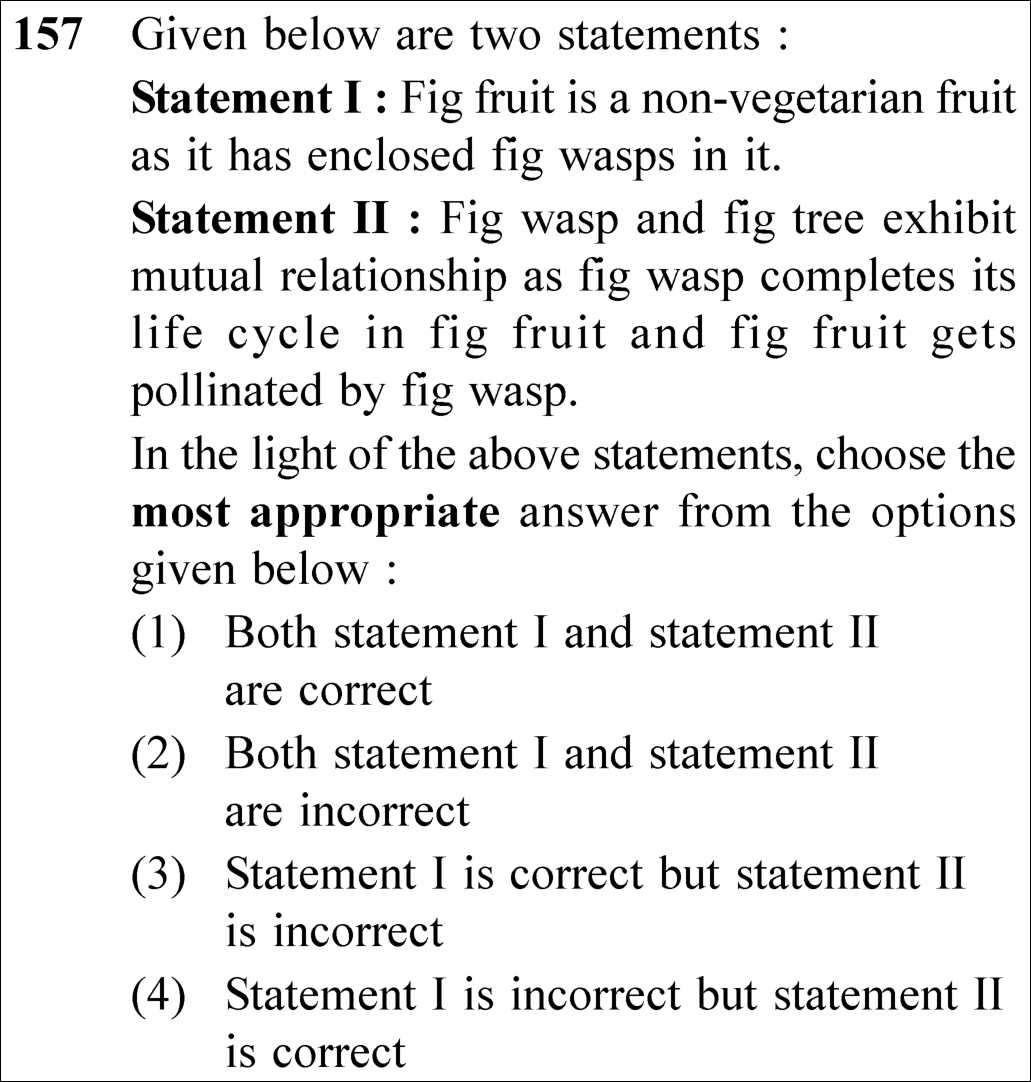
Given below are two statements: Statement I: Fig fruit is a non-vegetarian fruit as it has enclosed fig wasps in it. Statement II: Fig wasp and fig tree exhibit mutual relationship as fig wasp completes its life cycle in fig fruit and fig fruit gets pollinated by fig wasp. In the light of the above statements, choose the most appropriate answer from the options given below:

  1. (1)Both statement I and statement II are correct
  2. (2)Both statement I and statement II are incorrect
  3. (3)Statement I is correct but statement II is incorrect
  4. (4)Statement I is incorrect but statement II is correct
✓
Verified Against NTA Final Answer Key
Option (2) : Both statement I and statement II are incorrect
📚 Organisms and Populations Medium
📋 Given Parameters & Problem Setup
Statement I Fig fruit is a non-vegetarian fruit as it has enclosed fig wasps in it.
Statement II Fig wasp and fig tree exhibit mutual relationship as fig wasp completes its life cycle in fig fruit and fig fruit gets pollinated by fig wasp.
⚡

The 30-Second Exam Hall Shortcut: ⚡ Fig-Wasp Precision Terminology Fingerprint

⏱️ Save ~35 seconds

Statement I is unscientific/false ("non-vegetarian fruit" is scientifically invalid; the fruit is 100% plant tissue)! Statement II is botanically false because FRUITS do not get pollinated — FLOWERS/INFLORESCENCES (hypanthodium) get pollinated! Both statements are INCORRECT!

1 Analyze Statement I scientifically:
2 - Calling fig a "non-vegetarian fruit" is unscientific and botanically false. The fig is an aggregate/composite fruit (syconus) derived from a plant ovary/inflorescence. Any female wasp that enters is fully broken down by the plant's proteolytic enzyme (ficin); it does not classify the fruit as non-vegetarian. Statement I is INCORRECT.
3 Analyze Statement II botanically:
4 - "fig fruit gets pollinated by fig wasp" -> In botany, pollination is the transfer of pollen grains to the STIGMA OF A FLOWER, NEVER to a fruit! Pollination occurs inside the unopened inflorescence (hypanthodium) on female flowers long before fruit maturation.
5 - Furthermore, the wasp oviposits into the ovules of flowers, not "in fig fruit".
6 - Therefore, Statement II is botanically and scientifically INCORRECT.
7 Conclusion: Both statement I and statement II are incorrect (Option 2)!
8 Select Option (2)!
🛡️
Why You Can 100% Trust This Shortcut: Gause’s Competitive Exclusion Principle (NCERT Biology · Organisms and Populations) & NTA Final Key.
📐

Step-by-Step Rigorous Workflow & Mathematical Proof

Step 1

Scientific Analysis of Statement I

Addressing the popular myth vs biological reality of fig fruits:

  • • Botanically, a fruit is a mature, ripened ovary (or inflorescence axis, syconus in *Ficus*) produced exclusively by angiosperm plants.
  • • There is no scientific or botanical taxonomic category called a "non-vegetarian fruit".
  • • While a female agaonid pollinator wasp may enter the ostiole of the inflorescence and die after oviposition/pollination, the plant secretes a proteolytic enzyme called ficin that completely digests the insect into amino acids and elemental nutrients absorbed by the developing fruit tissue.
  • • Asserting that "Fig fruit is a non-vegetarian fruit" is biologically erroneous. Hence, Statement I is INCORRECT.
Step 2

Botanical Analysis of Statement II

Scrutinizing the precise morphological stage of pollination and life cycle completion:

  • • Pollination is strictly defined as the transfer of pollen grains from the anther to the receptive stigma of a flower.
  • • In the genus *Ficus*, the pollinator wasp enters the specialized urn-shaped inflorescence (hypanthodium), which houses hundreds of tiny male and female flowers along its inner cavity wall.
  • • The wasp pollinates the female flowers while searching for suitable egg-laying sites in the ovaries of gall flowers.
  • • A fruit (*syconus*) is the post-fertilization developmental product. A fruit does not possess stigmas or ovules and CANNOT "get pollinated".
  • • Therefore, claiming that the "fig fruit gets pollinated by fig wasp" is a glaring botanical contradiction. Hence, Statement II is INCORRECT.
Step 3

Conclusion

Because both Statement I and Statement II contain fundamental factual and botanical errors, the correct verdict is that both statements are incorrect, matching Option (2).

Statement I: Incorrect,Statement II: Incorrect  ⟹  Option (2)\text{Statement I: Incorrect}, \quad \text{Statement II: Incorrect} \implies \text{Option (2)}
⭐

360° Option Elimination Engine Key Feature

Diagnose every choice: Know exactly why the right option works and why distractors fail.

4-Option Deep Scan
1 A
✗ Incorrect
Verdict & Scientific Reason:

Incorrect. Neither statement is biologically accurate (non-vegetarian fruit is scientifically invalid, and fruits cannot be pollinated).

⚠️
Student Fallacy (Why candidates pick this trap): Accepting casual colloquial phrasing without botanical scrutiny.
2 B
✓ 100% Correct
Verdict & Scientific Reason:

100% correct. Accurately recognizes that Statement I is an unscientific cultural claim and Statement II contains a critical botanical error (fruits do not get pollinated). Matches NTA Final Answer Key.

💡
Why this is airtight: None; rigorous scientific and botanical precision.
3 C
✗ Incorrect
Verdict & Scientific Reason:

Incorrect. Statement I is false because fruits are strictly botanical plant products.

⚠️
Student Fallacy (Why candidates pick this trap): Believing the dietary myth that figs are non-vegetarian.
4 D
✗ Incorrect
Verdict & Scientific Reason:

Incorrect. Overlooks that Statement II claims the "fruit gets pollinated", which is botanically impossible.

⚠️
Student Fallacy (Why candidates pick this trap): Failing to catch the substitution of "flower/inflorescence" with "fruit" in pollination.
⚠️

NTA Trap Alert: Pollination Occurs in Flowers/Inflorescence, NEVER Fruit!

Students frequently read past the word "fruit" in Statement II ("fig fruit gets pollinated"). Remember: Pollination precedes fertilization; fertilization forms fruit. A fruit CANNOT be pollinated! Only flowers/inflorescences get pollinated.

🛡️ How to avoid the -1 mark: Check the anatomical subject: Flowers are pollinated -> Fruits are produced!
📖

Core NEET Syllabus Standard

NEET Biology Core Syllabus · Organisms and Populations Standard Benchmark
Core Scientific Principle Tested:

"Mutualism occurs between fig flowers (inflorescence) and wasps; fruits do not undergo pollination, and figs are botanical plant organs."

Syllabus Focus: Population Interactions · Mutualism (Fig-Wasp Co-evolution)
✓ Core NEET UG Syllabus Anchor Syllabus & Academic Standards ↗
Both FALSE: Fig is NO meat (I false), and Fruits CANNOT be pollinated (II false)!

Ready to attempt under real exam pressure?

Test your speed and accuracy in the authentic 180-minute timed NTA simulator.

Launch NEET 2025 CBT Test →

Spotted a mistake in this solution? Report an error ([email protected])

⚖️ Legal & Fair Dealing Notice: Sourced from publicly released NEET 2025 question papers and NEET answer keys for private study, research, and non-commercial educational practice under Fair Dealing (Section 52(1)(a) of the Indian Copyright Act, 1957). Not affiliated with or endorsed by NTA or NMC.

Solve 4 NEET Questions a Day — One per Subject

Cover all 1,140 official NEET questions in 285 days at your own pace. Progress is saved on your device. No login needed.