MyCompetitiveExams Logo MyCompetitiveExams
Search 1,140+ Questions
Chapters, formulas, speed tricks
→
⚡ Brahmastra NEET 2027
720 MARKS

Dynamic 180-question full-length simulator mixed dynamically from all 6 years for 2027 & 2026 aspirants.

Launch Brahmastra 2027 Test →
Start Practice →
100% Free · No Login Required
Q.97 Botany ⭐ 360° Option Elimination Active
Vault ↗

NEET 2025 Botany Question 97 Solution

Topic: Organisms and Populations · Official NTA Booklet Code 45
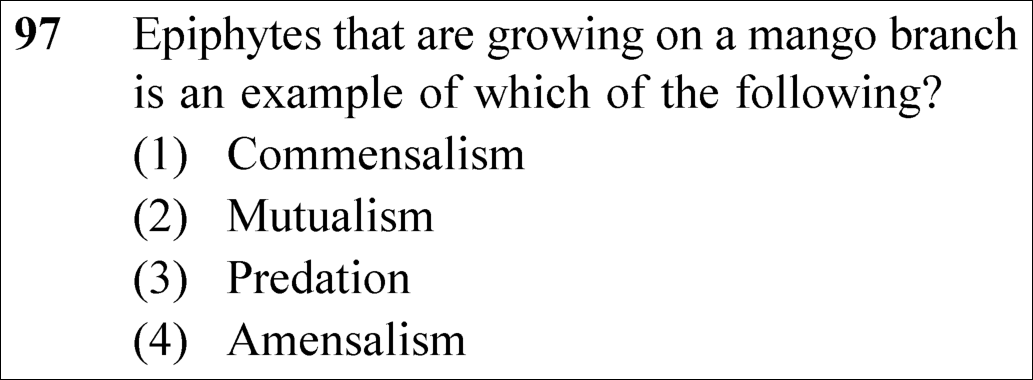
NEET 2025 Botany Question 97: Commensalism: Epiphytic Growth on Host Tree

Question

Epiphytes that are growing on a mango branch is an example of which of the following?

✓
Verified Against NTA Final Answer Key
Option (1) : Commensalism
📚 Organisms and Populations Easy
📋 Given Parameters & Problem Setup
Interacting Species Epiphytes (e.g. orchid) and Mango tree
Nature of Association Epiphyte grows on mango branch for physical support and sunlight without absorbing nutrients from the host
⚡

The 30-Second Exam Hall Shortcut: ⚡ (+, 0) Interaction Shortcut

⏱️ Save ~20 seconds

Orchid epiphyte benefits from support and sunlight (+). Mango tree is neither harmed nor benefited (0). An interaction of type (+, 0) is COMMENSALISM! ⟹ Commensalism!

1 Analyze the interaction between the epiphyte (e.g. orchid) and the mango tree:
2 Benefit to epiphyte: Gaining elevated physical perch for sunlight and moisture from humid air (+).
3 Effect on mango tree: The epiphyte does not tap into the vascular tissue of mango or steal nutrients/water; the tree is unharmed and receives no benefit (0).
4 Interaction type (+, 0) defines COMMENSALISM.
5 Contrast with alternatives:
6 - Mutualism: (+, +)
7 - Predation: (+, -)
8 - Amensalism: (-, 0)
9 - Parasitism: (+, -)
10 Select Option (1) Commensalism in under 5 seconds!
🛡️
Why You Can 100% Trust This Shortcut: Interspecific Population Interactions & Mutualism (NCERT Biology · Organisms and Populations).
📐

Step-by-Step Rigorous Workflow & Mathematical Proof

Step 1

Definition of Commensalism in Population Ecology

Commensalism is a positive interspecific interaction in which one population is benefited while the other remains unaffected:

Commensalism: (+,  0) Interaction\text{Commensalism: } (+, \; 0) \text{ Interaction}
  • • The benefiting partner is the commensal; the neutral partner is the host.
Step 2

Examine the Epiphyte-Mango Tree Relationship

Evaluate the ecological exchange between epiphyte and mango branch:

Epiphyte (Orchid)⟶(+) [Access to light and space],Mango tree⟶(0) [Neither harmed nor helped]\text{Epiphyte (Orchid)} \longrightarrow (+) \text{ [Access to light and space]}, \quad \text{Mango tree} \longrightarrow (0) \text{ [Neither harmed nor helped]}
  • • Epiphytes are non-parasitic space-dwellers; they synthesize their own food via photosynthesis and absorb atmospheric moisture via hygroscopic velamen roots.
  • • They do not produce haustoria or draw sap from the mango tree.
Step 3

Confirm with NCERT Canonical Examples

NCERT explicitly cites two benchmark examples of commensalism:

(1) Orchid on mango branch,(2) Barnacles on the back of a whale(1) \text{ Orchid on mango branch}, \quad (2) \text{ Barnacles on the back of a whale}
  • • Thus the interaction is unequivocally Commensalism, matching Option (1).
⭐

360° Option Elimination Engine Key Feature

Diagnose every choice: Know exactly why the right option works and why distractors fail.

4-Option Deep Scan
1 A
✓ 100% Correct
Verdict & Scientific Reason:

100% correct. (+, 0) interaction where orchid benefits and mango is unaffected.

💡
Why this is airtight: None; textbook ecological classification.
2 B
✗ Incorrect
Verdict & Scientific Reason:

Incorrect. Mutualism requires both species to benefit (+, +); the mango tree receives no benefit.

⚠️
Student Fallacy (Why candidates pick this trap): Thinking both species benefit.
3 C
✗ Incorrect
Verdict & Scientific Reason:

Incorrect. Predation is a (+, -) interaction involving killing of prey.

⚠️
Student Fallacy (Why candidates pick this trap): Confusing epiphyte with predator.
4 D
✗ Incorrect
Verdict & Scientific Reason:

Incorrect. Amensalism is a (-, 0) interaction where one species is harmed while the other is unaffected.

⚠️
Student Fallacy (Why candidates pick this trap): Inverting signs of interaction.
⚠️

NTA Trap Alert: Confusing Epiphytes with Parasitic Plants (Cuscuta)

Students sometimes confuse epiphytes with parasites like Cuscuta (dodder) or Loranthus. Parasites develop haustoria to rob food and water (+, - interaction: parasitism). Epiphytes only use the branch for MECHANICAL SUPPORT (+, 0 interaction: commensalism)!

🛡️ How to avoid the -1 mark: Epiphytes = Physical support only (Commensalism); Parasites = Nutrient theft (Parasitism)!
📖

Core NEET Syllabus Standard

NEET Biology Core Syllabus · Organisms and Populations Standard Benchmark
Core Scientific Principle Tested:

"An orchid growing as an epiphyte on a mango branch is a classic (+, 0) commensalism."

Syllabus Focus: Population Interactions: Commensalism
✓ Core NEET UG Syllabus Anchor Syllabus & Academic Standards ↗
Orchid gets light (+), Mango doesn’t care (0) ⟹ Commensalism (Option 1)!

Ready to attempt under real exam pressure?

Test your speed and accuracy in the authentic 180-minute timed NTA simulator.

Launch NEET 2025 CBT Test →

Spotted a mistake in this solution? Report an error ([email protected])

⚖️ Legal & Fair Dealing Notice: Sourced from publicly released NEET 2025 question papers and NEET answer keys for private study, research, and non-commercial educational practice under Fair Dealing (Section 52(1)(a) of the Indian Copyright Act, 1957). Not affiliated with or endorsed by NTA or NMC.

Solve 4 NEET Questions a Day — One per Subject

Cover all 1,140 official NEET questions in 285 days at your own pace. Progress is saved on your device. No login needed.