📋 Given Parameters & Problem Setup
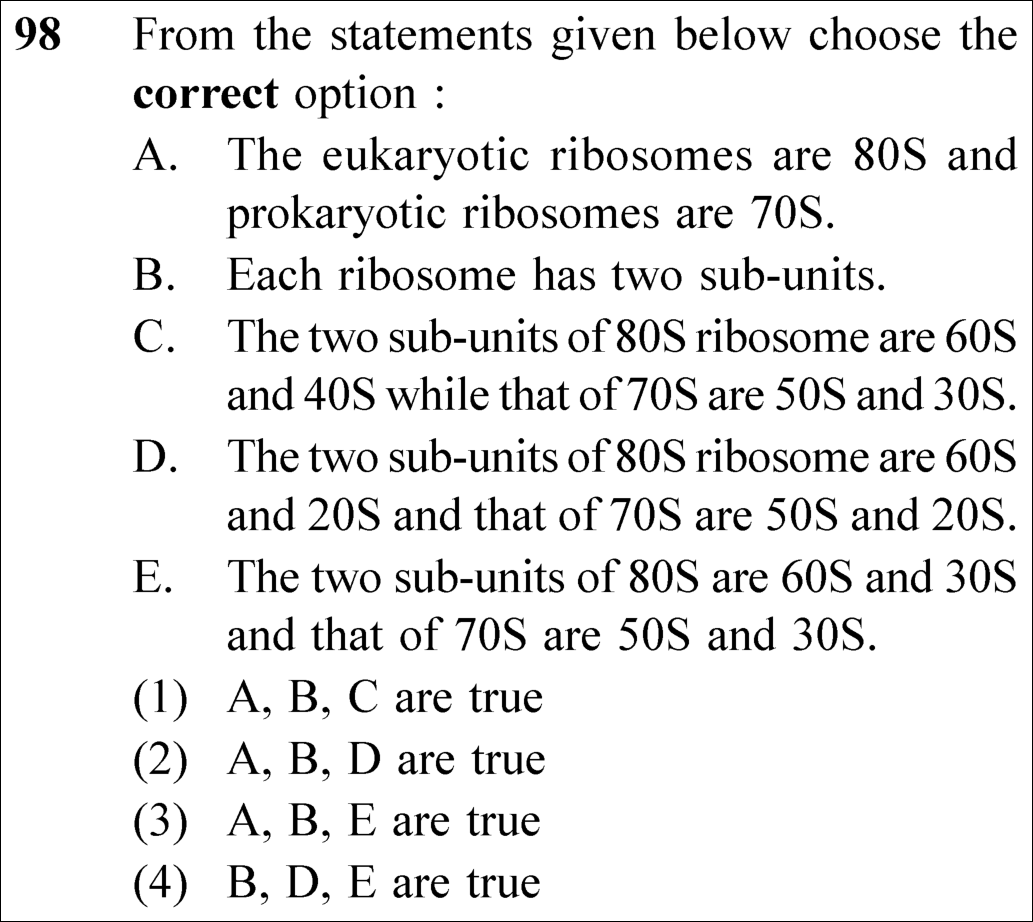
Statement A The eukaryotic ribosomes are 80S and prokaryotic ribosomes are 70S. (True)
Statement B Each ribosome has two sub-units. (True: one large, one small)
Statement C The two sub-units of 80S ribosome are 60S and 40S while that of 70S are 50S and 30S. (True)
Statement D The two sub-units of 80S ribosome are 60S and 20S... (False)
Statement E The two sub-units of 80S are 60S and 30S... (False)
80S = 60S (large) + 40S (small)! 70S = 50S (large) + 30S (small)! Statements A, B, and C are completely accurate! Statements D and E feature false subunit arithmetic! ⟹ A, B, C are true!
1 Check Statement A: Cytoplasmic eukaryotic ribosomes are 80S; prokaryotic ribosomes are 70S (also in chloroplasts/mitochondria). Statement A is TRUE.
2 Check Statement B: Every ribosome consists of two unequal ribonucleoprotein subunits (one large, one small). Statement B is TRUE.
3 Check Statement C: 80S dissociates into 60S and 40S subunits; 70S dissociates into 50S and 30S subunits. Statement C is TRUE.
4 Check Statements D and E: They list erroneous subunit combinations (60S/20S or 60S/30S). Both D and E are FALSE.
5 Conclusion: A, B, C are true.
6 Select Option (1) in under 10 seconds!
🛡️ Why You Can 100% Trust This Shortcut: Ribosomal Subunits & Sedimentation Coefficients (NCERT Biology · Cell: The Unit of Life: Prokaryotic 70S vs Eukaryotic 80S).
⚠️
Students often expect 60 + 40 = 100S or 50 + 30 = 80S. But Svedberg unit (S) is a sedimentation rate coefficient, not a simple mass addition! 60S + 40S forms an 80S ribosome, and 50S + 30S forms a 70S ribosome!
🛡️ How to avoid the -1 mark: Remember: 70S = 50S + 30S; 80S = 60S + 40S!
📖
NEET Biology Core Syllabus · Cell: The Unit of Life Standard Benchmark
Core Scientific Principle Tested:
"Prokaryotes have 70S (50S+30S); Eukaryotes have 80S (60S+40S)."
Syllabus Focus: Ribosomes: Structure and Subunits
Even numbers for Eukaryotes: 40, 60, 80! Odd numbers for Prokaryotes: 30, 50, 70 ⟹ A, B, C true!