MyCompetitiveExams Logo MyCompetitiveExams
Search 1,140+ Questions
Chapters, formulas, speed tricks
→
⚡ Brahmastra NEET 2027
720 MARKS

Dynamic 180-question full-length simulator mixed dynamically from all 6 years for 2027 & 2026 aspirants.

Launch Brahmastra 2027 Test →
Start Practice →
100% Free · No Login Required
Q.97 Botany ⭐ 360° Option Elimination Active
Vault ↗

NEET 2026 Botany Question 97 Solution

Topic: Cell: The Unit of Life · Official NTA Booklet Code 50
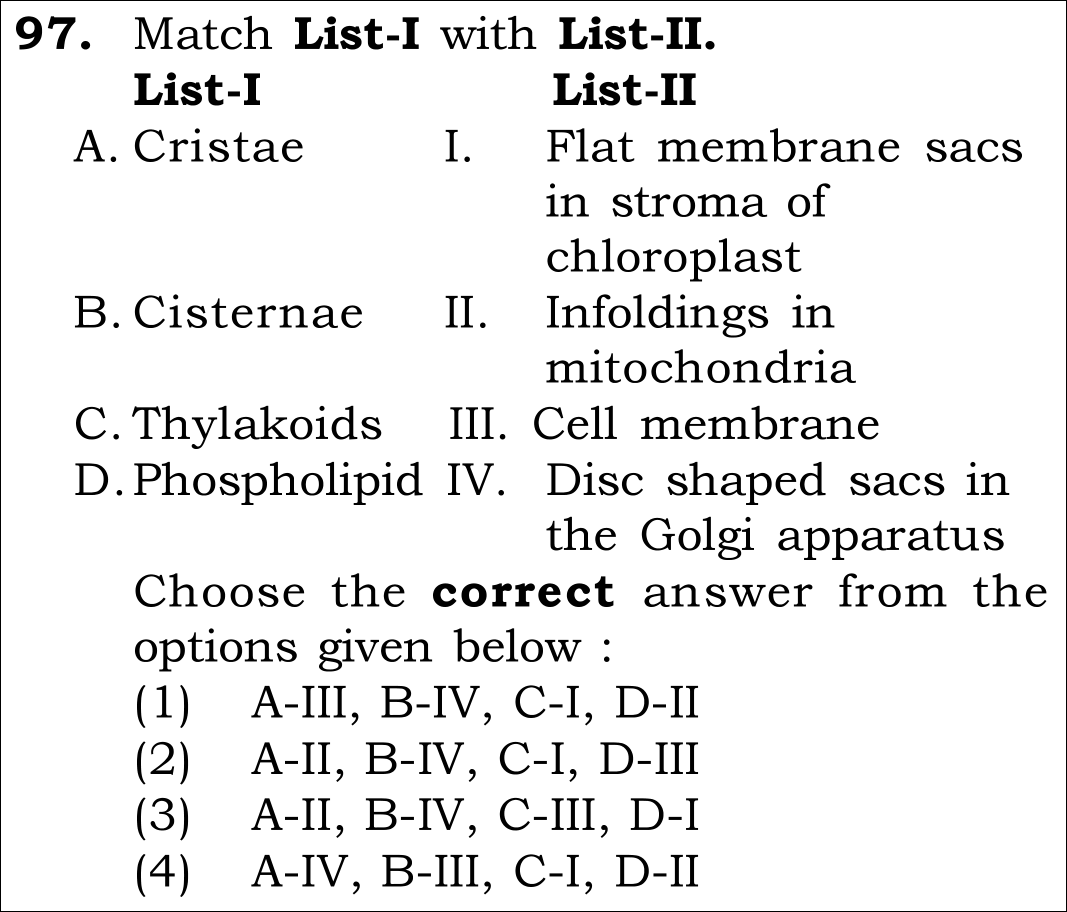
NEET 2026 Botany Question 97: Organellar Membrane Specializations: Cristae, Cisternae, Thylakoids, Phospholipids

Question

Match List-I with List-II. List I: A. Cristae; B. Cisternae; C. Thylakoids; D. Phospholipid. List II: I. Flat membrane sacs in stroma of chloroplast; II. Infoldings in mitochondria; III. Cell membrane; IV. Disc shaped sacs in the Golgi apparatus. Choose the correct answer from the options given below:

✓
Verified Against NTA Final Answer Key
Option (2) : A-II, B-IV, C-I, D-III
📚 Cell: The Unit of Life Easy
📋 Given Parameters & Problem Setup
List-I A. Cristae, B. Cisternae, C. Thylakoids, D. Phospholipid
List-II I. Flat membrane sacs in stroma of chloroplast, II. Infoldings in mitochondria, III. Cell membrane, IV. Disc shaped sacs in the Golgi apparatus
⚡

The 30-Second Exam Hall Shortcut: ⚡ Organellar Infolding & Sac Fingerprint

⏱️ Save ~45 seconds

Cristae = Mitochondria (A-II); Cisternae = Golgi (B-IV) -> Locks Option (2) in 10 seconds!

1 A. Cristae: Infoldings of the inner membrane of mitochondria to increase surface area -> A-II.
2 This immediately eliminates Options (1) and (4)!
3 B. Cisternae: Flattened disc-shaped concentric sacs in Golgi apparatus -> B-IV.
4 C. Thylakoids: Flattened membranous sacs in the stroma of chloroplasts (site of light reactions) -> C-I.
5 D. Phospholipid: Bilayer building block of the cell membrane (fluid mosaic) -> D-III.
6 Sequence: A-II, B-IV, C-I, D-III -> Option (2) is 100% verified!
🛡️
Why You Can 100% Trust This Shortcut: Direct verbatim alignment with NCERT Cell Biology sections on Mitochondria, Golgi apparatus, Plastids, and Plasma membrane.
📐

Step-by-Step Rigorous Workflow & Mathematical Proof

Step 1

Match Cristae (Item A)

The inner membrane of mitochondria forms a number of infoldings called cristae (sing. crista) towards the matrix. Cristae increase the surface area available for ATP synthesis and electron transport chain complexes.

Cristae⟶II. Infoldings in mitochondria\text{Cristae} \longrightarrow \text{II. Infoldings in mitochondria}
  • • Match: A -> II.
Step 2

Match Cisternae (Item B)

The Golgi apparatus consists of many flat, disc-shaped sacs or cisternae of 0.5 µm to 1.0 µm diameter, stacked parallel to each other with distinct cis (forming) and trans (maturing) faces.

Cisternae⟶IV. Disc shaped sacs in the Golgi apparatus\text{Cisternae} \longrightarrow \text{IV. Disc shaped sacs in the Golgi apparatus}
  • • Match: B -> IV.
Step 3

Match Thylakoids (Item C)

In the stroma of chloroplasts, a number of organized flattened membranous sacs are present, called thylakoids. Thylakoids are arranged in stacks like piles of coins called grana.

Thylakoids⟶I. Flat membrane sacs in stroma of chloroplast\text{Thylakoids} \longrightarrow \text{I. Flat membrane sacs in stroma of chloroplast}
  • • Match: C -> I.
Step 4

Match Phospholipid (Item D)

Phospholipids form the foundational continuous bimolecular lipid bilayer of the cell membrane, with hydrophilic polar heads pointing outward and hydrophobic fatty acid tails pointing inward.

Phospholipid⟶III. Cell membrane\text{Phospholipid} \longrightarrow \text{III. Cell membrane}
  • • Match: D -> III.
  • • Full Match: A-II, B-IV, C-I, D-III (Option 2).
⭐

360° Option Elimination Engine Key Feature

Diagnose every choice: Know exactly why the right option works and why distractors fail.

4-Option Deep Scan
1 A
✗ Incorrect
Verdict & Scientific Reason:

Incorrect. Assigns cell membrane to cristae and infoldings in mitochondria to phospholipids.

⚠️
Student Fallacy (Why candidates pick this trap): Swapping roman numerals II and III.
2 B
✓ 100% Correct
Verdict & Scientific Reason:

Exact match with textbook definitions of cellular membranes and organelles.

💡
Why this is airtight: None; flawless cytology knowledge.
3 C
✗ Incorrect
Verdict & Scientific Reason:

Incorrect. Assigns cell membrane to thylakoids and chloroplast sacs to phospholipids.

⚠️
Student Fallacy (Why candidates pick this trap): Swapping thylakoids and phospholipids.
4 D
✗ Incorrect
Verdict & Scientific Reason:

Incorrect. Assigns Golgi sacs to cristae.

⚠️
Student Fallacy (Why candidates pick this trap): Confusing cristae with cisternae.
⚠️

NTA Trap Alert: Confusing Cristae with Cisternae

The names sound very similar: Cristae are in MITOCHONDRIA (folds); Cisternae are in GOLGI (stacked flattened discs).

🛡️ How to avoid the -1 mark: Remember: Cristae has "T" for miTochondria; Cisternae has "G" sound for Golgi!
📖

Core NEET Syllabus Standard

NEET Biology Core Syllabus · Cell: The Unit of Life Standard Benchmark
Core Scientific Principle Tested:

"Organelles possess distinct specialized membranes: Cristae (mitochondria), Cisternae (Golgi), Thylakoids (chloroplast), Phospholipids (plasma membrane)."

Syllabus Focus: Endomembrane system, mitochondria, and plastid ultrastructure
✓ Core NEET UG Syllabus Anchor Syllabus & Academic Standards ↗
Cristae fold Mitochondria; Cisternae stack Golgi high; Thylakoid lights Chloroplast; Phospholipids line cell sky!

Ready to attempt under real exam pressure?

Test your speed and accuracy in the authentic 180-minute timed NTA simulator.

Launch NEET 2026 CBT Test →

Spotted a mistake in this solution? Report an error ([email protected])

⚖️ Legal & Fair Dealing Notice: Sourced from publicly released NEET 2026 question papers and NEET answer keys for private study, research, and non-commercial educational practice under Fair Dealing (Section 52(1)(a) of the Indian Copyright Act, 1957). Not affiliated with or endorsed by NTA or NMC.

Solve 4 NEET Questions a Day — One per Subject

Cover all 1,140 official NEET questions in 285 days at your own pace. Progress is saved on your device. No login needed.