MyCompetitiveExams Logo MyCompetitiveExams
Search 1,140+ Questions
Chapters, formulas, speed tricks
→
⚡ Brahmastra NEET 2027
720 MARKS

Dynamic 180-question full-length simulator mixed dynamically from all 6 years for 2027 & 2026 aspirants.

Launch Brahmastra 2027 Test →
Start Practice →
100% Free · No Login Required
Q.99 Botany ⭐ 360° Option Elimination Active
Vault ↗

NEET 2025 Botany Question 99 Solution

Topic: Biodiversity and Conservation · Official NTA Booklet Code 45
NEET 2025 Botany Question 99: In-Situ vs. Ex-Situ Biodiversity Conservation Methods

Question

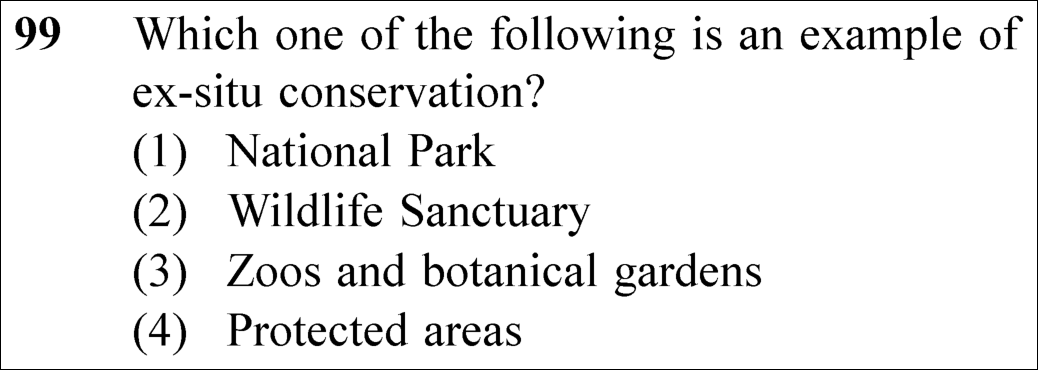
Which one of the following is an example of ex-situ conservation?

  1. (1)National Park
  2. (2)Wildlife Sanctuary
  3. (3)Zoos and botanical gardens
  4. (4)Protected areas
✓
Verified Against NTA Final Answer Key
Option (3) : Zoos and botanical gardens
📚 Biodiversity and Conservation Easy
📋 Given Parameters & Problem Setup
Target Strategy Ex-situ (off-site) conservation
Definition Threatened animals and plants removed from natural habitats and maintained in artificial, human-managed enclosures
⚡

The 30-Second Exam Hall Shortcut: ⚡ On-Site vs. Off-Site Conservation Test

⏱️ Save ~20 seconds

In-situ = On-site in natural wild habitat (National Parks, Wildlife Sanctuaries, Biosphere Reserves, Protected Areas). Ex-situ = Off-site human care (Zoological parks/Zoos, Botanical gardens, Seed banks, Safari parks)! ⟹ Zoos and botanical gardens!

1 Distinguish the two core conservation modes:
2 In-situ (on-site) conservation: Conserving species in their natural ecosystems and natural habitats. Examples: National Parks, Wildlife Sanctuaries, Biosphere Reserves, Sacred Groves, Protected Areas.
3 Ex-situ (off-site) conservation: Threatened animals and plants are taken out of their natural habitat and placed in special care settings. Examples: Zoological parks (Zoos), Botanical gardens, Wildlife safari parks, Cryopreservation, Seed banks.
4 Options (1), (2), and (4) are all in-situ conservation methods.
5 Option (3) Zoos and botanical gardens is the canonical example of ex-situ conservation.
6 Select Option (3) in under 5 seconds!
🛡️
Why You Can 100% Trust This Shortcut: Ex-situ vs In-situ Conservation Strategies (NCERT Biology · Biodiversity and Conservation: Botanical gardens and seed banks).
📐

Step-by-Step Rigorous Workflow & Mathematical Proof

Step 1

Define Ex-Situ Conservation

Ex-situ conservation involves the protection of endangered genetic materials, species, or organisms outside their natural habitats:

Ex-situ Conservation=Off-site protection in human-curated artificial environments\text{Ex-situ Conservation} = \text{Off-site protection in human-curated artificial environments}
  • • Used when a species is facing an imminent threat of extinction in the wild and requires urgent, intensive human intervention.
Step 2

Examine the Given Options

Classify each choice into in-situ or ex-situ categories:

In-situ: National Parks (1), Sanctuaries (2), Protected Areas (4)\text{In-situ: National Parks (1), Sanctuaries (2), Protected Areas (4)}
  • • National Parks: Strictly reserved for wild species in their natural habitat (In-situ).
  • • Wildlife Sanctuaries: Natural wild tract with regulated human activities (In-situ).
  • • Zoos and Botanical Gardens: Artificial enclosures maintaining living captive animals and cultivated plant collections (Ex-situ).
  • • Matches Option (3).
⭐

360° Option Elimination Engine Key Feature

Diagnose every choice: Know exactly why the right option works and why distractors fail.

4-Option Deep Scan
1 A
✗ Incorrect
Verdict & Scientific Reason:

Incorrect. In-situ conservation method.

⚠️
Student Fallacy (Why candidates pick this trap): Confusing in-situ with ex-situ.
2 B
✗ Incorrect
Verdict & Scientific Reason:

Incorrect. In-situ conservation method.

⚠️
Student Fallacy (Why candidates pick this trap): Thinking wildlife sanctuaries are off-site.
3 C
✓ 100% Correct
Verdict & Scientific Reason:

100% correct. Classic off-site (ex-situ) captive breeding and botanical conservation.

💡
Why this is airtight: None; textbook ecology knowledge.
4 D
✗ Incorrect
Verdict & Scientific Reason:

Incorrect. Protected areas are on-site in-situ reserves.

⚠️
Student Fallacy (Why candidates pick this trap): Classifying protected areas as ex-situ.
⚠️

NTA Trap Alert: Confusing Wildlife Safari Parks with Wildlife Sanctuaries

Wildlife SANCTUARY is in-situ (natural wild habitat). Wildlife SAFARI PARK and ZOOS are ex-situ (man-made enclosed habitats)!

🛡️ How to avoid the -1 mark: Sanctuary = In-situ; Zoo & Botanical Garden = Ex-situ!
📖

Core NEET Syllabus Standard

NEET Biology Core Syllabus · Biodiversity and Conservation Standard Benchmark
Core Scientific Principle Tested:

"Zoological parks, botanical gardens and wildlife safari parks serve ex-situ conservation purposes."

Syllabus Focus: How Do We Conserve Biodiversity? In-situ and Ex-situ Conservation
✓ Core NEET UG Syllabus Anchor Syllabus & Academic Standards ↗
Zoo & Garden = Human created = Ex-situ (Off-site, Option 3)!

Ready to attempt under real exam pressure?

Test your speed and accuracy in the authentic 180-minute timed NTA simulator.

Launch NEET 2025 CBT Test →

Spotted a mistake in this solution? Report an error ([email protected])

⚖️ Legal & Fair Dealing Notice: Sourced from publicly released NEET 2025 question papers and NEET answer keys for private study, research, and non-commercial educational practice under Fair Dealing (Section 52(1)(a) of the Indian Copyright Act, 1957). Not affiliated with or endorsed by NTA or NMC.

Solve 4 NEET Questions a Day — One per Subject

Cover all 1,140 official NEET questions in 285 days at your own pace. Progress is saved on your device. No login needed.