MyCompetitiveExams Logo MyCompetitiveExams
Search 1,140+ Questions
Chapters, formulas, speed tricks
→
⚡ Brahmastra NEET 2027
720 MARKS

Dynamic 180-question full-length simulator mixed dynamically from all 6 years for 2027 & 2026 aspirants.

Launch Brahmastra 2027 Test →
Start Practice →
100% Free · No Login Required
Q.144 Zoology ⭐ 360° Option Elimination Active
Vault ↗

NEET 2026 Zoology Question 144 Solution

Topic: Biodiversity and Conservation · Official NTA Booklet Code 50
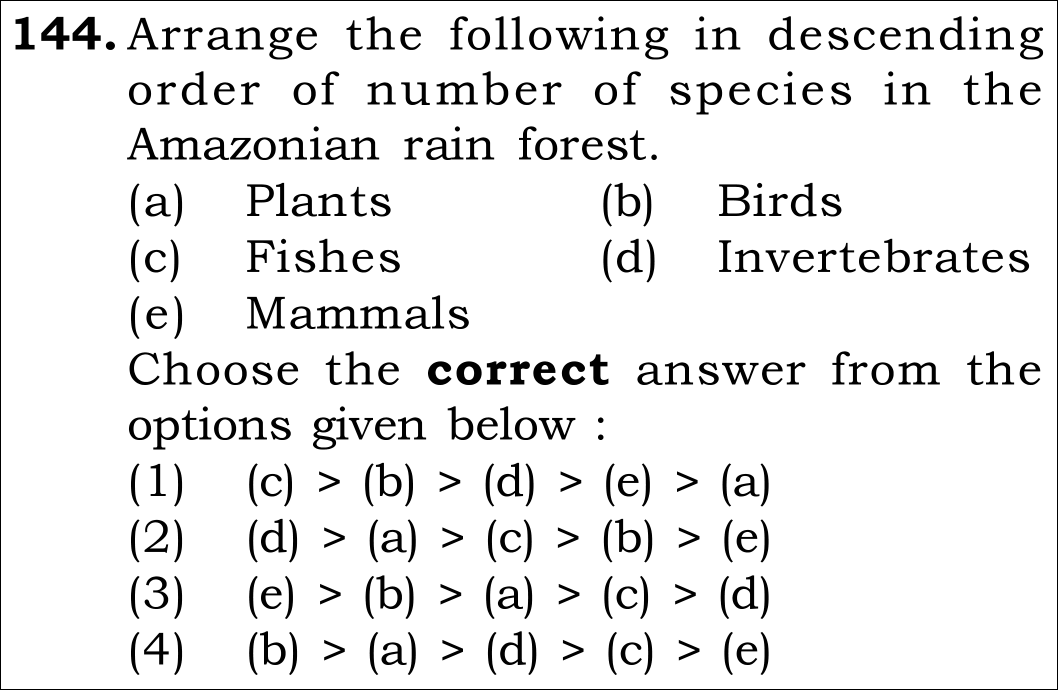
NEET 2026 Zoology Question 144: Species Richness Hierarchy in the Amazonian Rain Forest

Question

Arrange the following in descending order of number of species in the Amazonian rain forest. (a) Plants (b) Birds (c) Fishes (d) Invertebrates (e) Mammals Choose the correct answer from the options given below:

  1. (1)(c) > (b) > (d) > (e) > (a)
  2. (2)(d) > (a) > (c) > (b) > (e)
  3. (3)(e) > (b) > (a) > (c) > (d)
  4. (4)(b) > (a) > (d) > (c) > (e)
✓
Verified Against NTA Final Answer Key
Option (2) : (d) > (a) > (c) > (b) > (e)
📚 Biodiversity and Conservation Medium
📋 Given Parameters & Problem Setup
Ecosystem Amazonian rain forest in South America
Taxa Evaluated (a) Plants, (b) Birds, (c) Fishes, (d) Invertebrates, (e) Mammals
Ordering Condition Descending order of number of species
⚡

The 30-Second Exam Hall Shortcut: ⚡ Amazon Biodiversity Hierarchy Hack

⏱️ Save ~45 seconds

Invertebrates (1.25L) > Plants (40k) > Fishes (3k) > Birds (1.3k) > Mammals (427)!

1 Recall canonical species counts from NCERT Amazonian Rainforest paragraph:
2 Invertebrates (d): > 1,25,000 species (highest by far!).
3 Plants (a): > 40,000 species.
4 Fishes (c): 3,000 species.
5 Birds (b): 1,300 species.
6 Mammals (e): 427 species.
7 Descending sequence: (d) > (a) > (c) > (b) > (e).
8 Matches Option (2) directly in under 10 seconds!
🛡️
Why You Can 100% Trust This Shortcut: NCERT Biology · Biodiversity and Conservation (Global Species Diversity: Robert May’s estimate of 7 million global species).
📐

Step-by-Step Rigorous Workflow & Mathematical Proof

Step 1

Examine Canonical NCERT Species Data for Amazon Rainforest

The largely tropical Amazonian rain forest in South America harbors the greatest biodiversity on Earth. NCERT lists the exact documented species counts:

Invertebrates (d):>125,000 speciesPlants (a):>40,000 speciesFishes (c):3,000 speciesBirds (b):1,300 speciesMammals (e):427 species(Amphibians: 427,  Reptiles: 378)\begin{aligned} \text{Invertebrates (d)} &: > 125{,}000 \text{ species} \\ \text{Plants (a)} &: > 40{,}000 \text{ species} \\ \text{Fishes (c)} &: 3{,}000 \text{ species} \\ \text{Birds (b)} &: 1{,}300 \text{ species} \\ \text{Mammals (e)} &: 427 \text{ species} \quad (\text{Amphibians: } 427, \; \text{Reptiles: } 378) \end{aligned}
  • • Invertebrates comprise the largest biological diversity slice.
Step 2

Construct Descending Order

Sorting the groups from greatest number of species to smallest number of species gives:

Invertebrates(d)>Plants(a)>Fishes(c)>Birds(b)>Mammals(e)\mathbf{Invertebrates (d)} > \mathbf{Plants (a)} > \mathbf{Fishes (c)} > \mathbf{Birds (b)} > \mathbf{Mammals (e)}
  • • 125,000 > 40,000 > 3,000 > 1,300 > 427.
Step 3

Match with Options

Comparing with options: Option (1) starts with (c); Option (2) displays: (d) > (a) > (c) > (b) > (e); Option (3) starts with (e); Option (4) starts with (b). Option (2) is uniquely correct.

Correct Order=(d)>(a)>(c)>(b)>(e)  ⟹  Option (2)\text{Correct Order} = (\text{d}) > (\text{a}) > (\text{c}) > (\text{b}) > (\text{e}) \implies \text{Option (2)}
  • • Matches official NTA final answer key Option B / (2).
⭐

360° Option Elimination Engine Key Feature

Diagnose every choice: Know exactly why the right option works and why distractors fail.

4-Option Deep Scan
1 A
✗ Incorrect
Verdict & Scientific Reason:

Incorrect. Places Fishes before Invertebrates and Plants at the bottom.

⚠️
Student Fallacy (Why candidates pick this trap): Scrambled taxonomic count.
2 B
✓ 100% Correct
Verdict & Scientific Reason:

100% accurate. Matches exact species richness hierarchy: Invertebrates (125k) > Plants (40k) > Fishes (3k) > Birds (1.3k) > Mammals (427).

💡
Why this is airtight: None; flawless memory of NCERT biodiversity data.
3 C
✗ Incorrect
Verdict & Scientific Reason:

Incorrect. Reverses the entire order by placing Mammals (least species) first.

⚠️
Student Fallacy (Why candidates pick this trap): Confusing descending with ascending order.
4 D
✗ Incorrect
Verdict & Scientific Reason:

Incorrect. Places Birds ahead of Plants and Invertebrates.

⚠️
Student Fallacy (Why candidates pick this trap): Overestimating avian diversity relative to insect and plant taxa.
⚠️

NTA Trap Alert: Forgetting Invertebrate Hegemony

Invertebrates (specifically insects) constitute over 70% of animal species worldwide and over 1,25,000 species in the Amazon. Any descending list MUST start with Invertebrates (d).

🛡️ How to avoid the -1 mark: Remember: Invertebrates are always #1 in species numbers on Earth!
📖

Core NEET Syllabus Standard

NEET Biology Core Syllabus · Biodiversity and Conservation Standard Benchmark
Core Scientific Principle Tested:

"The Amazonian rainforest harbors >1,25,000 invertebrates, >40,000 plants, 3,000 fishes, 1,300 birds, and 427 mammals."

Syllabus Focus: Patterns of Biodiversity - Species Diversity in Amazon
✓ Core NEET UG Syllabus Anchor Syllabus & Academic Standards ↗
I-P-F-B-M: Invertebrates, Plants, Fishes, Birds, Mammals in the Amazonian realm!

Ready to attempt under real exam pressure?

Test your speed and accuracy in the authentic 180-minute timed NTA simulator.

Launch NEET 2026 CBT Test →

Spotted a mistake in this solution? Report an error ([email protected])

⚖️ Legal & Fair Dealing Notice: Sourced from publicly released NEET 2026 question papers and NEET answer keys for private study, research, and non-commercial educational practice under Fair Dealing (Section 52(1)(a) of the Indian Copyright Act, 1957). Not affiliated with or endorsed by NTA or NMC.

Solve 4 NEET Questions a Day — One per Subject

Cover all 1,140 official NEET questions in 285 days at your own pace. Progress is saved on your device. No login needed.