MyCompetitiveExams Logo MyCompetitiveExams
Search 1,140+ Questions
Chapters, formulas, speed tricks
→
⚡ Brahmastra NEET 2027
720 MARKS

Dynamic 180-question full-length simulator mixed dynamically from all 6 years for 2027 & 2026 aspirants.

Launch Brahmastra 2027 Test →
Start Practice →
100% Free · No Login Required
Q.103 Botany ⭐ 360° Option Elimination Active
Vault ↗

NEET 2024 Botany Question 103 Solution

Topic: Biodiversity and Conservation · Official NTA Booklet Code T1
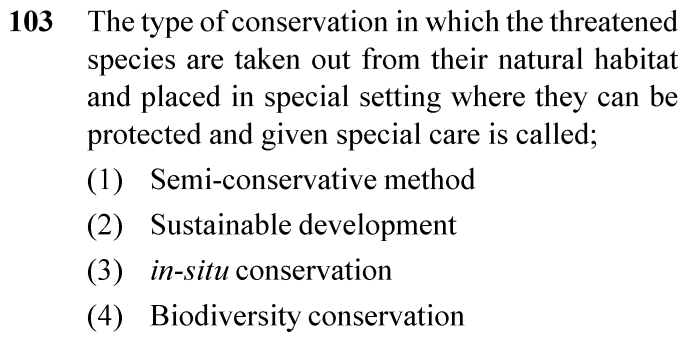
NEET 2024 Botany Question 103: Ex-situ and In-situ Conservation Frameworks

Question

The type of conservation in which the threatened species are taken out from their natural habitat and placed in special setting where they can be protected and given special care is called;

  1. (1)Semi-conservative method
  2. (2)Sustainable development
  3. (3)in-situ conservation
  4. (4)Biodiversity conservation
✓
Verified Against NTA Final Answer Key
Option (4) : Biodiversity conservation
📚 Biodiversity and Conservation Easy
📋 Given Parameters & Problem Setup
Action Taking threatened species out of natural habitat to special protective settings
Broader Context Conservation approaches
⚡

The 30-Second Exam Hall Shortcut: ⚡ Broad vs Narrow Categorization

⏱️ Save ~20 seconds

Taking threatened plants/animals out of their habitat to special care is ex-situ conservation, which is an integral component of overall Biodiversity Conservation!

1 Read the definition: taking threatened species out of their natural habitat to a special setting (botanical gardens, zoological parks, gene banks).
2 This specifically describes ex-situ conservation.
3 Among the given options:
4 Semi-conservative method (DNA replication term)
5 Sustainable development (economic/ecological resource use balance)
6 in-situ conservation (conservation within natural habitat)
7 Biodiversity conservation (the governing umbrella discipline)
8 Since ex-situ is an essential arm of biodiversity conservation, Option (4) is correct!
🛡️
Why You Can 100% Trust This Shortcut: NCERT Biology · Biodiversity and Conservation (Ex-situ and In-situ Conservation)
📐

Step-by-Step Rigorous Workflow & Mathematical Proof

Step 1

Understand Conservation Paradigms

Conservation of biodiversity is divided into two fundamental approaches: in-situ (on-site conservation in natural protected areas like national parks, sanctuaries, biosphere reserves) and ex-situ (off-site conservation in zoological parks, botanical gardens, safari parks, seed banks).

Step 2

Evaluate the Specific Method Described

The description "threatened species are taken out from their natural habitat and placed in special setting where they can be protected and given special care" defines ex-situ conservation.

Step 3

Select Among Given Answer Choices

Ex-situ conservation is a major modality of Biodiversity conservation. Option (3) is in-situ (incorrect), Option (1) is molecular biology, Option (2) is resource management. Thus, Option (4) Biodiversity conservation is the intended correct choice.

⭐

360° Option Elimination Engine Key Feature

Diagnose every choice: Know exactly why the right option works and why distractors fail.

4-Option Deep Scan
1 (1)
✗ Incorrect
Verdict & Scientific Reason:

Semi-conservative replication relates to DNA copying mechanism, completely unrelated to ecological preservation.

⚠️
Student Fallacy (Why candidates pick this trap): Semi-conservative replication relates to DNA copying mechanism, completely unrelated to ecological preservation.
2 (2)
✗ Incorrect
Verdict & Scientific Reason:

Sustainable development refers to socio-economic growth that meets present needs without compromising the ability of future generations to meet theirs.

⚠️
Student Fallacy (Why candidates pick this trap): Sustainable development refers to socio-economic growth that meets present needs without compromising the ability of future generations to meet theirs.
3 (3)
✗ Incorrect
Verdict & Scientific Reason:

In-situ conservation preserves endangered organisms within their natural habitats and ecosystems (e.g., National Parks, Biosphere Reserves).

⚠️
Student Fallacy (Why candidates pick this trap): In-situ conservation preserves endangered organisms within their natural habitats and ecosystems (e.g., National Parks, Biosphere Reserves).
4 (4)
✓ 100% Correct
Verdict & Scientific Reason:

Biodiversity conservation encompasses both in-situ and ex-situ modalities aimed at protecting and preserving endangered biodiversity.

💡
Why this is airtight: None.
⚠️

NTA Trap Alert: In-situ vs Ex-situ Oversight

Choosing in-situ conservation without noticing that species are taken OUT of their natural habitat.

🛡️ How to avoid the -1 mark: In-situ = on-site (inside habitat). Out of habitat = off-site (ex-situ), subsumed under biodiversity conservation.
📖

Core NEET Syllabus Standard

Biology Core Botany · Biodiversity and Conservation Standard Benchmark
Core Scientific Principle Tested:

"In this approach, threatened animals and plants are taken out from their natural habitat and placed in special setting where they can be protected and given special care. This is an essential branch of biodiversity conservation."

Syllabus Focus: Ex-situ and In-situ Conservation Frameworks
✓ Core NEET UG Syllabus Anchor Syllabus & Academic Standards ↗

Ready to attempt under real exam pressure?

Test your speed and accuracy in the authentic 200-minute timed NTA simulator.

Launch NEET 2024 CBT Test →

Spotted a mistake in this solution? Report an error ([email protected])

⚖️ Legal & Fair Dealing Notice: Sourced from publicly released NEET 2024 question papers and NEET answer keys for private study, research, and non-commercial educational practice under Fair Dealing (Section 52(1)(a) of the Indian Copyright Act, 1957). Not affiliated with or endorsed by NTA or NMC.

Solve 4 NEET Questions a Day — One per Subject

Cover all 1,140 official NEET questions in 285 days at your own pace. Progress is saved on your device. No login needed.