The 30-Second Exam Hall Shortcut: ⚡ Amazon Biodiversity Hierarchy Hack
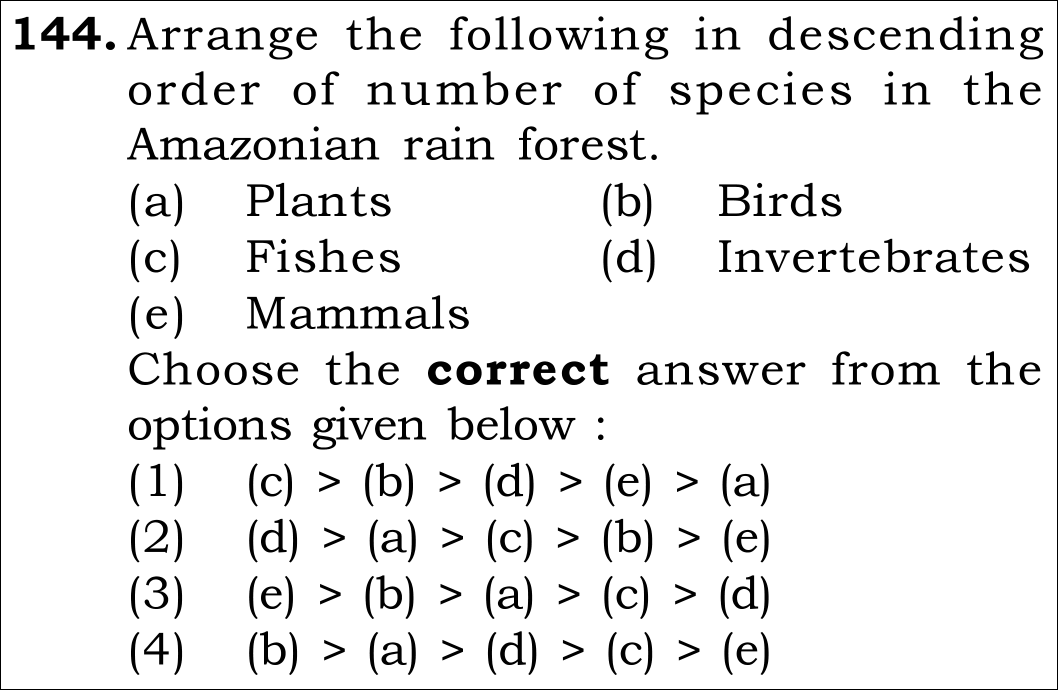
Invertebrates (1.25L) > Plants (40k) > Fishes (3k) > Birds (1.3k) > Mammals (427)!
Step-by-Step Rigorous Workflow & Mathematical Proof
Examine Canonical NCERT Species Data for Amazon Rainforest
The largely tropical Amazonian rain forest in South America harbors the greatest biodiversity on Earth. NCERT lists the exact documented species counts:
- • Invertebrates comprise the largest biological diversity slice.
Construct Descending Order
Sorting the groups from greatest number of species to smallest number of species gives:
- • 125,000 > 40,000 > 3,000 > 1,300 > 427.
Match with Options
Comparing with options: Option (1) starts with (c); Option (2) displays: (d) > (a) > (c) > (b) > (e); Option (3) starts with (e); Option (4) starts with (b). Option (2) is uniquely correct.
- • Matches official NTA final answer key Option B / (2).
360° Option Elimination Engine Key Feature
Diagnose every choice: Know exactly why the right option works and why distractors fail.
Incorrect. Places Fishes before Invertebrates and Plants at the bottom.
100% accurate. Matches exact species richness hierarchy: Invertebrates (125k) > Plants (40k) > Fishes (3k) > Birds (1.3k) > Mammals (427).
Incorrect. Reverses the entire order by placing Mammals (least species) first.
Incorrect. Places Birds ahead of Plants and Invertebrates.
NTA Trap Alert: Forgetting Invertebrate Hegemony
Invertebrates (specifically insects) constitute over 70% of animal species worldwide and over 1,25,000 species in the Amazon. Any descending list MUST start with Invertebrates (d).
Core NEET Syllabus Standard
"The Amazonian rainforest harbors >1,25,000 invertebrates, >40,000 plants, 3,000 fishes, 1,300 birds, and 427 mammals."