MyCompetitiveExams Logo MyCompetitiveExams
Search 1,140+ Questions
Chapters, formulas, speed tricks
→
⚡ Brahmastra NEET 2027
720 MARKS

Dynamic 180-question full-length simulator mixed dynamically from all 6 years for 2027 & 2026 aspirants.

Launch Brahmastra 2027 Test →
Start Practice →
100% Free · No Login Required
Q.143 Zoology ⭐ 360° Option Elimination Active
Vault ↗

NEET 2026 Zoology Question 143 Solution

Topic: Human Reproduction · Official NTA Booklet Code 50
NEET 2026 Zoology Question 143: Male vs Female Accessory Ducts and Reproductive Anatomy

Question

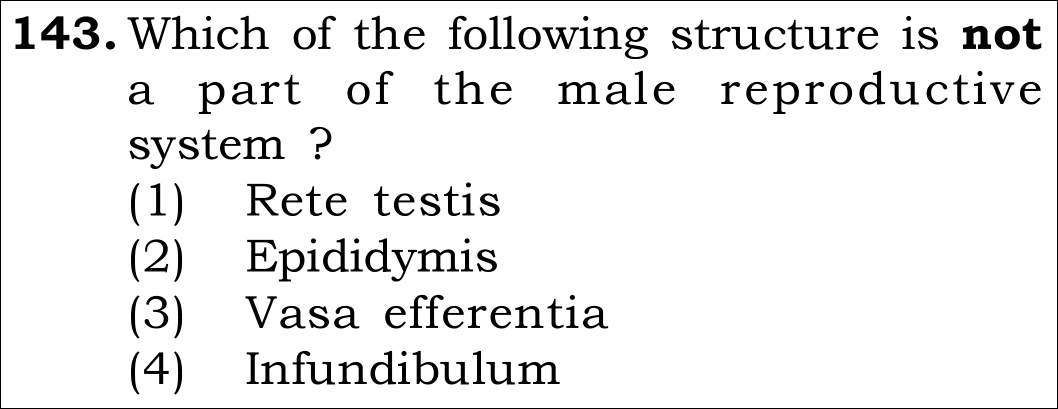
Which of the following structure is not a part of the male reproductive system?

  1. (1)Rete testis
  2. (2)Epididymis
  3. (3)Vasa efferentia
  4. (4)Infundibulum
✓
Verified Against NTA Final Answer Key
Option (4) : Infundibulum
📚 Human Reproduction Easy
📋 Given Parameters & Problem Setup
Evaluation Goal Identify structure that is NOT a part of the male reproductive system
Candidate Anatomical Structures Rete testis, Epididymis, Vasa efferentia, Infundibulum
⚡

The 30-Second Exam Hall Shortcut: ⚡ Female Fallopian Duct Spotter

⏱️ Save ~40 seconds

Infundibulum is the funnel-shaped entrance to the Fallopian Tube (Female)!

1 Recall male accessory ducts in sequence: Seminiferous tubules -> Rete testis -> Vasa efferentia -> Epididymis -> Vas deferens.
2 Options (1), (2), and (3) are all male accessory reproductive ducts.
3 Infundibulum is the funnel-shaped part of the female oviduct closest to the ovary (bearing fimbriae).
4 Therefore, Infundibulum is NOT part of the male system.
5 Select Option (4) in under 5 seconds!
🛡️
Why You Can 100% Trust This Shortcut: NCERT Biology · Human Reproduction (Male Reproductive System: Leydig cells produce androgens under LH stimulation).
📐

Step-by-Step Rigorous Workflow & Mathematical Proof

Step 1

Anatomy of the Male Reproductive Duct System

The male sex accessory ducts include the rete testis, vasa efferentia, epididymis, and vas deferens. Sperm generated in seminiferous tubules pass sequentially through these ducts to mature and undergo transport.

Male Ducts=Seminiferous Tubules→Rete Testis→Vasa Efferentia→Epididymis→Vas Deferens\text{Male Ducts} = \text{Seminiferous Tubules} \rightarrow \mathbf{Rete\text{ Testis}} \rightarrow \mathbf{Vasa\text{ Efferentia}} \rightarrow \mathbf{Epididymis} \rightarrow \text{Vas Deferens}
  • • Options (1), (2), and (3) belong to the male reproductive system.
Step 2

Anatomy of the Female Oviduct (Fallopian Tube)

Each Fallopian tube is 10–12 cm long and consists of three distinct segments: (1) Infundibulum (the funnel-shaped opening closest to the ovary, featuring finger-like fimbriae that collect the ovum after ovulation), (2) Ampulla (the wider middle region where fertilization occurs), and (3) Isthmus (the narrow terminal lumen joining the uterus).

Oviduct (Female)=Infundibulum (with fimbriae)→Ampulla→Isthmus\text{Oviduct (Female)} = \mathbf{Infundibulum\text{ (with fimbriae)}} \rightarrow \text{Ampulla} \rightarrow \text{Isthmus}
  • • Infundibulum is exclusively a female reproductive structure.
Step 3

Conclusion

Infundibulum is part of the female reproductive system, and therefore not part of the male reproductive system.

Not male structure=Infundibulum  ⟹  Option (4)\text{Not male structure} = \mathbf{Infundibulum} \implies \text{Option (4)}
  • • Matches official NTA final answer key Option D / (4).
⭐

360° Option Elimination Engine Key Feature

Diagnose every choice: Know exactly why the right option works and why distractors fail.

4-Option Deep Scan
1 A
✗ Incorrect
Verdict & Scientific Reason:

Incorrect. Rete testis is an essential male duct network located inside the mediastinum testis.

⚠️
Student Fallacy (Why candidates pick this trap): Failing to read the negative condition in the stem.
2 B
✗ Incorrect
Verdict & Scientific Reason:

Incorrect. Epididymis is the coiled male duct where spermatozoa undergo functional maturation and storage.

⚠️
Student Fallacy (Why candidates pick this trap): Misclassifying a prominent male organ.
3 C
✗ Incorrect
Verdict & Scientific Reason:

Incorrect. Vasa efferentia conduct sperm from rete testis to epididymis in the male system.

⚠️
Student Fallacy (Why candidates pick this trap): Confusing male vasa efferentia with female structures.
4 D
✓ 100% Correct
Verdict & Scientific Reason:

100% accurate. Infundibulum is the proximal funnel-shaped portion of the female Fallopian tube.

💡
Why this is airtight: None; sharp anatomical distinction.
⚠️

NTA Trap Alert: Duct Nomenclature Precision

Male ducts: Vasa efferentia, Vas deferens, Epididymis, Rete testis. Female ducts: Infundibulum, Ampulla, Isthmus, Uterus, Vagina.

🛡️ How to avoid the -1 mark: Associate Infundibulum with Fimbriae: both are female funnel parts collecting eggs!
📖

Core NEET Syllabus Standard

NEET Biology Core Syllabus · Human Reproduction Standard Benchmark
Core Scientific Principle Tested:

"The male accessory ducts are rete testis, vasa efferentia, epididymis, and vas deferens. Infundibulum is a component of the female Fallopian tube."

Syllabus Focus: Male and Female Reproductive Systems
✓ Core NEET UG Syllabus Anchor Syllabus & Academic Standards ↗
Rete, Vasa, Epididymis are for the Guy; Infundibulum and Fimbriae catch Eggs floating by!

Ready to attempt under real exam pressure?

Test your speed and accuracy in the authentic 180-minute timed NTA simulator.

Launch NEET 2026 CBT Test →

Spotted a mistake in this solution? Report an error ([email protected])

⚖️ Legal & Fair Dealing Notice: Sourced from publicly released NEET 2026 question papers and NEET answer keys for private study, research, and non-commercial educational practice under Fair Dealing (Section 52(1)(a) of the Indian Copyright Act, 1957). Not affiliated with or endorsed by NTA or NMC.

Solve 4 NEET Questions a Day — One per Subject

Cover all 1,140 official NEET questions in 285 days at your own pace. Progress is saved on your device. No login needed.