MyCompetitiveExams Logo MyCompetitiveExams
Search 1,140+ Questions
Chapters, formulas, speed tricks
→
⚡ Brahmastra NEET 2027
720 MARKS

Dynamic 180-question full-length simulator mixed dynamically from all 6 years for 2027 & 2026 aspirants.

Launch Brahmastra 2027 Test →
Start Practice →
100% Free · No Login Required
Q.148 Botany ⭐ 360° Option Elimination Active
Vault ↗

NEET 2023 Botany Question 148 Solution

Topic: Organisms and Populations · Official NTA Booklet Code G5
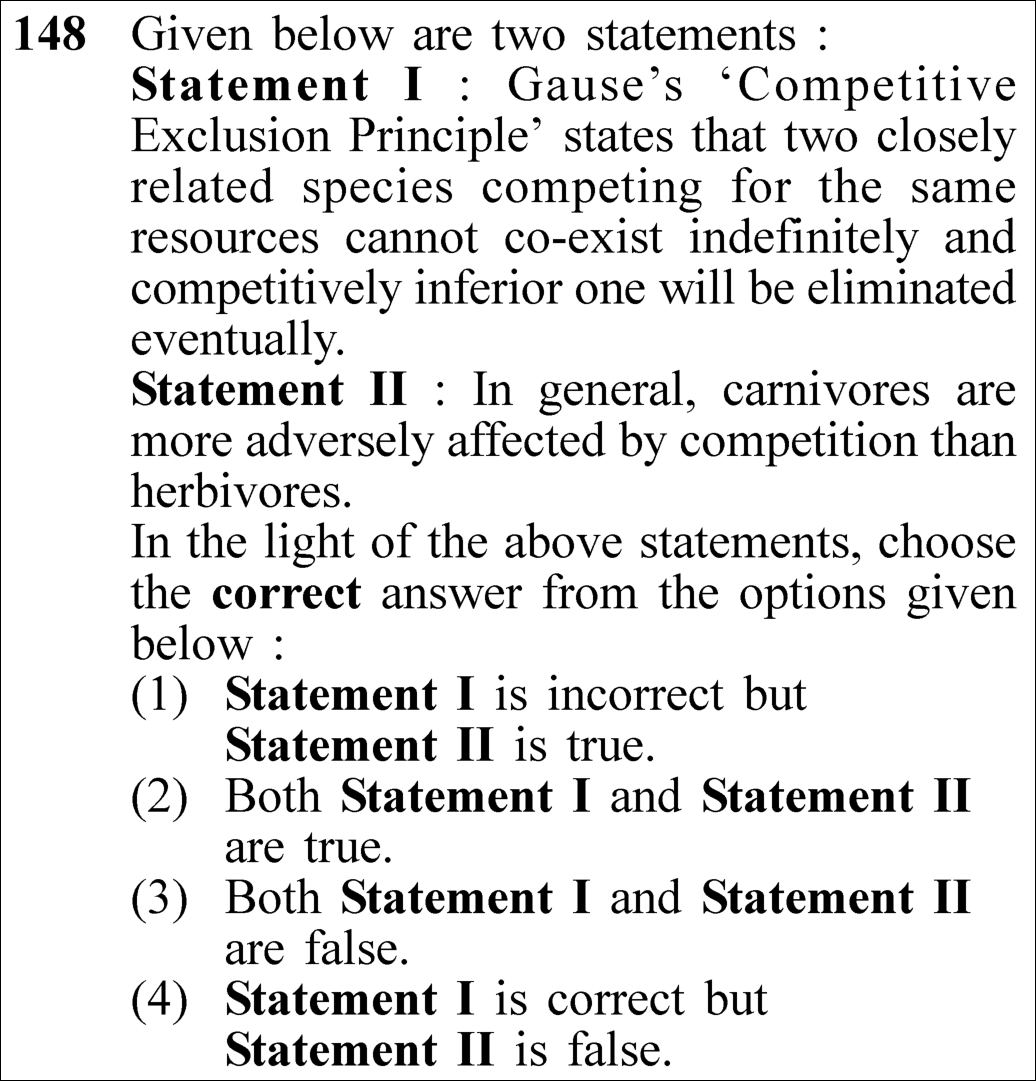
NEET 2023 Botany Question 148: Competition: Gause's Principle and Herbivore vs. Carnivore Susceptibility

Question

Given below are two statements: Statement I: Gause's 'Competitive Exclusion Principle' states that two closely related species competing for the same resources cannot co-exist indefinitely and competitively inferior one will be eliminated eventually. Statement II: In general, carnivores are more adversely affected by competition than herbivores. In the light of the above statements, choose the correct answer from the options given below:

  1. (1)Statement I is incorrect but Statement II is true.
  2. (2)Both Statement I and Statement II are true.
  3. (3)Both Statement I and Statement II are false.
  4. (4)Statement I is correct but Statement II is false.
✓
Verified Against NTA Final Answer Key
Option (4) : Statement I is correct but Statement II is false.
📚 Organisms and Populations Medium
📋 Given Parameters & Problem Setup
Statement I Gause's Principle: Two closely related species competing for same resources cannot co-exist indefinitely and inferior one is eliminated.
Statement II In general, carnivores are more adversely affected by competition than herbivores.
⚡

The 30-Second Exam Hall Shortcut: ⚡ Herbivores Are MORE Affected by Competition, NOT Carnivores!

⏱️ Save ~25 seconds

Statement I is verbatim Gause's Competitive Exclusion Principle -> Correct! But Statement II claims carnivores are more affected. NCERT explicitly states: "In general, herbivores and plants appear to be more adversely affected by competition than carnivores!" Statement II is False! Select Option (4)!

1 Check Statement I: Gause's Principle states competing species for limited resources cannot coexist indefinitely, inferior eliminated -> Verbatim NCERT, Correct.
2 Check Statement II: Claims carnivores are more adversely affected than herbivores -> NCERT says HERBIVORES and plants are more adversely affected -> False.
3 Statement I is correct but Statement II is false.
4 Match Option (4).
🛡️
Why You Can 100% Trust This Shortcut: Canonical NCERT Organisms and Populations competition ecological principles.
📐

Step-by-Step Rigorous Workflow & Mathematical Proof

Step 1

Evaluation of Statement I (Gause's Competitive Exclusion Principle)

Gause's principle describes resource competition under limiting conditions:

Gause’s Principle  ⟺  Two competing species with identical niches cannot coexist indefinitely  ⟹  Statement I is Correct\text{Gause's Principle} \iff \text{Two competing species with identical niches cannot coexist indefinitely} \implies \text{Statement I is } \mathbf{\text{Correct}}
Step 2

Evaluation of Statement II (Trophic Susceptibility to Competition)

Plants and herbivores compete intensely for limited forage, sunlight, and soil nutrients. Field ecological studies summarized in NCERT demonstrate that herbivores experience greater competitive displacement than carnivores:

Adverse Impact of Competition: Herbivores & Plants>Carnivores  ⟹  Statement II is False\text{Adverse Impact of Competition: } \mathbf{\text{Herbivores \& Plants}} > \text{Carnivores} \implies \text{Statement II is } \mathbf{\text{False}}
Step 3

Verbatim NCERT Reference

NCERT states verbatim: - Statement I: "Gause's 'Competitive Exclusion Principle' states that two closely related species competing for the same resources cannot co-exist indefinitely and the competitively inferior one will be eliminated eventually." - Statement II: "In general, herbivores and plants appear to be more adversely affected by competition than carnivores."

⭐

360° Option Elimination Engine Key Feature

Diagnose every choice: Know exactly why the right option works and why distractors fail.

4-Option Deep Scan
1 1
✗ Incorrect
Verdict & Scientific Reason:

Inverts both statements: Statement I is true, while Statement II is false.

⚠️
Student Fallacy (Why candidates pick this trap): Doubting Gause's principle or accepting the inverted trophic claim.
2 2
✗ Incorrect
Verdict & Scientific Reason:

Statement II is factually contradicted by NCERT ecology.

⚠️
Student Fallacy (Why candidates pick this trap): Assuming predators compete more fiercely for scarce prey than herbivores for abundant plants.
3 3
✗ Incorrect
Verdict & Scientific Reason:

Statement I is a foundational law of community ecology and fully correct.

⚠️
Student Fallacy (Why candidates pick this trap): Rejecting Gause's principle based on resource partitioning exceptions.
4 4
✓ 100% Correct
Verdict & Scientific Reason:

Statement I is verbatim NCERT, while Statement II directly inverts the relative susceptibility of herbivores and carnivores.

💡
Why this is airtight: None; rigorous ecological literacy.
⚠️

NTA Trap Alert: Trophic Level Competition Intuition Trap

Intuitively, students think apex carnivores (lions, tigers) fight violently and are more affected by competition. Ecologically, herbivores face severe food biomass and quality limitations that exert stronger population regulation.

🛡️ How to avoid the -1 mark: Remember NCERT rule: Herbivores and plants are MORE adversely affected by competition than carnivores.
📖

Core NEET Syllabus Standard

NCERT Biology · Organisms and Populations Standard Benchmark
Core Scientific Principle Tested:

"Gause's principle states two closely related species competing for same resources cannot coexist indefinitely. In general, herbivores and plants appear to be more adversely affected by competition than carnivores."

Syllabus Focus: Competition
✓ Core NEET UG Syllabus Anchor Syllabus & Academic Standards ↗

Ready to attempt under real exam pressure?

Test your speed and accuracy in the authentic 200-minute timed NTA simulator.

Launch NEET 2023 CBT Test →

Spotted a mistake in this solution? Report an error ([email protected])

⚖️ Legal & Fair Dealing Notice: Sourced from publicly released NEET 2023 question papers and NEET answer keys for private study, research, and non-commercial educational practice under Fair Dealing (Section 52(1)(a) of the Indian Copyright Act, 1957). Not affiliated with or endorsed by NTA or NMC.

Solve 4 NEET Questions a Day — One per Subject

Cover all 1,140 official NEET questions in 285 days at your own pace. Progress is saved on your device. No login needed.