MyCompetitiveExams Logo MyCompetitiveExams
Search 1,140+ Questions
Chapters, formulas, speed tricks
→
⚡ Brahmastra NEET 2027
720 MARKS

Dynamic 180-question full-length simulator mixed dynamically from all 6 years for 2027 & 2026 aspirants.

Launch Brahmastra 2027 Test →
Start Practice →
100% Free · No Login Required
Q.64 Chemistry ⭐ 360° Option Elimination Active
Vault ↗

NEET 2021 Chemistry Question 64 Solution

Topic: Solutions · Official NTA Booklet Code M1
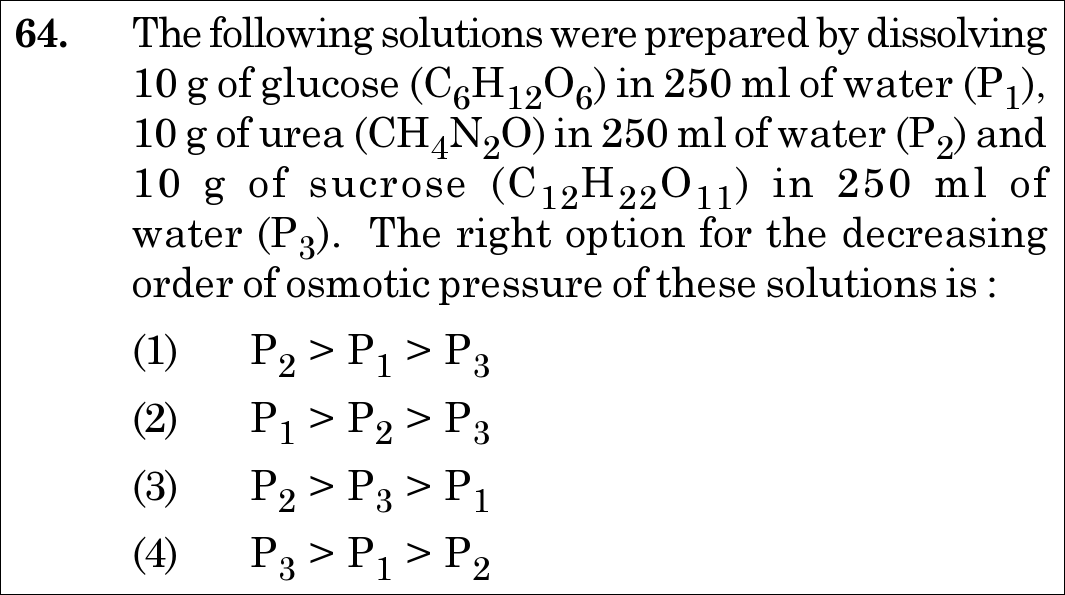
NEET 2021 Chemistry Question 64: Osmotic Pressure Comparison of Non-Electrolyte Solutions

Question

The following solutions were prepared by dissolving 10 g of glucose (C6H12O6) in 250 ml of water (P1), 10 g of urea (CH4N2O) in 250 ml of water (P2) and 10 g of sucrose (C12H22O11) in 250 ml of water (P3). The right option for the decreasing order of osmotic pressure of these solutions is:

  1. (1)P2 > P1 > P3
  2. (2)P1 > P2 > P3
  3. (3)P2 > P3 > P1
  4. (4)P3 > P1 > P2
✓
Verified Against NTA Final Answer Key
Option (1) : P2 > P1 > P3
📚 Solutions Easy
📋 Given Parameters & Problem Setup
Solute 1 10 g glucose (C6H12O6, M = 180 g/mol) in 250 mL (P1)
Solute 2 10 g urea (CH4N2O, M = 60 g/mol) in 250 mL (P2)
Solute 3 10 g sucrose (C12H22O11, M = 342 g/mol) in 250 mL (P3)
⚡

The 30-Second Exam Hall Shortcut: ⚡ Equal Mass & Volume: Π ∝ 1/Molar Mass!

⏱️ Save ~20 seconds

Osmotic pressure Π=wMVRT\Pi = \frac{w}{M V} R T. With identical dissolved mass (10 g10\text{ g}) and solution volume (250 mL250\text{ mL}), osmotic pressure is strictly inversely proportional to molar mass: Π∝1M\Pi \propto \frac{1}{M}! Urea (M=60M=60) has lowest molar mass   ⟹  \implies highest pressure (P2P_2). Glucose (M=180M=180) is intermediate (P1P_1). Sucrose (M=342M=342) is highest molar mass   ⟹  \implies lowest pressure (P3P_3). Decreasing order: P2>P1>P3P_2 > P_1 > P_3! Match Option (1)!

1 Formula: Π=CRT=nVRT=(wM)RTV\Pi = C R T = \frac{n}{V} R T = \left(\frac{w}{M}\right) \frac{R T}{V}.
2 Since w=10 gw = 10\text{ g}, V=250 mLV = 250\text{ mL}, and TT are identical for all solutions, Π∝1M\Pi \propto \frac{1}{M}.
3 Compare molar masses: Urea (M=60 g/molM = 60\text{ g/mol}) < Glucose (M=180 g/molM = 180\text{ g/mol}) < Sucrose (M=342 g/molM = 342\text{ g/mol}).
4 Invert order for osmotic pressure: Purea(P2)>Pglucose(P1)>Psucrose(P3)P_{\text{urea}} (P_2) > P_{\text{glucose}} (P_1) > P_{\text{sucrose}} (P_3).
5 Match Option (1) P2 > P1 > P3.
🛡️
Why You Can 100% Trust This Shortcut: Canonical van 't Hoff colligative property definition for non-electrolytes.
📐

Step-by-Step Rigorous Workflow & Mathematical Proof

Step 1

Formulating Osmotic Pressure for Non-Electrolytes

For dilute non-electrolyte solutions that neither associate nor dissociate (van 't Hoff factor i=1i = 1), osmotic pressure Π\Pi is given by:

Π=CRT=(nV)RT=(wM⋅V)RT\Pi = C R T = \left(\frac{n}{V}\right) R T = \left(\frac{w}{M \cdot V}\right) R T
Step 2

Calculating Number of Moles for Each Solution

Each solution contains w=10 gw = 10\text{ g} of solute dissolved in V=250 mL=0.25 LV = 250\text{ mL} = 0.25\text{ L} of water: - Solution 1 (Glucose, C6H12O6C_6H_{12}O_6): M1=180 g/molM_1 = 180\text{ g/mol} n1=10180=0.0556 mol  ⟹  C1=0.05560.25=0.222 Mn_1 = \frac{10}{180} = 0.0556\text{ mol} \implies C_1 = \frac{0.0556}{0.25} = 0.222\text{ M} - Solution 2 (Urea, NH2CONH2NH_2CONH_2): M2=60 g/molM_2 = 60\text{ g/mol} n2=1060=0.1667 mol  ⟹  C2=0.16670.25=0.667 Mn_2 = \frac{10}{60} = 0.1667\text{ mol} \implies C_2 = \frac{0.1667}{0.25} = 0.667\text{ M} - Solution 3 (Sucrose, C12H22O11C_{12}H_{22}O_{11}): M3=342 g/molM_3 = 342\text{ g/mol} n3=10342=0.0292 mol  ⟹  C3=0.02920.25=0.117 Mn_3 = \frac{10}{342} = 0.0292\text{ mol} \implies C_3 = \frac{0.0292}{0.25} = 0.117\text{ M}

Step 3

Ranking the Osmotic Pressures in Decreasing Order

Because osmotic pressure is directly proportional to molar concentration CC:

C2>C1>C3  ⟹  P2>P1>P3C_2 > C_1 > C_3 \implies P_2 > P_1 > P_3
⭐

360° Option Elimination Engine Key Feature

Diagnose every choice: Know exactly why the right option works and why distractors fail.

4-Option Deep Scan
1 1
✓ 100% Correct
Verdict & Scientific Reason:

Exact decreasing order of osmotic pressure: Urea (P2P_2) > Glucose (P1P_1) > Sucrose (P3P_3).

💡
Why this is airtight: None; rigorous colligative property computation.
2 2
✗ Incorrect
Verdict & Scientific Reason:

Places glucose above urea, which violates n2(10/60)>n1(10/180)n_2 (10/60) > n_1 (10/180).

⚠️
Student Fallacy (Why candidates pick this trap): Assuming larger molecule exerts higher osmotic pressure.
3 3
✗ Incorrect
Verdict & Scientific Reason:

Places sucrose above glucose (10/342>10/18010/342 > 10/180), which is false.

⚠️
Student Fallacy (Why candidates pick this trap): Inverting glucose and sucrose molar masses.
4 4
✗ Incorrect
Verdict & Scientific Reason:

Directly proportional to molar mass (complete inversion of colligative property).

⚠️
Student Fallacy (Why candidates pick this trap): Assuming colligative property scales with molecular weight rather than mole count.
⚠️

NTA Trap Alert: Molecular Size vs. Particle Number Trap

Students frequently think "sucrose is the largest molecule, so it pushes harder on the semipermeable membrane and gives the highest pressure". Colligative properties depend STRICTLY on the NUMBER of particles, NOT their size or molecular weight. Smaller molar mass   ⟹  \implies MORE moles for equal mass   ⟹  \implies HIGHER pressure.

🛡️ How to avoid the -1 mark: For equal masses: Smallest molar mass (M=60M=60) has the MOST moles   ⟹  \implies highest Π\Pi.
📖

Core NEET Syllabus Standard

NCERT Chemistry · Solutions Standard Benchmark
Core Scientific Principle Tested:

"Osmotic pressure is a colligative property proportional to the number of solute particles per unit volume: Π=wRTMV\Pi = \frac{w R T}{M V}."

Syllabus Focus: Colligative Properties and Determination of Molar Mass (Osmotic Pressure)
✓ Core NEET UG Syllabus Anchor Syllabus & Academic Standards ↗

Ready to attempt under real exam pressure?

Test your speed and accuracy in the authentic 200-minute timed NTA simulator.

Launch NEET 2021 CBT Test →

Spotted a mistake in this solution? Report an error ([email protected])

⚖️ Legal & Fair Dealing Notice: Sourced from publicly released NEET 2021 question papers and NEET answer keys for private study, research, and non-commercial educational practice under Fair Dealing (Section 52(1)(a) of the Indian Copyright Act, 1957). Not affiliated with or endorsed by NTA or NMC.

Solve 4 NEET Questions a Day — One per Subject

Cover all 1,140 official NEET questions in 285 days at your own pace. Progress is saved on your device. No login needed.