MyCompetitiveExams Logo MyCompetitiveExams
Search 1,140+ Questions
Chapters, formulas, speed tricks
→
⚡ Brahmastra NEET 2027
720 MARKS

Dynamic 180-question full-length simulator mixed dynamically from all 6 years for 2027 & 2026 aspirants.

Launch Brahmastra 2027 Test →
Start Practice →
100% Free · No Login Required
Q.65 Chemistry ⭐ 360° Option Elimination Active
Vault ↗

NEET 2021 Chemistry Question 65 Solution

Topic: General Principles and Processes of Isolation of Elements · Official NTA Booklet Code M1
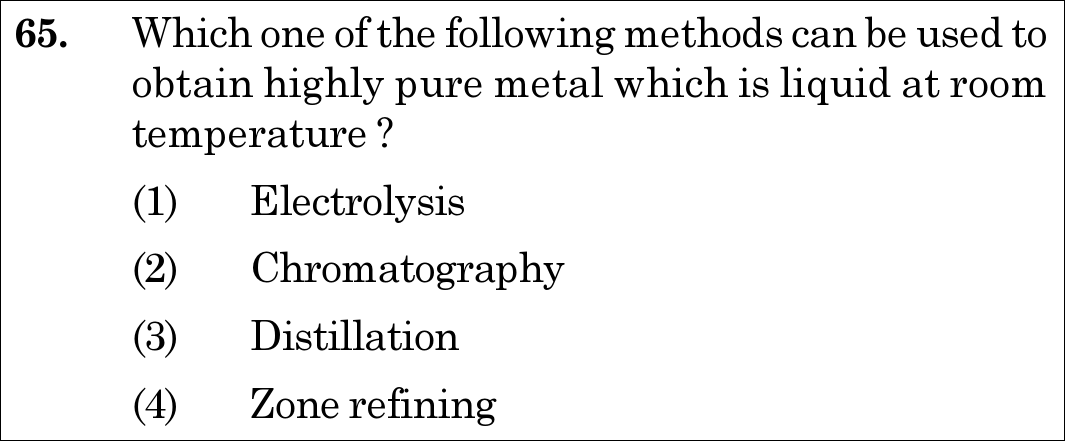
NEET 2021 Chemistry Question 65: Refining of Metals: Distillation for Low-Boiling and Liquid Metals

Question

Which one of the following methods can be used to obtain highly pure metal which is liquid at room temperature?

  1. (1)Electrolysis
  2. (2)Chromatography
  3. (3)Distillation
  4. (4)Zone refining
✓
Verified Against NTA Final Answer Key
Option (3) : Distillation
📚 General Principles and Processes of Isolation of Elements Easy
📋 Given Parameters & Problem Setup
Condition Highly pure metal which is liquid at room temperature (Mercury, Hg)
⚡

The 30-Second Exam Hall Shortcut: ⚡ Liquid Metal = Mercury (Low Boiling Point)   ⟹  \implies Distillation!

⏱️ Save ~20 seconds

The only metal that is liquid at room temperature is Mercury (HgHg). Mercury has an extraordinarily low boiling point (356.7∘C356.7^\circ\text{C}). The standard NCERT refining method for low-boiling metals (Zinc and Mercury) is DISTILLATION! Match Option (3)!

1 Identify the metal: "metal which is liquid at room temperature"   ⟹  \implies Mercury (HgHg).
2 Recall NCERT Refining of Metals section: "Distillation: This is very useful for low boiling metals like zinc and mercury. The impure metal is evaporated to obtain the pure metal as distillate."
3 Other methods: Zone refining is used for semiconductors (Si, Ge); Electrolysis is used for Cu, Al; Chromatography is used when impurities have similar chemical properties.
4 Match Option (3) Distillation.
🛡️
Why You Can 100% Trust This Shortcut: Canonical NCERT Metallurgy section on Refining (Distillation).
📐

Step-by-Step Rigorous Workflow & Mathematical Proof

Step 1

Identifying the Target Metal

Mercury (HgHg, atomic number 80) is the only metallic element that exists in the liquid state at standard room temperature (25∘C25^\circ\text{C} / 298 K298\text{ K}), having a melting point of −38.83∘C-38.83^\circ\text{C}.

Step 2

Evaluating Refining Techniques Described in NCERT

NCERT categorizes metal refining processes based on physical properties: - Distillation: Used specifically for metals with low boiling points, such as Zinc (ZnZn) and Mercury (HgHg). The impure volatile metal is vaporized and condensed as pure distillate, leaving non-volatile impurities behind. - Electrolysis: Applied to reactive or common industrial metals like copper, aluminum, and gold. - Zone Refining: Applied to ultra-pure semiconductors (Germanium, Silicon, Boron, Gallium, Indium). - Chromatography: Utilized when elements to be separated are available in minute quantities and exhibit close chemical similarities.

Step 3

Conclusion

Distillation is the designated metallurgical method to obtain highly pure mercury, corresponding to Option (3).

⭐

360° Option Elimination Engine Key Feature

Diagnose every choice: Know exactly why the right option works and why distractors fail.

4-Option Deep Scan
1 1
✗ Incorrect
Verdict & Scientific Reason:

Standard refining method for copper, silver, and aluminum, but not the specific industrial method for liquid mercury.

⚠️
Student Fallacy (Why candidates pick this trap): Assuming electrolysis is universal for all metals.
2 2
✗ Incorrect
Verdict & Scientific Reason:

Employed for microgram separations and lanthanoids/actinoids, not bulk mercury purification.

⚠️
Student Fallacy (Why candidates pick this trap): Overcomplicating the separation technique.
3 3
✓ 100% Correct
Verdict & Scientific Reason:

Verbatim NCERT refining method for low-boiling volatile metals like zinc and liquid mercury.

💡
Why this is airtight: None; textbook metallurgy precision.
4 4
✗ Incorrect
Verdict & Scientific Reason:

Used for solid semiconductor metals (Ge,Si,GaGe, Si, Ga) based on fractional crystallization.

⚠️
Student Fallacy (Why candidates pick this trap): Confusing semiconductor purification with low-boiling metal refining.
⚠️

NTA Trap Alert: Zone Refining vs. Distillation Trap

Students who see "highly pure metal" often instinctively guess Zone Refining (Option 4) because zone refining produces high-purity semiconductors. However, zone refining relies on a moving molten zone in a SOLID ingot, making it impossible for a metal that is already liquid at room temperature (Mercury).

🛡️ How to avoid the -1 mark: Liquid metal at room temperature   ⟹  Hg  ⟹  \implies Hg \implies volatile   ⟹  \implies Distillation.
📖

Core NEET Syllabus Standard

NCERT Chemistry · General Principles and Processes of Isolation of Elements Standard Benchmark
Core Scientific Principle Tested:

"Distillation is used to refine low-boiling metals such as zinc and mercury by converting the metal into vapor while impurities remain behind."

Syllabus Focus: Refining of Metals (Distillation)
✓ Core NEET UG Syllabus Anchor Syllabus & Academic Standards ↗

Ready to attempt under real exam pressure?

Test your speed and accuracy in the authentic 200-minute timed NTA simulator.

Launch NEET 2021 CBT Test →

Spotted a mistake in this solution? Report an error ([email protected])

⚖️ Legal & Fair Dealing Notice: Sourced from publicly released NEET 2021 question papers and NEET answer keys for private study, research, and non-commercial educational practice under Fair Dealing (Section 52(1)(a) of the Indian Copyright Act, 1957). Not affiliated with or endorsed by NTA or NMC.

Solve 4 NEET Questions a Day — One per Subject

Cover all 1,140 official NEET questions in 285 days at your own pace. Progress is saved on your device. No login needed.