The 30-Second Exam Hall Shortcut: ⚡ Blast Furnace Thermal Zone Division: Reduction of Fe₂O₃ Occurs at Top (500–800 K)!
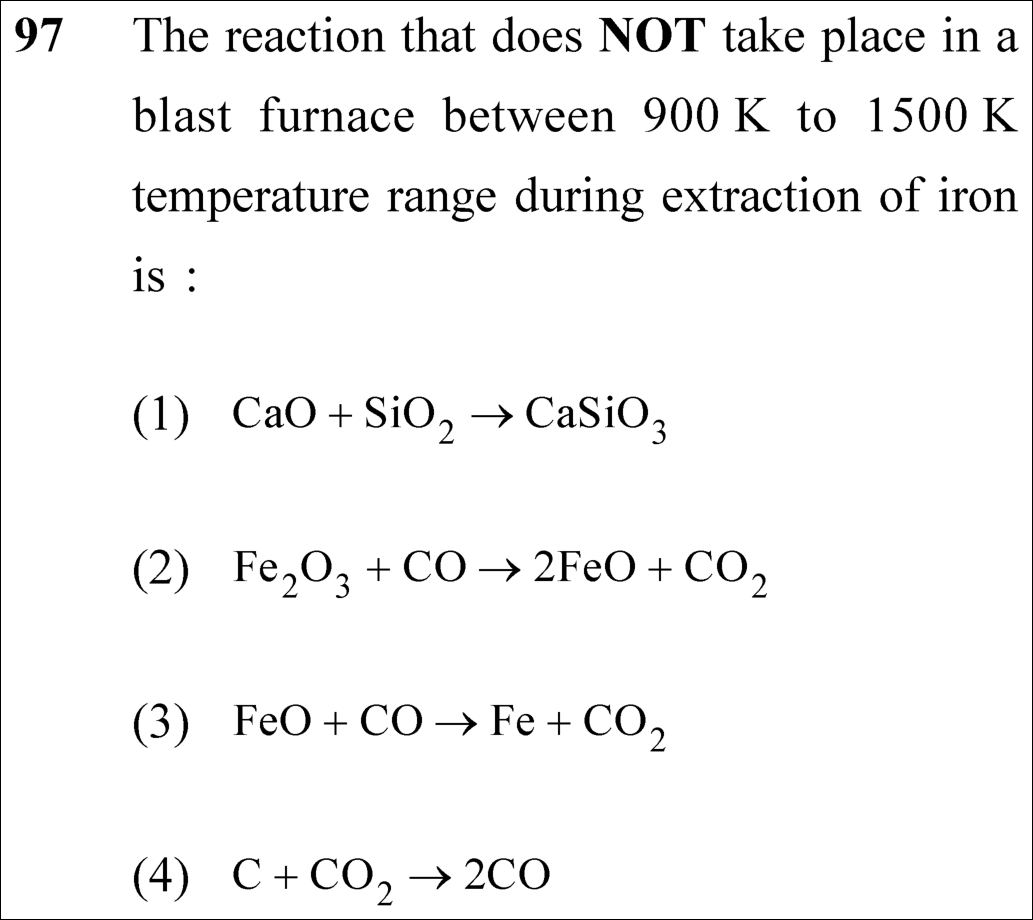
In a blast furnace, reduction of haematite (Fe₂O₃) by CO occurs at the TOP in the LOWER temperature zone (500 K – 800 K): Fe₂O₃ + CO ⟶ 2 FeO + CO₂. The higher temperature zone (900 K – 1500 K) in the middle/lower part features C + CO₂ ⟶ 2 CO, FeO + CO ⟶ Fe + CO₂, and slag formation CaO + SiO₂ ⟶ CaSiO₃! Therefore, reaction (2) does NOT occur in 900–1500 K! Lock Option (2) in 10 seconds!
Step-by-Step Rigorous Workflow & Mathematical Proof
Thermal Profile of the Blast Furnace
The blast furnace is divided into thermal zones based on height: (a) Upper lower-temperature zone (500 K to 800 K), and (b) Middle-to-lower higher-temperature zone (900 K to 1500 K):
Reactions in the Lower Temperature Range (500 K – 800 K)
At the top of the furnace, haematite (Fe₂O₃) is reduced in stages by carbon monoxide at 500 K – 800 K:
Reactions in the Higher Temperature Range (900 K – 1500 K)
In the 900 K to 1500 K zone, carbon dioxide is reduced by coke, FeO is reduced to iron, and limestone forms slag:
Identify the Reaction that Does NOT Take Place in 900–1500 K
Reaction (2), Fe₂O₃ + CO ⟶ 2 FeO + CO₂, takes place strictly at the lower temperatures (500 K – 800 K). Therefore, it does NOT occur in the 900 K to 1500 K range:
360° Option Elimination Engine Key Feature
Diagnose every choice: Know exactly why the right option works and why distractors fail.
Slag formation occurs actively between 1070 K and 1270 K (inside 900 K – 1500 K).
Accurate: This reduction step occurs at the cooler top of the blast furnace (500 K – 800 K), not between 900 K and 1500 K.
Reduction of FeO to Fe takes place directly within the 900 K – 1500 K range.
The endothermic Boudouard reaction occurs at high temperatures (around 1000 K – 1200 K).
NTA Trap Alert: Confusing Low and High Temperature Reduction Steps
Students remember that CO reduces iron oxides throughout the furnace, but forget that Fe₂O₃ is reduced to FeO at the top (cooler zone, 500–800 K), and FeO is reduced to molten Fe in the hotter zone (900–1500 K).
Core NEET Syllabus Standard
"Reduction of Fe₂O₃ by CO proceeds in the upper low-temperature zone (500–800 K); reduction of FeO and slag formation occur at 900–1500 K."