Q.66 Chemistry ⭐ 360° Option Elimination Active
NEET 2021 Chemistry Question 66 Solution
Topic: Hydrogen · Official NTA Booklet Code M1
Question
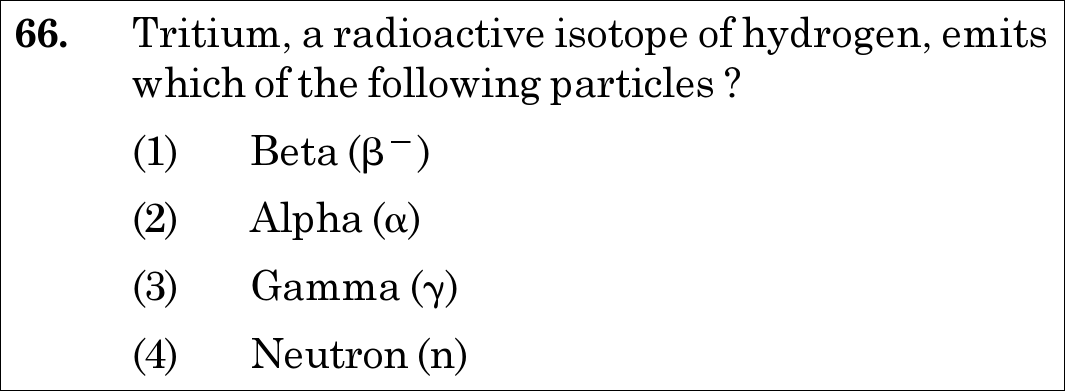
Tritium, a radioactive isotope of hydrogen, emits which of the following particles?
 MyCompetitiveExams
Dynamic 180-question full-length simulator mixed dynamically from all 6 years for 2027 & 2026 aspirants.
Tritium, a radioactive isotope of hydrogen, emits which of the following particles?
Verbatim NCERT Hydrogen: "Of these isotopes, only tritium is radioactive and emits low energy particles ( years)." The nuclear transmutation is . Match Option (1)!
Hydrogen has three naturally occurring isotopes: Protium (), Deuterium ( or ), and Tritium ( or ). Protium and deuterium are non-radioactive stable isotopes, whereas tritium is unstable.
Tritium contains 1 proton and 2 neutrons in its nucleus. The high neutron-to-proton ratio () places it above the nuclear stability belt. Stability is achieved by beta-minus () decay, in which a nuclear neutron transforms into a proton, an electron (beta particle), and an electron antineutrino:
The emitted particle has very low maximum kinetic energy (), and tritium has a half-life of .
Diagnose every choice: Know exactly why the right option works and why distractors fail.
Verbatim NCERT fact: tritium decays via low-energy emission.
Alpha emission requires loss of a nucleus, impossible for a nucleus of mass 3.
Tritium decay is a pure ground-state beta decay without accompanying gamma de-excitation.
Neutron emission does not occur spontaneously in tritium.
Students who associate radioactivity strictly with alpha particles often guess (Option 2). A tritium nucleus has mass number 3, making it physically impossible to emit an alpha particle (mass 4).
"Tritium is a radioactive isotope of hydrogen with a half-life of 12.33 years that decays by emitting low energy beta particles."
Test your speed and accuracy in the authentic 200-minute timed NTA simulator.
Spotted a mistake in this solution? Report an error ([email protected])
Cover all 1,140 official NEET questions in 285 days at your own pace. Progress is saved on your device. No login needed.