MyCompetitiveExams Logo MyCompetitiveExams
Search 1,140+ Questions
Chapters, formulas, speed tricks
→
⚡ Brahmastra NEET 2027
720 MARKS

Dynamic 180-question full-length simulator mixed dynamically from all 6 years for 2027 & 2026 aspirants.

Launch Brahmastra 2027 Test →
Start Practice →
100% Free · No Login Required
Q.132 Botany ⭐ 360° Option Elimination Active
Vault ↗

NEET 2021 Botany Question 132 Solution

Topic: Biotechnology: Principles and Processes · Official NTA Booklet Code M1
NEET 2021 Botany Question 132: Applications and Limitations of Polymerase Chain Reaction (PCR)

Question

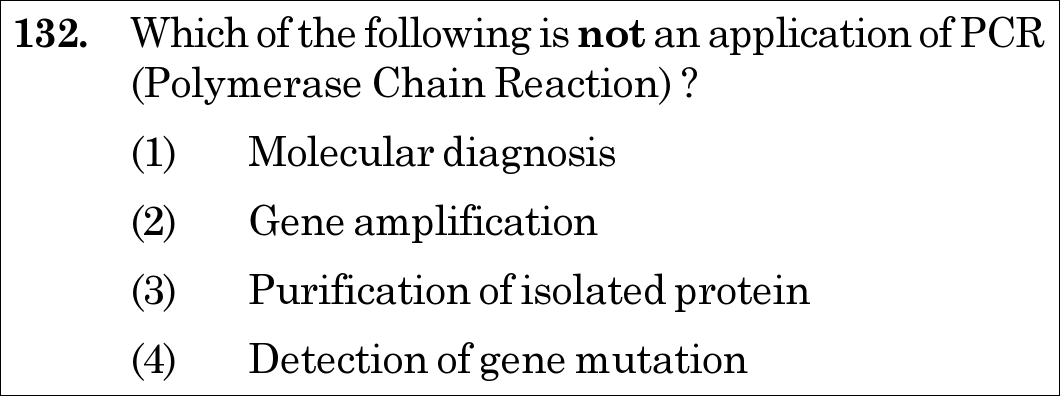
Which of the following is not an application of PCR (Polymerase Chain Reaction)?

  1. (1)Molecular diagnosis
  2. (2)Gene amplification
  3. (3)Purification of isolated protein
  4. (4)Detection of gene mutation
✓
Verified Against NTA Final Answer Key
Option (3) : Purification of isolated protein
📚 Biotechnology: Principles and Processes Easy
📋 Given Parameters & Problem Setup
Technique Polymerase Chain Reaction (PCR)
Target Identify which choice is NOT an application of PCR
⚡

The 30-Second Exam Hall Shortcut: ⚡ PCR Operates on DNA/Nucleic Acids, NEVER on Proteins!

⏱️ Save ~20 seconds

PCR is strictly an enzymatic gene/DNA amplification tool! It amplifies nucleic acids for molecular diagnosis, detects gene mutations, and amplifies scarce DNA. Protein purification requires downstream processing methods like chromatography and crystallization. Match Option (3)!

1 Molecular diagnosis: PCR detects low concentrations of viral/bacterial DNA (e.g., HIV, COVID-19)   ⟹  \implies Valid application.
2 Gene amplification: Exponential billion-fold in vitro synthesis of target DNA   ⟹  \implies Core purpose.
3 Purification of isolated protein: Done by chromatography, salting out, or dialysis in downstream processing   ⟹  \implies NOT a PCR application.
4 Detection of gene mutation: PCR followed by probe hybridization or sequencing identifies cancer/genetic mutations   ⟹  \implies Valid application.
5 Match Option (3).
🛡️
Why You Can 100% Trust This Shortcut: Canonical NCERT Biotechnology Principles on PCR Applications vs Downstream Processing.
📐

Step-by-Step Rigorous Workflow & Mathematical Proof

Step 1

Core Biochemical Nature of PCR

Polymerase Chain Reaction (PCR) is exclusively an enzymatic DNA polymerization assay utilizing thermostable DNA polymerase, oligonucleotide primers, and deoxynucleoside triphosphates (dNTPsdNTPs):

Target dsDNA→PCR Thermocycling2n×DNA Amplicons\text{Target dsDNA} \xrightarrow{\text{PCR Thermocycling}} 2^n \times \text{DNA Amplicons}
Step 2

Diagnostic and Genetic Applications of PCR

- Molecular diagnosis: Enables ultrasensitive early detection of infectious agents (e.g., HIV, Mycobacterium, viral hepatitis) before clinical symptoms appear. - Gene amplification: Yields microgram quantities of DNA from infinitesimal traces. - Detection of mutations: Identifies deletions, point mutations, and SNPs in suspected cancer patients and hereditary disorders.

Step 3

Exclusion of Protein Purification

PCR neither interacts with nor purifies proteins. Protein isolation and purification constitute downstream processing involving cell lysis, fractional centrifugation, filtration, and liquid chromatography (e.g., affinity chromatography).

⭐

360° Option Elimination Engine Key Feature

Diagnose every choice: Know exactly why the right option works and why distractors fail.

4-Option Deep Scan
1 1
✗ Incorrect
Verdict & Scientific Reason:

Molecular diagnosis is a major, widely utilized application of PCR (detecting trace pathogen DNA).

⚠️
Student Fallacy (Why candidates pick this trap): Selecting a legitimate medical application of PCR instead of the non-application.
2 2
✗ Incorrect
Verdict & Scientific Reason:

Gene amplification is the fundamental primary function of PCR.

⚠️
Student Fallacy (Why candidates pick this trap): Overlooking that the question asks for the option that is NOT an application.
3 3
✓ 100% Correct
Verdict & Scientific Reason:

PCR cannot purify proteins; protein purification is performed via downstream chromatographic processing.

💡
Why this is airtight: None. Accurately identifies the biochemical boundary of PCR.
4 4
✗ Incorrect
Verdict & Scientific Reason:

PCR followed by sequence analysis is routinely employed to detect point mutations, translocations, and cancer genes.

⚠️
Student Fallacy (Why candidates pick this trap): Unaware that PCR is used in cancer mutation screening.
⚠️

NTA Trap Alert: Nucleic Acid vs Protein Target Misconception

Students who skim the biotechnology chapters quickly forget that PCR only copies nucleic acids (DNA/RNA via RT-PCR). It has zero capacity to process or purify proteins.

🛡️ How to avoid the -1 mark: Fix the boundary: PCR = DNA/RNA only. Protein purification = Downstream processing.
📖

Core NEET Syllabus Standard

NEET / NCERT Biology · Biotechnology: Principles and Processes Standard Benchmark
Core Scientific Principle Tested:

"PCR is used for amplification of target gene, molecular diagnosis of pathogens, and detection of mutations. Protein purification is a component of downstream processing."

Syllabus Focus: Polymerase Chain Reaction (PCR) Applications
✓ Core NEET UG Syllabus Anchor Syllabus & Academic Standards ↗

Ready to attempt under real exam pressure?

Test your speed and accuracy in the authentic 200-minute timed NTA simulator.

Launch NEET 2021 CBT Test →

Spotted a mistake in this solution? Report an error ([email protected])

⚖️ Legal & Fair Dealing Notice: Sourced from publicly released NEET 2021 question papers and NEET answer keys for private study, research, and non-commercial educational practice under Fair Dealing (Section 52(1)(a) of the Indian Copyright Act, 1957). Not affiliated with or endorsed by NTA or NMC.

Solve 4 NEET Questions a Day — One per Subject

Cover all 1,140 official NEET questions in 285 days at your own pace. Progress is saved on your device. No login needed.